Peptide Price Finder

Home · Research · Inflammation & immune

ARA-290 research

What published studies found for ARA-290: 8 papers, 4 in humans, with sample sizes and key results, plus 4 registered clinical trials.

B
Some human evidence
Why: Several small, short placebo-controlled phase 2 trials (22-64 patients) in small-fiber neuropathy with nerve-fiber gains but mixed pain results.

ARA-290 (cibinetide), an erythropoietin-derived peptide that does not raise red cell counts, has a few small placebo-controlled phase 2 trials in sarcoidosis- and diabetes-related small-fiber neuropathy showing improvements in nerve-fiber measures and some symptom scores, plus supportive animal work. Trials are short (4 weeks), small (22-64 patients), and results on pain were mixed.

✓ 5 positive~ 3 mixed

Small trials of up to 4 weeks reported no safety concerns; long-term human safety data are lacking.

US compounding: Not compoundable. Not an FDA-approved drug and not nominated for FDA's 503A bulks list, so US pharmacies can't legally compound it. Status for every peptide.

Browse and filter these papersARA-290 prices and vendors

Registered clinical trials

4 trials of ARA-290 on ClinicalTrials.gov: 0 active, 2 completed, 1 with posted results. Registered trials include ones that haven't published yet.

TrialStatusPhasePeopleSponsor
Study of Efficacy of ARA 290 on Corneal Nerve Fiber Density and Neuropathic Symptoms of Subjects With SarcoidosisNCT02039687 · started 2014-01 · results postedCompletedPhase 264Araim Pharmaceuticals, Inc.
Cognitive and Neural Effects of ARA290NCT02070783 · started 2012-02CompletedPhase 1, Phase 236Leiden University Medical Center
ARA290 in T2D (Effects of ARA 290, an Erythropoietin Analogue) in Prediabetes and Type 2 Diabetes)NCT01933529 · started 2013-10Unknown statusPhase 224Claes-Göran Östenson
The Use of ARA290 for the Treatment of Diabetic Macular OedemaNCT06626971 · started 2016-04TerminatedPhase 29Belfast Health and Social Care Trust

All 4 ARA-290 trials, with countries and recruiting status

Human studies

~ Mixedhuman RCTInvest Ophthalmol Vis Sci · 2017

Cibinetide Improves Corneal Nerve Fiber Abundance in Patients With Sarcoidosis-Associated Small Nerve Fiber Loss and Neuropathic Pain.

n = 64 humansPhase 2b randomized trial, cibinetide 1, 4 or 8 mg/day vs placebo28 days

Phase 2b trial in 64 sarcoidosis patients with small-fiber nerve loss: 28 days of cibinetide increased corneal nerve fiber area at 4 mg/day (significant) but not at 1 or 8 mg; pain improved in all groups including placebo.

Key resultPlacebo-corrected CNFA change 109 (1 mg), 697 (4 mg; 95% CI 159 to 1236; P=0.012) and 431 (8 mg) um2; GAP-43+ fibers increased in the 4 mg group (P=0.035)
Studied
Patients with sarcoidosis-associated small nerve fiber loss and neuropathic pain
Compared with
Placebo
Main outcome
Change in corneal nerve fiber area (CNFA) at day 28
Sample
64 subjects randomized
Authors' conclusion
Cibinetide significantly increased small nerve fiber abundance in cornea and skin, consistent with a disease-modifying effect; CNFA supports use as a surrogate endpoint.
Limitations
Pain improved significantly in all groups; only the 4 mg dose reached significance for CNFA.
~ Mixedhuman RCTEur Neuropsychopharmacol · 2015

Testing the antidepressant properties of the peptide ARA290 in a human neuropsychological model of drug action.

n = 36 humansDouble-blind, randomized, parallel-group, single 2 mg doseAssessed one week after administration

In 36 healthy volunteers, a single 2 mg dose altered some measures of emotional processing but had no effect on mood, and results did not clearly support an antidepressant effect.

Key resultARA290 lowered neural responses to happy faces in the fusiform gyrus; no effects on mood or affective symptoms
Studied
Healthy volunteers
Compared with
Placebo
Main outcome
Neural processing of fearful vs happy faces and recognition of emotional facial expressions
Sample
36 healthy participants
Authors' conclusion
ARA290 may modulate some aspects of emotional processing, but the direction and strength of effects do not unequivocally support an antidepressant-like profile.
Limitations
Healthy volunteers, single dose; authors suggest testing different timing and dose.
✓ Positivehuman RCTMol Med · 2012

Safety and efficacy of ARA 290 in sarcoidosis patients with symptoms of small fiber neuropathy: a randomized, double-blind pilot study.

n = 22 humansDouble-blind, placebo-controlled exploratory pilot trial4 weeks (2 mg IV three times weekly)

Double-blind pilot in 22 sarcoidosis patients with small-fiber neuropathy: 4 weeks of IV ARA 290 improved neuropathy symptom scores vs placebo; pain and fatigue scores improved equally in both groups; no safety concerns.

Key resultSFNSL change at week 4: -11.5 +/- 3.04 with ARA 290 vs -2.9 +/- 3.34 with placebo (p < 0.05); BPI and FAS improved significantly but equivalently in both groups
Studied
Patients with sarcoidosis and symptoms of small fiber neuropathy (spontaneous pain score >=5)
Compared with
Placebo
Main outcome
Small fiber neuropathy screening list (SFNSL) score, pain intensity, SF-36, fatigue
Sample
22 patients (ARA 290 n=12, placebo n=10)
Authors' conclusion
ARA 290 appears to be safe in patients with sarcoidosis and can reduce neuropathic symptoms.
Limitations
Small exploratory pilot.
✓ Positivehuman RCTMol Med · 2015

ARA 290, a nonerythropoietic peptide engineered from erythropoietin, improves metabolic control and neuropathic symptoms in patients with type 2 diabetes.

Number of subjects not stated in abstractPhase 2 placebo-controlled study, ARA 290 4 mg self-administered subcutaneously daily28 days of treatment plus one month follow-up

Phase 2 placebo-controlled study in type 2 diabetes with painful neuropathy: 28 days of ARA 290 improved HbA1c, lipids and neuropathic symptom scores; no safety issues identified.

Key resultImproved HbA1c and lipid profiles throughout the 56-day observation period and significantly improved PainDetect scores in the ARA 290 group; no numeric values in abstract
Studied
Subjects with type 2 diabetes and painful neuropathy
Compared with
Placebo
Main outcome
HbA1c, lipid profiles, PainDetect neuropathic symptoms, corneal nerve fiber density
Authors' conclusion
ARA 290 may benefit both metabolic control and neuropathy in type 2 diabetes and deserves continued clinical evaluation.
Limitations
Sample size not stated in abstract.

Reviews

✓ PositivereviewExpert Opin Investig Drugs · 2014

ARA 290 for treatment of small fiber neuropathy in sarcoidosis.

Review of two phase II trialsNarrative review of two Phase II clinical trials

Review of two phase II sarcoidosis trials (by trial investigators): ARA 290 was associated with reduced neuropathic pain, more corneal nerve fibers and better quality of life, with an excellent safety profile.

Studied
Sarcoidosis patients with small fiber neuropathy (from two phase II trials)
Authors' conclusion
ARA 290 was consistently associated with improved neuropathic pain symptoms, more corneal nerve fibers and better quality of life with an excellent safety profile; the authors call prospects promising.
Limitations
Narrative review of two phase II trials, written by the trial investigators.

Animal & lab studies

✓ PositiveanimalFront Cardiovasc Med · 2022

A small erythropoietin derived non-hematopoietic peptide reduces cardiac inflammation, attenuates age associated declines in heart function and prolongs healthspan.

Longitudinal n=48 and cross-sectional n=144 ratsRandomized controlled trial, chronic ARA290 vs saline15 months

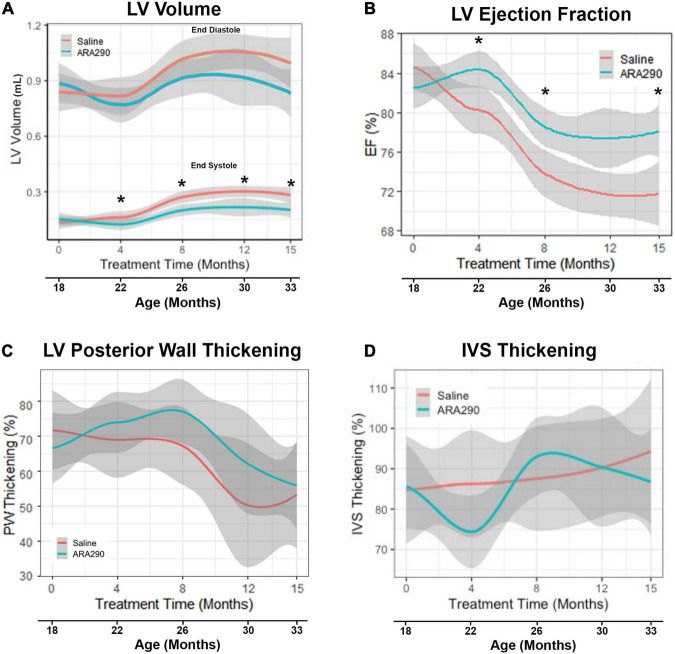
In aging rats treated for 15 months, ARA290 reduced cardiac inflammation, preserved heart function and blood pressure, and reduced frailty measures vs saline.

Studied
18-month-old Fischer 344 x Brown Norway rats
Compared with
Saline
Main outcome
Cardiac inflammation, echocardiography, blood pressure, frailty index
Authors' conclusion
ARA290 reduced cell and tissue inflammation, mitigated cardiovascular structural and functional changes, reduced frailty and preserved healthspan.
Limitations
Rat study.
FIGURE 1: Loess smooth curve (Red = Saline, Blue = ARA290) with 95% confidence intervals (gray) depicting the age-associated changes in left ventricul
FIGURE 1. From PMC9889362, CC BY (terms); resized.
~ MixedanimalNeuroscience · 2013

The erythropoietin-derived peptide ARA290 reverses mechanical allodynia in the neuritis model.

Groups: vehicle n=20, 30 ug/kg n=11, 120 ug/kg n=9Daily intraperitoneal ARA290 (30 or 120 ug/kg) vs saline vehicle from day 1 after surgery

In a rat nerve-inflammation pain model, daily ARA290 prevented touch-evoked pain (allodynia) but did not affect heat sensitivity.

Key resultBoth doses prevented development of mechanical allodynia; no significant effect on heat hyperalgesia; CCL2 and TNF-alpha mRNA not significantly different (p=0.24)
Studied
Rats with neuritis model
Compared with
Saline vehicle
Main outcome
Mechanical allodynia, heat hyperalgesia, TNF-alpha and CCL2 mRNA
Authors' conclusion
ARA290 may be beneficial for neuropathic pain symptoms where signs of nerve injury are absent; mechanism does not appear to involve inhibiting TNF-alpha or CCL2.
Limitations
Rat study; small group sizes for mRNA analysis (n=3-7).
✓ PositiveanimalJ Transl Med · 2013

Renoprotective capacities of non-erythropoietic EPO derivative, ARA290, following renal ischemia/reperfusion injury.

Twenty-six male Lewis/HanHsd ratsARA290 given early (1 h), late (4 h) or repetitively (1 and 4 h) post-reperfusion vs saline3 days

In rats with kidney ischemia-reperfusion injury, ARA290 given 1 hour after reperfusion improved kidney function and reduced inflammation; later dosing was less effective.

Studied
Male Lewis rats with unilateral renal ischemia (30 min) plus contralateral nephrectomy
Compared with
Saline vehicle
Main outcome
Renal function and renal inflammation / acute kidney injury
Authors' conclusion
ARA290 attenuated renal ischemia/reperfusion injury; early post-reperfusion administration appears most effective.
Limitations
Rat study; late or repetitive dosing only tended to improve markers.
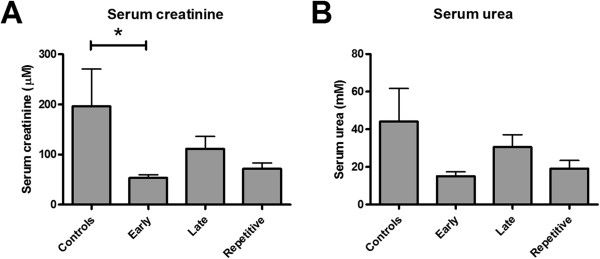
Figure 1: The effect of ARA290 on markers of renal function. Early ARA290 treatment significantly reduced serum creatinine levels at three days post-r
Figure 1. From PMC3842642, CC BY (terms); resized.

Verdicts are judged on each paper's own main outcome; grades run from A (strong human evidence) to D (little or none). Details are read from the abstracts, and figures are reproduced only from openly licensed full texts. Not medical advice.