Peptide Price Finder

Home · Research · Skin, hair & tanning

Argireline research

What published studies found for Argireline: 8 papers, 4 in humans, with sample sizes and key results, plus 3 registered clinical trials.

B
Some human evidence
Why: Only small human trials (60, 24 and 19 people) with conflicting wrinkle results; lab data show very little of the peptide penetrates skin.

Argireline (acetyl hexapeptide-3/-8) has several small human trials with mixed results: a 60-person placebo-controlled study in Chinese adults and a small four-arm trial reported less wrinkling, while a 19-person double-blind split-face study found no significant effect. Lab work shows very little of the peptide gets past the outer skin layer, and a 24-patient blepharospasm trial showed only a non-significant trend.

✓ 2 positive✗ 3 negative~ 1 mixed? 2 inconclusive

Topical use was well tolerated in small trials; injected use has been linked to infection in a case report.

Browse and filter these papersArgireline prices and vendors

Reported side effects

Registered clinical trials

3 trials of Argireline on ClinicalTrials.gov: 0 active, 2 completed, 1 with posted results. Registered trials include ones that haven't published yet.

TrialStatusPhasePeopleSponsor
Acetyl Hexapeptide-8 for BlepharospasmNCT01750346 · started 2012-11 · results postedTerminatedPhase 28National Institute of Neurological Disorders and Stroke (NINDS)
Argireline in Treatment of Periorbital WrinklesNCT01381484 · started 2009-03CompletedPhase 370Mahidol University
Topical Acetyl Hexapeptide-8 and the Cosmetic Appearance of Oily SkinNCT02597777 · started 2016-01Completed–14University of California, Davis

All 3 Argireline trials, with countries and recruiting status

Human studies

✓ Positivehuman RCTAm J Clin Dermatol · 2013

The anti-wrinkle efficacy of argireline, a synthetic hexapeptide, in Chinese subjects: a randomized, placebo-controlled study.

n = 60 humansRandomized, placebo-controlled study4 weeks (applied twice daily)

60 Chinese adults randomized 3:1 to argireline or placebo on periorbital wrinkles for 4 weeks: subjective anti-wrinkle efficacy 48.9% vs 0%, and skin-replica roughness parameters fell only with argireline (p<0.01).

Key resultTotal anti-wrinkle efficacy 48.9% with argireline vs 0% with placebo; roughness parameters decreased with argireline (p<0.01) but not placebo (p>0.05)
Studied
Chinese subjects with peri-orbital wrinkles
Compared with
Placebo
Main outcome
Global assessment of peri-orbital wrinkles (Daniell, Seeman) and objective roughness from silicone replicas
Sample
60 subjects randomized 3:1 to argireline or placebo
Authors' conclusion
Argireline had a significant anti-wrinkle effect in Chinese subjects.
Limitations
Short (4 weeks) trial.
? Inconclusivehuman RCTEur J Neurol · 2013

Pilot study of topical acetyl hexapeptide-8 in the treatment for blepharospasm in patients receiving botulinum toxin therapy.

n = 24 humansDouble-blind, placebo-controlled, randomized pilot trialFollowing 3-monthly botulinum toxin injections

24 blepharospasm patients receiving botulinum toxin, double-blind placebo-controlled trial of daily topical acetyl hexapeptide-8: only a non-significant trend to longer symptom control (3.7 vs 3.0 months); no significant adverse events.

Key resultTrend to longer time to return to baseline with active vs placebo (3.7 vs 3.0 months); 4/12 active patients had considerable extension of symptom control
Studied
Patients with blepharospasm receiving botulinum toxin
Compared with
Placebo
Main outcome
Time to return to baseline Jankovic Blepharospasm Rating Scale after botulinum toxin
Sample
24 patients with blepharospasm
Authors' conclusion
Topical AH8 is safe and promising for extending the duration of action of botulinum toxin therapy, but results were trends only.
Limitations
Pilot study; differences were trends, not significant.
✓ Positivehuman RCTJ Cosmet Dermatol · 2017

The efficacy study of the combination of tripeptide-10-citrulline and acetyl hexapeptide-3. A prospective, randomized controlled study.

Twenty-four healthy volunteers in 4 groupsProspective randomized controlled study60 days

24 volunteers randomized to four groups for 60 days: acetyl hexapeptide-3 improved some skin-microtopography wrinkle parameters and lowered TEWL vs control at several time points; groups were very small.

Key resultAt 20 days, acetyl hexapeptide-3 vs no peptide: cR2 P=.022; TEWL change G3 vs G4 P=.025
Studied
Healthy volunteers
Compared with
Neither peptide (G4); each peptide alone
Main outcome
Skin microtopography (cR2, cR3) and transepidermal water loss (TEWL)
Authors' conclusion
Results confirm antiwrinkle activity of acetyl hexapeptide-3 with a significant TEWL decrease, and provide clinical evidence for tripeptide-10 citrulline. The mechanism of any synergy was unclear.
Limitations
Small groups; synergy mechanism unclear.
✗ Negativehuman trialGMS Interdiscip Plast Reconstr Surg DGPW · 2023

Investigating the effects of Argireline in a skin serum containing hyaluronic acids on skin surface wrinkles using the Visia® Complexion Analysis camera system for objective skin analysis.

Nineteen female participants, split-faceDouble-blind split-face study with Visia imaging4 weeks

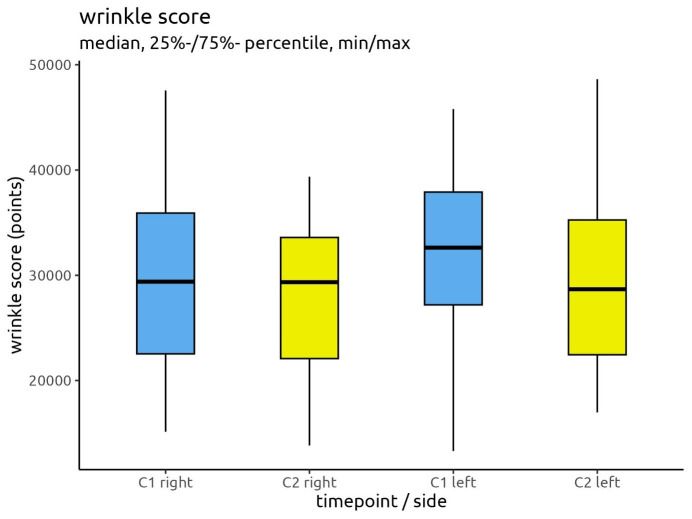
19 women applied a hyaluronic acid serum with argireline to one side of the face and without it to the other for 4 weeks (double-blind): no significant difference in wrinkle score (p=0.829) or skin-age measure; no irritation or allergy.

Key resultWrinkle scores fell non-significantly (right p=0.060, left p=0.176); right vs left side difference not significant (p=0.829)
Studied
Female participants recruited from a plastic surgery clinic
Compared with
Same hyaluronic acid serum without Argireline on the other side of the face
Main outcome
Wrinkle score and TruSkinAge from Visia camera
Authors' conclusion
The effect of Argireline was not proven; it had low toxicity but efficacy was not significant, so it is not deemed an alternative to botulinum toxin.
Limitations
Small sample; participants could use their own cosmetics; serum also contained hyaluronic acids.
Figure 4: Reduction of wrinkle scores between C1 and C2 for the right and left sides of the face
Figure 4. From PMC10665711, CC BY (terms); resized.

Reviews

~ MixedreviewInt J Mol Sci · 2025

Acetyl Hexapeptide-8 in Cosmeceuticals-A Review of Skin Permeability and Efficacy.

No new dataNarrative review

Review: clinical studies suggest reduced wrinkle depth and better elasticity and hydration, but poor skin penetration means it remains uncertain whether the peptide reaches neuromuscular junctions.

Main outcome
Skin permeability and efficacy of acetyl hexapeptide-8
Authors' conclusion
Preclinical and clinical studies indicate AH-8 may reduce wrinkle depth and improve elasticity and hydration, but low skin penetration limits bioavailability and the mechanism of topical action remains incompletely understood.
Limitations
Narrative review; no original data.
? InconclusivereviewInt J Toxicol · 2025

Safety Assessment of Acetyl Hexapeptide-8 Amide as Used in Cosmetics.

No new dataCosmetic ingredient safety assessment by an expert panel

Cosmetic Ingredient Review expert panel: safe in cosmetics at concentrations up to 0.005%; data were insufficient to judge safety at higher concentrations.

Main outcome
Safety in cosmetic use
Authors' conclusion
The Panel concluded Acetyl Hexapeptide-8 Amide is safe in cosmetics at concentrations up to 0.005%; data are insufficient to determine safety above 0.005%.
Limitations
Data insufficient above 0.005%.

Human studies

✗ Negativecase reportWorld J Clin Cases · 2021

Mycobacterium abscessus infection after facial injection of argireline: A case report.

Single case, a 45-year-old womanCase reportTreated 5 months

A 45-year-old woman developed Mycobacterium abscessus abscesses at forehead and temple sites one week after argireline injections, requiring 5 months of antibiotics.

Studied
45-year-old woman after argireline injections to forehead and temples
Main outcome
Infection after injection
Authors' conclusion
Reported the first case of Mycobacterium abscessus infection after argireline injection; it is easily misdiagnosed, microbiological examination aids diagnosis and standardized procedures can prevent it.
Limitations
Single case report.

Animal & lab studies

✗ Negativein vitroCutan Ocul Toxicol · 2015

In vitro skin penetration of acetyl hexapeptide-8 from a cosmetic formulation.

Cells / labIn vitro skin penetration study of a 10% peptide O/W emulsion24-hour exposure

In human cadaver and guinea-pig skin, most of a 10% acetyl hexapeptide-8 emulsion washed off; about 0.22% stayed in human stratum corneum, 0.01% reached the epidermis and none was detected in the dermis.

Key resultPeptide in stratum corneum of 0.54% (guinea pig) and 0.22% (human) of applied dose; epidermis 0.01%; none detected in dermis
Studied
Hairless guinea pig and human cadaver skin in in vitro diffusion cells
Main outcome
Peptide amount in skin layers
Authors' conclusion
Most peptide was washed off and what penetrated stayed in the stratum corneum; none reached the dermis. The data are useful for safety evaluation of cosmetic peptides.
Limitations
In vitro, cadaver and animal skin.

Verdicts are judged on each paper's own main outcome; grades run from A (strong human evidence) to D (little or none). Details are read from the abstracts, and figures are reproduced only from openly licensed full texts. Not medical advice.