Peptide Price Finder

Home · Research · Mitochondria & energy

BAM-15 research

What published studies found for BAM-15: 10 papers, 0 in humans, with sample sizes and key results.

C
Mostly animal studies
Why: Many mouse studies show less fat and better glucose control, but there are no human studies of BAM15 at all.

BAM15 is an experimental mitochondrial uncoupler tested only in animals and cells, where it reduced fat mass and improved glucose control in obese mice. One mouse study found it did not reduce body fat on its own. No human studies have been published.

✓ 8 positive~ 1 mixed? 1 inconclusive

No human safety data in the published literature.

US compounding: Not compoundable. Not an FDA-approved drug and not nominated for FDA's 503A bulks list, so US pharmacies can't legally compound it. Status for every peptide.

Browse and filter these papersBAM-15 prices and vendors

Reviews

? InconclusivereviewFront Endocrinol (Lausanne) · 2023

BAM15 as a mitochondrial uncoupler: a promising therapeutic agent for diverse diseases.

No new dataNarrative review

Review of preclinical BAM15 work: promising in obesity, diabetes, fatty liver and sepsis models, but high lipophilicity and delivery issues remain and clinical research is needed.

Studied
Literature on BAM15 across metabolic, liver, sepsis and cardiovascular disease
Main outcome
Mechanism and therapeutic potential of BAM15
Authors' conclusion
BAM15 shows promise in obesity, diabetes, fatty liver, sepsis and cardiovascular disease with an encouraging safety profile in preclinical work, but lipophilicity and delivery challenges remain and further research is needed.
Limitations
Preclinical evidence only; no human data described.
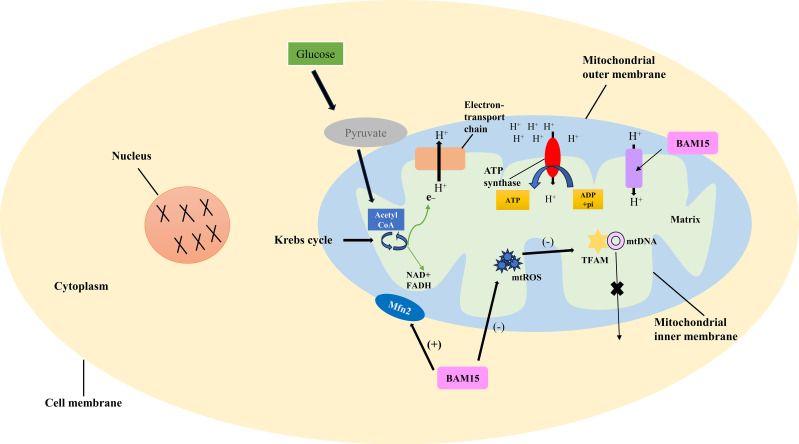
Figure 1: Mechanism of BAM15-induced uncoupling of oxidative phosphorylation. The link between pyruvate production, the Krebs cycle, proton release, a
Figure 1. From PMC10600450, CC BY (terms); resized.

Animal & lab studies

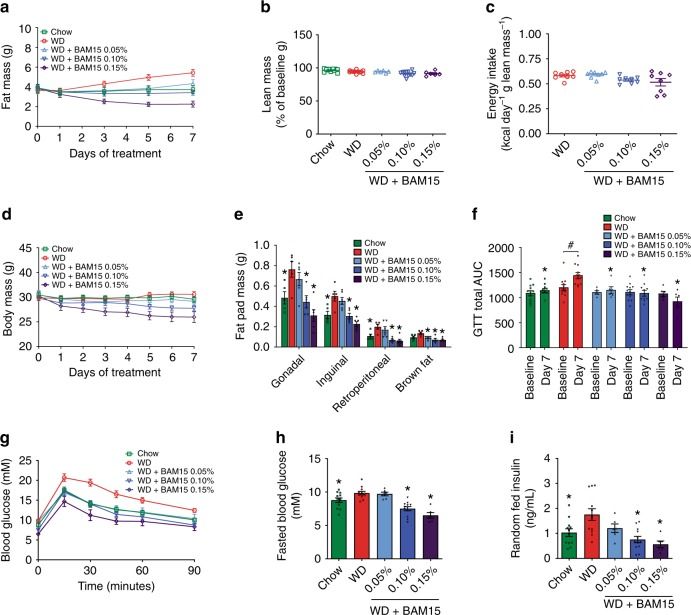
✓ PositiveanimalNat Commun · 2020

Mitochondrial uncoupler BAM15 reverses diet-induced obesity and insulin resistance in mice.

AnimalsAnimal study of orally administered BAM15 incl. hyperinsulinemic-euglycemic clamp

In diet-induced obese mice, oral BAM15 reduced body fat and liver fat and improved insulin sensitivity without changing food intake, lean mass, body temperature or toxicity markers.

Studied
Mice with diet-induced obesity
Main outcome
Body fat mass, nutrient oxidation, insulin sensitivity, toxicity markers
Authors' conclusion
BAM15 decreased body fat mass and hepatic fat and improved insulin sensitivity without altering food intake, lean mass or body temperature, or markers of toxicity, in mice.
Limitations
Mouse study; abstract gives no numbers or group sizes.
Fig. 3: BAM15 prevents diet-induced fat gain and glucose intolerance.a–d Mice fed a chow diet or WD ± BAM15 at doses of 0.05, 0.10, and 0.15% were e
Fig. 3. From PMC7224297, CC BY (terms); resized.
✓ PositiveanimalEMBO Mol Med · 2020

BAM15-mediated mitochondrial uncoupling protects against obesity and improves glycemic control.

Humans and animalsPreclinical in vitro and mouse study of BAM15 against diet-induced obesity

Mice treated with BAM15 resisted diet-induced weight gain and had better body composition and glycemic control.

Studied
C57BL/6J mice and in vitro cell systems
Main outcome
Weight gain, body composition, glycemic control, energy expenditure
Authors' conclusion
BAM15-treated mice resisted weight gain and showed improved body composition and glycemic control independent of weight loss; authors present this as first preclinical efficacy for BAM15 in obesity.
Limitations
Preclinical (mouse and in vitro) study.
Figure 5: BAM15 improves body composition and glycemic control independent of weight loss in C57BL/6J mice. BAM15 improves body composition and glycem
Figure 5. From PMC7338798, CC BY (terms); resized.
✓ PositiveanimalJ Cachexia Sarcopenia Muscle · 2022

Mitochondrial uncoupling attenuates sarcopenic obesity by enhancing skeletal muscle mitophagy and quality control.

AnimalsRandomized, BAM15 (0.1% w/w in high fat diet) vs high fat diet control10 weeks

In old obese mice, 10 weeks of BAM15 lowered body weight (54 to 42 g) and increased muscle mass, strength and activity.

Key resultBAM15 reduced body weight (54.0 ± 2.0 vs 42.3 ± 1.3 g, P < 0.001) and increased muscle mass (52.7 ± 0.4 vs 59.4 ± 1.0%, P < 0.001) and strength (91.1 ± 1.3 vs 124.9 ± 1.2 g, P < 0.0001).
Studied
Obese 80-week-old male C57BL/6J mice (sarcopenic obesity model)
Compared with
High fat diet control
Main outcome
Body weight, muscle mass and strength, mitochondrial quality control
Authors' conclusion
Mitochondrial uncoupling with BAM15 may mitigate age-related decline in muscle mass and function and protect against sarcopenic obesity, in mice.
Limitations
Mouse study; group sizes not stated in abstract.
✓ PositiveanimalMol Metab · 2023

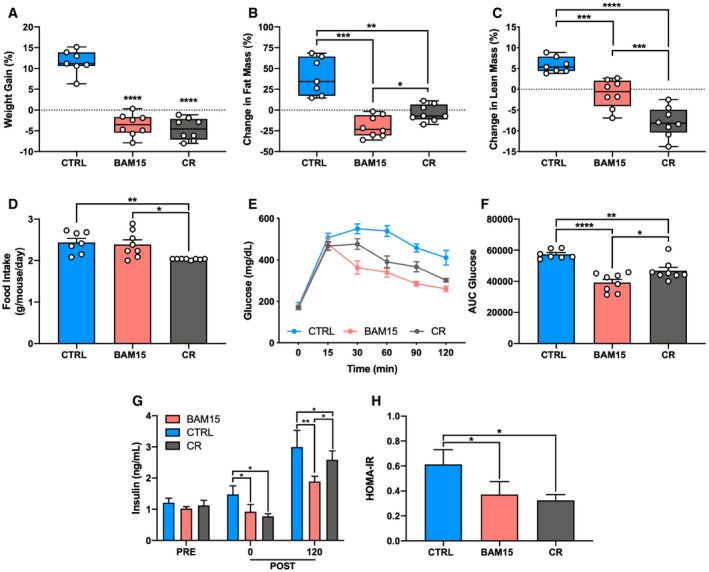
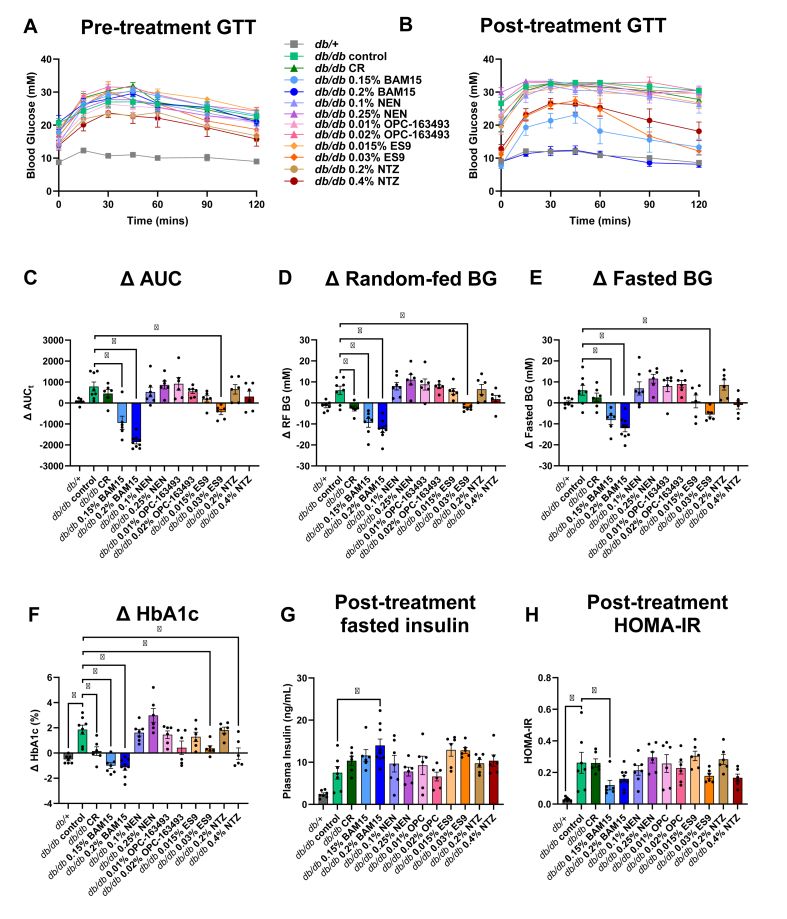
Targeting negative energy balance with calorie restriction and mitochondrial uncoupling in db/db mice.

AnimalsAnimal study comparing ~50% calorie restriction, BAM15 0.1% or 0.2% in diet, and 0.2% BAM15 with time-restricted feeding4 weeks

In diabetic db/db mice, higher-dose BAM15 matched 50% calorie restriction for weight loss and normalised glucose tolerance; the lower dose did not change body mass.

Studied
Male db/db mice (severe hyperglycemia, obesity, fatty liver)
Compared with
Calorie restriction; lean db/+ controls
Main outcome
Body weight, glucose tolerance, liver steatosis
Authors' conclusion
High-dose BAM15 matched calorie restriction on weight loss but normalized fasting glucose and glucose tolerance; low-dose BAM15 improved glucose control independent of weight loss. Supports uncouplers as potential treatment for metabolic disease.
Limitations
Mouse model; abstract gives no group sizes.
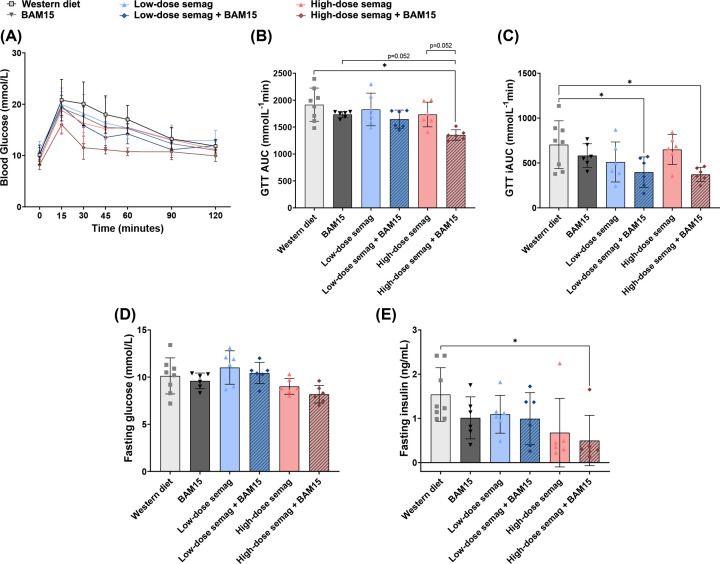
~ MixedanimalClin Sci (Lond) · 2024

Beneficial effects of simultaneously targeting calorie intake and calorie efficiency in diet-induced obese mice.

Six treatment groups; group sizes not statedAnimal study of semaglutide (low or high dose) with or without BAM15

In obese mice, combining BAM15 with semaglutide reduced body fat and liver triglycerides, an effect not achieved by BAM15 or semaglutide alone.

Studied
Diet-induced obese mice on high-fat western diet
Compared with
Western diet control, BAM15 alone, semaglutide alone
Main outcome
Body fat, liver triglycerides, glucose homeostasis
Authors' conclusion
Combining BAM15 with either semaglutide dose decreased body fat and liver triglycerides, which no monotherapy achieved, without loss of lean mass; high-dose semaglutide plus BAM15 had the greatest effect on glucose homeostasis.
Limitations
Mouse study.
Figure 4: High-dose semaglutide combined with BAM15 caused the greatest improvement in glucose homeostasisGlucose tolerance curves (A), total area und
Figure 4. From PMC10876416, CC BY (terms); resized.
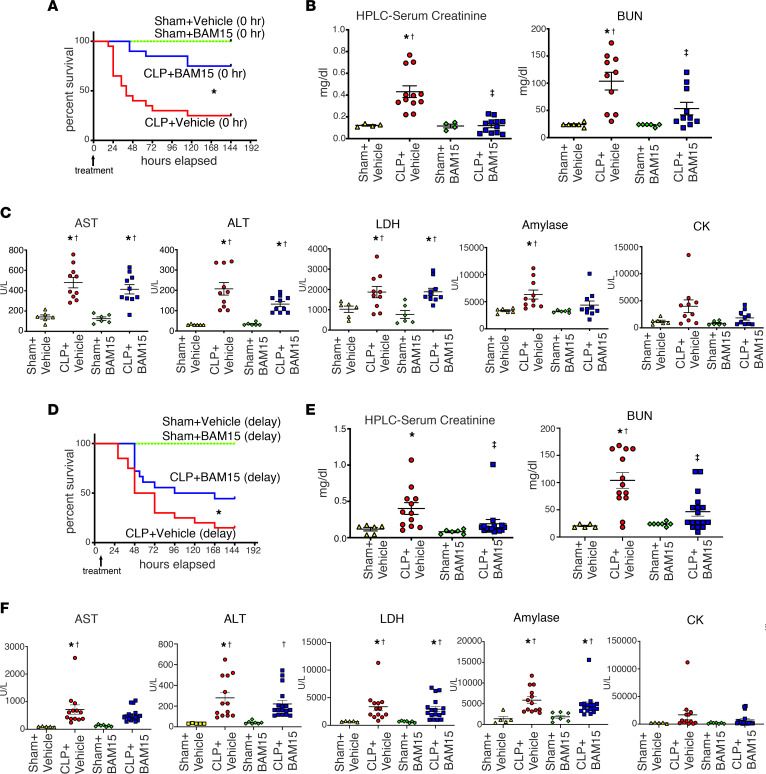
✓ PositiveanimalJ Clin Invest · 2023

BAM15 treats mouse sepsis and kidney injury, linking mortality, mitochondrial DNA, tubule damage, and neutrophils.

Humans and animalsAnimal sepsis model with BAM15 injected 0, 6 or 12 hours after CLP, plus in vitro mechanistic experiments

In a mouse sepsis model, BAM15 reduced mortality and kidney injury, even when given 12 hours after onset.

Studied
Mice with cecal ligation and puncture (CLP) sepsis; kidney tubule cells and neutrophils in vitro
Compared with
CLP mice without BAM15
Main outcome
Mortality, kidney damage, mitochondrial DNA release
Authors' conclusion
BAM15 reduced mortality, even at 12 hours, and kidney damage and splenic apoptosis, with mtDNA and mtROS mechanistically linked; authors call it an effective preventive and therapeutic candidate in experimental sepsis.
Limitations
Experimental mouse sepsis model.
Figure 1: BAM15 treatment improves mortality and AKI in septic mice, even with delayed administration.(A) Kaplan-Meier curves of male mice subjected t
Figure 1. From PMC10065071, CC BY (terms); resized.
✓ PositiveanimalMol Metab · 2025

Diverse actions of 15 structurally unrelated mitochondrial uncouplers in cells and mice.

Humans and animalsSide-by-side in vitro screen then 4-week mouse study with calorie-restriction and lean-control benchmarks4 weeks (mice)

Comparing 15 mitochondrial uncouplers in cells and the best five in db/db mice, BAM15 gave the best overall result, improving body weight, fat pad weight, glucose tolerance, HbA1c and liver triglyceride at 0.2% in chow.

Key result0.2% BAM15 significantly improved body weight, fat pad weight, glucose tolerance, blood glucose, HbA1c, liver weight and triglyceride content
Studied
CHO-K1 cells (15 uncouplers) and male db/db mice (5 uncouplers)
Compared with
Chow-fed db/db control, 35% calorie restriction, lean db/+ mice
Main outcome
Body weight, glucose control, HbA1c, liver steatosis
Authors' conclusion
BAM15 had the best overall effects among the uncouplers; uncouplers should not be generalized and each needs evaluating on its own actions.
Limitations
Mouse and cell study; no human data.
Figure 5: BAM15 and ES9 treatments improve glucose control in db/db mice. Intraperitoneal glucose tolerance tests were conducted A) prior to treatment
Figure 5. From PMC12303080, CC BY (terms); resized.
✓ PositiveanimalSci Rep · 2025

Combining RNA-seq, molecular docking and experimental verification to explore the mechanism of BAM15 as a potential drug for atherosclerosis.

Humans and animalsMouse treatment with RNA-seq, docking and cell experiments

In western-diet-fed ApoE-/- mice, oral BAM15 suppressed atherosclerosis and improved hyperlipidaemia and liver enzymes; in macrophages it reduced lipid accumulation.

Studied
Western-diet-fed ApoE-/- mice and RAW264.7 macrophages
Main outcome
Atherosclerosis, lipids, liver enzymes
Authors' conclusion
BAM15 inhibits atherosclerosis through multiple molecular targets (IL1A, SRC, CSF3) and is proposed as a potential anti-atherosclerotic drug.
Limitations
Animal and cell study; target mechanisms largely computational.
✓ PositiveanimalbioRxiv · 2025preprint

Mitochondrial uncoupler BAM15 improves skeletal muscle function and mitochondrial respiration in Sarcopenia

AnimalsBAM15-supplemented chow vs standard chow, 13-14 mice per group8 weeks

Preprint (not peer-reviewed): In 24-month-old mice given BAM15 in chow for 8 weeks, muscle mitochondrial efficiency and contractile function improved in aged males.

Studied
24-month-old male and female MitoQC mice (sarcopenia model) with 3-month-old reference mice
Compared with
Standard chow
Main outcome
Muscle mitochondrial respiration, contractile function, mitophagy
Authors' conclusion
BAM15 improved skeletal muscle mitochondrial efficiency and contractile function in aged male mice, supporting uncoupling as a strategy for sarcopenia.
Limitations
Preprint; mouse study; benefit seen in males only per the abstract.

Verdicts are judged on each paper's own main outcome; grades run from A (strong human evidence) to D (little or none). Details are read from the abstracts, and figures are reproduced only from openly licensed full texts. Not medical advice.