Peptide Price Finder

Home · Research · Skin, hair & tanning

Botulinum Toxin research

What published studies found for Botulinum Toxin: 8 papers, 8 in humans, with sample sizes and key results, plus 364 registered clinical trials.

A
Strong human evidence
Why: Cochrane review of 65 RCTs (14,919 people) and further meta-analyses consistently show reduced glabellar and upper-face wrinkles; approved drug.

Botulinum toxin type A is one of the best-studied cosmetic treatments: a Cochrane review of 65 RCTs (14,919 people) and several meta-analyses show it reliably reduces glabellar and other upper-face wrinkles within about 4 weeks. It is generally well tolerated, with eyelid ptosis the main notable adverse effect; evidence for off-label psychiatric uses is mixed.

✓ 7 positive✗ 1 negative

US compounding: Approved biologic: not compoundable. FDA-approved biologics (Botox and others); they can't be compounded. Status for every peptide.

Browse and filter these papers

Reported side effects

Registered clinical trials

364 trials of Botulinum Toxin on ClinicalTrials.gov: 46 active, 228 completed, 121 with posted results. Registered trials include ones that haven't published yet.

TrialStatusPhasePeopleSponsor
Beta-Agonist Versus OnabotulinumtoxinA Trial for Urgency Urinary IncontinenceNCT05806164 · started 2023-06-06Active, not recruitingPhase 4432Women and Infants Hospital of Rhode Island
Complex Treatment of a Chronic Anal FissureNCT03855046 · started 2019-09-01RecruitingPhase 4340State Scientific Centre of Coloproctology, Russian Federation
Head-to-Head Comparison of All Botulinum Neurotoxin Type A Products for Glabellar RhytidesNCT06448676 · started 2026-02-02RecruitingPhase 4325Academisch Medisch Centrum - Universiteit van Amsterdam (AMC-UvA)
Evaluation the Efficacy Between Botox Injection and Combination Pharmacotherapy in Patients With Detrusor OveractivityNCT05968885 · started 2021-10-01RecruitingPhase 4300Mackay Memorial Hospital
Botulinum Toxin Type A Injection Sites for Oral Commissure PtosisNCT07646886 · started 2026-07-01Not yet recruitingPhase 4266Peking University
A Clinical Study on Recombinant Botulinum Toxin Type A (YY001) for Injection in The Treatment of Upper Limb Spasticity in AdultsNCT06783114 · started 2024-09-14RecruitingPhase 2, Phase 3254Chongqing Claruvis Pharmaceutical Co., Ltd.
Prevention Atrial Fibrillation by BOTulinum Toxin Injections (BOTAF)NCT04075981 · started 2019-09-30Active, not recruitingPhase 3220Assistance Publique - Hôpitaux de Paris
Early Botulinum Toxin for Muscle Stiffness Reduction in First-Time Stroke Patients: Improving Recovery and IndependenceNCT06811142 · started 2025-01-28Active, not recruitingEarly phase 1200Instituto Mexicano del Seguro Social
Effectiveness of Methods for Pyloric Drainage in esophagecTomY: Botox vs. PyloromyotomyNCT06721520 · started 2024-12-03RecruitingPhase 2, Phase 3170The Cleveland Clinic
BOTOX® vs. XEOMIN® for Chronic MigraineNCT05598723 · started 2023-02-24RecruitingPhase 3128Naval Medical Center Camp Lejeune
Comparative Evaluation of Preoperative Preparation Methods in Patients With Large Incisional HerniasNCT07549113 · started 2024-04-01Recruiting–120State Budget Public Health Institution Scientific Research Institute - Ochapovsky Regional Clinical Hospital
Clinical Evaluation of Botulinum Toxin a in the Management of Temporomandibular Myofascial PainNCT07847541 · started 2026-08-15RecruitingPhase 2118Riphah International University

All 364 Botulinum Toxin trials, with countries and recruiting status

Meta-analyses & systematic reviews

✓ Positivemeta-analysisCochrane Database Syst Rev · 2021

Botulinum toxin type A for facial wrinkles.

n = 14,919 humansCochrane systematic review of RCTs (>50 participants each)Included studies lasted 1 week to 1 year

Cochrane review of 65 RCTs (14,919 participants): onabotulinumtoxinA 20 U for glabellar lines had far higher participant-assessed success than placebo at week 4 (RR 19.45), but probably more major adverse events, mainly eyelid ptosis (Peto OR 3.62).

Key resultOnabotulinumtoxinA 20 U vs placebo at week 4: participant-assessed success RR 19.45 (95% CI 8.60 to 43.99; 575 participants; 4 studies); major AEs Peto OR 3.62 (95% CI 1.50 to 8.74)
Studied
Adults (mostly female, 18-65 y) treated for facial wrinkles, mostly glabellar lines
Compared with
Placebo (36 studies), active control (19 studies), fillers
Main outcome
Participant-assessed success and major adverse events (ptosis, eyelid sensory disorder, strabismus)
Sample
65 RCTs, 14,919 randomised participants
Authors' conclusion
BontA reduces wrinkles within four weeks of treatment, but probably increases risk of ptosis. Evidence on multiple cycles, duration of effect and long-term outcomes is lacking.
Limitations
No study was at low risk of bias in all domains; studies were heterogeneous; AE evidence very low to moderate certainty.
✓ Positivemeta-analysisPlast Reconstr Surg · 2015

Efficacy and Safety of Botulinum Toxin Type A in the Treatment of Glabellar Lines: A Meta-Analysis of Randomized, Placebo-Controlled, Double-Blind Trials.

n = 1,474 humansMeta-analysis of randomized placebo-controlled double-blind trials

Seven placebo-controlled RCTs (1,474 subjects) of 20 U for glabellar lines: investigator-rated effective rate far higher than placebo (RR 33.54) with no significant difference in adverse-event frequency.

Key resultPooled investigator-assessed effective rate higher than control: RR 33.54 (95% CI 18.65 to 60.33); no significant differences in adverse event frequency between groups
Studied
Subjects with glabellar lines in randomized, placebo-controlled, double-blind trials using a 20-unit dose
Compared with
Placebo
Main outcome
Investigator-assessed effective rate; frequency of adverse events
Sample
7 placebo-controlled RCTs, 1,474 subjects
Authors' conclusion
A single 20-unit dose of botulinum toxin type A is considered remarkably effective and safe for glabellar lines.
✓ Positivemeta-analysisAesthetic Plast Surg · 2023

Efficacy and Safety of Botulinum Toxin Type A for Treatment of Glabellar Lines: A Network Meta-Analysis of Randomized Controlled Trials.

HumansNetwork meta-analysis of randomized controlled trialsEndpoints at approximately month 1

Network meta-analysis of RCTs: all BoNT/A formulations were far superior to placebo for glabellar lines; daxibotulinumtoxinA ranked highest; no significant differences in adverse events among products.

Studied
Patients with glabellar lines in RCTs of BoNT/A formulations
Compared with
Placebo and other BoNT/A formulations
Main outcome
Proportion with glabellar line severity none/mild and with >=1-point and 2-point improvement at maximum frown
Authors' conclusion
All BoNT/A formulations were far superior to placebo; daxibotulinumtoxinA may be not only more effective but also well-tolerated. No significant differences in adverse events among preparations.
Limitations
Number of studies and participants not stated in the abstract.
✓ Positivemeta-analysisAesthet Surg J · 2022

Complications of Cosmetic Botulinum Toxin A Injections to the Upper Face: A Systematic Review and Meta-Analysis.

24 studies, 4268 BoNT-A injection sessions and 1234 placebosSystematic review and meta-analysis (random effects; network meta-analysis where enough RCTs)

Meta-analysis of 24 studies (4,268 injection sessions) of upper-face injections: overall complication rate 16%, mostly mild and transient (headache, local skin reactions, facial neuromuscular symptoms).

Key resultOverall BoNT-A complication rate 16%; abobotulinum vs placebo OR 1.62 (1.15, 2.27; P > 0.05); onabotulinum vs placebo OR 1.34 (0.52, 3.48; P > 0.05)
Studied
Patients receiving cosmetic glabellar or forehead BoNT-A injections
Compared with
Placebo
Main outcome
Treatment-related complication rate
Authors' conclusion
Cosmetic BoNT-A injections in the glabellar and forehead region appear to be safe, and most complications are mild and transient.
Limitations
Heterogeneous complication reporting and inconsistent definitions of treatment-related complications.
✓ Positivemeta-analysisPlast Reconstr Surg · 2022

Glabellar Botulinum Toxin Injection Improves Depression Scores: A Systematic Review and Meta-Analysis.

9 prospective studies (5 RCTs) from 499 articles reviewedSystematic review and meta-analysisPrimary endpoint 6 weeks after treatment

Meta-analysis of 9 prospective studies (5 RCTs) of glabellar onabotulinumtoxinA for depression: depression scores improved, with a weighted change of -8.39 points at 6 weeks in the RCTs.

Key resultAll five RCTs improved at 6 weeks, weighted average change -8.39 points (p<0.0001); standardized mean difference across all nine studies -1.61 SD (p<0.0001)
Studied
Patients with depression treated with glabellar onabotulinumtoxinA
Main outcome
Mean difference in depression scores after treatment
Authors' conclusion
The studies support an antidepressant effect of glabellar onabotulinumtoxinA injections.

Human studies

✓ Positivehuman RCTAesthet Surg J · 2024

Efficacy and Safety of RelabotulinumtoxinA, a New Ready-to-Use Liquid Formulation Botulinum Toxin: Results From the READY-1 Double-Blind, Randomized, Placebo-Controlled Phase 3 Trial in Glabellar Lines.

n = 297 humansPhase 3 multicenter double-blind randomized placebo-controlled trial (3:1)6 months

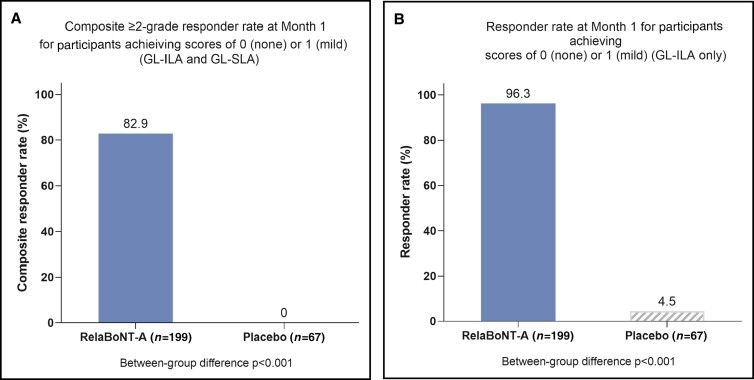
297 adults in a phase 3 placebo-controlled trial: liquid relabotulinumtoxinA 50 U gave an 82.9% composite 2-grade glabellar-line response at month 1 vs 0% with placebo; treatment-related adverse events 3.6%.

Key resultMonth 1 composite >=2-grade responder rate 82.9% (RelaBoNT-A, n=199) vs 0% (placebo, n=67; P<.001); RelaBoNT-A-related TEAEs 3.6%
Studied
Adults with moderate to severe glabellar lines
Compared with
Placebo
Main outcome
Composite >=2-grade responder rate at Month 1 at maximum frown
Sample
297 adults randomized and treated (3:1; RelaBoNT-A n=199, placebo n=67)
Authors' conclusion
A single RelaBoNT-A treatment was effective and demonstrated a favorable safety profile, with rapid onset and enduring effectiveness over the 6-month study.
Figure 1.: Primary efficacy outcomes (mITT population, with multiple imputation to handle missing values). (A) Composite ≥2-grade responder rate at Mon
Figure 1.. From PMC11566037, CC BY (terms); resized.
✗ Negativehuman RCTJ Psychopharmacol · 2022

Clinical effects of glabellar botulinum toxin injections on borderline personality disorder: A randomized controlled trial.

Fifty-four patients randomized (27 per arm)16-week single-blind two-center randomized controlled trial16 weeks (primary endpoint at 8 weeks)

54 patients with borderline personality disorder: glabellar botulinum toxin was no better than a minimal-acupuncture control at 8 weeks (p=0.68); side effects were mild (headache, skin/muscle irritation, dizziness).

Key resultBoth groups improved (BTX M=-0.39, ACU M=-0.35) but no superior effect of BTX, p=0.68; no secondary outcome differed
Studied
Patients with borderline personality disorder
Compared with
Minimal acupuncture control
Main outcome
Relative score change on ZAN-BPD at 8 weeks
Authors' conclusion
Evidence for BTX in borderline personality disorder remains limited, and designing adequate control conditions is an opportunity for further research.
Limitations
Single-blind; small sample.
✓ Positivehuman trialDermatol Surg · 2013

Long-term results for incobotulinumtoxinA in the treatment of glabellar frown lines.

n = 796 humansProspective open-label multicenter repeat-dose Phase III trial2 years (up to eight treatment cycles)

Open-label 2-year repeat-dose study in 796 subjects: 77-90% were responders after each of up to eight cycles of incobotulinumtoxinA 20 U, with no new safety concerns.

Key result77% to 88% responders at rest and 79% to 90% at maximum frown
Studied
Subjects with moderate or severe glabellar frown lines, enrolled from previous trials
Compared with
None (open-label, no control group)
Main outcome
Investigator-assessed responders on the Facial Wrinkle Scale (score 0 or 1) at Day 30 of each cycle
Sample
796 subjects
Authors' conclusion
IncobotulinumtoxinA injections were well tolerated and effective for glabellar frown lines for up to 2 years; no new tolerability or safety concerns.
Limitations
Open-label, no control group.

Verdicts are judged on each paper's own main outcome; grades run from A (strong human evidence) to D (little or none). Details are read from the abstracts, and figures are reproduced only from openly licensed full texts. Not medical advice.