Peptide Price Finder

Home · Research · Longevity & bioregulators

Cardiogen research

What published studies found for Cardiogen: 8 papers, 1 in humans, with sample sizes and key results, plus 1 registered clinical trials.

C
Mostly animal studies
Why: No controlled trials; one rat tumour study and one small non-randomized human report (cardiogen pooled with bronchogen), plus cell work from the developer's group.

Searches for 'Cardiogen' mostly return CardioGen-82, an unrelated rubidium-82 PET generator. For the peptide cardiogen (Ala-Glu-Asp-Arg), evidence is a few rat tissue-culture and tumour-model papers from one Russian group (the St Petersburg Institute of Bioregulation and Gerontology), plus one small uncontrolled-looking Russian clinical report in 32 elderly patients that cannot support efficacy conclusions.

✓ 3 positive~ 1 mixed? 4 inconclusive

Only one small Russian clinical report exists (no complications noted in 12 patients given cardiogen); papers about 'CardioGen-82' concern an unrelated PET radiopharmaceutical.

US compounding: Not compoundable. Not an FDA-approved drug and not nominated for FDA's 503A bulks list, so US pharmacies can't legally compound it. Status for every peptide.

Browse and filter these papersCardiogen prices and vendors

Registered clinical trials

1 trials of Cardiogen on ClinicalTrials.gov: 0 active, 1 completed. Registered trials include ones that haven't published yet.

TrialStatusPhasePeopleSponsor
Prospective Evaluation of Strontium in Patients After CardioGen-82 PET MPI ScanningNCT01424774 · started 2011-09Completed–155Bracco Diagnostics, Inc

All 1 Cardiogen trials, with countries and recruiting status

Human studies

? Inconclusivehuman trialНаука о жизни и здоровье · 2012Russian-language

Роль пептидных биорегуляторов в повышении эффективности лечения больных в пожилом возрасте

n = 32 humansTwo-group comparison of standard therapy with or without peptide bioregulators; randomization and blinding not stated20 days of treatment, assessed at 2 weeks

In 32 elderly patients, adding cardiogen (12 patients with ischaemic heart disease, hypertension, heart failure; given with bronchogen in 5 COPD patients) to standard care was followed by more improvement (95% vs 73%) than standard care alone; small, unblinded-looking, no stated randomization, and cardiogen was not isolated from bronchogen overall.

Key resultPositive dynamics in 95% with peptide bioregulators vs 73% with standard therapy alone; subjective improvement after 1 week in 89% vs 67%
Studied
Elderly patients (mean age 76) with ischaemic heart disease, hypertension and heart failure, or COPD
Compared with
Standard treatment alone (15 patients)
Main outcome
Subjective improvement and ECG, blood pressure, spirometry and blood chemistry
Sample
32 patients: 17 given peptide bioregulators (12 cardiogen, 5 bronchogen) and 15 controls
Authors' conclusion
The authors report marked effectiveness of cardiogen and bronchogen added to standard therapy, and no complications were observed.
Limitations
Very small, no stated randomization or blinding, no statistics given, mixed cardiogen/bronchogen group, outcome criteria loosely defined.
Reviews

? InconclusivereviewCells · 2022

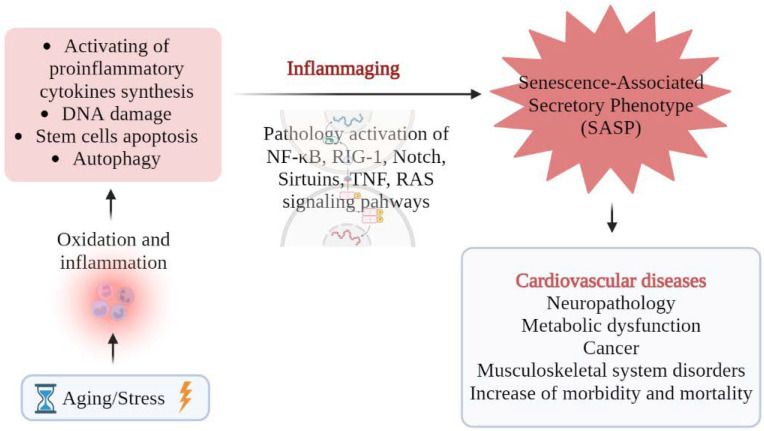
Senescence-Associated Secretory Phenotype of Cardiovascular System Cells and Inflammaging: Perspectives of Peptide Regulation.

No new dataNarrative review

A review of senescence-associated secretion in cardiovascular cells proposes vasoprotective peptides as a target but reports no clinical trial evidence.

Studied
Cardiovascular system cells and senescence-associated secretory phenotype
Authors' conclusion
Vasoprotective peptides, including KED tripeptide and AEDR tetrapeptide, regulate molecules involved in inflammaging and SASP, indicating prospects for peptide-based drugs for age-associated cardiovascular pathology.
Limitations
Narrative review; no original data.
Figure 1: SASP, inflammaging and age-associated diseases.
Figure 1. From PMC9818427, CC BY (terms); resized.

Animal & lab studies

~ MixedanimalBull Exp Biol Med · 2009

Tumor-modifying effect of cardiogen peptide on M-1 sarcoma in senescent rats.

AnimalsCardiogen injections in several dose groups vs control

In senescent rats with transplanted M-1 sarcoma, cardiogen injections dose-dependently slowed tumour growth via haemorrhagic necrosis and tumour-cell apoptosis, an anti-tumour rather than cardiac outcome.

Studied
Senescent rats with transplanted M-1 sarcoma
Compared with
Control
Main outcome
Tumor apoptosis and tumor growth
Authors' conclusion
Cardiogen dose-dependently inhibited M-1 sarcoma growth via hemorrhagic necrosis and increased tumor cell apoptosis, apparently acting through the tumor vascular network rather than by direct cytostatic effect.
Limitations
Rat transplant tumor model; group sizes not stated.
✓ Positivein vitroAdv Gerontol · 2009

[The effect of the amino acids and cardiogen on the development of myocard tissue culture from young and old rats].

Cells / labIn vitro tissue culture with 20 amino acids and cardiogen at 10(-12) M

In organotypic myocardial tissue culture from young and old rats, cardiogen stimulated cell proliferation in both ages and reduced p53 expression, interpreted as reduced apoptosis.

Key result7 of 20 amino acids stimulated proliferation in young rat tissue and only 2 in old rat tissue; cardiogen stimulated proliferation in both
Studied
Organotypic myocardial tissue explants from 3- and 24-month-old rats
Compared with
Control cultures
Main outcome
Cell proliferation and p53 expression (apoptosis)
Authors' conclusion
Cardiogen strongly stimulated proliferation in myocardial tissue from young and old rats and decreased p53 expression, which the authors suggest indicates inhibition of apoptosis.
Limitations
In vitro tissue explants; group sizes not stated.
✓ Positivein vitroAdv Gerontol · 2006

[The tissue-specific effect of synthetic peptides-biologic regulators in organotypic tissues culture in young and old rats].

Cells / labOrganotypic tissue culture with cardiogen, bronchogen, prostamax and pancragen at 0.05 ng/ml

In organotypic cultures from young and old rats, cardiogen stimulated heart explant growth specifically, while other peptides acted on their own matching tissues.

Studied
Organotypic explants of heart, lung, prostate and pancreas from young (3-week) and aged (18-month) rats
Compared with
Control explants
Main outcome
Tissue-specific explant growth
Authors' conclusion
At 0.05 ng/ml each peptide stimulated growth in its matching tissue culture compared with controls, so the authors suggest the peptides could stimulate reparative processes in ageing tissues.
Limitations
Explant cultures only; no numerical data in the abstract.
✓ Positivein vitroAdv Gerontol · 2010

[Peptidergic regulation of the expression of signal factors of fibroblast differentiation in the human prostate gland in cell aging].

Cells / labIn vitro study of peptides T-32, T-38 and cardiogen

In ageing human prostate fibroblast cultures, cardiogen and two other short peptides increased expression of differentiation signalling factors; the related peptide T-38 was most active.

Studied
Human prostate fibroblast cultures (young vs senescent)
Compared with
Control (young culture after 1 passage)
Main outcome
Expression of CXCL12, WEDC1 and ghrelin by confocal microscopy
Authors' conclusion
All the peptides enhanced expression of differentiation signaling factors reduced in senescent cultures; T-38 was the most active.
Limitations
In vitro; no quantitative data in the abstract.
? Inconclusivein vitroBiochemistry (Mosc) · 2013

Interaction of short peptides with FITC-labeled wheat histones and their complexes with deoxyribooligonucleotides.

No new dataFluorescence quenching binding assays

Binding study showing Ala-Glu-Asp-Arg and related short peptides attach to specific histone sites; mechanistic only.

Studied
Short peptides and FITC-labeled wheat histones in vitro
Main outcome
Peptide binding to histones and histone-oligonucleotide complexes
Authors' conclusion
Short peptides including Lys-Glu-Asp-Gly bind wheat histones in a site-specific manner; the authors suggest this may be an epigenetic control mechanism in chromatin.
Limitations
Cell-free assay with plant histones; mechanistic suggestion only.
? Inconclusivein vitroАктуальные проблемы медицины · 2010Russian-language

Влияние геропротекторных пептидов на экспрессию внутриядерных белков, регулирующих биосинтез рибосом в культуре опухолевых клеток

Cells / labIn vitro comparison of cardiogen and peptide T-32

In cultured tumour cells, cardiogen reduced expression of argyrophilic nucleolar-organizer proteins (ribosome biogenesis) while peptide T-32 raised it; mechanistic work from the developer's institute with no numbers in the abstract.

Studied
Tumour cell culture
Main outcome
Expression of argyrophilic proteins in nucleolar organizer regions
Authors' conclusion
Cardiogen decreased and T-32 stimulated expression of argyrophilic proteins of the nucleolar organizer region in tumour cells; the peptides act in opposite directions.
Limitations
Cell culture only; no quantitative data in the text available; developer's institute.

Verdicts are judged on each paper's own main outcome; grades run from A (strong human evidence) to D (little or none). Details are read from the abstracts, and figures are reproduced only from openly licensed full texts. Not medical advice.