Peptide Price Finder

Home · Research · Cognitive & nootropic

Cerebrolysin research

What published studies found for Cerebrolysin: 13 papers, 13 in humans, with sample sizes and key results, plus 40 registered clinical trials.

B
Some human evidence
Why: Many RCTs but conflicting: Cochrane and large stroke trials show no benefit on death or recovery, while small trials and meta-analyses in TBI and dementia report modest gains.

Cerebrolysin (a porcine brain peptide mixture) has many human RCTs and meta-analyses, but results are mixed: Cochrane reviews find no benefit on death in acute ischaemic stroke and a possible rise in non-fatal serious adverse events, while smaller and often industry-linked analyses report modest gains in dementia and traumatic brain injury. Added randomized trials in stroke, traumatic brain injury and Alzheimer's disease show small benefits in some (CARS, CAPTAIN II, an Alzheimer's dose-finding study) and a neutral large Asian stroke trial (CASTA), so the mixed picture and grade B stand.

✓ 7 positive✗ 3 negative~ 2 mixed? 1 inconclusive

In stroke trials total adverse events were similar to placebo, but Cochrane reviews flag more non-fatal serious adverse events.

US compounding: Not compoundable. Not an FDA-approved drug and not nominated for FDA's 503A bulks list, so US pharmacies can't legally compound it. Status for every peptide.

Browse and filter these papersCerebrolysin prices and vendors

Reported side effects

Registered clinical trials

40 trials of Cerebrolysin on ClinicalTrials.gov: 8 active, 18 completed, 3 with posted results. Registered trials include ones that haven't published yet.

TrialStatusPhasePeopleSponsor
Cerebrolysin in Critically Ill Patients With DeliriumNCT06677502 · started 2024-01-01Enrolling by invitation–500Medical University of Lublin
Combined Acupuncture-Based Therapy for Rehabilitation After Ischemic StrokeNCT07846488 · started 2026-12-01Not yet recruiting–440National Hospital of Acupuncture, Vietnam
Cerebrolysin After Reperfusion in Extended-window EndoVascular ThrombectomyNCT06339411 · started 2026-09-01Not yet recruitingPhase 2100Chang Gung Memorial Hospital
Efficacy of Prednisolone Versus Cerebrolysin in the Treatment of Bell's PalsyNCT05821075 · started 2023-08-24RecruitingPhase 1, Phase 290October 6 University
Safety and Feasibility of Using Cerebrolysin in the Treatment of Primary Intracerebral Hemorrhage - a Prospective Randomized Open Blinded End-point TrialNCT06899464 · started 2025-10-01Not yet recruitingPhase 430Cardinal Stefan Wyszynski University
Cerebrolysin in Early Stroke Rehabilitation - Tertiary StudyNCT07043686 · started 2025-06-13Recruiting–30University Medical Centre Ljubljana
CERebrolysin In CADASILNCT05755997 · started 2023-11-29Active, not recruitingPhase 230Ever Neuro Pharma GmbH
Efficacy and Safety of Cerebrolysin on Prolonged Disorders of ConsciousnessNCT04427241 · started 2023-06-01RecruitingPhase 412Konkuk University Medical Center
A Clinical Trial to Evaluate the Safety and Efficacy of 20 ml Cerebrolysin in Patients With Vascular DementiaNCT00947531 · started 2006-10 · results postedCompletedPhase 4242Ever Neuro Pharma GmbH
Comparative Study to Test Safety and Efficacy of Neurotrophic and Cholinergic Treatment of Alzheimer's DiseaseNCT00911807 · started 2004-10 · results postedCompletedPhase 2217Ever Neuro Pharma GmbH
Dl-3-n-butylphthalide and Cerebrolysin Treatment in Acute Ischemic StrokeNCT02149875 · started 2010-01 · results postedCompletedPhase 1, Phase 284Shanghai 6th People's Hospital
Cerebrolysin REGistry Study in Stroke - a High-quality Observational Study of Comparative EffectivenessNCT03480698 · started 2018-04-24Completed–1,851Ever Neuro Pharma GmbH

All 40 Cerebrolysin trials, with countries and recruiting status

Meta-analyses & systematic reviews

✓ Positivemeta-analysisAlzheimers Dement · 2025

Therapeutic strategies in vascular cognitive impairment: A systematic review and meta-analysis.

n = 22,347 humansSystematic review and meta-analysis of 173 trials

Broad meta-analysis of 173 vascular cognitive impairment trials: cerebrolysin was among interventions with small-to-moderate cognitive improvements, with overall low certainty of evidence.

Key resultSmall to moderate cognitive improvements were shown for several interventions including cerebrolysin; Ginkgo biloba showed the largest effect (Cohen's d: 0.83, 95% CI: 0.00 to 1.67)
Studied
People with vascular cognitive impairment
Main outcome
Cognition and functional outcomes
Sample
173 trials of many interventions, 22,347 participants in total (not Cerebrolysin-specific)
Authors' conclusion
Some interventions, including cerebrolysin, showed modest effects on cognition, but heterogeneity was substantial and certainty of evidence is overall low.
Limitations
Cerebrolysin is one of 91 interventions; heterogeneity and low certainty.
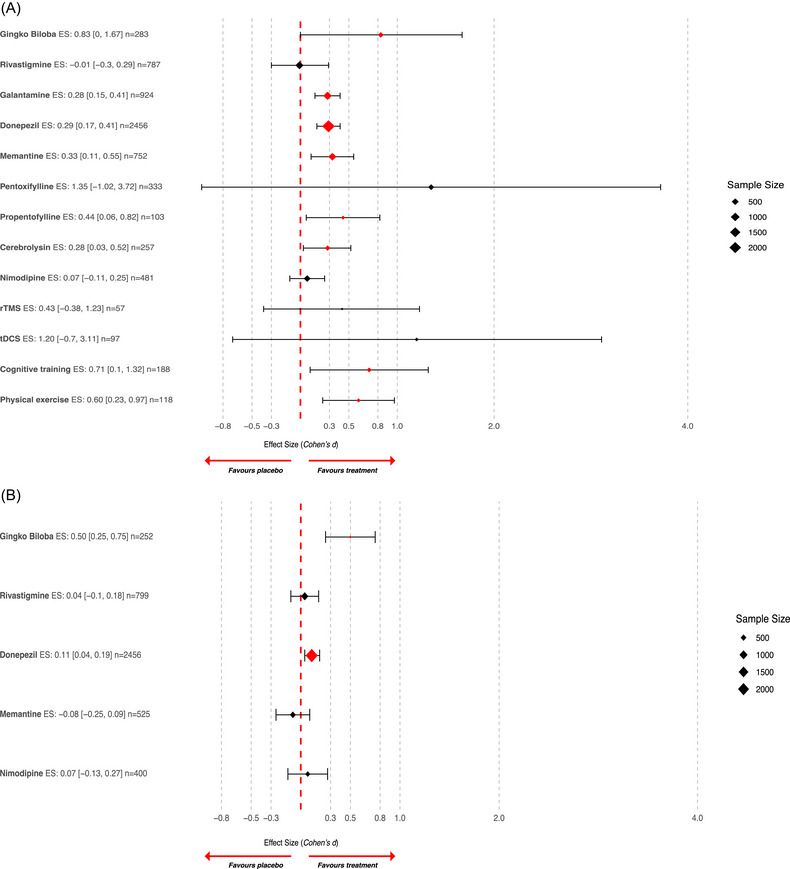
FIGURE 4: Forest plot of meta‐analysis of global cognitive efficiency outcomes (A) and of functional outcomes (B) for all meta‐analyzed interventions
FIGURE 4. From PMC12591988, CC BY (terms); resized.
~ Mixedmeta-analysisBrain Sci · 2023

Cerebrolysin in Patients with TBI: Systematic Review and Meta-Analysis.

n = 8,749 humansSystematic review and meta-analysis of retrospective and prospective studies

Meta-analysis of 10 retrospective and prospective TBI studies (8,749 patients): improvements in GCS and GOS, but no effect on mortality or length of stay.

Studied
Patients with traumatic brain injury
Main outcome
GCS, GOS, mortality, length of stay
Sample
10 clinical studies, 8749 patients (retrospective and prospective)
Authors' conclusion
Cerebrolysin was associated with statistically significant changes in GCS and GOS, but mortality and length of stay were not affected; further multi-center studies are needed.
Limitations
Includes retrospective studies; abstract gives no effect sizes.
Figure 3: Effect of Cerebrolysin on GOS score (Z value = 12.962, p < 0.05). [21,22].
Figure 3. From PMC10046100, CC BY (terms); resized.
✗ Negativemeta-analysisDrug Des Devel Ther · 2017

Cerebrolysin for functional recovery in patients with acute ischemic stroke: a meta-analysis of randomized controlled trials.

n = 1,649 humansMeta-analysis of randomized controlled trialsPrimary outcome at Day 90

Meta-analysis of 6 RCTs (1,649 acute stroke patients): no significant effect on day-90 functional recovery (mRS, NIHSS, Barthel); adverse events not increased.

Key resultmRS response RR 1.33 (95% CI 0.79-2.24, P=0.28); NIHSS RR 1.03 (P=0.77); Barthel RR 0.95 (P=0.44); serious adverse events RR 1.20 (P=0.29)
Studied
Patients with acute ischemic stroke
Compared with
Placebo
Main outcome
Functional recovery at Day 90 (mRS, NIHSS, Barthel Index response)
Sample
1,649 patients pooled from six RCTs
Authors' conclusion
Cerebrolysin had no significant effect on functional recovery at Day 90, and routine administration to patients with AIS cannot be supported by the available evidence from RCTs.
? Inconclusivemeta-analysisCochrane Database Syst Rev · 2019

Cerebrolysin for vascular dementia.

n = 597 humansCochrane systematic review and meta-analysis of RCTsFollow-up ranged from 15 days to three years

Cochrane review of 6 RCTs (597 people) in vascular dementia: improved cognition (SMD 0.36) and global function, but very-low-quality evidence with high risk of bias; benefits may be too small to matter.

Key resultCognition SMD 0.36 (95% CI 0.13 to 0.58; three studies, 420 people); global function response RR 2.69 (95% CI 1.82 to 3.98; two studies, 379 participants); both very low-quality evidence
Studied
People with vascular dementia (mild to moderate where reported)
Compared with
Placebo
Main outcome
Cognitive function, global function, mortality
Sample
6 RCTs, 597 participants
Authors' conclusion
Cerebrolysin improved cognition and general function with no suggestion of adverse effects, but the data are not definitive; any benefit may be too small to be clinically meaningful.
Limitations
Very low-quality evidence, heterogeneity, high risk of bias, industry funding, no new studies since 2013.
✓ Positivemeta-analysisNeurol Sci · 2021

Cerebrolysin after moderate to severe traumatic brain injury: prospective meta-analysis of the CAPTAIN trial series.

n = 185 humansProspective meta-analysis of two phase IIIb/IV randomized, double-blind, placebo-controlled trials (CAPTAIN)Outcomes at Day 10, 30 and 90

Prospective meta-analysis of two RCTs (185 patients) in moderate-severe traumatic brain injury: small-to-medium benefit on a combined outcome at days 30 and 90; similar safety to placebo.

Key resultDay 30 MWcombined = 0.60 (95% CI 0.52 to 0.66, p = 0.0156); Day 90 MWcombined = 0.60 (95% CI 0.52 to 0.68, p = 0.0146)
Studied
Patients with moderate-severe traumatic brain injury (GCS 6 to 12)
Compared with
Physiological saline placebo
Main outcome
Multidimensional ensemble of functional and neuropsychological outcomes
Sample
185 patients across two trials
Authors' conclusion
Small-to-medium effect favoring Cerebrolysin with comparable safety; the authors suggest guideline integration should be considered after careful review.
Limitations
Only two trials, 185 patients.
✓ Positivemeta-analysisDement Geriatr Cogn Disord · 2015

Cerebrolysin in mild-to-moderate Alzheimer's disease: a meta-analysis of randomized controlled clinical trials.

6 randomized double-blind placebo-controlled trials (participant total not stated in abstract)Meta-analysis of randomized double-blind placebo-controlled trials of 30 ml/day Cerebrolysin4 weeks and 6 months

Meta-analysis of 6 placebo-controlled RCTs in mild-to-moderate Alzheimer's disease: better cognition at 4 weeks and global clinical change at 4 weeks and 6 months; safety comparable to placebo.

Key resultCognition at 4 weeks SMD -0.40 (95% CI -0.66 to -0.13; p = 0.0031); global clinical change at 4 weeks OR 3.32 (95% CI 1.20-9.21; p = 0.0212)
Studied
Patients with mild-to-moderate Alzheimer's disease
Compared with
Placebo
Main outcome
Cognitive function and global clinical change
Authors' conclusion
Cerebrolysin showed an overall beneficial effect and a favorable benefit-risk ratio in mild-to-moderate AD; safety was comparable to placebo.
Limitations
Cognitive benefit not significant at 6 months; small number of trials.
✗ Negativesystematic reviewCochrane Database Syst Rev · 2023

Cerebrolysin for acute ischaemic stroke.

n = 1,773 humansCochrane systematic review of RCTs (Cerebrolysin or Cerebrolysin-like agents vs placebo or no treatment)

Cochrane review of 7 RCTs (1,773 patients) in acute ischaemic stroke: little or no effect on all-cause death (RR 0.96); non-fatal serious adverse events increased (RR 2.39).

Key resultAll-cause death RR 0.96 (95% CI 0.65 to 1.41; 6 trials, 1689 participants); non-fatal serious adverse events RR 2.39 (95% CI 1.10 to 5.23; 3 trials, 1335 participants)
Studied
People with acute ischaemic stroke, treatment started within 48 hours of onset
Compared with
Placebo or no treatment
Main outcome
All-cause death; serious adverse events
Sample
7 RCTs, 1773 participants (includes one Cortexin trial of 272)
Authors' conclusion
Moderate-certainty evidence indicates Cerebrolysin probably has no beneficial effect on preventing all-cause death, and a potential increase in non-fatal serious adverse events.
Limitations
Risk of bias unclear in most studies; manufacturer supported three studies; functional outcomes not reported.

Human studies

✗ Negativehuman RCTStroke · 2012

Cerebrolysin in patients with acute ischemic stroke in Asia: results of a double-blind, placebo-controlled randomized trial.

n = 1,070 humansDouble-blind, placebo-controlled randomized trial, plus aspirin10 days treatment, 90 days follow-up

CASTA: in 1,070 Asian patients with acute ischaemic stroke, Cerebrolysin for 10 days did not beat placebo on the primary combined endpoint; a post hoc trend in severe strokes (NIHSS >12) needs confirmation.

Key resultNo significant difference on the primary endpoint; post hoc in NIHSS >12, 90-day mortality 20.2% placebo vs 10.5% Cerebrolysin.
Studied
Patients with acute ischemic hemispheric stroke randomized within 12 hours
Compared with
Saline placebo
Main outcome
Combined global test of mRS, Barthel Index and NIHSS
Sample
1070 patients (529 Cerebrolysin, 541 placebo)
Authors' conclusion
The confirmatory endpoint was neutral; a favourable trend in severely affected patients should be confirmed by a further trial.
Limitations
Subgroup finding is post hoc.
✓ Positivehuman RCTNeurol Sci · 2020

Efficacy and safety of cerebrolysin in neurorecovery after moderate-severe traumatic brain injury: results from the CAPTAIN II trial.

n = 142 humansSingle-center, randomized, double-blind, placebo-controlled phase IIIb/IV trial10 days plus two 10-day cycles; assessed at 10, 30, 90 days

CAPTAIN II: in 139 analysed patients with moderate-severe TBI, Cerebrolysin added to standard care gave a small-to-medium benefit on a combined 13-scale outcome at day 90 (P=0.0119); safety similar to placebo.

Key resultSmall-to-medium effect favouring Cerebrolysin (MW combined 0.59, 95% CI 0.52 to 0.66, P = 0.0119).
Studied
Patients with moderate to severe traumatic brain injury (GCS 7-12)
Compared with
Saline placebo
Main outcome
Ensemble of 13 outcome scales at day 90
Sample
142 enrolled, 139 analysed
Authors' conclusion
The trial confirms previous beneficial effects of Cerebrolysin on overall outcome after moderate-severe TBI; findings should be aggregated with existing literature.
Limitations
Single center.
✓ Positivehuman RCTEur J Neurol · 2011

Efficacy and safety of Cerebrolysin in moderate to moderately severe Alzheimer's disease: results of a randomized, double-blind, controlled trial investigating three dosages of Cerebrolysin.

n = 133 humansRandomized, double-blind, placebo-controlled dose-finding trial (subgroup analysis)12 weeks treatment, assessed at week 24

Dose-finding trial subgroup: in moderate to moderately severe Alzheimer's disease, 12 weeks of Cerebrolysin (10, 30 or 60 ml) improved global clinical function at week 24 versus placebo; secondary measures such as MMSE were not significant.

Studied
Patients with moderate to moderately severe Alzheimer's disease
Compared with
Saline placebo
Main outcome
ADAS-cog+ and CIBIC+
Sample
133 patients with moderate to moderately severe AD in the ITT subgroup (MMSE 14-20)
Authors' conclusion
Cerebrolysin improved global clinical function at all three doses and cognition and other measures at specific doses; benefits in advanced AD need to be confirmed in larger trials.
Limitations
Subgroup analysis of a dose-finding study; small groups.
~ Mixedhuman RCTNeurol Sci · 2020

Safety and efficacy of Cerebrolysin in acute brain injury and neurorecovery: CAPTAIN I-a randomized, placebo-controlled, double-blind, Asian-Pacific trial.

n = 46 humansRandomized, double-blind, placebo-controlled phase IIIb/IV multicentre trial10 days plus two 10-day cycles

CAPTAIN I: in 46 patients with moderate-severe TBI, the primary combined outcome narrowly missed significance in the ITT analysis (significant per protocol); three single outcomes favoured Cerebrolysin; safety similar to placebo.

Key resultITT primary ensemble pWei-Lachin < 0.1 (MW combined 0.63, 95% CI 0.48-0.77); per-protocol pWei-Lachin = 0.0240.
Studied
Patients with moderate-to-severe traumatic brain injury
Compared with
Saline placebo
Main outcome
Multidimensional ensemble of 14 outcome scales
Sample
46 patients (22 Cerebrolysin, 24 placebo)
Authors' conclusion
Beneficial effects of Cerebrolysin after TBI are suggested; results should be confirmed by a larger RCT.
Limitations
Small trial; primary analysis not significant in ITT population.
✓ Positivehuman RCTStroke · 2016

Cerebrolysin and Recovery After Stroke (CARS): A Randomized, Placebo-Controlled, Double-Blind, Multicenter Trial.

HumansRandomized, double-blind, placebo-controlled multicenter trial21 days treatment, day 90 endpoint

CARS: in early rehabilitation after ischaemic stroke, 21 days of Cerebrolysin gave better day-90 arm function (Action Research Arm Test) than placebo (Mann-Whitney 0.71, 95% CI 0.63-0.79); safety similar to placebo, but exploratory and small.

Key resultMann-Whitney estimator 0.71 (95% CI, 0.63-0.79; P<0.0001) favouring Cerebrolysin; premature discontinuation 3.8%.
Studied
Patients with acute stroke starting treatment 24-72 hours after onset, with standardized rehabilitation
Compared with
Saline placebo
Main outcome
Action Research Arm Test score at day 90
Authors' conclusion
Cerebrolysin had a beneficial effect on function and global outcome in early rehabilitation after stroke with safety comparable to placebo; the authors say results need confirming in a large trial.
Limitations
Described by authors as exploratory with a relatively small sample size.
✓ Positivehuman trialBMC Neurol · 2023

Cerebrolysin as an Early Add-on to Reperfusion Therapy: Risk of Hemorrhagic Transformation after Ischemic Stroke (CEREHETIS), a prospective, randomized, multicenter pilot study.

126 Cerebrolysin plus 215 controlsProspective, randomized, open-label pilot with active control14 days treatment, 90 days follow-up

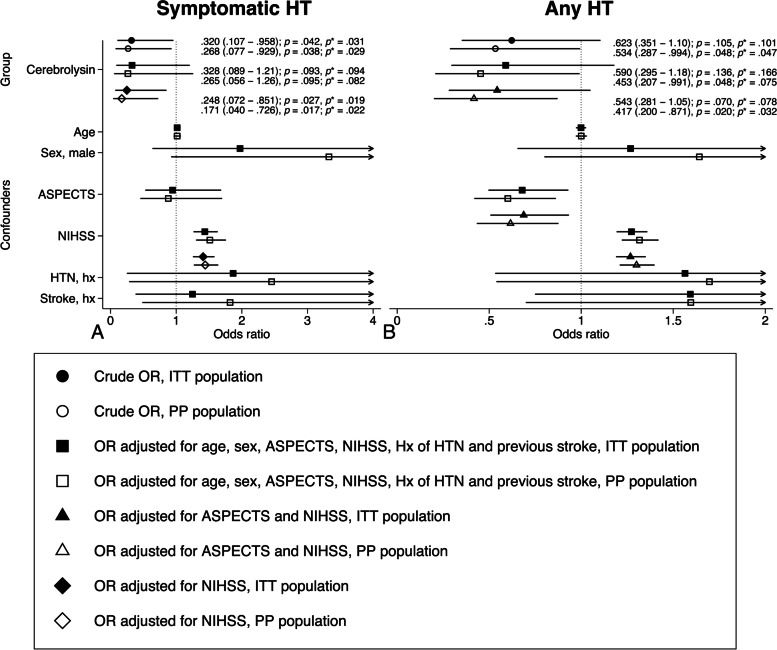
CEREHETIS: in 341 stroke patients given alteplase, adding Cerebrolysin (126) cut symptomatic haemorrhagic transformation versus alteplase alone (OR 0.248) with no serious related adverse events, but no 90-day functional difference.

Key resultSymptomatic HT odds ratio 0.248 (95% CI 0.072-0.851; p = 0.019); no difference in mRS at day 90.
Studied
Patients with acute ischaemic stroke treated with alteplase
Compared with
Alteplase alone
Main outcome
Rate of any and symptomatic haemorrhagic transformation
Authors' conclusion
Early add-on of Cerebrolysin was safe and decreased symptomatic HT and early deficit; no effect on day 90 functional outcome.
Limitations
Open-label pilot study.
Fig. 3: Primary endpoints. Univariate and multivariate logistic regression. Crude and adjusted OR with CI are reported. Solid markers – intention-to
Fig. 3. From PMC10041692, CC BY (terms); resized.

Verdicts are judged on each paper's own main outcome; grades run from A (strong human evidence) to D (little or none). Details are read from the abstracts, and figures are reproduced only from openly licensed full texts. Not medical advice.