Peptide Price Finder

Home · Research · Growth hormone

CJC-1295 with DAC research

What published studies found for CJC-1295 with DAC: 7 papers, 4 in humans, with sample sizes and key results, plus 1 registered clinical trials.

B
Some human evidence
Why: Small placebo-controlled early-phase trials in healthy adults show sustained GH and IGF-I rises; no trials test body composition, recovery or performance.

CJC-1295 (an albumin-binding, long-acting GHRH analog) has small early-phase human studies in healthy adults showing sustained rises in GH and IGF-I, plus rat and mouse work; no published trials test clinical outcomes such as body composition, recovery or performance.

✓ 4 positive? 3 inconclusive

Short-term trials in healthy adults reported no serious adverse reactions but the abstracts do not list specific adverse effects; there is no long-term human safety data.

US compounding: Not compoundable (no pending nomination). Removed from FDA's Category 2 on about April 22, 2026 after its nominations were withdrawn. That doesn't add it to any allowed list, so US pharmacies still can't compound it from bulk ingredient. Status for every peptide.

Browse and filter these papersCJC-1295 with DAC prices and vendors

Registered clinical trials

1 trials of CJC-1295 with DAC on ClinicalTrials.gov: 0 active, 0 completed. Registered trials include ones that haven't published yet.

TrialStatusPhasePeopleSponsor
A Study to Evaluate CJC 1295 in HIV Patients With Visceral ObesityNCT00267527 · started 2005-12TerminatedPhase 2120ConjuChem

All 1 CJC-1295 with DAC trials, with countries and recruiting status

Meta-analyses & systematic reviews

? Inconclusivesystematic reviewAm J Sports Med · 2026

Peptide Supplements and Their Therapeutic Applications in Sports Medicine.

No new dataScoping review (PubMed, PRISMA)

Scoping review including CJC-1295 concluded that claimed musculoskeletal recovery and performance benefits are unsubstantiated by human trials and that these peptides should not be recommended.

Studied
Literature on 6 peptides (BPC-157, TB-500, CJC-1295, MK-677, ipamorelin, GHK-Cu) for musculoskeletal recovery
Main outcome
Musculoskeletal recovery and performance in animal and human models
Authors' conclusion
67% of publications were preclinical; human data were limited and showed modest improvements at best. Claimed benefits remain unsubstantiated by human trials, and these peptides should not currently be recommended.
Limitations
Few, poorly controlled human studies; heterogeneous dosing and routes.
Human studies

✓ Positivehuman RCTJ Clin Endocrinol Metab · 2006

Prolonged stimulation of growth hormone (GH) and insulin-like growth factor I secretion by CJC-1295, a long-acting analog of GH-releasing hormone, in healthy adults.

Number of subjects not stated in abstractTwo randomized, placebo-controlled, double-blind ascending-dose trials (single doses in study 1; two or three weekly or biweekly doses in study 2)Trials of 28 and 49 days

In two placebo-controlled ascending-dose trials in healthy adults aged 21-61, a single injection raised GH 2- to 10-fold for 6+ days and IGF-I 1.5- to 3-fold for 9-11 days (half-life 5.8-8.1 days); no serious adverse reactions.

Key resultSingle injection raised mean plasma GH 2- to 10-fold for 6 d or more and IGF-I 1.5- to 3-fold for 9-11 d; estimated half-life 5.8-8.1 d; no serious adverse reactions
Studied
Healthy adults aged 21-61 years
Compared with
Placebo
Main outcome
Peak concentrations and AUC of GH and IGF-I; CJC-1295 pharmacokinetics
Authors' conclusion
Subcutaneous CJC-1295 produced sustained, dose-dependent increases in GH and IGF-I in healthy adults and was safe and relatively well tolerated, particularly at 30 or 60 microg/kg; data support potential therapeutic utility.
Limitations
Healthy adults only; sample size not stated in abstract.
? Inconclusivehuman trialGrowth Horm IGF Res · 2009

Activation of the GH/IGF-1 axis by CJC-1295, a long-acting GHRH analog, results in serum protein profile changes in normal adult subjects.

n = 11 humansBefore-and-after serum proteomics (2D gel electrophoresis, mass spectrometry)One week after CJC-1295 injection

In 11 healthy young men, a CJC-1295 injection altered several serum proteins (e.g., apolipoprotein A1 and transthyretin isoforms) a week later; a biomarker study, not a test of clinical benefit.

Key resultTwo protein spots decreased (apolipoprotein A1 and transthyretin isoforms) and three increased (beta-hemoglobin and albumin/immunoglobulin fragments); a linear relationship was found between one spot and IGF-1 levels
Studied
Healthy young adult men
Compared with
Same subjects before treatment
Main outcome
Serum protein changes and correlation with GH/IGF-1
Sample
Sera from 11 healthy young adult men before and one week after CJC-1295
Authors' conclusion
The identified proteins may represent potential biomarkers of GH and/or IGF-1 action, although the molecular links remain to be clarified.
Limitations
Biomarker discovery in 11 men without a control group; not a test of clinical benefit.
✓ Positivehuman trialJ Clin Endocrinol Metab · 2006

Pulsatile secretion of growth hormone (GH) persists during continuous stimulation by CJC-1295, a long-acting GH-releasing hormone analog.

Number of men not stated in abstractBefore-and-after study: overnight 12-h sampling every 20 min before and 1 week after a single injection of 60 or 90 microg/kg CJC-12951 week after injection

In healthy men aged 20-40, one injection raised trough GH 7.5-fold, mean GH 46% and IGF-I 45% a week later while preserving normal GH pulsatility.

Key resultTrough GH 7.5-fold higher (P < 0.0001); mean GH levels +46% (P < 0.01); IGF-I +45% (P < 0.001); pulse frequency and magnitude unaltered
Studied
Healthy men aged 20-40
Compared with
Same subjects before injection
Main outcome
GH pulsatility, trough and mean GH, IGF-I
Authors' conclusion
CJC-1295 increased trough and mean GH secretion and IGF-I production with preserved GH pulsatility; long-acting GHRH preparations may have clinical utility in patients with intact pituitary GH secretory capability.
Limitations
No placebo control stated; healthy men only.

Reviews

? InconclusivereviewFront Endocrinol (Lausanne) · 2026

The emerging landscape of performance-enhancing peptides modulating GH-IGF1 axis: bridging the gap between clinical evidence and patient self-administration.

No new dataNarrative review of unregulated GH-IGF-1 axis peptides including PEG-MGF

A 2026 narrative review of GH-IGF-1 axis 'research compound' peptides, including CJC-1295 with and without DAC, ranks them by evidence tier and concludes performance and recomposition benefits are unproven, with reported class adverse effects including prolactin and cortisol rises, dysglycaemia, fluid retention, myalgia and injection-site reactions.

Authors' conclusion
Peptides are stratified into evidence tiers from regulatory-grade trial data to no human studies; performance benefits are uncertain, and the authors propose a clinical assessment algorithm without legitimising off-label use.
Limitations
Narrative review; some peptides lack human studies.
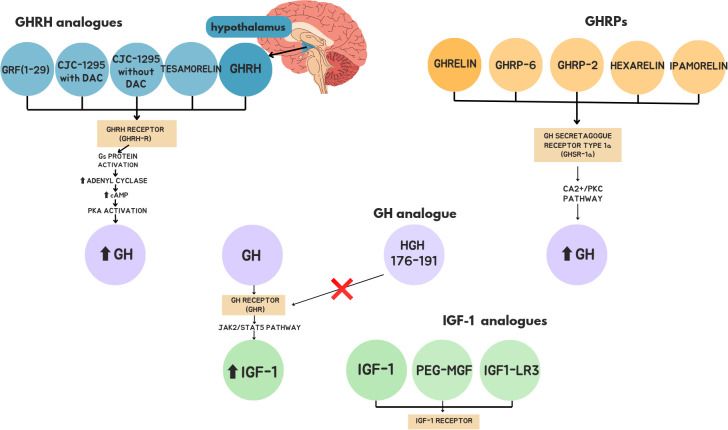
Figure 2: Overview of the discussed compounds and their receptors. The diagram summarises the principal receptor targets and canonical intracellular s
Figure 2. From PMC13322892, CC BY (terms); resized.

Animal & lab studies

✓ PositiveanimalAm J Physiol Endocrinol Metab · 2006

Once-daily administration of CJC-1295, a long-acting growth hormone-releasing hormone (GHRH) analog, normalizes growth in the GHRH knockout mouse.

Animals2 microg CJC-1295 given every 24, 48 or 72 h vs placebo5 weeks

In GHRH-knockout mice, daily CJC-1295 for 5 weeks normalized body weight, length and body composition; dosing every 48-72 h was less effective.

Studied
GHRH knockout mice (1 week old at start), with heterozygous mice as controls
Compared with
Placebo-treated GHRH knockout mice and heterozygous controls
Main outcome
Body weight, length, body composition, pituitary GH mRNA
Authors' conclusion
Once-daily CJC-1295 maintained normal body composition and growth in GHRH knockout mice; the same dose was less effective every 48 or 72 h.
Limitations
Mouse model of GHRH deficiency; no numbers in abstract.
✓ PositiveanimalEndocrinology · 2005

Human growth hormone-releasing factor (hGRF)1-29-albumin bioconjugates activate the GRF receptor on the anterior pituitary in rats: identification of CJC-1295 as a long-lasting GRF analog.

AnimalsSubcutaneous administration of maleimido GRF derivatives, comparing GH response with unmodified hGRF(1-29)2-h GH response; plasma persistence beyond 72 h

In rats, CJC-1295 bound to albumin, persisted in plasma beyond 72 h and gave a 4-fold greater GH response over 2 h than unmodified hGRF(1-29).

Key resultCJC-1295 gave a 4-fold increase in GH AUC over 2 h compared with hGRF(1-29) and was present in plasma beyond 72 h
Studied
Normal male Sprague Dawley rats and cultured rat anterior pituitary cells
Compared with
hGRF(1-29)
Main outcome
GH area under the curve; plasma persistence
Authors' conclusion
CJC-1295 was identified as a stable, active hGRF(1-29) analog with an extended plasma half-life via binding to serum albumin.
Limitations
Rat study; early characterization paper.

Verdicts are judged on each paper's own main outcome; grades run from A (strong human evidence) to D (little or none). Details are read from the abstracts, and figures are reproduced only from openly licensed full texts. Not medical advice.