Peptide Price Finder

Home · Research · Sleep & mood

DSIP research

What published studies found for DSIP: 9 papers, 6 in humans, with sample sizes and key results.

B
Some human evidence
Why: A few small placebo-controlled insomnia trials (about 14-16 people each) gave weak, inconsistent results; the rest is uncontrolled reports and rodent work.

Delta sleep-inducing peptide was tested in several small human insomnia trials in the 1980s-90s with inconsistent results; the better-controlled studies found weak or clinically insignificant benefits, and reviews describe its biology as still unresolved. Newer work is limited to rodent studies (stroke recovery, sleep at simulated altitude).

✓ 3 positive✗ 3 negative~ 1 mixed? 2 inconclusive

Human data are limited to small, mostly older trials; one insomnia study reported no daytime sedation or other side effects.

US compounding: Advisory panel voted against. Emideltide (DSIP) was the one peptide the advisory committee voted against adding in July 2026. It's off Category 2 but on no allowed list, so it can't be compounded. Status for every peptide.

Browse and filter these papersDSIP prices and vendors

Reported side effects

Human studies

✗ Negativehuman RCTNeuropsychobiology · 1992

Effects of delta sleep-inducing peptide on sleep of chronic insomniac patients. A double-blind study.

n = 16 humansDouble-blind matched-pairs parallel-groups study5 consecutive nights (DSIP before nights 3 to 5)

Double-blind parallel trial in 16 chronic insomniacs: DSIP gave slightly better sleep efficiency and latency, but effects were weak and subjective sleep quality did not change; judged not of major therapeutic benefit.

Studied
Chronic insomniac patients sleeping in the laboratory
Compared with
Glucose solution (placebo)
Main outcome
Sleep structure, objective (polysomnography) and subjective sleep quality, tiredness
Sample
16 chronic insomniac patients
Authors' conclusion
Objective sleep efficiency was higher and latency shorter with DSIP, but effects were weak and partly due to a change in the placebo group; short-term DSIP treatment is not likely to be of major therapeutic benefit.
Limitations
Small sample; effects weak; short-term treatment.
✗ Negativehuman RCTEur J Anaesthesiol · 2009

Delta sleep-inducing peptide alters bispectral index, the electroencephalogram and heart rate variability when used as an adjunct to isoflurane anaesthesia.

Twenty-four female patients (12 saline, 12 DSIP), written in wordsRandomized controlled study with saline controls

24 surgical patients randomized to DSIP or saline during isoflurane anaesthesia: DSIP raised heart rate, reduced heart-rate variability and paradoxically lightened anaesthetic depth.

Key resultDSIP at 25 nmol/kg significantly increased heart rate, decreased HRV, reduced delta rhythm and increased BIS during isoflurane anaesthesia
Studied
Female ASA I or II patients under propofol/isoflurane anaesthesia
Compared with
Saline
Main outcome
Bispectral index, EEG and heart rate variability
Authors' conclusion
DSIP probably reduced parasympathetic tone and lightened the depth of anaesthesia, contrary to the hypothesis that it would increase anaesthetic depth.
Limitations
Small groups of 12 patients; anaesthesia setting, not sleep.
✓ Positivehuman trialEur Neurol · 1987

Effects of delta-sleep-inducing peptide on 24-hour sleep-wake behaviour in severe chronic insomnia.

n = 14 humansPlacebo-controlled double-blind administration with polysomnography7 successive nights

Placebo-controlled, double-blind 7-night study in 14 severe chronic insomniacs: improved night sleep and daytime alertness and performance.

Studied
Middle-aged severe chronic insomniacs
Compared with
Placebo baseline and posttreatment nights
Main outcome
Night sleep and daytime alertness and performance
Sample
14 middle-aged chronic insomniacs
Authors' conclusion
DSIP substantially improved night sleep and daytime alertness and performance in chronic insomniacs, with efficiency reaching normal-control levels.
Limitations
Small sample of 14.
? Inconclusivehuman trialEur Neurol · 1984

Therapeutic effects of delta-sleep-inducing peptide (DSIP) in patients with chronic, pronounced pain episodes. A clinical pilot study.

n = 7 humansClinical pilot study comparing baseline with control period5 consecutive days then 5 injections every 48-72 h

Uncontrolled pilot in 7 patients with chronic pain episodes (migraine, tinnitus, psychogenic pain): pain levels fell in 6 of 7 after DSIP courses.

Key resultDSIP lowered pain levels significantly in 6 out of 7 patients
Studied
Patients with migraine, vasomotor headaches, chronic tinnitus and psychogenic pain attacks
Compared with
Baseline (anamnestic) values
Main outcome
Pain levels and depressive states
Sample
7 patients
Authors' conclusion
Pilot study suggests DSIP lowered pain and concomitant depressive states significantly after intravenous administration.
Limitations
Pilot with 7 patients; no placebo control.
✓ Positivehuman trialExperientia · 1981

The influence of synthetic DSIP (delta-sleep-inducing-peptide) on disturbed human sleep.

n = 6 humansAcute intravenous administration studySingle administration; effects up to 6 h of night sleep

6 chronic insomniacs given intravenous DSIP: longer and less interrupted sleep, with a slight arousing effect in the first hour.

Studied
Middle-aged chronic insomniacs
Main outcome
Sleep duration and quality
Sample
6 middle-aged chronic insomniacs
Authors' conclusion
DSIP 25 nmoles/kg gave longer sleep duration and higher sleep quality with fewer interruptions, with a normalizing influence on human sleep regulation.
Limitations
Only 6 patients; no placebo comparison described.
✗ Negativehuman trialInt J Clin Pharmacol Res · 1987

Study of delta sleep-inducing peptide efficacy in improving sleep on short-term administration to chronic insomniacs.

HumansDouble-blind crossover with polysomnographyFour nights

Double-blind crossover trial in insomniacs over 4 nights: changes vs placebo were explained by baseline differences; improvement judged of little clinical significance.

Studied
Chronic insomniac patients
Compared with
Placebo
Main outcome
Polysomnographic sleep parameters
Authors' conclusion
Sleep improvement under DSIP 25 nmol/kg i.v. is of little clinical significance; NREM and stage 2 differences vs placebo already existed at baseline.
Limitations
Sample size not stated in abstract; short-term.

Reviews

? InconclusivereviewJ Neurochem · 2006

Delta sleep-inducing peptide (DSIP): a still unresolved riddle.

No new dataMini-review

Review concluding the link between DSIP and sleep is poorly documented and weak, with no identified gene, precursor protein or receptor.

Authors' conclusion
The hypothesis that DSIP is a sleep factor is poorly documented; the authors hypothesize a DSIP-like peptide responsible for DSIP-like immunoreactivity and activity.
Limitations
Narrative mini-review presenting a hypothesis; no original data reported.

Animal & lab studies

~ MixedanimalMolecules · 2021

Delta Sleep-Inducing Peptide Recovers Motor Function in SD Rats after Focal Stroke.

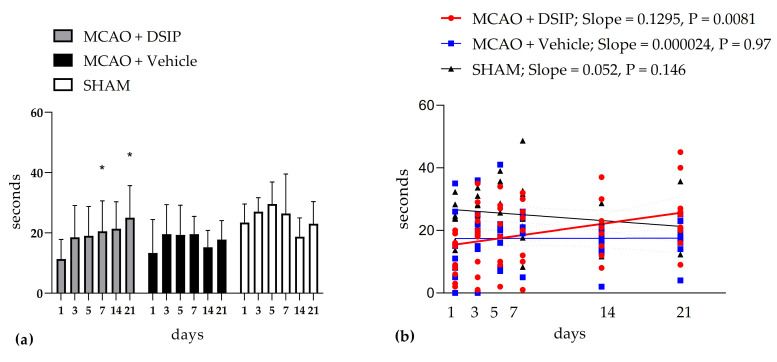
AnimalsVehicle-controlled animal study with sham group; behavioural tests days 1-218 days of treatment, 21 days follow-up

Rats with induced focal stroke (MCAO) given intranasal DSIP before and for 7 days after: infarct volume was smaller but not significantly so, while rotarod motor performance recovered significantly faster than with vehicle.

Studied
Sprague-Dawley rats with middle cerebral artery occlusion (MCAO)
Compared with
Vehicle (and sham-operated rats)
Main outcome
Infarct volume and motor tests (rotarod, bilateral asymmetry)
Authors' conclusion
Intranasal DSIP over 8 days accelerated recovery of motor function, although the reduction in infarct size was not significant.
Limitations
Rat stroke model; infarct-size difference not significant; no human data.
Figure 1: Latent time of falling from a rotating rod: (a) Results are presented as group mean ± standard deviation. * p < 0.01 relative to the first d
Figure 1. From PMC8434407, CC BY (terms); resized.
✓ PositiveanimalLife Sci · 2018

Phosphorylated delta sleep inducing peptide restores spatial memory and p-CREB expression by improving sleep architecture at high altitude.

AnimalsControlled animal study with telemetric sleep recording

Rats exposed to simulated high altitude (hypobaric hypoxia): daily phosphorylated DSIP increased non-REM and REM sleep and improved water-maze memory; naloxone reduced the memory benefit.

Studied
Rats trained in the Morris water maze and exposed to chronic hypobaric hypoxia (7620 m)
Compared with
Untreated hypoxia-exposed rats (naloxone arm also tested)
Main outcome
Sleep architecture, water-maze memory, hippocampal CREB/p-CREB
Authors' conclusion
The authors conclude that improving sleep quality with p-DSIP restored spatial memory via CREB phosphorylation during simulated high-altitude hypoxia.
Limitations
Rat study of the phosphorylated analogue; no human data.

Verdicts are judged on each paper's own main outcome; grades run from A (strong human evidence) to D (little or none). Details are read from the abstracts, and figures are reproduced only from openly licensed full texts. Not medical advice.