Peptide Price Finder

Home · Research · GLP-1 & metabolic

Eloralintide research

What published studies found for Eloralintide: 4 papers, 4 in humans, with sample sizes and key results, plus 22 registered clinical trials.

B
Some human evidence
Why: One 48-week phase 2 RCT (263 adults) showed up to about 20% weight loss, plus phase 1 studies; no phase 3 trials yet.

Eloralintide (a selective amylin receptor agonist) has been tested in humans in two phase 1 studies and one 48-week phase 2 RCT of 263 adults, which showed dose-dependent weight loss of up to about 20% vs 0.4% on placebo; no phase 3 or long-term data are available yet, and nausea and fatigue were common at higher doses.

✓ 3 positive? 1 inconclusive

Human data cover at most 48 weeks in a few hundred people; no long-term or outcome data yet.

US compounding: Not compoundable. Not an FDA-approved drug and not nominated for FDA's 503A bulks list, so US pharmacies can't legally compound it. Status for every peptide.

Browse and filter these papersEloralintide prices and vendors

Reported side effects

Registered clinical trials

22 trials of Eloralintide on ClinicalTrials.gov: 15 active, 7 completed, 1 with posted results. Registered trials include ones that haven't published yet.

TrialStatusPhasePeopleSponsor
A Study of Eloralintide (LY3841136) in Participants With Obesity, or Overweight Without Type 2 DiabetesNCT07321886 · started 2026-02-06RecruitingPhase 31,980Eli Lilly and Company
A Master Protocol Study (LY900038) of Multiple Intervention-Specific-Appendices (ISAs) in Adult Participants With Obesity or OverweightNCT06143956 · started 2023-11-17RecruitingPhase 21,481Eli Lilly and Company
A Study of Eloralintide (LY3841136) in Participants With Obesity or Overweight, and Type 2 DiabetesNCT07282600 · started 2025-12-15RecruitingPhase 31,035Eli Lilly and Company
A Study of Eloralintide (LY3841136) in Participants With Persistent Obesity Who Are Treated With a Weekly IncretinNCT07392190 · started 2026-02-10RecruitingPhase 3900Eli Lilly and Company
Efficacy and Safety of Eloralintide (LY3841136) in Participants With Osteoarthritis Knee Pain and Obesity or OverweightNCT07353931 · started 2026-02-09RecruitingPhase 3900Eli Lilly and Company
A Study of Eloralintide (LY3841136) in Participants With Obstructive Sleep Apnea and Obesity or OverweightNCT07369011 · started 2026-02-10RecruitingPhase 3800Eli Lilly and Company
A Study to Investigate Weight Management With Macupatide and Eloralintide, Alone or in Combination, in Adult Participants With Obesity or OverweightNCT07589608 · started 2026-05-15RecruitingPhase 2400Eli Lilly and Company
A Study of Macupatide (LY3532226) and Eloralintide (LY3841136), Alone or in Combination, in Adults With Obesity or Overweight and With Type 2 DiabetesNCT07215559 · started 2025-10-16RecruitingPhase 2200Eli Lilly and Company
A Study of Eloralintide (LY3841136) in Participants With Overweight or ObesityNCT07665879 · started 2026-06-24RecruitingPhase 1115Eli Lilly and Company
A Study of Macupatide (LY3532226) in Participants With Obesity or Overweight Without Type 2 DiabetesNCT07765511 · started 2026-10Not yet recruitingPhase 160Eli Lilly and Company
A Study of Eloralintide (LY3841136) in Healthy ParticipantsNCT07701083 · started 2026-07-20Active, not recruitingPhase 158Eli Lilly and Company
A Study of Eloralintide (LY3841136) in Participants With Obesity or OverweightNCT07738614 · started 2026-07-31RecruitingPhase 156Eli Lilly and Company

All 22 Eloralintide trials, with countries and recruiting status

Meta-analyses & systematic reviews

✓ Positivemeta-analysisEndocrinol Diabetes Metab · 2026

Novel Amylin-Based Therapies for Weight Management in Adults With Overweight or Obesity Without Diabetes: A Network Meta-Analysis.

n = 4,642 humansFrequentist random-effects network meta-analysis of RCTs12-68 weeks

Network meta-analysis of 6 trials (4,642 people) estimated high-dose eloralintide at about 18% more weight loss than placebo, with more GI adverse events; authors rate the data as sparse and low-certainty.

Key resultVersus placebo, high-dose eloralintide mean difference -18.01% (P score 0.89), behind high-dose amycretin (-23.95%) and similar to CagriSema (-17.18%)
Studied
Adults with overweight or obesity without diabetes in trials of amylin-based therapies
Compared with
Placebo or active comparators (semaglutide, liraglutide)
Main outcome
Percent change in body weight; GI adverse events
Sample
6 trials, N = 4642, 12-68 weeks
Authors' conclusion
Novel amylin-based therapies may induce substantial short- to medium-term weight loss but increase GI adverse events; data are sparse and low-certainty, so findings are preliminary.
Limitations
Sparse, low-certainty data; indirect comparisons across trials.
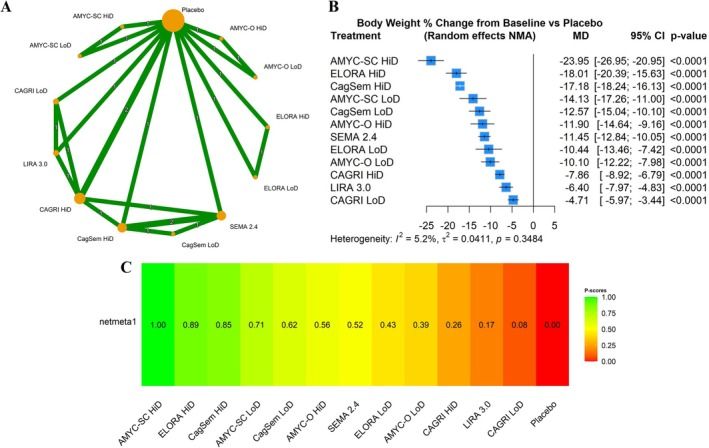
FIGURE 2: (A) Network diagram of treatment comparisons for percent change in body weight. This network meta‐analysis (NMA) graph illustrates compariso
FIGURE 2. From PMC13240113, CC BY (terms); resized.

Human studies

✓ Positivehuman RCTLancet · 2025

Eloralintide, a selective amylin receptor agonist for the treatment of obesity: a 48-week phase 2, multicentre, double-blind, randomised, placebo-controlled trial.

n = 263 humansPhase 2, multicentre (46 US centres), double-blind, randomised, placebo-controlled dose-ranging trial48 weeks

In 263 US adults with obesity/overweight, 48 weeks of eloralintide reduced weight by 9-20% depending on dose vs 0.4% with placebo; nausea (up to 64%) and fatigue (up to 46%) were the most common adverse events.

Key resultMean bodyweight change (efficacy estimand) ranged from -9% (1 mg) to -20% (9 mg; 95% CI -22.7 to -17.5) vs -0.4% with placebo
Studied
Adults 18-75 years with obesity (BMI 30 or higher) or overweight (BMI 27 or higher) with a weight-related comorbidity, without type 2 diabetes
Compared with
Placebo
Main outcome
Percent change in bodyweight from baseline at 48 weeks
Sample
263 randomized across six eloralintide arms and placebo
Authors' conclusion
Eloralintide produced clinically meaningful, dose-dependent bodyweight reductions over 48 weeks and was generally well tolerated, supporting its potential for obesity treatment.
Limitations
Phase 2; funded by Eli Lilly; nausea up to 64% and fatigue up to 46% at some doses.
✓ Positivehuman trialDiabetes Obes Metab · 2026

Eloralintide, a selective, long-acting amylin receptor agonist for treatment of obesity: Phase 1 proof of concept.

n = 100 humansPhase 1, 12-week randomised, placebo-controlled, participant- and investigator-blinded multiple ascending dose study12 weeks

In a 12-week phase 1 multiple-dose study in 100 people with obesity/overweight, weight fell 2.6-11.3%; decreased appetite (19%), headache (12%) and fatigue (11%) were most common, GI events infrequent.

Key resultLeast squares mean body weight reduction across dose groups ranged from 2.6% to 11.3% at Week 12
Studied
Participants with obesity or overweight (mean age 44 years, 29% female, mean BMI 32.6 kg/m2)
Compared with
Placebo
Main outcome
Safety, tolerability, pharmacokinetics and body weight
Sample
100 participants in 5 multiple ascending dose cohorts
Authors' conclusion
Once-weekly eloralintide was well tolerated with minimal GI adverse events and resulted in clinically meaningful weight loss.
Limitations
Phase 1, 12-week study.
? Inconclusivehuman trialMol Metab · 2025

Eloralintide (LY3841136), a novel amylin receptor agonist for the treatment of obesity: From discovery to clinical proof of concept.

n = 48 humans and animalsTranslational package: in vitro receptor assays, rat and monkey studies, and a phase 1 randomized placebo-controlled single-ascending-dose trial (0.04-12 mg)Week-4 body weight in the phase 1 trial

Reduced food intake and weight (mainly fat) in obese rats; in a single-dose phase 1 study in 48 healthy people it was mostly well tolerated, with 2.5-4.4% weight loss at 4 weeks at the higher doses.

Key resultIn the phase 1 trial, week-4 weight change was -2.5% (p < 0.01) with 4 mg and -4.4% (p < 0.001) with 12 mg vs +0.6% with placebo
Studied
Cell lines, rats, monkeys, and 48 healthy participants (mean BMI 27.5 kg/m2)
Compared with
Placebo; cagrilintide in rat taste-avoidance test
Main outcome
Receptor selectivity, food intake and body weight, safety
Sample
48 healthy participants in the phase 1 single-ascending-dose trial
Authors' conclusion
Eloralintide, an AMY1R-selective agonist, may offer a promising new therapeutic with favorable GI tolerability for obesity.
Limitations
Single doses and small human cohorts; most evidence is preclinical.

Verdicts are judged on each paper's own main outcome; grades run from A (strong human evidence) to D (little or none). Details are read from the abstracts, and figures are reproduced only from openly licensed full texts. Not medical advice.