Peptide Price Finder

Home · Research · Longevity & bioregulators

FOXO4-DRI research

What published studies found for FOXO4-DRI: 7 papers, 0 in humans, with sample sizes and key results.

C
Mostly animal studies
Why: Several mouse studies (aging, testosterone, lung fibrosis), mostly positive but one showing worse pulmonary hypertension; no human data.

FOXO4-DRI is an experimental senolytic peptide that disrupts the FOXO4-p53 interaction to kill senescent cells; all evidence comes from mouse studies and cell cultures, with no human trials or human safety data. Animal results are mostly favorable (fitness, kidney function, testosterone, lung fibrosis), but one study found senescent-cell clearance, including with FOXO4-DRI, worsened pulmonary hypertension in mice.

✓ 5 positive✗ 1 negative~ 1 mixed

No human safety or efficacy data exist in the published literature; mouse data suggest senolytic clearance may harm pulmonary vascular function in some settings.

US compounding: Not compoundable. Not an FDA-approved drug and not nominated for FDA's 503A bulks list, so US pharmacies can't legally compound it. Status for every peptide.

Browse and filter these papersFOXO4-DRI prices and vendors

Animal & lab studies

✓ PositiveanimalCell · 2017

Targeted Apoptosis of Senescent Cells Restores Tissue Homeostasis in Response to Chemotoxicity and Aging.

Humans and animalsPreclinical study designing a FOXO4 peptide that disrupts FOXO4-p53 interaction

Original Cell study: FOXO4-DRI selectively triggered apoptosis in senescent cells, counteracted doxorubicin chemotoxicity, and restored fitness, fur density and kidney function in fast-aging and naturally aged mice.

Studied
Senescent human cells in vitro; doxorubicin-treated, fast-aging XpdTTD/TTD and naturally aged mice
Main outcome
Apoptosis of senescent cells; chemotoxicity, fitness, fur density, renal function
Authors' conclusion
The FOXO4 peptide selectively induced apoptosis in senescent cells, neutralized doxorubicin chemotoxicity and restored fitness, fur density and renal function in aged mice, as shown by the authors.
Limitations
Mouse and cell study only; numbers not in the abstract.
✗ NegativeanimalCirculation · 2023

Eliminating Senescent Cells Can Promote Pulmonary Hypertension Development and Progression.

Humans and animalsHuman tissue analysis plus animal models with senescent-cell clearance (suicide gene, ABT263, FOXO4-DRI)

In mouse and rat pulmonary hypertension models, clearing senescent cells (including with FOXO4-DRI in serotonin-transporter mice) worsened pulmonary hemodynamics and caused loss of pulmonary endothelial cells.

Studied
Patients with pulmonary arterial hypertension (lung tissue) and mouse and rat pulmonary hypertension models
Compared with
Relevant control animals
Main outcome
Pulmonary hemodynamics, vessel remodeling, pulmonary endothelial cell loss
Authors' conclusion
Eliminating senescent pulmonary endothelial cells with senolytic interventions, including FOXO4-DRI in SM22-5-HTT+ mice, may worsen pulmonary hemodynamics.
Limitations
Animal models; FOXO4-DRI tested in one mouse model only. A safety signal against senolytics in this context.
✓ PositiveanimalAging (Albany NY) · 2020

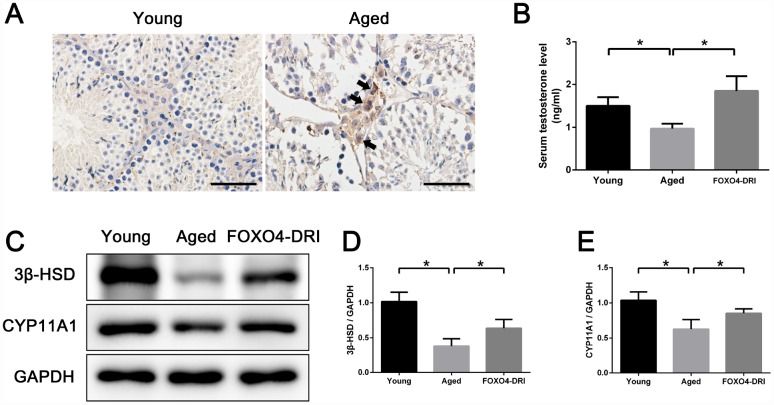
FOXO4-DRI alleviates age-related testosterone secretion insufficiency by targeting senescent Leydig cells in aged mice.

Humans and animalsIn vitro and in vivo study of FOXO4-DRI

In naturally aged mice, FOXO4-DRI removed senescent Leydig cells, improved the testicular microenvironment and alleviated age-related testosterone insufficiency.

Studied
Human testis tissue, H2O2-induced senescent TM3 Leydig cells, and naturally aged mice
Main outcome
Senescent Leydig cell apoptosis; testicular microenvironment; testosterone secretion
Authors' conclusion
FOXO4-DRI selectively induced apoptosis in senescent Leydig cells and, in naturally aged mice, improved the testicular microenvironment and alleviated testosterone insufficiency, suggesting therapeutic potential.
Limitations
Cell and mouse data only; numbers not in the abstract.
Figure 6: FOXO4-DRI alleviates testosterone secretion insufficiency in naturally aged mice. (A) Immunohistochemical staining showing that FOXO4 was ra
Figure 6. From PMC7053614, CC BY (terms); resized.
✓ PositiveanimalExp Gerontol · 2024

FOXO4-DRI improves spermatogenesis in aged mice through reducing senescence-associated secretory phenotype secretion from Leydig cells.

Humans and animalsIn vitro and in vivo study of FOXO4-DRI

In naturally aged mice, FOXO4-DRI reduced senescent Leydig cell secretions and improved sperm quality and spermatogenesis.

Studied
Senescent Leydig cells, co-cultured GC-1 SPG cells and naturally aged mice
Main outcome
SASP secretion, sperm quality, spermatogenesis
Authors' conclusion
FOXO4-DRI induced apoptosis in senescent Leydig cells, reduced certain SASP secretion and, in naturally aged mice, improved sperm quality and spermatogenesis.
Limitations
Cell and mouse data only; numbers not in the abstract.
✓ PositiveanimalJ Cell Mol Med · 2022

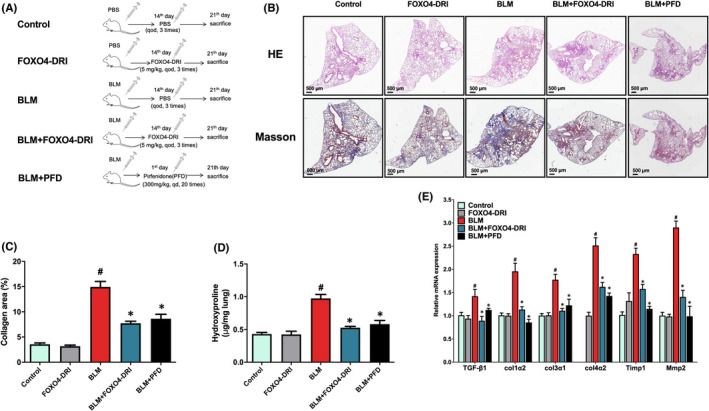
FOXO4 peptide targets myofibroblast ameliorates bleomycin-induced pulmonary fibrosis in mice through ECM-receptor interaction pathway.

Humans and animalsMouse model comparing FOXO4-DRI with pirfenidone, plus in vitro myofibroblast assays

In a bleomycin lung-fibrosis mouse model, FOXO4-DRI reduced senescent cells and collagen deposition, comparable to the approved drug pirfenidone.

Studied
Bleomycin-induced pulmonary fibrosis mouse model; mouse and human lung fibroblast cell lines
Compared with
Pirfenidone
Main outcome
Senescent cells, SASP, morphology and collagen deposition
Authors' conclusion
Like pirfenidone, FOXO4-DRI decreased senescent cells and collagen deposition and reduced myofibroblasts; the authors suggest it may be a viable therapeutic option for pulmonary fibrosis.
Limitations
Mouse and cell-line study; numbers not in the abstract.
FIGURE 1: FOXO4‐D‐Retro‐Inverso(FOXO4‐DRI) ameliorates bleomycin (BLM)‐induced pulmonary fibrosis (PF). (A) Schematic diagram illustrating the experim
FIGURE 1. From PMC9170815, CC BY (terms); resized.
~ Mixedin vitroFront Bioeng Biotechnol · 2021

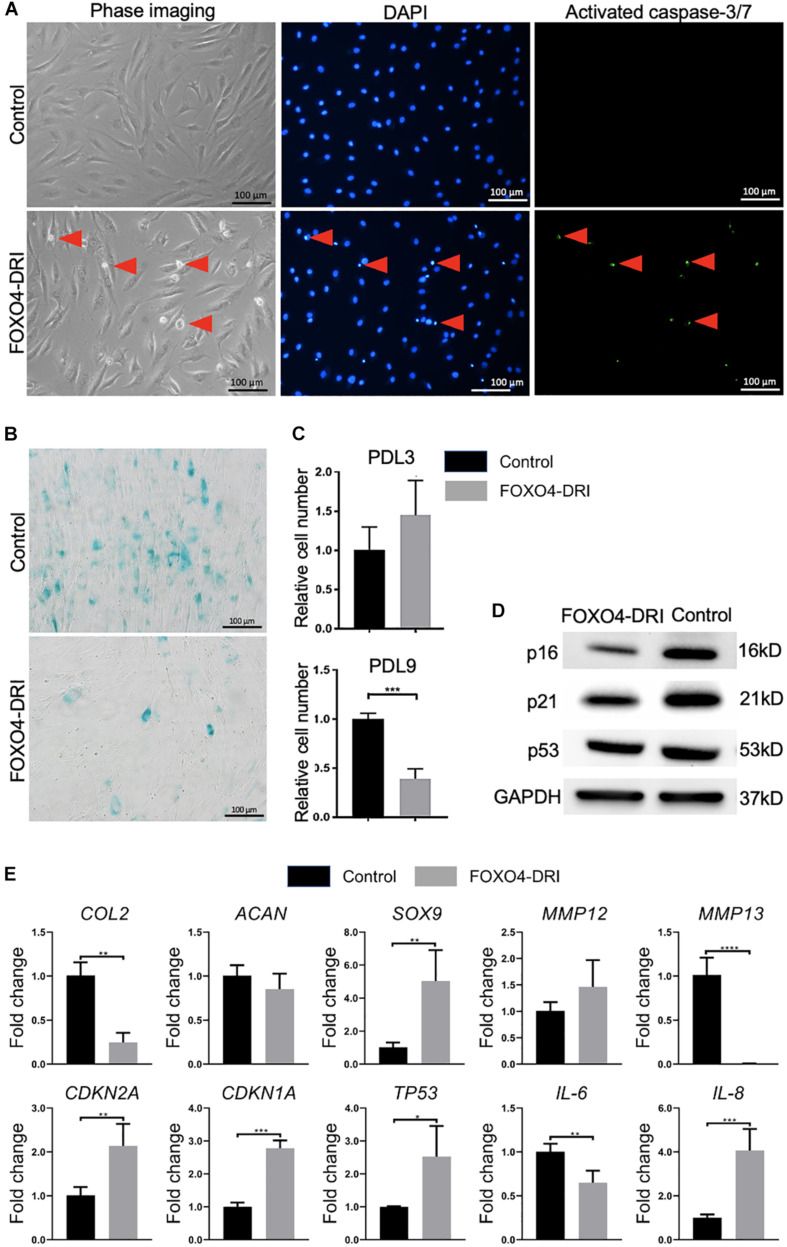
Senolytic Peptide FOXO4-DRI Selectively Removes Senescent Cells From in vitro Expanded Human Chondrocytes.

Cells / labIn vitro treatment of expanded chondrocytes followed by pellet culture

In expanded human chondrocytes, FOXO4-DRI removed over half of late-passage (senescent) cells but did not improve their cartilage-forming potential.

Studied
Expanded human chondrocytes from healthy donors (population doubling level 3 and 9)
Compared with
Untreated chondrocytes; minimally expanded PDL3 cells
Main outcome
Cell number, senescence level, chondrogenic potential
Authors' conclusion
FOXO4-DRI removed more than half of PDL9 cells and reduced senescence, but did not enhance chondrogenic potential; its utility for cartilage formation needs further investigation.
Limitations
In vitro only; no benefit on cartilage formation shown.
FIGURE 2: Assessment of senescence level in PDL9 cells after FOXO4-DRI treatment. The samples with (FOXO4-DRI) or without (Control) FOXO4-DRI treatmen
FIGURE 2. From PMC8116695, CC BY (terms); resized.
✓ Positivein vitroMol Carcinog · 2026

Acylglycerol Kinase Sensitizes Glioblastoma to Temozolomide via Limiting Mitochondrial Damage Related Cellular Senescence.

Cells / labIn vitro cell experiments (plus TCGA data analysis)

In glioblastoma cell experiments, FOXO4-DRI used as a senolytic cleared temozolomide-induced senescent cells by apoptosis and enhanced temozolomide's effect; the peptide was a tool in a study mainly about acylglycerol kinase.

Studied
Glioblastoma cell lines treated with temozolomide
Compared with
Mito-TEMPO
Main outcome
Senescence, apoptosis and temozolomide efficacy
Authors' conclusion
FOXO4-DRI and Mito-TEMPO enhanced temozolomide efficacy by eliminating senescent cells via apoptosis; co-targeting AGK and senescence may be a strategy.
Limitations
Cell culture; FOXO4-DRI was a secondary tool, not the study focus.

Verdicts are judged on each paper's own main outcome; grades run from A (strong human evidence) to D (little or none). Details are read from the abstracts, and figures are reproduced only from openly licensed full texts. Not medical advice.