Peptide Price Finder

Home · Research · Skin, hair & tanning

GHK-Cu research

What published studies found for GHK-Cu: 14 papers, 4 in humans, with sample sizes and key results, plus 1 registered clinical trials.

B
Some human evidence
Why: Only one small RCT (13 patients, topical after laser resurfacing), which found no objective benefit; everything else is cell and animal work.

Most evidence for GHK-Cu comes from cell-culture and animal studies (wound healing, lung and muscle injury, inflammation models). Controlled human data are very sparse: the only randomized trial among the candidates (13 patients after CO2 laser resurfacing) found no objective benefit, and recent systematic reviews describe GHK-Cu as promising but clinically unproven. Added studies are further cell, animal and review work, plus one uncontrolled human hair study of a multi-ingredient product that cannot be attributed to GHK-Cu.

✓ 6 positive✗ 1 negative~ 1 mixed? 6 inconclusive

No human adverse-event data are reported in the reviewed abstracts; reviews note that rigorous human safety data are lacking.

US compounding: Under review, not compoundable yet. Non-injectable GHK-Cu (topical etc.) is back in Category 1, so pharmacies may compound it while FDA evaluates. Injectable GHK-Cu was removed from Category 2 in April 2026 and isn't on any allowed list. FDA plans advisory-committee review before the end of February 2027. Status for every peptide.

Browse and filter these papersGHK-Cu prices and vendors

Registered clinical trials

1 trials of GHK-Cu on ClinicalTrials.gov: 1 active, 0 completed. Registered trials include ones that haven't published yet.

TrialStatusPhasePeopleSponsor
Topical GHK-Cu Gel for Acute Skin Wound HealingNCT07437586 · started 2026-02-02RecruitingPhase 260Hudson Biotech

All 1 GHK-Cu trials, with countries and recruiting status

Meta-analyses & systematic reviews

? Inconclusivesystematic reviewPharmaceutics · 2026

GHK-Cu as a Bioactive Metallopeptide and Drug-Delivery Cargo: Coordination Chemistry, Formulation Science, Therapeutic Evidence, and a Translational Roadmap.

Structured evidence-mapping review; number of studies not stated in abstractSystematic evidence-mapping review (no quantitative pooling)

Evidence-mapping review through 2026: preclinical data consistently support matrix remodeling, repair, anti-inflammatory and angiogenic effects, but clinical evidence is sparse and small; a 13-participant post-laser study was negative on objective endpoints. Authors conclude GHK-Cu is 'promising but unproven'.

Key resultA 13-participant post-CO2-laser study was negative on objective endpoints; a 2026 18-participant split-face eyebrow study reported positive cosmetic hair outcomes
Studied
Literature on GHK, GHK-Cu and copper-peptide delivery systems
Main outcome
Biological evidence level and formulation quality of GHK-Cu studies
Authors' conclusion
Preclinical data are consistent, but clinical evidence is sparse; until active-entity requirements are met and controlled efficacy shown, GHK-Cu is a promising but unproven therapeutic cargo.
Limitations
No pooling possible; clinical studies small and GHK-Cu speciation poorly defined.
? Inconclusivesystematic reviewArch Intern Med Res · 2026

A Systematic Review of the Mechanisms and Therapeutic Applications of GHK-Cu (Glycyl-L-Histidyl-L-Lysine-Copper Complex) in Topical Microneedle Delivery: A Case for Expanded Clinical Trials.

64 records retained from 1,247 screenedSystematic review (PRISMA), qualitative synthesis

Review of 64 records (2005-2026) found a deep preclinical evidence base but thin, fragmented human data, mostly small cosmetic-cream trials, and no adequately powered published RCT of microneedle-delivered GHK-Cu.

Studied
GHK-Cu literature 2005-2026 across in vitro, ex vivo, rodent, non-rodent and human studies
Main outcome
Mechanisms and therapeutic applications of GHK-Cu, with focus on microneedle delivery
Authors' conclusion
Preclinical evidence is deep and mechanistically coherent, but human data are thin; well-designed human trials of microneedle-delivered GHK-Cu are needed.
Limitations
Human trials mostly small cosmetic-cream studies; no adequately powered published RCT of microneedle delivery.

Human studies

✗ Negativehuman RCTArch Facial Plast Surg · 2006

Effects of topical copper tripeptide complex on CO2 laser-resurfaced skin.

Thirteen patients completed the study (written as a word in the abstract)Randomized, blinded-evaluator comparison of post-laser regimens with or without GHK-Cu12 weeks

13 patients randomized to post-CO2-laser skin care with or without GHK-Cu: no difference in erythema resolution or in blinded ratings of wrinkles and skin quality; only patient-reported satisfaction was higher with GHK-Cu (P = .04).

Key resultNo significant between-group difference in erythema or objective skin quality; patient-rated overall skin quality improvement higher with GHK-Cu (P = .04)
Studied
Patients with circumoral CO2 laser skin resurfacing
Compared with
Post-laser skin regimen without GHK-Cu
Main outcome
Erythema resolution; wrinkles and overall skin quality; patient questionnaire
Authors' conclusion
GHK-Cu skin care offered no significant reduction of post-laser erythema and no objective improvement, but patient satisfaction was significantly higher.
Limitations
Very small trial (13 completers).
? Inconclusivehuman trialJ Cosmet Laser Ther · 2018

Intradermal injections of a hair growth factor formulation for enhancement of human hair regrowth - safety and efficacy evaluation in a first-in-man pilot clinical study.

n = 1,000 humansOpen-label, single-arm pilot of intradermal injections of a formulation containing VEGF, bFGF, IGF, KGF, thymosin beta4 and copper tripeptide-1Eight sessions, once every 3 weeks

Uncontrolled pilot in 1,000 people with hair loss: scalp injections of a multi-ingredient growth-factor mix that included copper tripeptide-1; reduced hair fall in 83% by pull test, but effect cannot be attributed to GHK-Cu.

Key resultSignificant reduction in hair fall in 83% of patients on hair pull test.
Studied
Patients with hair loss
Main outcome
Hair pull test, videomicroscopy, safety
Sample
1000 patients
Authors' conclusion
The formulation appeared safe and to reduce hair fall and enhance regrowth.
Limitations
No control group; multi-ingredient product so no GHK-Cu-specific effect.

Reviews

? InconclusivereviewBioimpacts · 2025

Topically applied GHK as an anti-wrinkle peptide: Advantages, problems and prospective.

No new dataNarrative review

Review of topical GHK as an anti-wrinkle peptide: cellular studies support activity, but the authors note a 'surprising absence of clinical studies' of GHK-Cu and limited data on skin permeability.

Studied
Topical GHK, GHK-Cu and Pal-GHK as anti-wrinkle ingredients
Main outcome
Anti-wrinkle effectiveness and skin permeability of GHK
Authors' conclusion
Cellular studies support GHK as an anti-wrinkle ingredient, but there is a surprising absence of clinical studies of GHK-Cu and Pal-GHK; permeability can be increased with enhancement methods.
Limitations
Narrative review; clinical evidence absent.
? InconclusivereviewAm J Sports Med · 2026

Peptide Supplements and Their Therapeutic Applications in Sports Medicine.

No new dataScoping review (PubMed, PRISMA)

Scoping review of six popular sports-medicine peptides including GHK-Cu: most data are from animal models and claimed musculoskeletal benefits remain unsubstantiated by human trials.

Studied
Literature on 6 peptides (BPC-157, TB-500, CJC-1295, MK-677, ipamorelin, GHK-Cu) for musculoskeletal recovery
Main outcome
Musculoskeletal recovery and performance in animal and human models
Authors' conclusion
67% of publications were preclinical; human data were limited and showed modest improvements at best. Claimed benefits remain unsubstantiated by human trials, and these peptides should not currently be recommended.
Limitations
Few, poorly controlled human studies; heterogeneous dosing and routes.
? InconclusivereviewInt J Mol Sci · 2018

Regenerative and Protective Actions of the GHK-Cu Peptide in the Light of the New Gene Data.

No new dataNarrative review

Review of GHK-Cu's regenerative and protective actions in skin, lung, bone and other tissues, with new gene-expression data; mostly cell and animal work, authors view all actions as health-positive.

Authors' conclusion
GHK has multiple biological actions that appear health-positive, and recent genetic data may explain the diverse protective and healing actions.
Limitations
Narrative review by the group that developed the peptide; no new trial data.

Animal & lab studies

✓ PositiveanimalJ Cachexia Sarcopenia Muscle · 2023

Glycyl-l-histidyl-l-lysine-Cu2+ rescues cigarette smoking-induced skeletal muscle dysfunction via a sirtuin 1-dependent pathway.

9 COPD patients and 11 healthy subjects (plasma); mouse numbers not statedHuman plasma comparison plus in vitro and mouse experiments

Plasma GHK was lower in 9 COPD patients than in 11 controls (70 vs 133 ng/mL); in cigarette-smoke-exposed mice, injected GHK-Cu reduced muscle mass loss and improved grip strength, apparently via SIRT1.

Key resultPlasma GHK 70.27 +/- 38.87 ng/mL in COPD vs 133.0 +/- 54.54 ng/mL in controls (P = 0.009); GHK-Cu improved grip strength 175.5 +/- 36.15 g vs 257.6 +/- 37.98 g and 339.1 +/- 72.22 g (P < 0.01)
Studied
Patients with COPD vs age-paired healthy subjects; C2C12 myotubes; cigarette-smoke-exposed C57BL/6 mice
Compared with
Healthy subjects (plasma); smoke-exposed untreated mice
Main outcome
Plasma GHK; muscle mass, cross-sectional area and grip strength
Authors' conclusion
Plasma GHK was decreased in COPD and associated with muscle mass; exogenous GHK-Cu protected mice against smoking-induced muscle dysfunction via SIRT1.
Limitations
Very small human sample (9 vs 11); efficacy shown only in mice and cells.
✓ PositiveanimalFront Mol Biosci · 2022

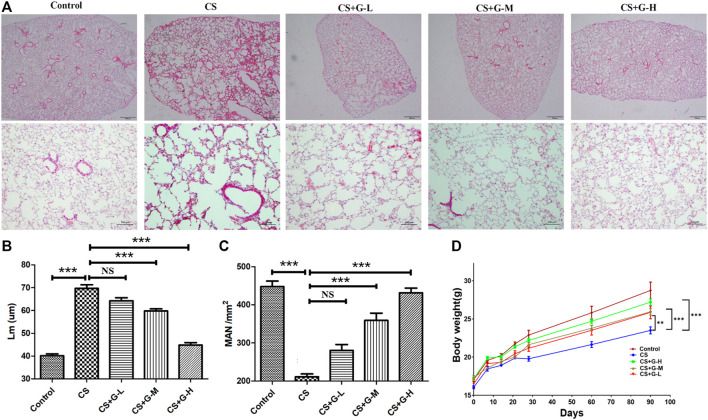
Glycyl-L-histidyl-L-lysine-Cu2+ attenuates cigarette smoke-induced pulmonary emphysema and inflammation by reducing oxidative stress pathway.

Humans and animalsMouse emphysema model with intraperitoneal GHK-Cu (0.2, 2, 20 ug/g/day) plus in vitro assay12 weeks

In mice exposed to cigarette smoke for 12 weeks, intraperitoneal GHK-Cu attenuated emphysema and lowered lung inflammatory cytokines and oxidative-stress markers.

Studied
C57BL/6J mice exposed to cigarette smoke for 12 weeks; human alveolar epithelial A549 cells
Compared with
Cigarette smoke exposure without GHK-Cu
Main outcome
Emphysema, inflammatory cytokines and oxidative stress markers
Authors' conclusion
GHK-Cu attenuated smoke-induced emphysema through anti-inflammation (NF-kB down) and antioxidation (Nrf2/Keap1 up) in mouse lung tissue.
Limitations
Mouse and cell study; animal numbers not given in the abstract.
FIGURE 1: GHK-Cu alleviates cigarette smoke-induced emphysematous changes. (A) Photomicrograph of HE-stained slides for histological analysis of mice
FIGURE 1. From PMC9354777, CC BY (terms); resized.
~ MixedanimalJ Orthop Res · 2015

Tripeptide-copper complex GHK-Cu (II) transiently improved healing outcome in a rat model of ACL reconstruction.

72 rats randomized to saline, 0.3 or 3 mg/ml GHK-Cu (24 per group)Randomized animal study, weekly intra-articular injections4 weeks of injections; harvest at 6 or 12 weeks

Rats after ACL reconstruction: weekly knee GHK-Cu injections reduced knee laxity at 6 weeks (p = 0.009) but the benefit was gone by 12 weeks and strength and histology did not differ.

Key resultAt 6 weeks side-to-side laxity was smaller with GHK-Cu (p = 0.009); no difference at 12 weeks.
Studied
Rats after unilateral anterior cruciate ligament reconstruction
Compared with
Saline
Main outcome
Knee laxity, graft stiffness and ultimate load, gait, histology
Authors' conclusion
GHK-Cu improved graft healing in rat ACL reconstruction but the beneficial effects could not last once treatment was discontinued.
Limitations
Rat model; transient effect.
✓ PositiveanimalFront Pharmacol · 2025

Exploring the beneficial effects of GHK-Cu on an experimental model of colitis and the underlying mechanisms.

AnimalsAnimal and in vitro study

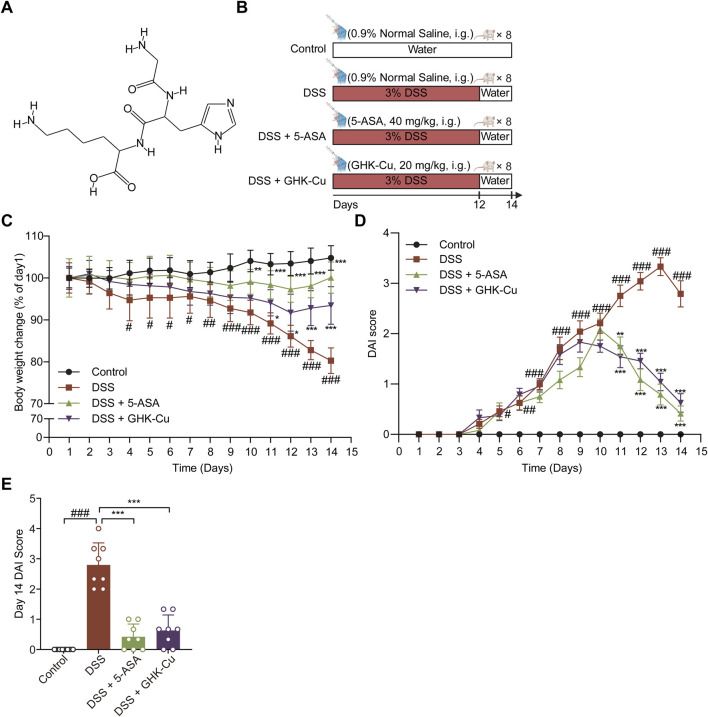
Mice with DSS-induced colitis: GHK-Cu reduced weight loss, disease activity and inflammation and appeared to act via the SIRT1/STAT3 pathway; animal and cell model only.

Studied
BALB/c mice with dextran sulfate sodium colitis; mouse macrophage and epithelial cell models
Main outcome
Disease activity index, histology, inflammatory markers
Authors' conclusion
GHK-Cu alleviated experimental ulcerative colitis, with STAT3 identified as a core target.
Limitations
Mouse model; no human data.
FIGURE 1: GHK-Cu could alleviate DSS-induced colitis. (A) Chemical structure of GHK. (B) Experimental scheme of the animal experimental design. (C) Bo
FIGURE 1. From PMC12263609, CC BY (terms); resized.
✓ PositiveanimalbioRxiv · 2026preprint

Middle-aged mice treated with GHK-Cu peptide administered intraperitoneally or intranasally show behavioral rescue but divergent hippocampal aging programs

AnimalsAnimal study; intraperitoneal 5 days vs intranasal 8 weeks of GHK-Cu (15 mg/kg)5 days or 8 weeks

Preprint (not peer-reviewed): aged mice given GHK-Cu intranasally for 8 weeks learned faster in a spatial task, with shifts in hippocampal inflammation and gene programs; a short intraperitoneal course had weaker effects.

Key resultIntranasal GHK-Cu improved escape latency across Trials 2-4 in both sexes (P < 0.05).
Studied
Aged C57BL/6J mice (20-21 months)
Main outcome
Spatial escape learning, hippocampal markers and gene expression
Authors' conclusion
GHK-Cu rescued learning behaviour in aged mice, with route-dependent molecular effects.
Limitations
Preprint; mouse study.
✓ Positivein vitroLife Sci · 2000

The tripeptide-copper complex glycyl-L-histidyl-L-lysine-Cu2+ stimulates matrix metalloproteinase-2 expression by fibroblast cultures.

Cells / labIn vitro fibroblast culture study

In cultured dermal fibroblasts, GHK-Cu increased MMP-2 and TIMP-1/TIMP-2 secretion; the MMP-2 effect was reproduced by copper ions but not by GHK alone.

Studied
Cultured human dermal fibroblasts
Compared with
GHK alone and copper ions
Main outcome
MMP-2 and TIMP-1/TIMP-2 expression and secretion
Authors' conclusion
GHK-Cu increased MMP-2 and TIMP-1/2 secretion; the MMP-2 effect was reproduced by copper ions but not by GHK alone, suggesting GHK-Cu modulates matrix remodeling by acting on wound fibroblasts.
Limitations
In vitro only.
✓ Positivein vitroArch Facial Plast Surg · 2005

Effects of copper tripeptide on the growth and expression of growth factors by normal and irradiated fibroblasts.

Cells / labIn vitro

Human fibroblasts (normal and from irradiated patients): GHK-Cu 1 nanomolar sped population doubling and raised early bFGF and VEGF production in irradiated cells; cell culture only.

Key resultGHK-Cu-treated cells doubled faster than untreated; irradiated cells produced significantly more bFGF and VEGF early after exposure.
Studied
Primary human dermal fibroblasts, normal and irradiated, in serum-free medium
Compared with
Untreated cells
Main outcome
Cell growth and growth factor production
Authors' conclusion
Copper tripeptide accelerates growth of normal and irradiated fibroblasts and may improve wound healing via early growth-factor production.
Limitations
Cell culture only.

Verdicts are judged on each paper's own main outcome; grades run from A (strong human evidence) to D (little or none). Details are read from the abstracts, and figures are reproduced only from openly licensed full texts. Not medical advice.