Peptide Price Finder

Home · Research · Growth hormone

GHRP-6 research

What published studies found for GHRP-6: 7 papers, 4 in humans, with sample sizes and key results.

B
Some human evidence
Why: Small placebo-controlled and diagnostic human studies show strong GH release; no controlled trials of therapeutic benefit, healing data are in rodents.

GHRP-6 potently releases GH in humans and, combined with GHRH, is a validated diagnostic test for adult GH deficiency; therapeutic human data are limited to pharmacokinetic, endocrine and small pediatric studies. Tissue-protective and healing effects come from rodent studies only.

✓ 4 positive~ 1 mixed? 2 inconclusive

Human exposure in published studies is mostly single doses or 7-day courses; no long-term human safety data exist.

US compounding: Not compoundable (Category 3). 503A Category 3 (nominated without adequate support) and on the 503B Category 2 safety list: not compoundable from bulk. Status for every peptide.

Browse and filter these papersGHRP-6 prices and vendors

Reported side effects

Human studies

~ Mixedhuman RCTNeuroendocrinology · 1995

Growth hormone-releasing peptide-6 stimulates sleep, growth hormone, ACTH and cortisol release in normal man.

Number of subjects not given in the abstract (normal male controls)Placebo-controlled comparison of repeated i.v. boluses (4 x 50 micrograms) on sleep EEG and hormone profilesOne night (sleep EEG 23.00 to 07.00 h)

In healthy men, repeated IV GHRP-6 vs placebo raised nocturnal GH (15.4 vs 5.5 ng/ml) but also ACTH and cortisol (56.0 vs 25.2 ng/ml), and increased stage 2 sleep without changing slow-wave sleep.

Key resultGH 15.4 +/- 9.6 vs 5.5 +/- 4.0 ng/ml (p < 0.02); cortisol 56.0 +/- 31.0 vs 25.2 +/- 9.0 ng/ml (p < 0.02); stage 2 sleep 270.1 +/- 25.3 vs 245.4 +/- 25.8 min (p < 0.02)
Studied
Normal male controls
Compared with
Placebo
Main outcome
Nocturnal GH, ACTH, cortisol and sleep EEG
Authors' conclusion
GHRP stimulates not only GH release but also ACTH and cortisol secretion; it enhances stage 2 sleep and does not affect slow-wave sleep.
Limitations
Healthy men only; abstract truncated so design details are incomplete.
✓ Positivehuman trialEur J Endocrinol · 1995

Growth hormone-releasing effect of oral growth hormone-releasing peptide 6 (GHRP-6) administration in children with short stature.

n = 13 humansSingle-dose comparison of oral GHRP-6 with intravenous GHRH-29 (and arginine interaction)

In 13 children with normal short stature, a single oral GHRP-6 dose raised GH (peak 18.8 vs baseline 1.1 µg/l) similarly to IV GHRH; growth outcomes were not studied.

Key resultOral GHRP-6 raised GH from 1.1 +/- 0.3 to 18.8 +/- 3.0 micrograms/l (p < 0.0006), similar to GHRH (2.2 +/- 0.9 to 20.8 +/- 4.5, p < 0.007)
Studied
Children aged 6.2-10.5 years, prepubertal, with normal short stature
Compared with
Intravenous GHRH-29 1 microgram/kg
Main outcome
GH response
Sample
13 children with normal short stature
Authors' conclusion
Oral GHRP-6 (300 micrograms/kg) elicited a GH response similar to intravenous GHRH in children with normal short stature.
Limitations
Small acute study; abstract truncated; growth outcomes not studied.
? Inconclusivehuman trialEur J Pharm Sci · 2013

Pharmacokinetic study of Growth Hormone-Releasing Peptide 6 (GHRP-6) in nine male healthy volunteers.

n = 9 humansPharmacokinetic study, single intravenous bolus at 100, 200 and 400 ug/kgPlasma sampling to 12 h post-administration

In 9 healthy men given single IV doses, GHRP-6 had an elimination half-life of about 2.5 h with roughly dose-proportional exposure; a pharmacokinetic study with no efficacy outcome.

Key resultDistribution half-life 7.6 +/- 1.9 min and elimination half-life 2.5 +/- 1.1 h (bi-exponential model)
Studied
Healthy male volunteers
Main outcome
Plasma pharmacokinetics of GHRP-6 (LC-MS)
Sample
Nine healthy male volunteers
Authors' conclusion
GHRP-6 disposition fits a bi-exponential model, with a trend for AUC to increase proportionally with dose; atypical concentration spikes occurred in four of nine subjects.
Limitations
Small pharmacokinetic study with no efficacy outcome.
✓ Positivehuman trialLancet · 2000

GH-releasing hormone and GH-releasing peptide-6 for diagnostic testing in GH-deficient adults.

125 adults with organic pituitary disease plus 125 healthy controlsMulticentre diagnostic-accuracy study, GHRH/GHRP-6 test vs insulin tolerance test (ROC analysis)120 min sampling after a single test

In 125 adults with pituitary disease and 125 controls, a combined GHRH + GHRP-6 test separated GH-deficient from healthy adults better than the insulin tolerance test, with no side-effects reported.

Key resultMean GH peak 59.2 microg/L (SD 2.2) in controls vs 4.1 (0.3) in cases after GHRH/GHRP-6; after ITT 14.3 (1.7) vs 0.5 (0.06); differential response greater for GHRH/GHRP-6 (p<0.001)
Studied
Adults with organic pituitary disease (GH-deficient, ITT GH peak <= 3 microg/L) and healthy controls
Compared with
Insulin tolerance test (ITT)
Main outcome
Peak GH after GHRH/GHRP-6 test vs ITT
Authors' conclusion
The GHRH/GHRP-6 test is a convenient, safe and reliable test for adult GH deficiency; an evoked GH of >= 15.0 microg/L accurately distinguishes healthy from GH-deficient adults.
Limitations
Diagnostic test study; only 27 controls had an ITT for comparison.

Reviews

? InconclusivereviewSex Med Rev · 2018

The Safety and Efficacy of Growth Hormone Secretagogues.

Review of clinical studies (number not stated)Literature review

Review of human GH secretagogue studies: few long-term controlled studies; generally well tolerated but with concern for raised blood glucose, and long-term safety is unknown.

Studied
Humans receiving GH secretagogues (GH-releasing peptides, ibutamoren)
Main outcome
Safety and efficacy of GH secretagogues
Authors' conclusion
Few long-term controlled studies exist; GHSs are well tolerated with some concern for raised blood glucose via reduced insulin sensitivity, and long-term safety, including cancer, needs study.
Limitations
Few long-term, rigorously controlled studies.

Animal & lab studies

✓ PositiveanimalFront Pharmacol · 2024

Growth hormone releasing peptide-6 (GHRP-6) prevents doxorubicin-induced myocardial and extra-myocardial damages by activating prosurvival mechanisms.

AnimalsAnimal study with echocardiography, histopathology, electron microscopy and gene expression

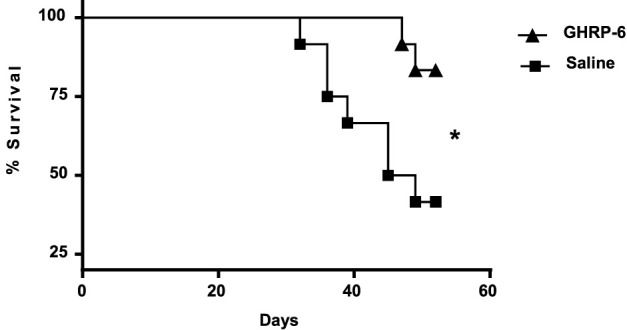
In rats given doxorubicin, concurrent GHRP-6 prevented ventricular dilation, preserved heart function and reduced organ damage and mortality.

Studied
Otherwise healthy rats given doxorubicin
Compared with
Doxorubicin without GHRP-6
Main outcome
Prevention of dilated cardiomyopathy and organ damage
Authors' conclusion
GHRP-6 given with doxorubicin prevented ventricular dilation, preserved LV systolic function, attenuated extracardiac toxicity and reduced morbidity and mortality, with antioxidant and prosurvival effects. These findings are in rats.
Limitations
Rat study; animal numbers not given in the abstract.
FIGURE 2: Survival curve in doxorubicin-treated animals. GHRP-6 and saline experimental groups started the study with n = 12 rats per group. The stati
FIGURE 2. From PMC11169835, CC BY (terms); resized.
✓ PositiveanimalPlast Surg Int · 2016

Growth Hormone-Releasing Peptide 6 Enhances the Healing Process and Improves the Esthetic Outcome of the Wounds.

AnimalsAnimal study, topical GHRP-6 jelly (400 ug/mL)5 days (rats); 30 days (rabbits)

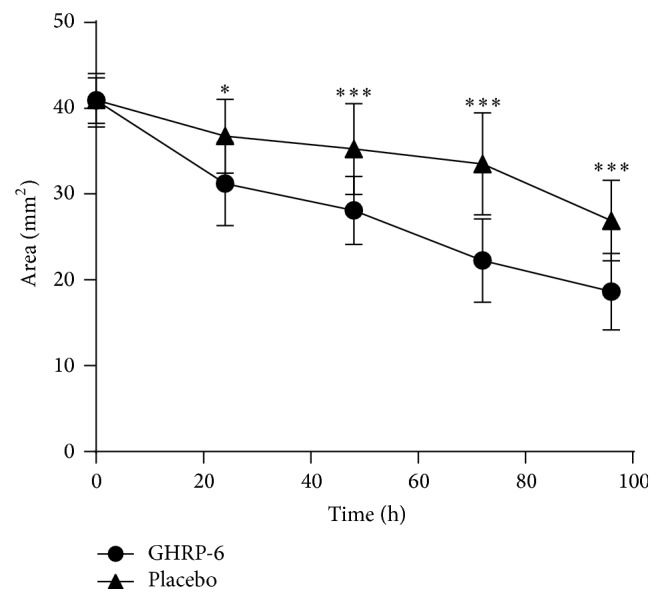
Topical GHRP-6 reduced wound inflammation in rats and prevented hypertrophic scar formation in a rabbit ear model, but did not reverse established scars.

Studied
Wistar rats with excisional wounds; rabbit ear hypertrophic scar model
Main outcome
Wound closure, inflammatory and fibrotic markers, scar formation
Authors' conclusion
GHRP-6 attenuated wound inflammation and fibrotic cytokines and dramatically reduced hypertrophic scar onset in rabbits via PPARg, but had no effect on established lesions.
Limitations
Animal models only; no effect on consolidated scars.
Figure 1: GHRP-6 accelerated wound closure. Differences in wounded area reduction appeared since the first 24 hours of postinjury. GHRP-6-induced cont
Figure 1. From PMC4854984, CC BY (terms); resized.

Verdicts are judged on each paper's own main outcome; grades run from A (strong human evidence) to D (little or none). Details are read from the abstracts, and figures are reproduced only from openly licensed full texts. Not medical advice.