Peptide Price Finder

Home · Research · GLP-1 & metabolic

HGH Fragment 176-191 research

What published studies found for HGH Fragment 176-191: 9 papers, 0 in humans, with sample sizes and key results.

C
Mostly animal studies
Why: No human trial results; several rodent studies found fat-gain reduction but also hyperglycaemia; AOD9604 papers concern a modified analogue.

Evidence for the C-terminal growth hormone fragment (hGH 176/177-191) comes only from rodent and cell studies, mostly from the 1970s-1990s: it reduced fat gain in obese mice, but several rat studies found the same fragments raised blood sugar and caused insulin resistance. No human trial results were found in PubMed, and recent reviews describe it as an unregulated gray-market peptide with limited evidence. The later AOD9604 papers (a modified Tyr-extended 177-191 fragment, in mice and rabbits) report fat-loss and cartilage effects without the hyperglycaemia seen with hGH.

✓ 3 positive✗ 2 negative~ 1 mixed? 3 inconclusive

No human safety data in the published literature found; rat studies report raised blood sugar and insulin resistance.

US compounding: Not compoundable. Not an FDA-approved drug and not nominated for FDA's 503A bulks list, so US pharmacies can't legally compound it. Status for every peptide.

Browse and filter these papersHGH Fragment 176-191 prices and vendors

Reviews

? InconclusivereviewFront Endocrinol (Lausanne) · 2026

The emerging landscape of performance-enhancing peptides modulating GH-IGF1 axis: bridging the gap between clinical evidence and patient self-administration.

No new dataNarrative review of unregulated GH-IGF-1 axis peptides including PEG-MGF

Review of unregulated GH-axis peptides including hGH 176-191 (AOD9604) notes no approval for physique/performance uses, uncertain product composition, and reported adverse effects across the class such as dysglycaemia and injection-site reactions.

Authors' conclusion
Peptides are stratified into evidence tiers from regulatory-grade trial data to no human studies; performance benefits are uncertain, and the authors propose a clinical assessment algorithm without legitimising off-label use.
Limitations
Narrative review; some peptides lack human studies.
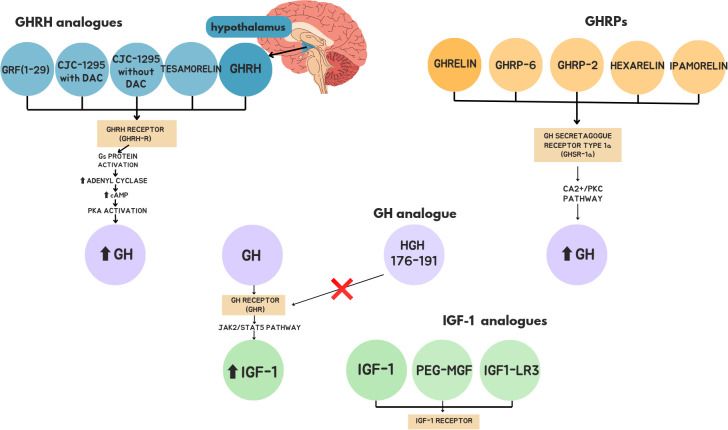
Figure 2: Overview of the discussed compounds and their receptors. The diagram summarises the principal receptor targets and canonical intracellular s
Figure 2. From PMC13322892, CC BY (terms); resized.
? InconclusivereviewJ Sports Med Phys Fitness · 2026

A new era of doping? Use of peptide and peptide-analog drugs in recreational and professional sport and bodybuilding: a critical review.

No new dataCritical review of peptide use in sport and bodybuilding (includes Frag 176-191)

Critical review: Frag 176-191 and similar peptides are promoted for fat loss, but clinical evidence for sport use is limited and unregulated products are often mislabeled or contaminated.

Authors' conclusion
Clinical evidence for peptide use in sport is limited and peptides remain experimental with poorly defined long-term risks; their use should be considered high-risk and ethically problematic.
Limitations
Prevalence studies are lacking and most studies do not reflect bodybuilding protocols.

Animal & lab studies

✓ PositiveanimalAnn Clin Lab Sci · 2015

Effect of Intra-articular Injection of AOD9604 with or without Hyaluronic Acid in Rabbit Osteoarthritis Model.

n = 32 animalsRandomized weekly intra-articular injections: saline, hyaluronic acid, AOD9604, or both4-7 weeks of injections, assessed at 8 weeks

In rabbits with collagenase-induced knee osteoarthritis (n=32), intra-articular AOD9604 (a modified hGH fragment) improved cartilage scores and lameness versus saline, and was best combined with hyaluronic acid.

Studied
Rabbits with collagenase-induced knee osteoarthritis
Compared with
Saline
Main outcome
Cartilage morphology and histology, lameness
Sample
32 rabbits in four groups
Authors' conclusion
AOD9604 injections enhanced cartilage regeneration; AOD9604 with hyaluronic acid was more effective than either alone in this model.
Limitations
Rabbit study of AOD9604, a modified fragment, not native 176-191.
✓ PositiveanimalBiochem Mol Biol Int · 1994

Reduction of cumulative body weight gain and adipose tissue mass in obese mice: response to chronic treatment with synthetic hGH 177-191 peptide.

AnimalsChronic treatment with synthetic hGH 177-191 peptideLong-term

In obese (ob/ob) mice, long-term hGH 177-191 reduced cumulative weight gain and fat mass and inhibited fat production in adipose tissue.

Studied
Obese C57BL/6J (ob/ob) mice
Compared with
Untreated mice (implied)
Main outcome
Cumulative body weight gain, adipose tissue mass, lipogenesis
Authors' conclusion
hGH 177-191 reduced cumulative weight gain and adipose mass and inhibited lipogenesis in obese mice; authors suggest potential for obesity treatment.
Limitations
Mouse study; numbers not in abstract.
~ MixedanimalBiochem Mol Biol Int · 1993

Antilipogenic action of synthetic C-terminal sequence 177-191 of human growth hormone.

AnimalsTest of synthetic hGH 177-191 for antilipogenic and lipolytic activity

In rats, the fragment blocked new fat formation like intact hGH but showed no significant fat-breakdown (lipolytic) effect.

Studied
Rats (epididymal fat pads)
Compared with
Intact hGH
Main outcome
Antilipogenic activity; glycerol release
Authors' conclusion
hGH 177-191 had antilipogenic activity identical to intact hGH with no significant lipolytic effect, supporting that the functional domain lies in the C-terminal region.
Limitations
Animal tissue study.
✗ NegativeanimalAm J Physiol · 1978

Hyperglycemic action of synthetic C-terminal fragments of human growth hormone.

AnimalsIn vivo comparison of C-terminal hGH fragments (172-191 to 180-191)

In normal rats, hGH 176-191 and related fragments caused a short rise in blood glucose, a sustained rise in insulin, and reduced insulin sensitivity.

Key resultA single 5 nmol/kg dose of peptides containing residues 178-191 significantly reduced insulin sensitivity in insulin tolerance tests
Studied
Normal rats
Compared with
Different fragment lengths
Main outcome
Blood glucose, plasma insulin, insulin sensitivity
Authors' conclusion
Four of the six fragments (including 176-191) caused a short-lived rise in glucose and sustained rise in insulin; shorter fragments were inert.
Limitations
Rat study.
✗ NegativeanimalActa Endocrinol (Copenh) · 1982

Effect of C-terminal chain shortening on the insulin-antagonistic activity of human growth hormone 177--191.

AnimalsIn vivo insulin-antagonist assays of shortened Cam-hGH 177-191 fragments

In normal rats, nanomolar amounts of modified hGH 177-191 caused significant high blood sugar and insulin resistance.

Studied
Normal rats
Compared with
Shortened fragments
Main outcome
Hyperglycaemia and insulin resistance
Authors' conclusion
An insulin-antagonistic core of hGH lies within residues 178 to 190; shorter fragments were inactive even at much higher doses.
Limitations
Rat study.
✓ PositiveanimalInt J Obes Relat Metab Disord · 2001

Increase of fat oxidation and weight loss in obese mice caused by chronic treatment with human growth hormone or a modified C-terminal fragment.

Humans and animals14-day mini-pump infusion of hGH, AOD9604 or saline, plus in vitro binding assays14 days

In obese ob/ob mice, 14 days of hGH or the modified fragment AOD9604 (Tyr-extended hGH 177-191) reduced weight gain and increased fat oxidation, and unlike hGH, AOD9604 did not cause hyperglycaemia or bind the hGH receptor.

Studied
Obese (ob/ob) and lean C57BL/6J mice; hGH-receptor-transfected BaF-BO3 cells
Compared with
Saline
Main outcome
Body weight gain, fat oxidation, glycaemia
Authors' conclusion
Both hGH and its C-terminal fragment reduced weight gain, increased fat oxidation and stimulated lipolysis in obese mice, yet AOD9604 does not interact with the hGH receptor.
Limitations
Mouse study of AOD9604, a modified fragment rather than native 176-191.
? Inconclusivein vitroBiochem Mol Biol Int · 1993

Effect of an antilipogenic fragment of human growth hormone on glucose transport in rat adipocytes.

Cells / labIn vitro glucose transport assay with hGH 177-191

In fat cells from obese rats, hGH 177-191 reduced basal and insulin-stimulated glucose uptake, more potently than intact hGH.

Studied
Adipocytes isolated from genetically obese Zucker rats
Compared with
Intact hGH at equimolar concentration
Main outcome
2-deoxyglucose uptake
Authors' conclusion
The peptide reduced basal and insulin-stimulated glucose uptake and was more potent than intact hGH, which may contribute to its antilipogenic property.
Limitations
In vitro, rat cells.

Verdicts are judged on each paper's own main outcome; grades run from A (strong human evidence) to D (little or none). Details are read from the abstracts, and figures are reproduced only from openly licensed full texts. Not medical advice.