Peptide Price Finder

Home · Research · Growth hormone

IGF-1 DES research

What published studies found for IGF-1 DES: 10 papers, 0 in humans, with sample sizes and key results.

C
Mostly animal studies
Why: Never tested in humans; rat, mouse and pig studies show anabolic effects, with negative neuroprotection results and tumour signals in transgenic mice.

IGF-1 DES (des(1-3)IGF-I) is a naturally occurring truncated IGF-I that is more potent than IGF-I in cell and rodent studies; all in-vivo evidence is from rats, mice and pigs, mostly from the early 1990s. It has never been evaluated in human trials, and animal and cell studies raise growth-promoting (tumour) concerns.

✓ 4 positive✗ 4 negative? 2 inconclusive

No human safety data in the published literature; animal and cell studies show potent mitogenic effects, including promotion of mammary tumours in transgenic mice.

US compounding: Not compoundable. Not an FDA-approved drug and not nominated for FDA's 503A bulks list, so US pharmacies can't legally compound it. Status for every peptide.

Browse and filter these papersIGF-1 DES prices and vendors

Reviews

? InconclusivereviewInt J Biochem Cell Biol · 1996

Des(1-3)IGF-I: a truncated form of insulin-like growth factor-I.

No new dataNarrative review

Review noting des(1-3)IGF-I is ~10-fold more potent than IGF-I in cultured cells due to weak IGF-binding-protein binding, with anabolic effects mainly in gut tissue in vivo; clinical use had not been evaluated.

Studied
Literature on des(1-3)IGF-I, a truncated IGF-I variant
Main outcome
Potency, biology and potential clinical use
Authors' conclusion
Des(1-3)IGF-I is generally about 10-fold more potent than IGF-I in cultured cells due to reduced IGFBP binding, with selective anabolic effects in gut in vivo. Clinical opportunities have not yet been evaluated.
Limitations
No clinical data.

Animal & lab studies

✓ PositiveanimalBiochem J · 1991

Increased weight gain, nitrogen retention and muscle protein synthesis following treatment of diabetic rats with insulin-like growth factor (IGF)-I and des(1-3)IGF-I.

AnimalsAnimal infusion study of hGH, IGF-I, des(1-3)IGF-I and insulin7 days

In diabetic rats, 7 days of des(1-3)IGF-I improved weight gain and nitrogen retention (~70% of insulin's effect) via increased muscle protein synthesis, without fixing glucose control.

Key resultIGF-I gave about 30% of the improvement achieved with insulin (significant in only one of two experiments, P < 0.05); a 2.5-fold higher IGF-I dose or des(1-3)IGF-I gave approx. 70% of insulin's effect.
Studied
Streptozotocin-induced diabetic rats
Compared with
Vehicle controls; insulin; hGH
Main outcome
Body weight, nitrogen retention, muscle protein synthesis
Authors' conclusion
IGF peptides stimulate muscle protein synthesis and improve nitrogen balance in diabetic rats without improving glucosuria; des(1-3)IGF-I is at least as potent as IGF-I.
Limitations
Rat model; group sizes not stated in abstract.
✓ PositiveanimalMiner Electrolyte Metab · 1992

Insulin-like growth factor I and its variant, des(1-3)IGF-I, improve nitrogen balance and food utilization in rats with renal failure.

5/6 nephrectomy rats, 8 per group (4 groups); 7 sham controlsAnimal study of subcutaneous IGF-I (0.9 or 2.2 mg/kg/day) or des(1-3)IGF-I (0.9 mg/kg/day) by osmotic pump7 days

In rats with partial kidney removal, des(1-3)IGF-I improved food utilization 13-16%, cut nitrogen excretion 24% and lowered serum urea 25%, without altering carcass composition.

Key resultFood utilization improved 13-16% in all peptide groups; nitrogen excretion fell 24% with des(1-3)IGF-I and 16% and 18% with low- and high-dose IGF-I.
Studied
Rats after 5/6 nephrectomy (renal failure model)
Compared with
Vehicle-treated nephrectomized rats; sham-operated controls
Main outcome
Nitrogen balance, food utilization, serum urea, muscle protein degradation
Authors' conclusion
IGF-I, and more particularly des(1-3)IGF-I, may be efficacious in overcoming impaired growth in renal failure.
Limitations
Rat model; 7-day study.
✓ PositiveanimalAm J Physiol · 1991

IGF-I and the truncated analogue des-(1-3)IGF-I enhance growth in rats after gut resection.

AnimalsAnimal study of IGF-I (0.96 or 2.4 mg/kg/day) or des-(1-3)IGF-I (0.96 mg/kg/day) by osmotic pump7 days

In rats after removal of 80% of the small bowel, des(1-3)IGF-I improved weight gain and nitrogen balance; kidney and thymus weights also increased.

Key resultNitrogen balance over the last 3 days was 242 ± 14 mg/d (high-dose IGF-I) and 217 ± 13 mg/d (des-(1-3)IGF-I) vs 153 ± 21 mg/d in controls (P less than 0.05).
Studied
170 g rats after resection of 80% of jejunum plus ileum
Compared with
Vehicle and low-dose IGF-I
Main outcome
Weight gain and nitrogen balance
Authors' conclusion
High-dose IGF-I and des-(1-3)IGF-I enhanced weight gain and nitrogen balance after gut resection in rats; effects partly explained by reduced muscle protein breakdown.
Limitations
Rat model; abstract truncated.
✓ PositiveanimalJ Endocrinol · 1990

Enhanced potency of truncated insulin-like growth factor-I (des(1-3)IGF-I) relative to IGF-I in lit/lit mice.

AnimalsAnimal study comparing daily injections of IGF-I and des(1-3)IGF-I3 weeks

In GH-deficient mice, 3 weeks of des(1-3)IGF-I increased body length at a tenth of the effective IGF-I dose, with increased kidney and heart weights; body weight did not change significantly.

Key result30 µg IGF-I, 30 µg des(1-3)IGF-I or 3 µg des(1-3)IGF-I daily increased length substantially more than in controls or 3 µg IGF-I; body weight changes were not statistically significant.
Studied
lit/lit (GH-deficient) mice
Compared with
Controls; IGF-I
Main outcome
Total length, nose-rump length, body and organ weights
Authors' conclusion
The higher potency of des(1-3)IGF-I seen in cultured cells also applies in vivo in at least one GH-deficient mouse strain.
Limitations
One mouse strain; group sizes not stated in abstract.
✗ NegativeanimalOncogene · 2000

Cooperative interaction between mutant p53 and des(1-3)IGF-I accelerates mammary tumorigenesis.

AnimalsTransgenic mouse mammary tumorigenesis studyUp to 23 months of age

Transgenic mice overexpressing des(1-3)IGF-I in the mammary gland developed pre-cancerous lesions, and 53% developed mammary adenocarcinomas by 23 months; mutant p53 accelerated tumour onset.

Key resultBy 23 months, 53% of WAP-DES mice developed mammary adenocarcinomas; tumor latency was reduced by 8 months in bitransgenic mice.
Studied
Transgenic mice overexpressing des(1-3)hIGF-I (WAP-DES) and/or mutant p53 (p53172R-H)
Compared with
Nontransgenic and p53172R-H mice
Main outcome
Mammary tumor incidence and latency
Authors' conclusion
Overexpression of des(1-3)hIGF-I increases mammary intraepithelial neoplasia and stochastic tumors, and mutant p53 accelerates tumors with genomic instability. This is transgenic overexpression, not drug dosing.
Limitations
Transgenic overexpression model; not peptide administration.
✗ NegativeanimalEndocrinology · 1996

The effects of insulin-like growth factor (IGF)-1, IGF-2, and des-IGF-1 on neuronal loss after hypoxic-ischemic brain injury in adult rats: evidence for a role for IGF binding proteins.

Groups of 10 to 20 rats per treatmentAnimal experiment, intraventricular dosingNeuronal loss assessed 5 days later

In adult rats after hypoxic-ischemic brain injury, central IGF-1 reduced neuronal loss, but des-IGF-1 at 2 or 20 micrograms did not (only a non-significant trend at 150 micrograms), pointing to a role for IGF binding proteins.

Key resultIGF-1 (20 micrograms) reduced neuronal loss in all regions (P < 0.01); des-IGF-1 at 2 and 20 micrograms did not.
Studied
Adult rats with unilateral hypoxic-ischemic brain injury
Compared with
IGF-1, IGF-2, vehicle
Main outcome
Neuronal loss in cortex, striatum, hippocampus and other regions
Authors' conclusion
Binding proteins may target IGF-1's neuroprotective action; IGF-2 may antagonise IGF-1 by displacing it from them.
Limitations
Rat study of des-IGF-1 as a comparator; 1996.
✗ NegativeanimalBrain Behav · 2026

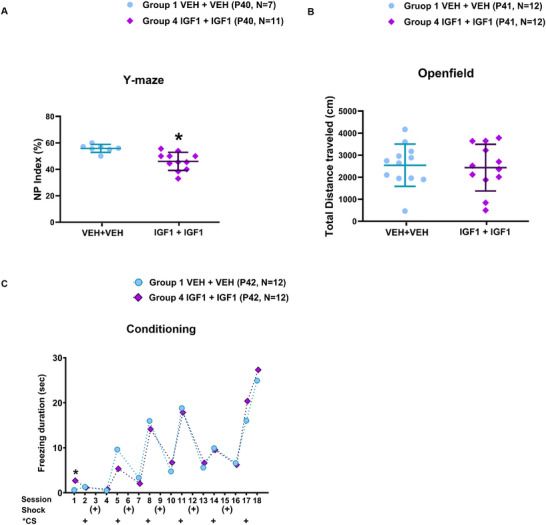
Prenatal (1-3)IGF-1 Treatment Is Ineffective and Behaviorally Detrimental in a Rat Model of Cortical Malformation.

AnimalsAnimal study with in utero MRI and behavioural testingPrenatal plus prolonged early postnatal treatment

In a rat model of cortical malformation, prenatal and early postnatal (1-3)IGF-1 did not improve brain growth, neurometabolites or seizure susceptibility, and long-term exposure impaired spatial working memory.

Studied
Rat offspring in a MAM-induced cortical malformation model
Compared with
Untreated / vehicle groups
Main outcome
Brain morphology, neurometabolites, seizure susceptibility, behaviour
Authors' conclusion
No benefit in any paradigm and detrimental behavioural effects, cautioning against assuming earlier or longer IGF-1-based treatment is beneficial.
Limitations
Animal model of one specific malformation.
FIGURE 5: Effects of long‐term (1–3)IGF‐1 treatment on behavior in MAM‐exposed rats. (A) Y‐maze testing at P40 revealed a significant reduction in nov
FIGURE 5. From PMC13087530, CC BY (terms); resized.
✗ NegativeanimalProc Natl Acad Sci U S A · 1995

Cardioprotective effect of insulin-like growth factor I in myocardial ischemia followed by reperfusion.

AnimalsAnimal experiment20 min ischemia plus 24 h reperfusion

In rats with myocardial ischemia-reperfusion, IGF-I reduced heart injury and cardiomyocyte apoptosis, but this protection was not seen with des-(1-3)-IGF-I.

Studied
Rats with myocardial ischemia followed by reperfusion
Compared with
IGF-I; vehicle
Main outcome
Creatine kinase loss, neutrophil accumulation, myocyte apoptosis
Authors' conclusion
IGF-I protected ischemic myocardium; the abstract states the protective effect was not observed with des-(1-3)-IGF-I.
Limitations
Des-(1-3)-IGF-I was only a comparator in a study of IGF-I; 1995.
? Inconclusivein vitroMol Cell Endocrinol · 2002

Des (1-3) IGF-I-stimulated growth of human stromal BPH cells is inhibited by a vitamin D3 analogue.

Cells / labIn vitro cell study of Des(1-3)IGF-I and a vitamin D3 analogue

In human benign prostatic hyperplasia stromal cells, des(1-3)IGF-I acted as a potent mitogen, stimulating growth and inhibiting apoptosis.

Studied
Human stromal benign prostatic hyperplasia (BPH) cells
Main outcome
BPH cell proliferation, apoptosis, bcl-2 expression
Authors' conclusion
Des(1-3)IGF-I is a potent mitogen for BPH stromal cells, stimulating growth and inhibiting apoptosis; a vitamin D3 analogue inhibited this and induced apoptosis, so such analogues might be considered for BPH treatment.
Limitations
In vitro only.

Verdicts are judged on each paper's own main outcome; grades run from A (strong human evidence) to D (little or none). Details are read from the abstracts, and figures are reproduced only from openly licensed full texts. Not medical advice.