Peptide Price Finder

Home · Research · Growth hormone

IGF-1 LR3 research

What published studies found for IGF-1 LR3: 11 papers, 0 in humans, with sample sizes and key results, plus 9 registered clinical trials.

C
Mostly animal studies
Why: Only animal studies (rats, pigs, sheep, mice) with mixed growth effects and strong hypoglycemia; no human trials.

IGF-1 LR3 (Long R3 IGF-I) has been studied only in animals (rats, pigs, sheep, mice), mostly with growth and metabolic outcomes; it is a potent IGF-I analog with mixed growth effects across species and stronger, longer hypoglycemia than IGF-I. Recent fetal sheep and Alzheimer's-mouse studies found no growth or cognitive benefit. No controlled human trials exist, and a 2026 narrative review notes the reported adverse effects of the wider class of unregulated GH-IGF-1 axis peptides.

✓ 2 positive✗ 3 negative~ 4 mixed? 2 inconclusive

No human safety data in the published literature; animal studies show potent, prolonged hypoglycemia and suppression of the body's own GH/IGF-I.

US compounding: Not compoundable. Not an FDA-approved drug and not nominated for FDA's 503A bulks list, so US pharmacies can't legally compound it. Status for every peptide.

Browse and filter these papersIGF-1 LR3 prices and vendors

Registered clinical trials

9 trials of IGF-1 LR3 on ClinicalTrials.gov: 0 active, 5 completed, 5 with posted results. Registered trials include ones that haven't published yet.

TrialStatusPhasePeopleSponsor
Prepubertal Children With Growth Failure Associated With Primary Insulin-Like Growth Factor-1 (IGF-1) DeficiencyNCT00125164 · started 2004-03 · results postedCompletedPhase 3137Ipsen
Treatment of Children and Adolescents With Growth Failure Associated With Primary IGF-1 DeficiencyNCT00330668 · started 2005-11 · results postedTerminatedPhase 3114Ipsen
rhGH and rhIGF-1 Combination Therapy in Children With Short Stature Associated With IGF-1 DeficiencyNCT00572156 · started 2007-12 · results postedTerminatedPhase 2106Ipsen
Long-Term Treatment With rhIGF-1 in GHISNCT00571727 · started 1991-05-20 · results postedCompletedPhase 2, Phase 392Ipsen
Recombinant Human Insulin-Like Growth Factor (rhIGF-1) Treatment of Short Stature Associated With IGF-1 DeficiencyNCT00125190 · started 2005-07 · results postedCompletedPhase 2, Phase 345Ipsen
Evaluation of the Safety and Efficacy of Using Insulin-like Growth Factor-1 in Patients With a Heart AttackNCT01438086 · started 2011-10CompletedPhase 1, Phase 247University College Cork
IGF-I Stimulation of Collagen Synthesis in Ehlers-Danlos PatientsNCT01446783 · started 2011-09Completed–15Bispebjerg Hospital
IGFD Registry: A Patient Registry for Monitoring Long-term Safety and Efficacy of IncrelexNCT00747604 · started 2006-06Terminated–1,378Ipsen
Effects of IGF-I in HIV Metabolic DiseaseNCT01329744 · started 2011-06TerminatedPhase 116University of Texas Southwestern Medical Center

All 9 IGF-1 LR3 trials, with countries and recruiting status

Reviews

? InconclusivereviewFront Endocrinol (Lausanne) · 2026

The emerging landscape of performance-enhancing peptides modulating GH-IGF1 axis: bridging the gap between clinical evidence and patient self-administration.

No new dataNarrative review of unregulated GH-IGF-1 axis peptides including PEG-MGF

Narrative review placing IGF-1 LR3 among unregulated GH/IGF-axis peptides with little or no human study, flagging dysglycaemia and theoretical mitogenic risks.

Authors' conclusion
Peptides are stratified into evidence tiers from regulatory-grade trial data to no human studies; performance benefits are uncertain, and the authors propose a clinical assessment algorithm without legitimising off-label use.
Limitations
Narrative review; some peptides lack human studies.
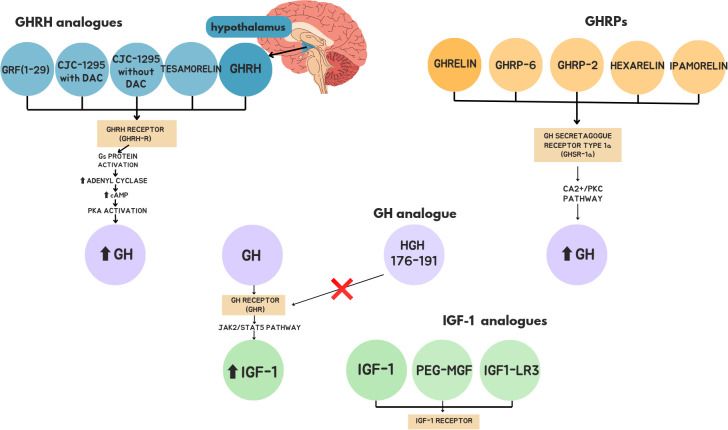
Figure 2: Overview of the discussed compounds and their receptors. The diagram summarises the principal receptor targets and canonical intracellular s
Figure 2. From PMC13322892, CC BY (terms); resized.

Animal & lab studies

~ MixedanimalJ Dev Orig Health Dis · 2023

Attenuated glucose-stimulated insulin secretion during an acute IGF-1 LR3 infusion into fetal sheep does not persist in isolated islets.

n = 10 animalsAcute in vivo infusion with hyperglycemic clamp, then in vitro islet testing90-minute infusion

A 90-minute IGF-1 LR3 infusion lowered plasma insulin and glucose-stimulated insulin secretion in fetal sheep, but islets isolated afterwards recovered their insulin secretion in vitro.

Studied
Late-gestation fetal sheep and their isolated pancreatic islets
Compared with
Vehicle control
Main outcome
Insulin concentrations, in vivo and in vitro glucose-stimulated insulin secretion
Sample
10 fetal sheep infused in vivo; 6 per group for islet studies
Authors' conclusion
IGF-1 LR3 acutely lowered fetal insulin secretion in vivo, but isolated islets retained the ability to recover secretion, which may matter for long-term effects of growth-restriction therapies.
Limitations
Animal study with small groups; no human data.
✓ PositiveanimalBiochem J · 1992

Insulin-like growth factor-I (IGF-I) and especially IGF-I variants are anabolic in dexamethasone-treated rats.

AnimalsAnimal study, IGF-I and analogues (des(1-3)IGF-I, LR3IGF-I) via subcutaneous osmotic pumps7 days

In rats made catabolic with dexamethasone, LR3IGF-I was about 2.5-fold more potent than IGF-I at improving weight and nitrogen retention, though carcass (muscle) weights stayed low and gut weight rose up to 45%.

Key resultHighest IGF-I dose (695 µg/day) gave a 6 g body weight increase over 7 days vs a 19 g loss in the dexamethasone-only group; the analogues were approx. 2.5-fold more potent than IGF-I.
Studied
150 g male rats made catabolic with dexamethasone (20 µg/day)
Compared with
Dexamethasone-only and pair-fed controls; native IGF-I
Main outcome
Body weight, nitrogen retention, muscle protein synthesis and breakdown
Authors' conclusion
IGF-I partially reversed dexamethasone-induced catabolism, and analogues that bind weakly to IGF-binding proteins were more potent, showing potential of IGF-I variants in catabolic states.
Limitations
Rat study; group sizes not stated in abstract.
~ MixedanimalJ Endocrinol · 1996

Superior potency of infused IGF-I analogues which bind poorly to IGF-binding proteins is maintained when administered by injection.

AnimalsAnimal study comparing LR3IGF-I and IGF-I by continuous infusion vs once- or twice-daily injection7 days

In rats, LR3IGF-I was 1.5-2x more potent than IGF-I for weight gain and organ growth, but barely equal to IGF-I at reversing dexamethasone-induced muscle loss.

Key resultBy injection, methylhistidine excretion in dexamethasone-treated rats was reduced to a threefold greater extent by LR3IGF-I than by IGF-I; infused LR3IGF-I was generally 1.5- to 2-fold more potent than IGF-I.
Studied
Normal growing rats (150 g) and dexamethasone-treated catabolic rats
Compared with
IGF-I; vehicle
Main outcome
Body weight gain, organ weights, feed efficiency, methylhistidine excretion
Authors' conclusion
LR3IGF-I kept superior potency to IGF-I for several actions when injected, though much reduced vs infusion; low-binding-protein analogues may have advantages where injection is necessary.
Limitations
Rat study; LR3IGF-I was only barely equipotent with IGF-I for restoring carcass muscle.
✗ NegativeanimalJ Endocrinol · 1997

Long [R3] insulin-like growth factor-I reduces growth, plasma growth hormone, IGF binding protein-3 and endogenous IGF-I concentrations in pigs.

AnimalsAnimal infusion study of IGF-I or LR3IGF-I, alone or with porcine GH4-day infusion

In finisher pigs, a 4-day LR3IGF-I infusion decreased daily weight gain and food intake and suppressed GH, IGF-I, IGFBP-3 and insulin.

Key resultLR3IGF-I (180 µg/kg/day) decreased average daily gain, food intake and plasma IGFBP-3, IGF-I and insulin; mean plasma GH fell 23% and area under GH peaks 60%.
Studied
Finisher pigs
Compared with
IGF-I; porcine GH combination
Main outcome
Growth performance and plasma hormones
Authors' conclusion
Both IGF-I and LR3IGF-I suppress plasma GH in finisher pigs, which may contribute to LR3IGF-I's inhibitory effect on growth in the pig (unlike the rat).
Limitations
Pig study; group sizes not stated in abstract.
✗ NegativeanimalJ Endocrinol · 1995

Long R3 insulin-like growth factor-I (IGF-I) infusion stimulates organ growth but reduces plasma IGF-I, IGF-II and IGF binding protein concentrations in the guinea pig.

AnimalsAnimal study of continuous infusion of IGF-I, IGF-II or LR3IGF-I7 days

In guinea pigs, 7 days of LR3IGF-I enlarged adrenals, gut, kidneys and spleen but did not increase overall body growth or change carcass composition.

Key resultBody weight gain, feed intake and carcass composition were not significantly affected by any treatment; LR3IGF-I significantly increased fractional weights of adrenals, gut, kidneys and spleen.
Studied
Female guinea pigs (350 g)
Compared with
Vehicle infusion
Main outcome
Body weight gain, feed conversion, carcass composition, organ weights
Authors' conclusion
Chronic IGF infusion did not stimulate overall growth in guinea pigs, possibly because total circulating IGF concentrations were not increased.
Limitations
Guinea pig study; abstract truncated.
? InconclusiveanimalJ Endocrinol · 1997

IGF-I variants which bind poorly to IGF-binding proteins show more potent and prolonged hypoglycaemic action than native IGF-I in pigs and marmoset monkeys.

AnimalsAnimal bolus injection dose-response comparison of IGF-I and variants including LR3IGF-IBlood sampled from 30 min before to 4 h after injection

In pigs, LR3IGF-I and related variants lowered blood glucose 2-3x more potently and for longer than native IGF-I (about 4-8x greater cumulative hypoglycemia), a potential safety concern.

Key resultIGF variants were consistently 2- to 3-fold more potent than IGF-I for lowering plasma glucose; cumulative suppression over four hours was approximately 4- to 8-fold greater.
Studied
Marmoset monkeys (anaesthetised and conscious) and pigs
Compared with
Native IGF-I; insulin in pigs
Main outcome
Plasma glucose lowering and duration
Authors' conclusion
Variants binding poorly to IGFBPs have more potent, prolonged hypoglycaemic action than IGF-I in these animals, suggesting possible superior efficacy, especially des(1-3)IGF-I, as an adjunct to insulin.
Limitations
Acute animal study; group sizes not stated in abstract.
✓ PositiveanimalGrowth Factors · 1994

Treatment with IGF-I peptides improves function of the remnant gut following small bowel resection in rats.

AnimalsAnimal study of subcutaneous IGF-I, LR3IGF-I and des(1-3)IGF-I7 days

In rats after removal of most of the small bowel, LR3IGF-I reduced fat and nitrogen malabsorption and increased weight gain and gut growth.

Key resultAt 278 µg/day, IGF-I, LR3IGF-I or des(1-3)IGF-I significantly attenuated fat and nitrogen malabsorption after 70% resection; total gut weight increased by up to 21%.
Studied
Growing rats after 70% or 80% jejuno-ileal resection
Compared with
IGF-I vs analogues
Main outcome
Gut growth, fat and nitrogen absorption, body weight gain
Authors' conclusion
IGF-I peptides improved gastrointestinal absorptive function after partial gut resection, likely via increased absorptive surface area.
Limitations
Rat study; responses weaker after 80% resection.
✗ NegativeanimalAm J Physiol Endocrinol Metab · 2025

IGF-1 LR3 does not promote growth in late-gestation growth-restricted fetal sheep.

7 treated and 7 vehicle fetal sheep (14 total, summed from the abstract)Vehicle-controlled 1-week infusion1 week

A 1-week IGF-1 LR3 infusion into growth-restricted fetal sheep (7 treated, 7 vehicle) did not improve fetal weight and lowered circulating amino acids.

Key resultFetal body weight, insulin, glucose, oxygen and GSIS did not differ between groups; amino acids fell in the LR3 group (P = 0.0232)
Studied
Late-gestation growth-restricted fetal sheep
Compared with
Vehicle
Main outcome
Fetal body weight, insulin, glucose, oxygen, glucose-stimulated insulin secretion, amino acids
Authors' conclusion
One week of IGF-1 LR3 did not improve growth in growth-restricted fetuses; falling amino acids may mean amino acid supply limits any growth effect.
Limitations
Fetal sheep; small groups; lower dose than the authors' earlier normal-fetus study.
~ MixedanimalJ Alzheimers Dis · 2025

Intranasal long R3 insulin-like growth factor-1 treatment promotes amyloid plaque remodeling in cerebral cortex but fails to preserve cognitive function in male 5XFAD mice.

19-27 mice per groupVehicle-controlled intranasal treatment with behavioural, imaging and tissue analysis, plus BV-2 microglial cell experiments7 months

In male 5XFAD Alzheimer's-model mice, 7 months of intranasal LR3-IGF-1 improved body composition and remodelled amyloid plaques but did not preserve cognition.

Studied
Male wildtype and 5XFAD mice, treated from 3 to 10 months of age
Compared with
Intranasal vehicle
Main outcome
Cognition and behaviour; amyloid-beta pathology; body composition
Authors' conclusion
LR3 had favourable effects on amyloid plaque remodelling in cortex but failed to preserve behaviour or memory, so the data do not support it as a monotherapy.
Limitations
Male mice of one transgenic model only.
~ MixedanimalBr J Nutr · 2002

Insulin-like growth factor-I and analogues increase growth in artificially-reared neonatal pigs.

Two experiments in neonatal pigs (42 in the first, 18 in the second, spelled out in the abstract)Infusion experiments of control, IGF-I or LR3IGF-I at several rates8 days (experiment 1); 18 days (experiment 2)

In artificially reared neonatal pigs, IGF-I and LR3IGF-I infusion did not change weight gain in limit-fed piglets, but ad libitum-fed pigs infused with LR3IGF-I gained more weight than controls (457 vs 386 g/d, P<0.01) and IGF-I did not.

Key resultWeight gain over the second 9 days: 457 g/d with LR3IGF-I vs 386 g/d control (P<0.01); IGF-I 413 g/d (P=0.15)
Studied
Artificially reared neonatal pigs
Compared with
Control saline; IGF-I
Main outcome
Daily weight gain, milk intake, plasma IGF concentrations
Authors' conclusion
IGF-I, and particularly LR3IGF-I, can increase growth rate and milk intake in ad libitum-fed artificially reared pigs but not in limit-fed piglets.
Limitations
Neonatal pig study; effect depended on feeding regimen.

Verdicts are judged on each paper's own main outcome; grades run from A (strong human evidence) to D (little or none). Details are read from the abstracts, and figures are reproduced only from openly licensed full texts. Not medical advice.