Peptide Price Finder

Home · Research · Growth hormone

Ipamorelin research

What published studies found for Ipamorelin: 8 papers, 3 in humans, with sample sizes and key results, plus 10 registered clinical trials.

B
Some human evidence
Why: One phase 2 RCT (114 surgery patients) found no significant benefit and a small pharmacokinetic study; body-composition claims rest on rat studies.

Ipamorelin is a selective ghrelin-receptor GH secretagogue; human data are limited to a pharmacokinetic study in healthy men and one phase 2 RCT for postoperative ileus that found no significant benefit. Claims about body composition, recovery or anti-aging rest on rodent studies and narrative reviews, not human trials.

✓ 5 positive✗ 1 negative? 2 inconclusive

The one RCT reported ipamorelin was well tolerated with adverse-event rates similar to placebo (87.5% vs 94.8%), but specific adverse effects are not described in the abstracts; long-term human safety data are absent.

US compounding: Not compoundable (no pending nomination). Removed from FDA's Category 2 on about April 22, 2026 after its nominations were withdrawn. That doesn't add it to any allowed list, so US pharmacies still can't compound it from bulk ingredient. It also remains on FDA's Category 2 safety list for 503B outsourcing facilities. Status for every peptide.

Browse and filter these papersIpamorelin prices and vendors

Registered clinical trials

10 trials of Ipamorelin on ClinicalTrials.gov: 0 active, 9 completed. Registered trials include ones that haven't published yet.

TrialStatusPhasePeopleSponsor
Safety and Efficacy of Ipamorelin Compared to Placebo for the Recovery of Gastrointestinal FunctionNCT01280344 · started 2011-04CompletedPhase 2320Helsinn Therapeutics (U.S.), Inc
Study of NNZ-2566 in Patients With Traumatic Brain Injury Under EFICNCT01366820 · started 2013-02CompletedPhase 2261Neuren Pharmaceuticals Limited
Study of NNZ-2566 in Patients With Traumatic Brain InjuryNCT00805818 · started 2010-04CompletedPhase 2261Neuren Pharmaceuticals Limited
Safety and Efficacy of Ipamorelin for Management of Post-Operative IleusNCT00672074 · started 2008-04CompletedPhase 2117Helsinn Therapeutics (U.S.), Inc
A Safety Study of NNZ-2566 in Pediatric Rett SyndromeNCT02715115 · started 2016-03CompletedPhase 282Neuren Pharmaceuticals Limited
A Safety Study of NNZ-2566 in Patients With Fragile X SyndromeNCT01894958 · started 2014-01CompletedPhase 272Neuren Pharmaceuticals Limited
A Safety Study of NNZ-2566 in Patients With Rett SyndromeNCT01703533 · started 2013-03CompletedPhase 267Neuren Pharmaceuticals Limited
Safety Study of NNZ-2566 in Healthy Female SubjectsNCT00961779 · started 2010-03CompletedPhase 139Neuren Pharmaceuticals Limited
Safety Study of NNZ-2566 in Healthy Subjects, Following Oral AdministrationNCT01420042 · started 2012-02CompletedPhase 124Neuren Pharmaceuticals Limited
A Safety and Efficacy Study of NNZ-2566 in Patients With Mild Traumatic Brain Injury (mTBI)NCT02100150 · started 2014-09TerminatedPhase 232Neuren Pharmaceuticals Limited

All 10 Ipamorelin trials, with countries and recruiting status

Meta-analyses & systematic reviews

? Inconclusivesystematic reviewAm J Sports Med · 2026

Peptide Supplements and Their Therapeutic Applications in Sports Medicine.

No new dataScoping review (PubMed, PRISMA)

Scoping review of six peptides including ipamorelin found 67% of studies were animal-based and human studies were few and poorly controlled; claimed musculoskeletal benefits remain unsubstantiated.

Studied
Literature on 6 peptides (BPC-157, TB-500, CJC-1295, MK-677, ipamorelin, GHK-Cu) for musculoskeletal recovery
Main outcome
Musculoskeletal recovery and performance in animal and human models
Authors' conclusion
67% of publications were preclinical; human data were limited and showed modest improvements at best. Claimed benefits remain unsubstantiated by human trials, and these peptides should not currently be recommended.
Limitations
Few, poorly controlled human studies; heterogeneous dosing and routes.
Human studies

✗ Negativehuman RCTInt J Colorectal Dis · 2014

Prospective, randomized, controlled, proof-of-concept study of the Ghrelin mimetic ipamorelin for the management of postoperative ileus in bowel resection patients.

n = 114 humansMulticenter, double-blind, placebo-controlled phase 2 proof-of-concept randomized trialTwice daily from postoperative day 1 to day 7 or discharge

In 114 bowel-resection patients, IV ipamorelin vs placebo did not significantly shorten time to first tolerated meal (median 25.3 vs 32.6 h, p = 0.15); it was well tolerated.

Key resultMedian time to first tolerated meal 25.3 h with ipamorelin vs 32.6 h with placebo (p = 0.15)
Studied
Adults undergoing small or large bowel resection (open or laparoscopic)
Compared with
Placebo
Main outcome
Time from first dose to tolerance of a standardized solid meal
Sample
One hundred seventeen patients enrolled; 114 in the safety and modified intent-to-treat populations
Authors' conclusion
Ipamorelin 0.03 mg/kg twice daily for up to 7 days was well tolerated, but there were no significant differences from placebo in key and secondary efficacy analyses.
Limitations
Small proof-of-concept study with a broad range of underlying conditions.
✓ Positivehuman trialPharm Res · 1999

Pharmacokinetic-pharmacodynamic modeling of ipamorelin, a growth hormone releasing peptide, in human volunteers.

Eight healthy male subjects at each of 5 dose levelsDose-escalation pharmacokinetic/pharmacodynamic study with PK/PD modeling15-minute infusions

In healthy men given escalating IV infusions, ipamorelin produced a single GH pulse peaking at ~40 minutes at all dose levels, with a ~2-hour half-life.

Key resultTerminal half-life 2 hours, clearance 0.078 L/h/kg; GH release peaked at 0.67 hours; SC50 214 nmol/L
Studied
Healthy male volunteers
Main outcome
Ipamorelin pharmacokinetics and GH release
Authors' conclusion
The PK/PD model provides a useful characterization of ipamorelin disposition and GH responses across a range of doses.
Limitations
Interindividual variability of PD parameters was larger than that of PK parameters.

Reviews

? InconclusivereviewFront Endocrinol (Lausanne) · 2026

The emerging landscape of performance-enhancing peptides modulating GH-IGF1 axis: bridging the gap between clinical evidence and patient self-administration.

No new dataNarrative review of unregulated GH-IGF-1 axis peptides including PEG-MGF

Narrative review of unregulated GH-axis peptides (including ipamorelin) concluding that performance and body-recomposition benefits are uncertain and that adverse endocrine and metabolic effects are reported with this class.

Authors' conclusion
Peptides are stratified into evidence tiers from regulatory-grade trial data to no human studies; performance benefits are uncertain, and the authors propose a clinical assessment algorithm without legitimising off-label use.
Limitations
Narrative review; some peptides lack human studies.
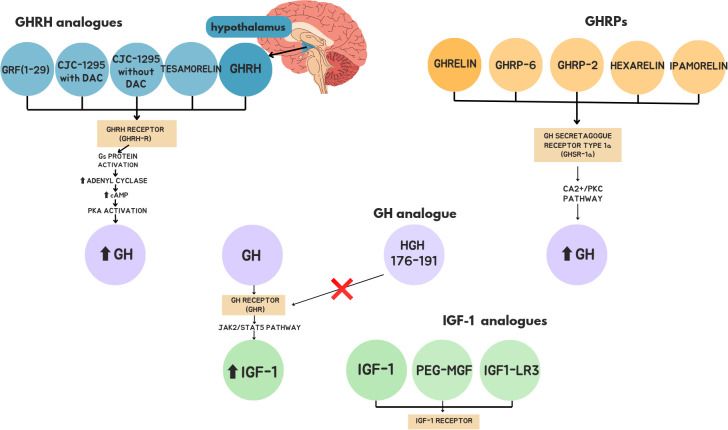
Figure 2: Overview of the discussed compounds and their receptors. The diagram summarises the principal receptor targets and canonical intracellular s
Figure 2. From PMC13322892, CC BY (terms); resized.

Animal & lab studies

✓ PositiveanimalEur J Endocrinol · 1998

Ipamorelin, the first selective growth hormone secretagogue.

AnimalsPreclinical pharmacological characterization

In rat pituitary cells, rats and swine, ipamorelin released GH with potency similar to GHRP-6 but, unlike GHRP-2/GHRP-6, did not raise ACTH or cortisol.

Key resultIn rats ipamorelin ED50 = 80+/-42 nmol/kg vs 115+/-36 nmol/kg for GHRP-6; in swine ED50 = 2.3+/-0.03 nmol/kg; no ACTH or cortisol release even at doses more than 200-fold above the GH ED50
Studied
Rat pituitary cells, anaesthetised rats and conscious swine
Compared with
GHRP-6 and GHRP-2
Main outcome
GH release and selectivity (ACTH, cortisol, other pituitary hormones)
Authors' conclusion
Ipamorelin is the first GHRP-receptor agonist with a GH-release selectivity similar to GHRH, making it an interesting candidate for clinical development.
Limitations
Animal and in vitro data only.
✓ PositiveanimalGrowth Horm IGF Res · 2001

The growth hormone secretagogue ipamorelin counteracts glucocorticoid-induced decrease in bone formation of adult rats.

AnimalsIn vivo rat study with 4 groups (GC, GHS, both)3 months

In adult female rats on glucocorticoids, adding ipamorelin for 3 months increased calf muscle tetanic tension and quadrupled periosteal bone formation rate vs glucocorticoid alone.

Key resultPeriosteal bone formation rate increased four-fold and maximum tetanic tension increased significantly with GC plus ipamorelin vs GC alone
Studied
8-month-old female rats given methylprednisolone
Compared with
Glucocorticoid alone
Main outcome
Muscle tetanic tension and periosteal bone formation rate
Authors' conclusion
Ipamorelin counteracted the glucocorticoid-induced decrease in muscle strength and bone formation in rats.
Limitations
Animal study; group sizes not stated in the abstract.
✓ PositiveanimalGrowth Horm IGF Res · 1999

Ipamorelin, a new growth-hormone-releasing peptide, induces longitudinal bone growth in rats.

AnimalsDose-ranging in vivo study (0, 18, 90 and 450 microg/day s.c. three times daily)15 days

In adult female rats, 15 days of ipamorelin dose-dependently increased longitudinal bone growth rate (42 to 52 µm/day) and body weight gain, without changing total IGF-I.

Key resultLongitudinal growth rate rose dose-dependently from 42 microm/day (vehicle) to 44, 50 and 52 microm/day (P<0.0001)
Studied
Adult female rats
Compared with
Vehicle
Main outcome
Longitudinal bone growth rate, body weight gain, GH release
Authors' conclusion
Ipamorelin increased longitudinal bone growth in rats; whether GH secretagogues have a place in treating children with growth retardation requires future clinical studies.
Limitations
Animal study; short duration.
✓ PositiveanimalJ Pharmacol Exp Ther · 2009

Efficacy of ipamorelin, a novel ghrelin mimetic, in a rodent model of postoperative ileus.

AnimalsRodent model, single or 2-day repetitive intravenous dosing48 h

In rats after abdominal surgery, ipamorelin shortened time to first bowel movement and repeated dosing increased fecal output, food intake and weight gain.

Key resultSingle 1 mg/kg dose decreased time to first bowel movement; repetitive dosing (0.1 or 1 mg/kg) significantly increased cumulative fecal pellet output, food intake and body weight gain
Studied
Fasted male rats with laparotomy and intestinal manipulation (postoperative ileus model)
Compared with
Vehicle (saline) and GHRP-6
Main outcome
Time to first bowel movement, fecal output, food intake, body weight gain
Authors' conclusion
Postsurgical intravenous ipamorelin may ameliorate symptoms in patients with postoperative ileus.
Limitations
Rodent model only.

Verdicts are judged on each paper's own main outcome; grades run from A (strong human evidence) to D (little or none). Details are read from the abstracts, and figures are reproduced only from openly licensed full texts. Not medical advice.