Peptide Price Finder

Home · Research · GLP-1 & metabolic

Lipo-B research

What published studies found for Lipo-B: 3 papers, 2 in humans, with sample sizes and key results.

D
Little or no evidence
Why: No studies of Lipo-B injections for fat loss; only observational B12-obesity associations and a review saying human lipotrope trials are lacking.

No published studies were found that test 'Lipo-B' (lipotropic injections with vitamin B12) for weight or fat loss. Related papers only show that low B12 is sometimes associated with obesity in observational data, and human studies of dietary 'lipotropes' are described as essentially absent.

? 3 inconclusive

No human safety data for lipotropic/B12 'Lipo-B' injections were found in the published literature.

Browse and filter these papers

Meta-analyses & systematic reviews

? Inconclusivemeta-analysisFront Public Health · 2025

Vitamin B12, folate, and homocysteine levels in children and adolescents with obesity: a systematic review and meta-analysis.

n = 7,791 humansSystematic review and random-effects meta-analysis of studies comparing serum levels

Meta-analysis of 20 observational studies (7,791 children/adolescents): vitamin B12 levels did not differ significantly between those with and without obesity; homocysteine was higher in obesity.

Key resultB12 SMD -0.24 (95% CI -0.53 to 0.06; p > 0.05); folate SMD -0.12 (-0.29 to 0.06; p > 0.05); homocysteine SMD 0.77 (0.39 to 1.14; p < 0.001)
Studied
Children and adolescents with and without obesity
Compared with
Children/adolescents without obesity
Main outcome
Serum vitamin B12, folate and homocysteine levels
Sample
20 studies, 7,791 children and adolescents
Authors' conclusion
Children and adolescents with obesity had higher homocysteine levels, with no significant differences in vitamin B12 or folate; Hcy may play a role in obesity development.
Limitations
High heterogeneity (I2 up to 86.4%); compares blood levels, not supplementation.
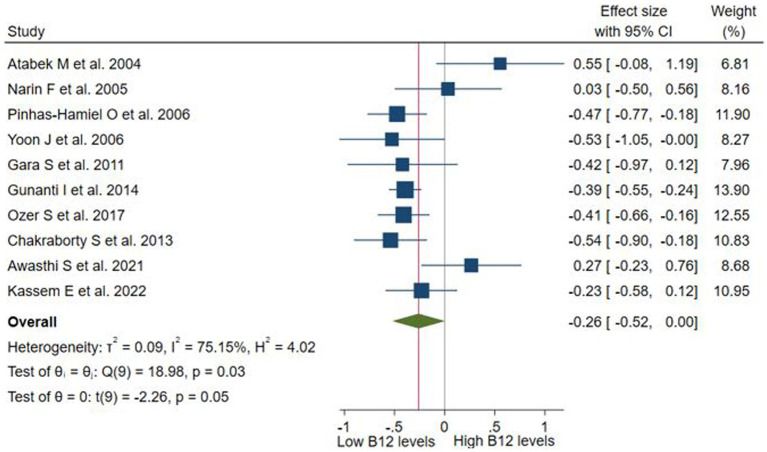
Figure 2: Differences in serum levels of vitamin B12 among children or adolescents with and without obesity.
Figure 2. From PMC11842448, CC BY (terms); resized.

Human studies

? Inconclusivehuman observationalNiger J Clin Pract · 2017

Evaluation of serum Vitamin B12 level and related nutritional status among apparently healthy obese female individuals.

Number of participants not stated in abstractCross-sectional study

Cross-sectional study of women: obese participants had lower B12 levels and more B12 deficiency than non-obese, an association that does not show B12 causes weight loss.

Key resultB12 282.5 +/- 106.8 (nonobese) vs 242.5 +/- 107.5 pg/mL (obese), P = 0.001; B12 deficiency 37.6% vs 24.7% in obese vs nonobese (P = 0.019)
Studied
Women, obese and non-obese
Compared with
Non-obese women
Main outcome
Serum vitamin B12 level and deficiency
Authors' conclusion
Obesity was associated with low vitamin B12 in obese women, and consumption of certain foods contributes to higher B12 levels.
Limitations
Cross-sectional association only; cannot show that B12 affects weight.

Reviews

? InconclusivereviewCrit Rev Food Sci Nutr · 2013

Plant-based foods as a source of lipotropes for human nutrition: a survey of in vivo studies.

No new dataSurvey/review of in vivo studies, mainly rat

Review of 'lipotropes' (choline, betaine, inositol, methionine, carnitine): fat-mobilising effects come mainly from rat studies; human intervention studies are practically non-existent.

Studied
Plant-derived lipotropes and phytochemicals
Authors' conclusion
Several plant compounds may be lipotropic in rats, but this remains to be confirmed in humans, for whom intervention studies are practically non-existent.
Limitations
Mostly rat data; human intervention studies lacking.

Verdicts are judged on each paper's own main outcome; grades run from A (strong human evidence) to D (little or none). Details are read from the abstracts, and figures are reproduced only from openly licensed full texts. Not medical advice.