Peptide Price Finder

Home · Research · Skin, hair & tanning

Melanotan I research

What published studies found for Melanotan I: 7 papers, 4 in humans, with sample sizes and key results.

B
Some human evidence
Why: Approved as afamelanotide for EPP on two placebo-controlled RCTs with only 168 patients, plus one 55-patient vitiligo trial; no trials of tanning injections.

Melanotan I is the research name of afamelanotide, an approved implant for erythropoietic protoporphyria (EPP). Randomized trials (two placebo-controlled trials with 168 EPP patients and one 55-patient vitiligo trial) show modest benefits in pain-free sun exposure and repigmentation; evidence about unlicensed 'Melanotan I' injections sold online is limited to case reports of mole changes.

✓ 4 positive✗ 2 negative? 1 inconclusive

Approved afamelanotide implants have trial safety data; unlicensed injectable 'Melanotan I' products have not been tested.

US compounding: FDA-approved drug. Approved as afamelanotide (Scenesse implant) for erythropoietic protoporphyria; injectable research melanotan-I isn't an approved product. Status for every peptide.

Browse and filter these papersMelanotan I prices and vendors

Reported side effects

Human studies

✓ Positivehuman RCTN Engl J Med · 2015

Afamelanotide for Erythropoietic Protoporphyria.

Two RCTs: 74 patients (EU) and 94 patients (US)Two multicenter randomized double-blind placebo-controlled trials of 16 mg afamelanotide implants every 60 days180 days (EU) and 270 days (US)

Two placebo-controlled RCTs in EPP (74 EU and 94 US patients) with 16 mg implants: pain-free time in direct sunlight increased (US median 69.4 vs 40.8 h, P=0.04; EU 6.0 vs 0.8 h, P=0.005), phototoxic reactions fell and quality of life improved; adverse events were mostly mild.

Key resultUS: median pain-free time 69.4 vs 40.8 hours (P=0.04); EU: 6.0 vs 0.8 hours (P=0.005); phototoxic reactions 77 vs 146 (P=0.04)
Studied
Patients with erythropoietic protoporphyria
Compared with
Placebo implant
Main outcome
Hours of direct sunlight exposure without pain
Authors' conclusion
Afamelanotide had an acceptable side-effect profile and increased pain-free sun exposure and quality of life in erythropoietic protoporphyria.
✓ Positivehuman RCTJAMA Dermatol · 2015

Afamelanotide and narrowband UV-B phototherapy for the treatment of vitiligo: a randomized multicenter trial.

55 randomized (28 combination, 27 NB-UV-B alone)Randomized multicenter trialAfamelanotide monthly for 4 months; repigmentation assessed to day 168

55 adults with vitiligo randomized to narrowband UV-B plus afamelanotide or UV-B alone: repigmentation was faster and greater with the combination (48.6% vs 33.3% at day 168), mainly in darker skin types; nausea and minor infections occurred in the combination group.

Key resultRepigmentation at day 168 was 48.64% (95% CI 39.49%-57.80%) with combination vs 33.26% (95% CI 24.18%-42.33%) with NB-UV-B alone
Studied
Adults with Fitzpatrick skin phototype III to VI and nonsegmental vitiligo involving 15% to 50% of body surface area
Compared with
Narrowband UV-B monotherapy
Main outcome
Vitiligo Area Scoring Index and VETF repigmentation
Authors' conclusion
Afamelanotide implant plus NB-UV-B gave faster, statistically superior repigmentation than NB-UV-B alone, more noticeably in skin phototypes IV to VI.
Limitations
Small trial; adverse events included erythema, minor infections and nausea.
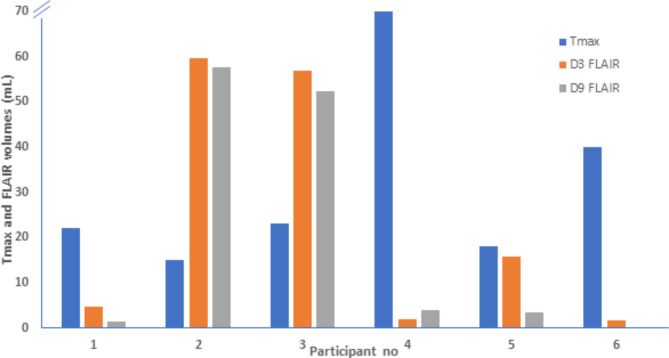
? Inconclusivehuman trialBMC Neurol · 2023

A feasibility and safety study of afamelanotide in acute stroke patients - an open label, proof of concept, phase iia clinical trial.

n = 6 humansOpen-label proof-of-concept phase IIa feasibility and safety trialFollow-up to Day 42

Open-label phase IIa in 6 acute stroke patients: implants were tolerated; one fatal recurrent stroke was judged unrelated; neurological scores improved but there was no control group.

Key resultMedian NIHSS improved from 6 to 2 on D7 in surviving patients; one fatal recurrent stroke judged unrelated to study drug
Studied
Acute ischemic stroke patients within 24 h of onset, ineligible for revascularisation
Compared with
None
Main outcome
Treatment-emergent adverse events and neurological assessments
Sample
6 acute ischemic stroke patients
Authors' conclusion
Afamelanotide was well tolerated and safe in this small sample, with apparent good recovery and radiological improvement that needs testing in randomized studies.
Limitations
Six patients, open-label, no control group.
Fig. 3: Comparison of Tmax and FLAIR volumes for all patients
Fig. 3. From PMC10373257, CC BY (terms); resized.
✗ Negativehuman observationalBr J Dermatol · 2024

The effects of cholecalciferol and afamelanotide on vitamin D levels in erythropoietic protoporphyria: a multicentre cohort study.

n = 230 humansMulticentre observational cohort study using routinely collected data2005 to 2021 data

Cohort of 230 EPP patients: afamelanotide alone did not raise vitamin D levels (beta = 0.5, 95% CI -3.2 to 4.2) and vitamin D deficiency remained common; only cholecalciferol raised levels.

Key resultAfamelanotide alone: beta = 0.5 (95% CI -3.2 to 4.2); cholecalciferol beta = 11.6 (95% CI 7.2-15.9); combined beta = 15.2 (95% CI 12.3-18.1)
Studied
Adults with erythropoietic protoporphyria from two centers (Netherlands, Germany)
Compared with
Untreated vs cholecalciferol vs afamelanotide vs combined
Main outcome
Vitamin D levels
Sample
230 patients, 1774 vitamin D measurements
Authors' conclusion
Afamelanotide did not affect vitamin D levels; cholecalciferol remains essential for vitamin D deficiency in EPP.
Limitations
Observational, routinely collected data.

Reviews

✓ PositivereviewAm J Clin Dermatol · 2016

Afamelanotide: A Review in Erythropoietic Protoporphyria.

No new dataDrug review of efficacy and tolerability in erythropoietic protoporphyria

Review of EPP trials: in phase III CUV039, afamelanotide increased time in direct sunlight without pain vs placebo; generally well tolerated, with headache and implant-site reactions commonly reported.

Compared with
Placebo (in the reviewed trials)
Main outcome
Light tolerance
Authors' conclusion
Afamelanotide improved light tolerance versus placebo in EPP, was generally well tolerated, and is a useful addition to EPP management.
✓ PositivereviewJ Drugs Dermatol · 2021

Afamelanotide: An Orphan Drug with Potential for Broad Dermatologic Applications.

No new dataLiterature review of afamelanotide in cutaneous diseases

Review: RCT evidence supports use beyond EPP in polymorphic light eruption and vitiligo, with smaller studies in acne and other conditions; no serious adverse effects reported, but diffuse hyperpigmentation occurs in almost all patients. Larger studies are needed.

Authors' conclusion
RCT evidence supports use beyond EPP (polymorphic light eruption, vitiligo); no serious adverse effects reported but diffuse hyperpigmentation is nearly universal; larger studies are needed.
✗ NegativereviewHautarzt · 2015

[Undesirable pigmentation].

No new dataNarrative review of hyperpigmentation

Dermatology review on unwanted pigmentation: case reports describe activation of dysplastic nevi by unlicensed melanotan I, which the authors describe as dangerous.

Authors' conclusion
Melanotan I can activate dysplastic nevi, and melanotan I and bleaching creams are dangerous; hyperpigmentation is best treated with combination therapy.
Limitations
No guidelines established.

Verdicts are judged on each paper's own main outcome; grades run from A (strong human evidence) to D (little or none). Details are read from the abstracts, and figures are reproduced only from openly licensed full texts. Not medical advice.