Peptide Price Finder

Home · Research · Mitochondria & energy

Methylene Blue research

What published studies found for Methylene Blue: 7 papers, 7 in humans, with sample sizes and key results, plus 128 registered clinical trials.

B
Some human evidence
Why: Only small RCTs of methylene blue itself (memory, bipolar depression); the large Alzheimer's trials used the related LMTM/HMTM and missed their goals.

Human RCTs give mixed results: small studies found single low doses of methylene blue improved memory-task performance and that it eased residual depression in bipolar disorder, but large phase 3 Alzheimer's trials of the related compound LMTM/HMTM missed their primary endpoints. It can cause serotonin syndrome when combined with serotonergic antidepressants.

✓ 2 positive✗ 2 negative~ 1 mixed? 2 inconclusive

Serious serotonin toxicity has been reported when methylene blue is given to people taking SSRIs or similar drugs.

Browse and filter these papersMethylene Blue prices and vendors

Reported side effects

Registered clinical trials

128 trials of Methylene Blue on ClinicalTrials.gov: 22 active, 71 completed, 19 with posted results. Registered trials include ones that haven't published yet.

TrialStatusPhasePeopleSponsor
Efficacy of Methylene Blue Plus Ropivacaine for Post-Hemorrhoidectomy Pain.NCT07164807 · started 2025-08-30Not yet recruitingPhase 4177The Affiliated Hospital of Putian University
Intravenous Methylene Blue for Treating Refractory Neonatal Septic ShockNCT06306001 · started 2024-03-15Not yet recruitingPhase 2, Phase 3130Post Graduate Institute of Medical Education and Research, Chandigarh
Efficacy of Methylene Blue Photodynamic Therapy for Treatment of Deep Tissue AbscessesNCT06052956 · started 2026-07-15Not yet recruitingPhase 2120University of Rochester
Randomised Controlled Trial of Fluorescent Urography Using Intravenous Methylene Blue Compared to White Light Alone in Left-sided Colorectal SurgeryNCT07835932 · started 2026-10-01Not yet recruitingPhase 4108Chinese University of Hong Kong
Comparison of Two-Position and Four-Position Cervical Injection Techniques for Sentinel Lymph Node Mapping in Endometrial Cancer Using Methylene BlueNCT07040657 · started 2025-05-01Recruiting–100Dokuz Eylul University
Perineural Methylene Blue Infusion in Lower Limb Amputation SurgeryNCT05830630 · started 2023-05-01Recruiting–72Tanta University
The Effect of Methylene Blue Infiltrating Injection on Anal Pain After Milligan-Morgan Surgery: A Randomized Controlled Clinical StudyNCT06660680 · started 2024-10-25Enrolling by invitationPhase 360The Second Affiliated Hospital of Anhui University of Traditional Chinese Medicine
Evaluation of Perioperative Cystoscopy and Methylene Blue Test in Detecting Complications in TVT and TOT ProceduresNCT06801938 · started 2025-01-01Recruiting–58Gaziosmanpasa Research and Education Hospital
A Phase 2 Study of Methylene Blue Photodynamic Therapy for Treatment of Breast AbscessesNCT07179003 · started 2027-07Not yet recruitingPhase 250University of Rochester
Topical Methylene Blue-Photodynamic Therapy (MB-PDT) for Burn Wound InfectionNCT07494773 · started 2026-06Not yet recruitingEarly phase 150University of Oklahoma
Early Methylene Blue in the Microhemodynamics of Septic PatientsNCT07264543 · started 2026-01-09RecruitingPhase 2, Phase 350Centro de Estudos e Pesquisa em Emergencias Medicas e Terapia Intensiva
Exploring Different Dose-frequency Home Photodynamic Therapy Protocols Using a Novel Home-targeted LED Device for OnychomycosisNCT07012343 · started 2025-01-13Active, not recruiting–50Chulalongkorn University

All 128 Methylene Blue trials, with countries and recruiting status

Meta-analyses & systematic reviews

✗ Negativesystematic reviewPsychosomatics · 2010

The role of methylene blue in serotonin syndrome: a systematic review.

n = 26 humansSystematic review of case reports and clinical audits

Review of 9 case reports and 2 audits: 26 patients developed acute confusion after IV methylene blue, 25 of whom were on serotonergic drugs, consistent with serotonin syndrome.

Studied
Patients who received methylene blue and developed confusion, neuropsychiatric complications or autonomic instability (24 were taking an SRI)
Main outcome
Serotonin syndrome after methylene blue
Sample
9 case reports and 2 retrospective reviews; 26 patients developed an acute confusional state
Authors' conclusion
Serotonin reuptake inhibitors can interact with methylene blue, causing a serious adverse reaction consistent with serotonin syndrome.
Limitations
Based on case reports and retrospective reviews.
Human studies

✗ Negativehuman RCTLancet · 2016

Efficacy and safety of tau-aggregation inhibitor therapy in patients with mild or moderate Alzheimer's disease: a randomised, controlled, double-blind, parallel-arm, phase 3 trial.

n = 891 humansRandomised, controlled, double-blind, parallel-group phase 3 trial of LMTM (a reduced methylthioninium form), 3:3:415 months (primary outcomes at week 65)

Phase 3 RCT (891 patients with mild-moderate Alzheimer's disease): LMTM, a reduced form of methylthioninium, showed no benefit on cognition or daily function over 15 months.

Key resultADAS-Cog vs control: 75 mg -0·02 (p=0·9834), 125 mg -0·43 (p=0·9323); ADCS-ADL: 75 mg -0·93 (p=0·8659), 125 mg -0·34 (p=0·9479)
Studied
Patients under 90 with mild to moderate Alzheimer's disease, 115 centres in 16 countries
Compared with
Control LMTM 4 mg twice daily (for blinding)
Main outcome
Change in ADAS-Cog and ADCS-ADL at week 65
Sample
891 participants randomized (357 control, 268 LMTM 75 mg, 266 LMTM 125 mg)
Authors' conclusion
The primary analysis was negative and the results do not suggest benefit of LMTM as add-on treatment for mild to moderate Alzheimer's disease.
Limitations
Control arm received low-dose LMTM; many patients used other Alzheimer's medicines.
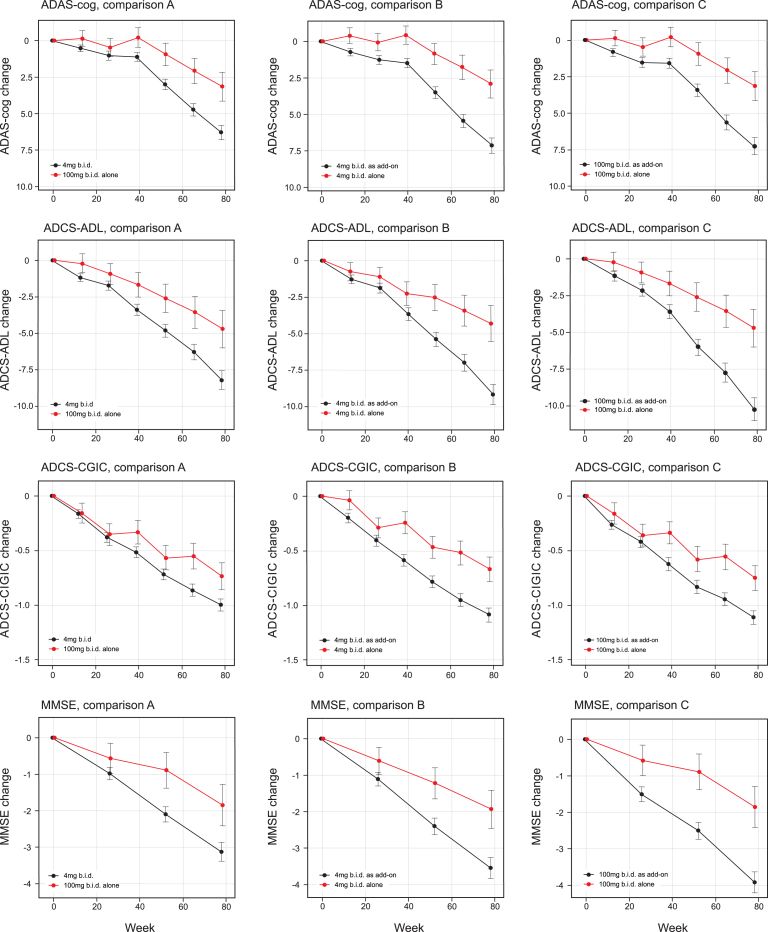
? Inconclusivehuman RCTJ Alzheimers Dis · 2018

Potential of Low Dose Leuco-Methylthioninium Bis(Hydromethanesulphonate) (LMTM) Monotherapy for Treatment of Mild Alzheimer's Disease: Cohort Analysis as Modified Primary Outcome in a Phase III Clinical Trial.

n = 800 humansNon-randomized cohort analyses as modified primary outcomes within an 18-month phase III trial of LMTM18 months

Revised, non-randomized cohort analysis of an 800-patient phase 3 LMTM trial suggested benefit for monotherapy users; authors state a new randomized trial is needed.

Studied
Patients with mild Alzheimer's disease
Compared with
LMTM 4 mg twice a day (randomized control, add-on or monotherapy)
Main outcome
ADAS-cog, ADCS-ADL, MRI atrophy, glucose uptake
Sample
800 mild AD patients randomized; monotherapy subgroups n = 79 and n = 76
Authors' conclusion
Results support the hypothesis that LMTM might be effective as monotherapy and that 4 mg twice a day may work as well as higher doses; a further randomized trial is required.
Limitations
Primary analysis revised before unblinding to non-randomized subgroup comparisons; monotherapy vs add-on is not randomized.
Fig.2: Least squares estimates of mean change from baseline and S.E. on primary and principal secondary outcomes. Primary analyses as defined in th
Fig.2. From PMC5734125, CC BY (terms); resized.
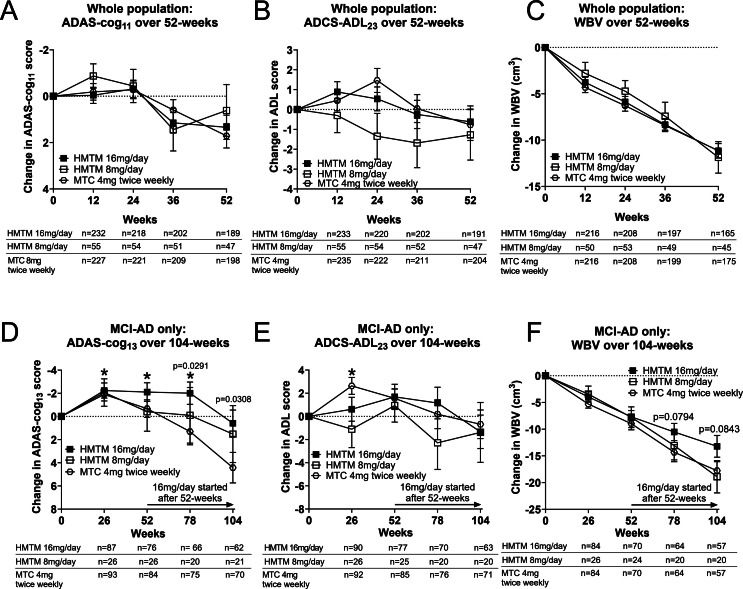
~ Mixedhuman RCTJ Prev Alzheimers Dis · 2026

Clinical, imaging and blood biomarker outcomes in a Phase 3 clinical trial of tau aggregation inhibitor hydromethylthionine mesylate in mild cognitive impairment and mild to moderate dementia due to Alzheimer's disease.

n = 598 humansPhase 3 trial with modified delayed-start design; hydromethylthionine mesylate (HMTM) 16 or 8 mg/day52 weeks controlled, followed to 104 weeks

Phase 3 trial of HMTM (598 patients, MCI or mild-moderate Alzheimer's): no separation on primary clinical endpoints at 52 weeks, with later cognitive and biomarker differences in the MCI subgroup.

Key resultNo significant co-primary difference at 52 weeks; in MCI, ADAS-cog13 differences at 78 weeks (p = 0·0291) and 104 weeks (p = 0·0308); NfL progression reduced at 52 weeks (p = 0·0291)
Studied
Participants with MCI or mild to moderate dementia due to Alzheimer's disease, 82 centres
Compared with
Methylthioninium chloride 4 mg twice weekly (urinary colourant for blinding)
Main outcome
ADAS-cog11 and ADCS-ADL23; NfL, pTau217 and grey matter atrophy biomarkers
Sample
598 amyloid β-PET positive participants (263 MCI, 335 mild to moderate dementia)
Authors' conclusion
Symptomatic activity in the control arm precluded separation on primary endpoints at 52 weeks; in MCI, clinical separation emerged only at 78 and 104 weeks. HMTM was well tolerated.
Limitations
Primary clinical endpoints not met at 52 weeks; control arm had symptomatic activity; later findings partly rely on external controls.
Fig. 2: Cognitive, functional, and imaging endpoints. Prespecified efficacy results for the co-primary clinical, functional and secondary endpoints
Fig. 2. From PMC12861207, CC BY (terms); resized.
✓ Positivehuman RCTBr J Psychiatry · 2017

Methylene blue treatment for residual symptoms of bipolar disorder: randomised crossover study.

Thirty-seven participants enrolledDouble-blind randomised crossover study6 months

Crossover RCT in 37 people with bipolar disorder: methylene blue improved residual depression and anxiety scores, but not cognition.

Key resultActive dose 195 mg improved depression on MADRS and HAM-D (P = 0.02 and 0.05) and anxiety on HAM-A (P = 0.02)
Studied
Patients with bipolar disorder treated with lamotrigine
Compared with
Low dose methylene blue 15 mg ('placebo')
Main outcome
Depression, mania, anxiety and cognitive functioning
Authors' conclusion
Methylene blue as adjunct improved residual depression and anxiety symptoms in bipolar disorder; effects on cognition were not significant.
Limitations
Comparator was a low active dose rather than inert placebo; small sample.
✓ Positivehuman RCTRadiology · 2016

Multimodal Randomized Functional MR Imaging of the Effects of Methylene Blue in the Human Brain.

Twenty-six healthy subjects enrolled (age 22-62)Prospective randomized, double-blinded, placebo-controlled fMRI trial; single low oral doseSingle dose; imaging 1 hour after administration

RCT in 26 healthy adults: a single low dose of methylene blue increased brain fMRI responses and improved correct memory-retrieval answers by 7% versus placebo.

Key result7% increase in correct responses during memory retrieval (P = .01)
Studied
Healthy adults
Compared with
Placebo
Main outcome
fMRI activity during sustained attention and short-term memory tasks
Authors' conclusion
Low-dose methylene blue can increase functional MR imaging activity during sustained attention and short-term memory tasks and enhance memory retrieval.
Limitations
Healthy volunteers, single dose, small sample.
? Inconclusivehuman RCTBrain Imaging Behav · 2017

Methylene blue modulates functional connectivity in the human brain.

HumansRandomized, double-blinded, placebo-controlled task-based and task-free fMRI; single low oral doseSingle dose; imaging 1 hour after administration

Placebo-controlled fMRI study in healthy adults: a single low dose altered brain network connectivity; no clinical outcomes were measured.

Studied
Healthy adults
Compared with
Placebo
Main outcome
Cerebral blood flow and functional connectivity
Authors' conclusion
Low-dose methylene blue modulated task-related and resting-state neural networks, supporting further investigation in healthy and disease populations.
Limitations
Single dose in healthy adults; sample size not given in abstract.

Verdicts are judged on each paper's own main outcome; grades run from A (strong human evidence) to D (little or none). Details are read from the abstracts, and figures are reproduced only from openly licensed full texts. Not medical advice.