Peptide Price Finder

Home · Research · Mitochondria & energy

MOTS-c research

What published studies found for MOTS-c: 10 papers, 0 in humans, with sample sizes and key results, plus 2 registered clinical trials.

C
Mostly animal studies
Why: No human trials of MOTS-c given as a treatment; benefits on metabolism and muscle come from multiple mouse studies and cell cultures.

MOTS-c is a mitochondria-derived peptide whose benefits (less diet-induced obesity, better insulin sensitivity, improved physical capacity) have been shown only in mice and cells. No published human trials of MOTS-c administration were found; human data are limited to measurements of natural MOTS-c levels.

✓ 7 positive✗ 1 negative~ 1 mixed? 1 inconclusive

No human safety data in the published literature.

US compounding: Recommended for compounding, not legal yet. FDA's Pharmacy Compounding Advisory Committee voted on July 23-24, 2026 to recommend adding it to the 503A bulks list (FDA staff had recommended against). The vote isn't binding: compounding stays illegal until FDA accepts it and finishes proposed and final rulemaking, which typically takes a year or more. Vote: 7-5 (evaluated for obesity and osteoporosis). Status for every peptide.

Browse and filter these papersMOTS-c prices and vendors

Registered clinical trials

2 trials of MOTS-c on ClinicalTrials.gov: 1 active, 1 completed. Registered trials include ones that haven't published yet.

TrialStatusPhasePeopleSponsor
MOTS-c for Improving Insulin Sensitivity in Adults With Prediabetes and Overweight/ObesityNCT07505745 · started 2026-02-02RecruitingPhase 2120Hudson Biotech
A Phase 1a/1b Study of CB4211 in Healthy Non-obese Subjects and Subjects With Nonalcoholic Fatty Liver DiseaseNCT03998514 · started 2018-07-09CompletedPhase 188CohBar, Inc.

All 2 MOTS-c trials, with countries and recruiting status

Reviews

? InconclusivereviewSports Med · 2026

Safety and Efficacy of Approved and Unapproved Peptide Therapies for Musculoskeletal Injuries and Athletic Performance.

No new dataNarrative review of approved and unapproved peptides including sermorelin

Review of gray-market peptides used in sports medicine, including MOTS-c: animal results are favourable but rigorous human safety data are scarce, with potential for serious harm.

Authors' conclusion
Many unapproved peptides show favorable tissue repair and metabolic outcomes in animal models, but rigorous human safety data are scarce and there is potential for serious harm to patients.
Limitations
Covers twelve peptides, not sermorelin alone; no original data.
Animal & lab studies

✓ PositiveanimalCell Metab · 2015

The mitochondrial-derived peptide MOTS-c promotes metabolic homeostasis and reduces obesity and insulin resistance.

AnimalsIdentification of MOTS-c, a 16-amino-acid peptide encoded in mitochondrial 12S rRNA, with mouse treatment studies

Discovery study: MOTS-c treatment in mice prevented age- and high-fat-diet-induced insulin resistance and diet-induced obesity.

Studied
Mice (age-dependent and high-fat-diet models) and cells
Main outcome
Insulin sensitivity, obesity, AMPK activation, folate cycle
Authors' conclusion
MOTS-c treatment prevented age-dependent and high-fat-diet-induced insulin resistance and diet-induced obesity in mice, suggesting mitochondria regulate metabolic homeostasis via genome-encoded peptides.
Limitations
Mouse study.
✓ PositiveanimalNat Commun · 2021

MOTS-c is an exercise-induced mitochondrial-encoded regulator of age-dependent physical decline and muscle homeostasis.

Humans and animalsMOTS-c treatment in mice, including late-life intermittent treatment (3x/week) started at 23.5 mo.

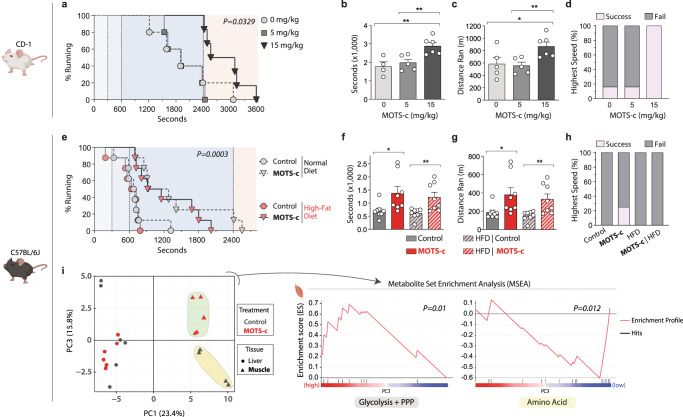
MOTS-c improved physical performance in young, middle-aged and old mice, and late-life treatment increased physical capacity; in humans, exercise raised endogenous MOTS-c levels.

Studied
Young (2 mo.), middle-age (12 mo.) and old (22 mo.) mice; human exercise samples
Main outcome
Physical performance, healthspan, muscle metabolism, nuclear gene regulation
Authors' conclusion
MOTS-c enhanced physical performance in mice of all ages and late-life treatment increased physical capacity and healthspan; in humans, exercise induces endogenous MOTS-c in muscle and circulation.
Limitations
Efficacy shown in mice; human data limited to exercise-induced expression.
Fig. 2: MOTS-c treatment increases physical capacity in young mice regardless of diet.a–c Treadmill performance of 12-week-old male CD-1 (outbred) m
Fig. 2. From PMC7817689, CC BY (terms); resized.
✓ PositiveanimalPharmacol Res · 2022

The mitochondrial-derived peptide MOTS-c relieves hyperglycemia and insulin resistance in gestational diabetes mellitus.

AnimalsDaily MOTS-c administration during pregnancyDuring pregnancy

In a gestational diabetes mouse model, MOTS-c lowered blood glucose, improved insulin sensitivity and reduced offspring deaths.

Studied
Mouse model of gestational diabetes (short-term high-fat diet plus low-dose streptozotocin)
Compared with
Untreated GDM mice
Main outcome
Blood glucose and insulin, glucose and insulin tolerance, reproductive outcomes
Authors' conclusion
MOTS-c alleviated hyperglycemia, improved insulin sensitivity and glucose tolerance, reduced birth weight and offspring death in GDM mice, and may be a promising strategy for gestational diabetes.
Limitations
Mouse model.
✓ PositiveanimalAm J Physiol Endocrinol Metab · 2024

Mitochondrial-derived microprotein MOTS-c attenuates immobilization-induced skeletal muscle atrophy by suppressing lipid infiltration.

Three groups of male C57BL/6J mice (10 wk old); group sizes not statedRandomized groups: non-immobilized control, immobilized control, immobilized plus MOTS-c 15 mg/kg/day8 days

In immobilised mice, MOTS-c limited muscle loss to about 5% versus 15% in untreated controls and lowered inflammatory cytokines.

Key resultImmobilization reduced muscle mass by about 15% whereas MOTS-c limited the reduction to 5%
Studied
Male C57BL/6J mice with casting-tape immobilization
Compared with
Immobilized control injected with sterile water
Main outcome
Skeletal muscle mass, AKT/FOXO signaling, cytokines, lipid infiltration
Authors' conclusion
MOTS-c attenuated immobilization-induced muscle atrophy in mice, apparently by suppressing muscle lipid infiltration via adipogenesis-related genes.
Limitations
Mouse study; group sizes not stated in abstract.
✓ PositiveanimalFree Radic Biol Med · 2026

MOTS-c improves intrinsic muscle mitochondrial bioenergetic health and efficiency in a PGC-1α/AMPK-dependent manner.

Humans and animalsMOTS-c administration in mice with PGC-1alpha and AMPK dependence tests; human arterio-venous difference measurement

MOTS-c improved mouse muscle mitochondrial efficiency and lowered oxidative stress via PGC-1alpha and AMPK; a human exercise component found muscle may not be the source of circulating MOTS-c.

Studied
Two transgenic mouse strains (skeletal muscle) and humans performing one-legged knee extensor exercise
Main outcome
Muscle mitochondrial bioenergetics, ROS emission, circulating MOTS-c
Authors' conclusion
MOTS-c improved muscle mitochondrial bioenergetics in a PGC-1alpha/AMPK-dependent manner and lowered ROS. In humans, no arterio-venous difference suggested skeletal muscle may not be the source of circulating MOTS-c after exercise.
Limitations
Mechanistic mouse work; small human exercise measurement.
~ MixedanimalFront Med (Lausanne) · 2026

MOTS-c partially protects against skeletal muscle deterioration in C26 cachexia.

Humans and animalsIn vitro myotube assay plus vehicle-controlled mouse study

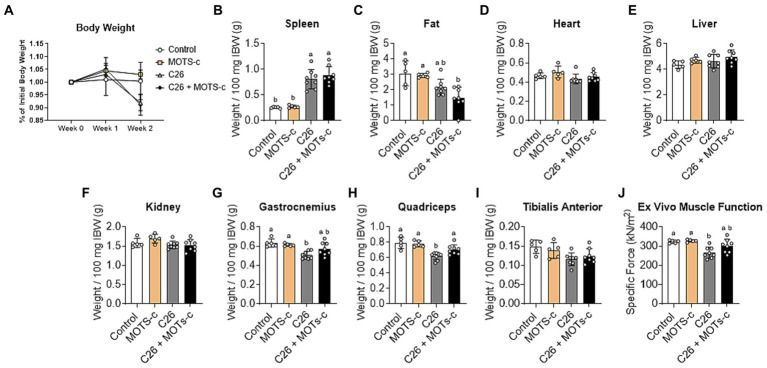
In mice with Colon-26 cancer cachexia, MOTS-c did not prevent body-weight or fat loss but preserved skeletal muscle (quadriceps weight +12% vs vehicle), with more PGC-1alpha and AMPK signalling in myotubes.

Key resultQuadriceps weight +12% vs C26 vehicle; MOTS-c did not prevent total body weight or fat loss; in myotubes PGC-1alpha mRNA +84.6% and AMPK phosphorylation +103.1%
Studied
Differentiated myotubes and male mice bearing Colon-26 carcinoma
Compared with
Vehicle-treated tumour-bearing mice
Main outcome
Body weight, organ and muscle mass, FOXO signalling, atrogenes and mitochondrial biogenesis markers
Authors' conclusion
MOTS-c partially protects against skeletal muscle loss in C26 cachexia, supporting therapeutic potential; the authors note human studies are needed.
Limitations
Mouse model; only partial protection and no effect on body weight.
Figure 1: (A) Body weight, (B) spleen, (C) fat, (D) heart, (E) liver, and (F) kidney, (G) gastrocnemius, (H) Quadriceps, (I) tibialis anterior muscle.
Figure 1. From PMC13243040, CC BY (terms); resized.
✓ PositiveanimalElife · 2026

MOTS-c is a mitochondrial-encoded interferon-linked host defense peptide.

Humans and animalsIn vitro and mouse laboratory study

MOTS-c showed direct antibacterial activity against E. coli and MRSA, fully neutralized MRSA in a mouse peritonitis model, and reprogrammed mouse monocytes into macrophages with better bacterial clearance.

Studied
Bacteria, human and mouse monocytes/macrophages, and a mouse model of acute peritonitis
Main outcome
Antibacterial activity, MRSA infectivity in mice, macrophage transcriptome and bacterial clearance
Authors' conclusion
The authors present MOTS-c as a first-in-class mitochondrial-encoded host defense peptide.
Limitations
Mechanistic cell and mouse work; no human administration.
✗ Negativein vitroInflamm Regen · 2026

Mitochondrial-derived peptide MOTS-c activates metabolic signaling but blunts reparative function in human mesenchymal stromal cells.

Cells from 6 obese and 6 lean donors (n = 6/group); mouse model of renal artery stenosisIn vitro treatment of human MSCs plus in vivo MSC transfer into stenotic mouse kidneys

In human fat-derived mesenchymal stromal cells (6 obese and 6 lean donors), MOTS-c activated AMPK but reduced proliferation and raised senescence genes (p16, p21) and TNF-alpha; MOTS-c-pretreated cells also failed to improve mouse kidney outcomes.

Key resultMOTS-c reduced proliferation and increased p16, p21 and TNF-alpha in obese MSCs; pretreated MSCs failed to improve renal perfusion, fibrosis or tubular injury
Studied
Adipose-derived MSCs from patients with obesity and lean donors, and mice with renal artery stenosis
Compared with
Untreated MSCs (obese and lean)
Main outcome
Proliferation, senescence and inflammatory gene expression; renal perfusion, fibrosis and tubular injury
Authors' conclusion
Restoring MOTS-c signalling was insufficient to reverse obesity-induced MSC dysfunction and may exacerbate senescence and inflammation; effects of mitochondrial-derived peptides are context-dependent.
Limitations
Small donor numbers; cell-therapy context rather than direct peptide administration.
✓ Positivein vitroPhysiol Rep · 2026

Mitochondrial-derived peptides MOTS-c and humanin attenuate dexamethasone-induced atrophy in human skeletal muscle cells.

Cells / labIn vitro co-treatment with MOTS-c or S14G-humanin

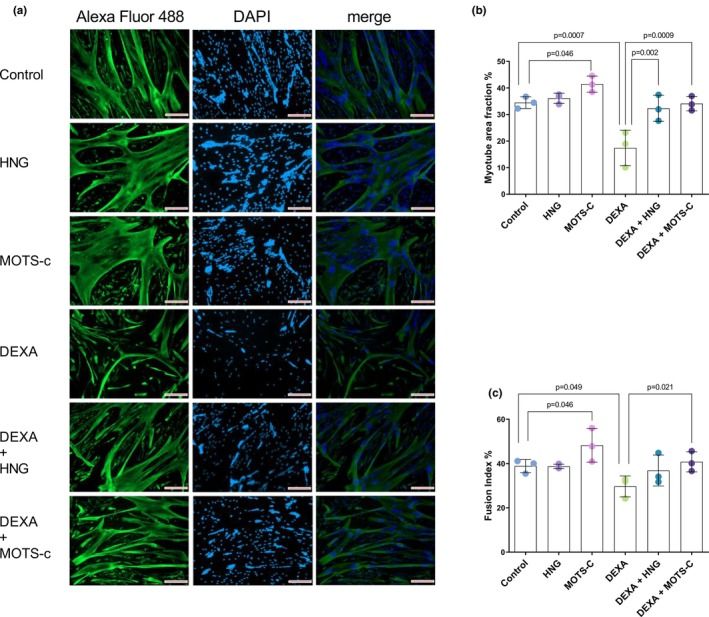
In primary human myotubes exposed to dexamethasone, MOTS-c fully preserved myotube area (p<0.001) and fusion index (p=0.02), raised Akt phosphorylation and blunted MURF1 and STAT3 activation; cultured cells at 10 uM.

Key resultMOTS-c preserved myotube area (p<0.001) and fusion index (p=0.02) and blunted MURF1 upregulation (p=0.03) and STAT3 activation (p=0.005) vs dexamethasone alone
Studied
Primary human skeletal myotubes exposed to dexamethasone
Compared with
Dexamethasone alone
Main outcome
Myotube area, fusion index, MURF1/MAFbx, Akt and STAT3 signalling
Authors' conclusion
The authors suggest MOTS-c could be an effective inhibitor of glucocorticoid-induced atrophy in human muscle via selective MURF1 inhibition, enhanced Akt signalling and suppressed STAT3.
Limitations
Cultured cells at a high concentration; no in vivo or human administration.
FIGURE 1: MOTS‐c and HNG mitigate dexamethasone‐induced myotube atrophy. Primary human skeletal muscle myotubes were treated with vehicle (Control), 1
FIGURE 1. From PMC12930096, CC BY (terms); resized.

Verdicts are judged on each paper's own main outcome; grades run from A (strong human evidence) to D (little or none). Details are read from the abstracts, and figures are reproduced only from openly licensed full texts. Not medical advice.