Peptide Price Finder

Home · Research · Cognitive & nootropic

Orexin A research

What published studies found for Orexin A: 8 papers, 5 in humans, with sample sizes and key results.

B
Some human evidence
Why: A few tiny placebo-controlled crossover trials (7-14 narcolepsy patients) show REM-sleep changes but no effect on daytime sleepiness.

Orexin A has been given intranasally in a few very small placebo-controlled crossover trials in narcolepsy and healthy men, with effects on REM sleep, olfaction and sympathetic nerve activity but not on daytime sleepiness; most other data come from rodent and primate studies.

✓ 5 positive~ 2 mixed? 1 inconclusive

No adverse effects are described in the small human trial abstracts; human exposure is limited to single doses in a few dozen people.

US compounding: Not compoundable. Not an FDA-approved drug and not nominated for FDA's 503A bulks list, so US pharmacies can't legally compound it. Status for every peptide.

Browse and filter these papersOrexin A prices and vendors

Meta-analyses & systematic reviews

~ Mixedsystematic reviewCureus · 2024

Treatment of Narcolepsy Type 1 With Orexin: A Systematic Review.

3 studies included (70 publications retrieved)Systematic review of randomized clinical trials

Systematic review of 3 human trials in narcolepsy type 1: orexin A reduced wake-REM transitions and REM time but did not increase wake time or relieve daytime sleepiness.

Studied
Humans with narcolepsy type 1 treated with orexin-A
Main outcome
Efficacy of orexin-A in narcolepsy type 1
Authors' conclusion
Orexin decreased wake-REM transitions and total REM sleep time without increasing wake time. Failure to relieve daytime sleepiness suggests orexin deficiency is not the only factor in type 1 narcolepsy.
Limitations
Only three studies met inclusion criteria.
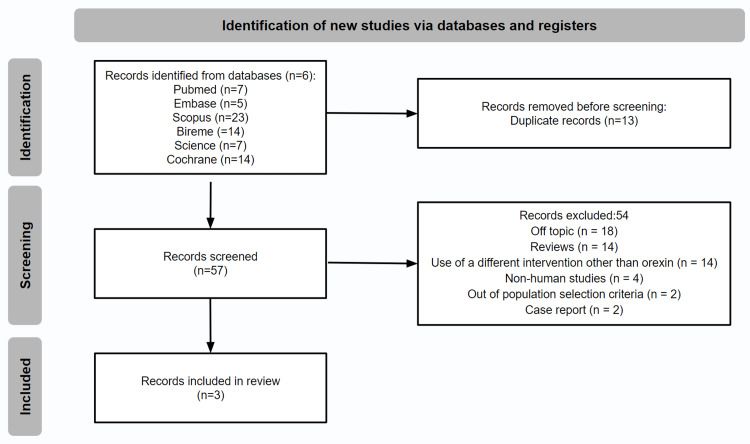
Figure 1: Flowchart of the steps that were performed in the systematic review for the identification, screening, and inclusion of the studies.
Figure 1. From PMC11781994, CC BY (terms); resized.

Human studies

? Inconclusivehuman RCTJ Neurophysiol · 2022

Intranasal orexin A modulates sympathetic vascular tone: a pilot study in healthy male humans.

n = 10 humansBalanced, double-blind crossover pilot studyMeasured 30-45 min after single dose

Crossover pilot in 10 healthy men: intranasal orexin A increased muscle sympathetic nerve activity without changing blood pressure or heart rate; physiological study only.

Key resultResting MSNA burst rate rose +5.8 ± 0.8 vs +2.1 ± 0.6 bursts/min with orexin A vs placebo (P = 0.007).
Studied
Lean healthy males, mean age 25.8 yr
Compared with
Intranasal placebo
Main outcome
Muscle sympathetic nerve activity (MSNA) and baroreflex function
Sample
10 lean healthy males
Authors' conclusion
Intranasal orexin A (500 nmol) acutely induced vasoconstrictory sympathoactivation in healthy men; BP, heart rate and baroreflex sensitivity were not altered.
Limitations
Pilot study in 10 healthy males only.
✓ Positivehuman RCTBehav Brain Res · 2014

The effect of intranasal orexin-A (hypocretin-1) on sleep, wakefulness and attention in narcolepsy with cataplexy.

Fourteen subjects with narcolepsy with cataplexyWithin-subject, random-order, double-blind crossover, placebo-controlledSingle morning dose with sleep recording that night

Crossover RCT in 14 narcolepsy-with-cataplexy patients: intranasal orexin A reduced wake-REM transitions and REM duration and reduced attention-test errors.

Key resultAfter intranasal orexin-A (435 nmol), patients had fewer wake-REM transitions and decreased REM sleep duration, and fewer false reactions in divided attention testing (no numbers in abstract).
Studied
Subjects with narcolepsy with cataplexy
Compared with
Intranasal sterile water (placebo)
Main outcome
Sleep structure, wakefulness and attention
Authors' conclusion
Results support orexin-A as a REM sleep stabilizing factor with functional effects on sleep alterations and attention in narcolepsy with cataplexy.
Limitations
Small crossover study with single dose.
~ Mixedhuman RCTSleep Med · 2011

Effects of intranasal hypocretin-1 (orexin A) on sleep in narcolepsy with cataplexy.

Eight subjects with narcolepsy with cataplexyDouble-blind, random-order crossover, placebo-controlled pilot studySingle dose before night sleep

Crossover RCT in 8 narcolepsy patients: intranasal orexin A did not change nocturnal wakefulness but reduced REM sleep and direct wake-to-REM transitions.

Key resultNo significant effect on nocturnal wakefulness; REM sleep quantity was reduced and direct wake-to-REM transitions were significantly reduced (no numbers in abstract).
Studied
Subjects with narcolepsy with cataplexy
Compared with
Placebo
Main outcome
Nocturnal polysomnography (wakefulness, REM sleep)
Authors' conclusion
Pilot evidence that intranasal hcrt-1 (435 nmol) has functional effects on sleep in narcolepsy with cataplexy; may encourage further intranasal studies.
Limitations
Pilot study with eight subjects.
✓ Positivehuman RCTBrain · 2008

Olfactory dysfunction in patients with narcolepsy with cataplexy is restored by intranasal Orexin A (Hypocretin-1).

10 narcolepsy patients and 10 matched controls; 7 patients in the crossoverCase-control olfactory comparison plus double-blind, randomized, placebo-controlled crossover of intranasal orexin A in 7 patients

Crossover RCT in 7 narcolepsy patients: intranasal orexin A improved odour detection thresholds vs placebo.

Key resultIn all patients the PEA olfactory threshold increased after orexin A (median 11.5, range 6.5-13.25) vs placebo (median 7.75, range 6.25-11.25; P < 0.05).
Studied
Narcolepsy with cataplexy patients and matched healthy controls
Compared with
Matched healthy controls; placebo
Main outcome
Olfactory TDI scores and PEA odour detection threshold
Authors' conclusion
Results support mild olfactory dysfunction as an intrinsic symptom of narcolepsy with cataplexy and that intranasal orexin A restores olfactory function.
Limitations
Small sample; crossover given to only seven patients.

Animal & lab studies

✓ PositiveanimalJ Neurosci · 2007

Systemic and nasal delivery of orexin-A (Hypocretin-1) reduces the effects of sleep deprivation on cognitive performance in nonhuman primates.

AnimalsAnimal experiment with intravenous (2.5-10.0 µg/kg) and nasal (about 1.0 µg/kg) orexin-A during a delayed match-to-sample task

In sleep-deprived rhesus monkeys, intravenous and nasal orexin A improved short-term memory task performance, nasal more than intravenous.

Key resultBoth routes significantly improved performance in sleep-deprived monkeys; nasal delivery was significantly more effective than the highest i.v. dose (10 µg/kg).
Studied
Sleep-deprived (30-36 h) rhesus monkeys
Compared with
Non-sleep-deprived alert animals; i.v. vs nasal route
Main outcome
Short-term memory task performance and cerebral glucose metabolism
Authors' conclusion
Findings provide strong evidence that intranasal orexin-A alleviates cognitive deficits produced by sleep loss in monkeys.
Limitations
Nonhuman primate study; number of animals not given in abstract.
✓ PositiveanimalJ Neuroinflammation · 2024

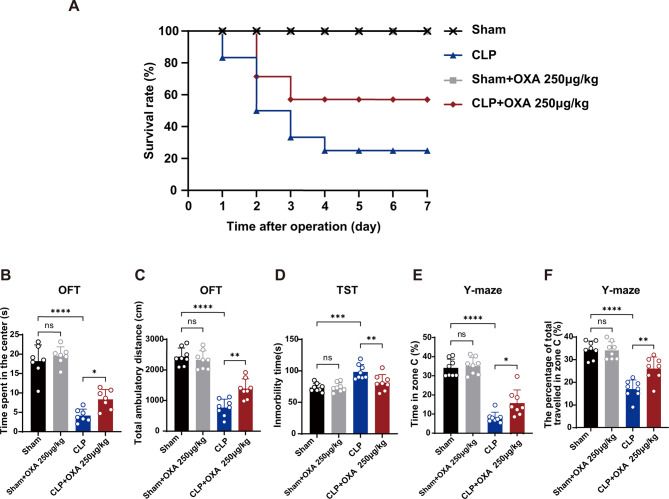
Therapeutic effects of orexin-A in sepsis-associated encephalopathy in mice.

AnimalsAnimal model with intranasal orexin-A after surgery; receptor blockers used for mechanism

In a mouse sepsis-associated encephalopathy model, intranasal orexin A reduced mortality, cognitive deficits and neuroinflammation.

Studied
Mice with sepsis-associated encephalopathy (cecal ligation and perforation)
Compared with
Untreated model; OXR1 and OXR2 blockers
Main outcome
Survival, cognition, BBB integrity, inflammation
Authors' conclusion
Intranasal OXA reduced mortality, improved cognitive and emotional deficits, protected the BBB and inhibited OXR2/RAS/MAPK activation, suggesting it may be a promising approach for sepsis-associated encephalopathy.
Limitations
Mouse study; group sizes not stated in abstract.
Fig. 2: Treatment with 250 µg/kg OXA increases 7-day survival and ameliorates cognitive and affective deficits in CLP-induced sepsis. A Survival cur
Fig. 2. From PMC11102217, CC BY (terms); resized.
✓ PositiveanimalExp Neurol · 2025

Orexin A alleviates chronic cerebral hypoperfusion-induced neuroinflammation and cognitive dysfunction by inhibiting the NEK7/NLRP3 pathway.

Humans and animalsAnimal model with 4 weeks of intranasal Orexin A (250 µg/kg) plus in vitro hypoxia experiments4 weeks of treatment after 8 weeks of modeling

In rats with chronic cerebral hypoperfusion, 4 weeks of intranasal orexin A reduced neuroinflammation and cognitive impairment.

Studied
Adult male SD rats with chronic cerebral hypoperfusion (vascular dementia model) plus BV2 microglia / HT22 neuron cultures
Compared with
Untreated hypoperfusion rats; cells without Orexin A
Main outcome
Cognition, NLRP3 inflammasome activation, microglial polarization, pyroptosis
Authors' conclusion
Orexin A restored M1/M2 microglial balance by inhibiting the NEK7/NLRP3 pathway, easing neuroinflammation and pyroptosis and improving cognition after chronic cerebral hypoperfusion in this model.
Limitations
Preclinical rat and cell study.

Verdicts are judged on each paper's own main outcome; grades run from A (strong human evidence) to D (little or none). Details are read from the abstracts, and figures are reproduced only from openly licensed full texts. Not medical advice.