Peptide Price Finder

Home · Research · Cognitive & nootropic

Orexin B research

What published studies found for Orexin B: 11 papers, 0 in humans, with sample sizes and key results.

C
Mostly animal studies
Why: No human administration studies; evidence comes from rodent and pig studies (Parkinson's, pain, sepsis, heart) and cell work.

Evidence for administered orexin B is limited to animal and cell studies (Parkinson's models, neuropathic pain, sepsis, aneurysm, cardiac protection, retina, adipose cells), and one rat study found no effect on epileptiform activity; no human administration studies were found. The only human data measure the body's own orexin B levels, for example higher plasma levels in depression.

✓ 8 positive✗ 1 negative? 2 inconclusive

No human safety data in the published literature.

US compounding: Not compoundable. Not an FDA-approved drug and not nominated for FDA's 503A bulks list, so US pharmacies can't legally compound it. Status for every peptide.

Browse and filter these papersOrexin B prices and vendors

Reviews

? InconclusivereviewNeurosci Res · 2017

The roles of orexins in sleep/wake regulation.

No new dataNarrative review

Review of orexin A and B in sleep/wake regulation: orexin signalling deficiency causes narcolepsy; does not evaluate orexin B as a treatment.

Studied
Literature on orexin neuropeptides and sleep/wake regulation
Authors' conclusion
Orexins play critical roles in maintaining wakefulness by regulating monoaminergic and cholinergic neurons, and deficient orexin signaling causes narcolepsy-cataplexy.
Limitations
Review of orexins generally (A and B), not orexin-B specifically; no original data.
Animal & lab studies

✓ PositiveanimalNeurosci Lett · 2021

Orexin-B exerts excitatory effects on nigral dopaminergic neurons and alleviates motor disorders in MPTP parkinsonian mice.

AnimalsElectrophysiology on nigral dopaminergic neurons plus intracerebroventricular orexin-B

In MPTP parkinsonian mice, intracerebroventricular orexin B reduced dopaminergic neuron degeneration and improved motor coordination.

Studied
MPTP parkinsonian mice
Compared with
Orexin-2 receptor blockade
Main outcome
Dopaminergic neuron firing, degeneration, spontaneous activity and motor coordination
Authors' conclusion
Orexin-B may protect dopaminergic neurons and improve motor disorders in parkinsonian mice, partly via excitatory effects on nigral dopaminergic neurons through orexin-2 receptor.
Limitations
Mouse model only.
✓ PositiveanimalMol Biol Rep · 2024

Orexin B protects dopaminergic neurons from 1-Methyl-4-phenyl-1,2,3,6-tetrahydropyridine-induced neurotoxicity associated with reduced extracellular signal-regulated kinase phosphorylation.

Humans and animalsIn vivo mouse model and in vitro cell model with RNA-Seq and Western blot24 h after MPP+ challenge in cells

Orexin B reduced MPTP-induced dopaminergic neuron loss and improved motor ability in mice, and reduced MPP+ toxicity in SH-SY5Y cells.

Studied
MPTP-treated mice and MPP+-treated SH-SY5Y cells (Parkinson's models)
Main outcome
Dopaminergic neuron death, pole test motor function, ERK phosphorylation
Authors' conclusion
Orexin B decreased dopaminergic neuron death, alleviated neurotoxicity and enhanced motor ability, associated with reduced ERK phosphorylation; it may have therapeutic potential for Parkinson's disease.
Limitations
Mouse and cell models only.
✓ PositiveanimalNeuropeptides · 2024

The protective effects of orexin B in neuropathic pain by suppressing inflammatory response.

AnimalsDose-dependent orexin B administration with behavioral and molecular assays

In rats with chronic constriction nerve injury, orexin B dose-dependently reduced neuropathic pain behaviour and spinal inflammation.

Studied
Rats with chronic constriction injury-induced neuropathic pain
Compared with
CCI-treated rats without orexin B
Main outcome
Mechanical withdrawal threshold, thermal withdrawal latency, spinal inflammatory markers
Authors' conclusion
Orexin B might ameliorate CCI-evoked neuropathic pain by inhibiting microglial activation and inflammatory response, via JNK/NF-kB signaling.
Limitations
Rat model only.
✓ PositiveanimalCNS Neurosci Ther · 2026

Orexin B Reduces Cerebral Aneurysms Through Inhibition of SP-1.

38 aneurysm patients and 43 healthy controls (serum levels); mice and cells for the main experimentsSerum measurement, murine aneurysm model, in vitro studiesOrexin B 30 μg/kg/day for 7 weeks

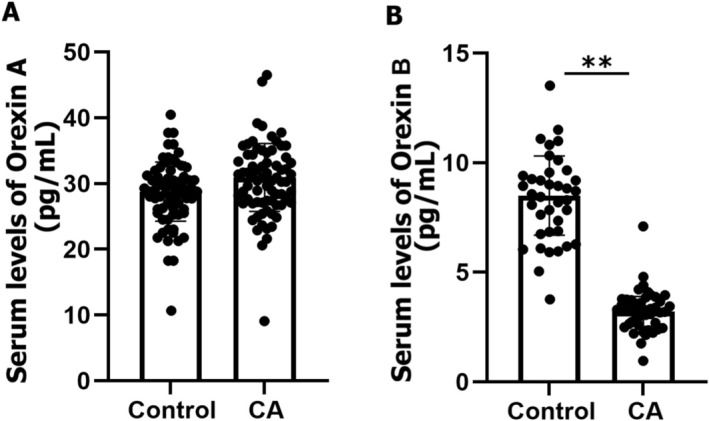
In an elastase-induced mouse aneurysm model, orexin B roughly halved aneurysm size (3.72 to 1.93 mm) via OX2R; patients with aneurysms had lower serum orexin B.

Key resultSerum Orexin B was 3.21 ± 0.52 in patients vs 8.56 ± 1.23 pg/mL in controls (p < 0.01); orexin B reduced aneurysm size in WT mice from 3.72 ± 0.469 mm to 1.93 ± 0.252 mm (p < 0.01) but not in OX2R-/- mice
Studied
Patients with cerebral aneurysms and controls; elastase-induced aneurysm in WT and OX2R knockout mice; human brain microvascular endothelial cells
Compared with
Untreated mice and OX2R-/- mice
Main outcome
Aneurysm size, inflammatory mediators, SP-1 expression
Authors' conclusion
Orexin B protects against cerebral aneurysm formation through OX2R-dependent anti-inflammatory mechanisms involving SP-1 suppression, a potential therapeutic target.
Limitations
Patient data are serum levels only; treatment effects shown in mice and cells.
FIGURE 1: Serum levels of Orexin A and Orexin B in normal individuals and CA patients. (A) Serum Orexin A levels in normal subjects (29.5 ± 4.21 pg/mL
FIGURE 1. From PMC13245276, CC BY (terms); resized.
✓ PositiveanimalBiotechnol Appl Biochem · 2025

orexin B alleviates sepsis-associated lung injury through the attenuation of pulmonary endothelial barrier dysfunction by regulating the rho-associated coiled-coil containing protein kinase 2/zonula occludens-1 (ROCK2/ZO-1) axis.

Humans and animalsFour-group animal experiment (Sham, Sham+orexin B, CLP, CLP+orexin B) plus in vitro model

In septic mice, orexin B decreased mortality and lung injury and reduced pulmonary inflammatory markers.

Studied
Mice with cecal ligation and puncture sepsis and LPS-treated mouse lung microvascular endothelial cells
Compared with
CLP without orexin B
Main outcome
Mortality, M-CASS score, lung injury, endothelial permeability
Authors' conclusion
Orexin B alleviates sepsis-induced acute lung injury by ameliorating lung endothelial permeability, via ROCK2 and ZO-1/occludin.
Limitations
Mouse and cell models only.
✓ PositiveanimalClin Sci (Lond) · 2018

Functional cardiac orexin receptors: role of orexin-B/orexin 2 receptor in myocardial protection.

Humans and animalsExpression analysis, isolated cardiomyocyte, Langendorff ischaemia/reperfusion and in vivo rat models

In rat heart models, orexin B (not orexin A) increased cardiomyocyte contraction and was cardioprotective after ischaemia/reperfusion.

Studied
Rat hearts and isolated cardiomyocytes, and human heart samples including heart failure patients
Compared with
Orexin-A
Main outcome
Contractile shortening, protein phosphorylation, ischaemia/reperfusion protection
Authors' conclusion
The authors provide evidence of a distinct orexin system in the heart that exerts a cardioprotective role via an orexin-B/OX2R pathway; OX2R expression correlated negatively with heart failure severity.
Limitations
Mostly rat models.
✓ PositiveanimalDomest Anim Endocrinol · 1999

Cloning of porcine prepro-orexin cDNA and effects of an intramuscular injection of synthetic porcine orexin-B on feed intake in young pigs.

26 cross-bred piglets in three replicates (written out in words)Intramuscular orexin-B vs vehicle injectionFeed intake monitored 24 h

In weanling pigs, a single intramuscular injection of orexin B led to an extra meal at 12 h compared with controls.

Key resultTotal feed intake at 24 h improved by 18% in orexin-treated pigs (P = 0.05); an additional meal at 12 h (P = 0.02)
Studied
Weanling piglets
Compared with
Vehicle (sterile water)
Main outcome
Feed intake
Authors' conclusion
Orexin-B stimulated feed intake in young pigs; stimulating appetite after weaning could improve swine-production efficiency.
Limitations
Single dose, short 24 h observation in pigs.
✗ NegativeanimalActa Neurobiol Exp (Wars) · 2026

Modulation of electrically evoked hippocampal epileptiform activity by exogenous orexins in the rat CA1 field.

AnimalsIn vivo electrophysiology with intraventricular or cortical orexin-A or orexin-B

In anesthetized rats, orexin-B given into the ventricle or cortex (10 µg/10 µl) did not significantly change electrically evoked hippocampal epileptiform activity, whereas orexin-A reduced it.

Studied
Anesthetized rats with electrically evoked hippocampal CA1 epileptiform discharges
Compared with
Control animals; orexin-A
Main outcome
Duration and amplitude of epileptiform discharges
Authors' conclusion
Neither cortical nor intraventricular orexin-B significantly changed evoked epileptiform activity, suggesting the orexin-A effect may involve OX1 receptor signalling.
Limitations
Acute anesthetized rat experiment; group sizes not given in the abstract.
✓ PositiveanimalNeuropharmacology · 2018

Orexin-B modulates synaptic transmission of rod bipolar cells in rat retina.

AnimalsElectroretinography and patch-clamp recordings with orexin-B and receptor/pathway blockers

In rats, intravitreal orexin-B increased the amplitude of the electroretinographic b-wave and, in retinal slices, suppressed GABA-receptor currents of rod bipolar cells through OX1R and OX2R.

Studied
Rat retina in vivo and in slices or isolated rod bipolar cells
Main outcome
Rod bipolar cell activity and GABA receptor-mediated currents
Authors' conclusion
Orexin-B potentiated rod bipolar cell activity, which the authors suggest may improve visual acuity and contrast sensitivity in the dark phase.
Limitations
Basic physiology in rat tissue; the visual benefit is speculative.
? Inconclusivein vitroDomest Anim Endocrinol · 2021

Orexin B inhibits viability and differentiation of stromal cells from swine adipose tissue.

Cells / labIn vitro orexin B treatment

Orexin B reduced proliferation and adipogenic differentiation (P < 0.05) of cultured stromal cells from swine adipose tissue.

Key resultOrexin B inhibited ASC proliferation (P < 0.05) and adipogenic differentiation (P < 0.05)
Studied
Cultured adipose-derived stromal cells from pigs
Compared with
Untreated cells
Main outcome
Cell proliferation and adipogenic differentiation
Authors' conclusion
Orexin B modifies differentiation of swine adipose stromal cells, which may be of interest for lean-meat production and obesity research.
Limitations
Pig cell culture only; obesity relevance is extrapolated.

Verdicts are judged on each paper's own main outcome; grades run from A (strong human evidence) to D (little or none). Details are read from the abstracts, and figures are reproduced only from openly licensed full texts. Not medical advice.