Peptide Price Finder

Home · Research · GLP-1 & metabolic

Retatrutide research

What published studies found for Retatrutide: 7 papers, 7 in humans, with sample sizes and key results, plus 34 registered clinical trials.

A
Strong human evidence
Why: Several phase 2-3 placebo-controlled RCTs (over 1,200 people) and two meta-analyses show large, consistent weight loss and glucose control; not yet approved.

Retatrutide (a GIP/GLP-1/glucagon triple agonist) has consistent results from several placebo-controlled human trials, mostly phase 2 plus one phase 3 diabetes trial, showing large dose-dependent weight loss (up to about 24% at 48 weeks) and improved blood sugar and liver fat; phase 3 obesity outcome data and long-term safety are not yet in the published candidates.

✓ 6 positive? 1 inconclusive

Long-term safety beyond about 48 weeks has not been reported in the published candidates.

US compounding: Not compoundable. Not an FDA-approved drug and not nominated for FDA's 503A bulks list, so US pharmacies can't legally compound it. Status for every peptide.

Browse and filter these papersRetatrutide prices and vendors

Reported side effects

Registered clinical trials

34 trials of Retatrutide on ClinicalTrials.gov: 11 active, 22 completed, 2 with posted results. Registered trials include ones that haven't published yet.

TrialStatusPhasePeopleSponsor
The Effect of Retatrutide Once Weekly on Cardiovascular Outcomes and Kidney Outcomes in Adults Living With Obesity (TRIUMPH-Outcomes)NCT06383390 · started 2024-04-30Active, not recruitingPhase 310,000Eli Lilly and Company
A Master Protocol of Multiple Agents in Adults With Metabolic Dysfunction-Associated Steatotic Liver Disease (SYNERGY-Outcomes)NCT07165028 · started 2025-10-15RecruitingPhase 34,500Eli Lilly and Company
Effect of Retatrutide Compared With Semaglutide in Adult Participants With Type 2 Diabetes and Inadequate Glycemic Control With Metformin With or Without SGLT2 Inhibitor (TRANSCEND-T2D-2)NCT06260722 · started 2024-02-21Active, not recruitingPhase 31,250Eli Lilly and Company
A Study of Retatrutide (LY3437943) Compared to Tirzepatide (LY3298176) in Adults Who Have ObesityNCT06662383 · started 2024-11-01Active, not recruitingPhase 3800Eli Lilly and Company
A Study of Retatrutide (LY3437943) in the Maintenance of Weight Reduction in Individuals With ObesityNCT06859268 · started 2025-03-05Active, not recruitingPhase 3643Eli Lilly and Company
A Study of Retatrutide (LY3437943) in Participants Without Type 2 Diabetes Who Have Obesity or OverweightNCT07357415 · started 2026-01-24Active, not recruitingPhase 3600Eli Lilly and Company
A Study of Retatrutide (LY3437943) in Participants Who Have Obesity or Overweight and Chronic Low Back PainNCT07035093 · started 2025-05-29Active, not recruitingPhase 3586Eli Lilly and Company
Effect of Retatrutide Compared With Placebo in Participants With Type 2 Diabetes and Moderate or Severe Renal Impairment, With Inadequate Glycemic Control on Basal Insulin, With or Without Metformin and/or SGLT2 Inhibitor (TRANSCEND-T2D-3)NCT06297603 · started 2024-03-15Active, not recruitingPhase 3320Eli Lilly and Company
Effect of LY3437943 Versus Placebo in Participants Who Have Obesity or Are OverweightNCT07467447 · started 2026-02-15RecruitingPhase 2300Hudson Biotech
A Study of Retatrutide (LY3437943) in Participants With Obesity or OverweightNCT07232719 · started 2025-11-17Active, not recruitingPhase 3250Eli Lilly and Company
A Study to Evaluate the Effect of Retatrutide on Insulin Secretion and Insulin Sensitivity in Adult Participants With Type 2 Diabetes MellitusNCT06982859 · started 2025-06-02Active, not recruitingPhase 195Eli Lilly and Company
A Study of LY3437943 in Participants Who Have Obesity or Are OverweightNCT04881760 · started 2021-05-20 · results postedCompletedPhase 2338Eli Lilly and Company

All 34 Retatrutide trials, with countries and recruiting status

Meta-analyses & systematic reviews

✓ Positivemeta-analysisProc (Bayl Univ Med Cent) · 2025

Efficacy and safety of retatrutide, a novel GLP-1, GIP, and glucagon receptor agonist for obesity treatment: a systematic review and meta-analysis of randomized controlled trials.

n = 878 humansSystematic review and meta-analysis of randomized controlled trials vs placebo

Pooling 3 RCTs (878 patients), retatrutide reduced body weight by 14.33% vs placebo and improved glucose and blood pressure, with no significant difference in overall adverse events; authors call for longer trials.

Key resultBody weight MD -14.33% and HbA1c MD -0.91% (both P < 0.00001); adverse events did not differ (RR 1.11, P = 0.24).
Studied
Obese patients with or without diabetes
Compared with
Placebo
Main outcome
Body weight, BMI, waist, glucose, HbA1c, blood pressure, adverse events
Sample
3 RCTs, 878 patients
Authors' conclusion
Retatrutide significantly improved body weight and metabolic outcomes with an appropriate safety profile; larger, longer trials are required.
Limitations
Only three trials; further large long-term trials needed.
✓ Positivemeta-analysisMetabol Open · 2024

Effects of once-weekly subcutaneous retatrutide on weight and metabolic markers: A systematic review and meta-analysis of randomized controlled trials.

n = 640 humansSystematic review and meta-analysis of placebo-controlled RCTs

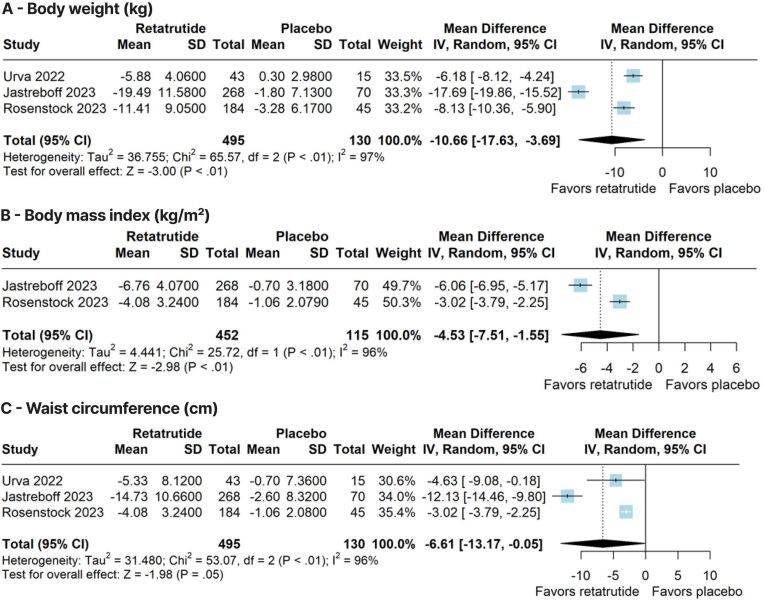
Pooling 3 RCTs (640 patients), retatrutide reduced weight by 10.66 kg vs placebo, with more non-severe GI and hypersensitivity adverse events.

Key resultBody weight WMD -10.66 kg (95% CI -17.63, -3.69); weight reduction ≥10%: RR 9.32 (95% CI 4.56-19.06).
Studied
Patients with overweight, obesity and/or type 2 diabetes
Compared with
Placebo
Main outcome
Body weight, BMI, waist circumference, weight-loss thresholds, side effects
Sample
3 studies, 640 patients (510 on retatrutide)
Authors' conclusion
Once-weekly retatrutide was associated with significant weight reduction and metabolic improvement, with more non-severe gastrointestinal and hypersensitivity adverse events. Phase 3 trials are expected for long-term data.
Limitations
Only three studies.
Fig. 2: Forest plots of pooled comparisons between retatrutide and placebo. (A) Body weight (kg). (B) Body mass index (kg/m2). (C) Waist circumferen
Fig. 2. From PMC11420505, CC BY (terms); resized.

Human studies

✓ Positivehuman RCTLancet · 2026

Efficacy and safety of retatrutide, a GIP, GLP-1, and glucagon receptor agonist, in people with type 2 diabetes and inadequate glycaemic control with diet and exercise (TRANSCEND-T2D-1): a double-blind, randomised, phase 3 trial.

n = 537 humansPhase 3 randomised, double-blind, placebo-controlled trial (TRANSCEND-T2D-1), 48 sites40 weeks

In 537 adults with type 2 diabetes, 40 weeks of retatrutide lowered HbA1c by 0.88-1.12 points more than placebo and body weight by 11.5-15.3% vs 2.6%; discontinuation due to adverse events 2-5%.

Key resultHbA1c treatment differences vs placebo ranged from -0.88% (95% CI -1.18 to -0.59) with 4 mg to -1.12% (-1.39 to -0.85) with 12 mg (all p<0.0001); bodyweight change -15.3% with 12 mg vs -2.6% placebo.
Studied
Adults with type 2 diabetes inadequately controlled by diet and exercise (HbA1c 7.0-9.5%, BMI ≥23)
Compared with
Placebo
Main outcome
Change in HbA1c from baseline to week 40
Sample
537 randomized (134, 133, 136 retatrutide; 134 placebo)
Authors' conclusion
Retatrutide monotherapy significantly improved glycaemic control and reduced bodyweight in adults with type 2 diabetes, with an adverse event profile consistent with GLP-1 agonists.
Limitations
Sponsor-funded (Eli Lilly); 40-week duration.
✓ Positivehuman RCTN Engl J Med · 2023

Triple-Hormone-Receptor Agonist Retatrutide for Obesity - A Phase 2 Trial.

n = 338 humansPhase 2 double-blind, randomized, placebo-controlled trial48 weeks

In 338 adults with obesity, 48 weeks of retatrutide reduced weight by 8.7-24.2% depending on dose vs 2.1% with placebo; GI events were dose-related and heart rate rose, peaking at 24 weeks.

Key resultAt 48 weeks the LS mean body weight change was -24.2% with 12 mg retatrutide vs -2.1% with placebo.
Studied
Adults with BMI ≥30, or 27 to <30 plus a weight-related condition
Compared with
Placebo
Main outcome
Percentage change in body weight at 24 weeks (primary) and 48 weeks
Sample
338 adults enrolled
Authors' conclusion
In adults with obesity, 48 weeks of retatrutide produced substantial, dose-related body weight reductions; GI adverse events were dose-related and partly mitigated by a lower starting dose.
Limitations
Phase 2; dose-dependent heart rate increases noted.
✓ Positivehuman RCTLancet · 2023

Retatrutide, a GIP, GLP-1 and glucagon receptor agonist, for people with type 2 diabetes: a randomised, double-blind, placebo and active-controlled, parallel-group, phase 2 trial conducted in the USA.

n = 281 humansPhase 2 randomised, double-blind, double-dummy, placebo- and active-controlled trial, 42 US sites24 weeks primary; 36 weeks secondary

In 281 people with type 2 diabetes, retatrutide at 4 mg or more lowered HbA1c by up to 2.02% and weight by up to 16.9% at 36 weeks, outperforming placebo and dulaglutide at higher doses; GI events in 35% vs 13% on placebo.

Key resultHbA1c fell by -2.02% with retatrutide 12 mg vs -0.01% placebo and -1.41% dulaglutide; weight at 36 weeks fell 16.94% (12 mg) vs 3.00% placebo.
Studied
Adults aged 18-75 with type 2 diabetes, HbA1c 7.0-10.5%, BMI 25-50
Compared with
Placebo and dulaglutide 1.5 mg
Main outcome
Change in HbA1c at 24 weeks
Sample
281 randomized and in safety analysis; 275 in efficacy analyses
Authors' conclusion
Retatrutide showed clinically meaningful glycaemic improvement and robust weight reduction in type 2 diabetes, with a safety profile consistent with GLP-1 receptor agonists; data informed phase 3 dose selection.
Limitations
Phase 2; sponsor-funded; small groups per dose.
✓ Positivehuman RCTNat Med · 2024

Triple hormone receptor agonist retatrutide for metabolic dysfunction-associated steatotic liver disease: a randomized phase 2a trial.

n = 98 humansRandomized, double-blind, placebo-controlled phase 2a substudy48 weeks of treatment; primary at 24 weeks

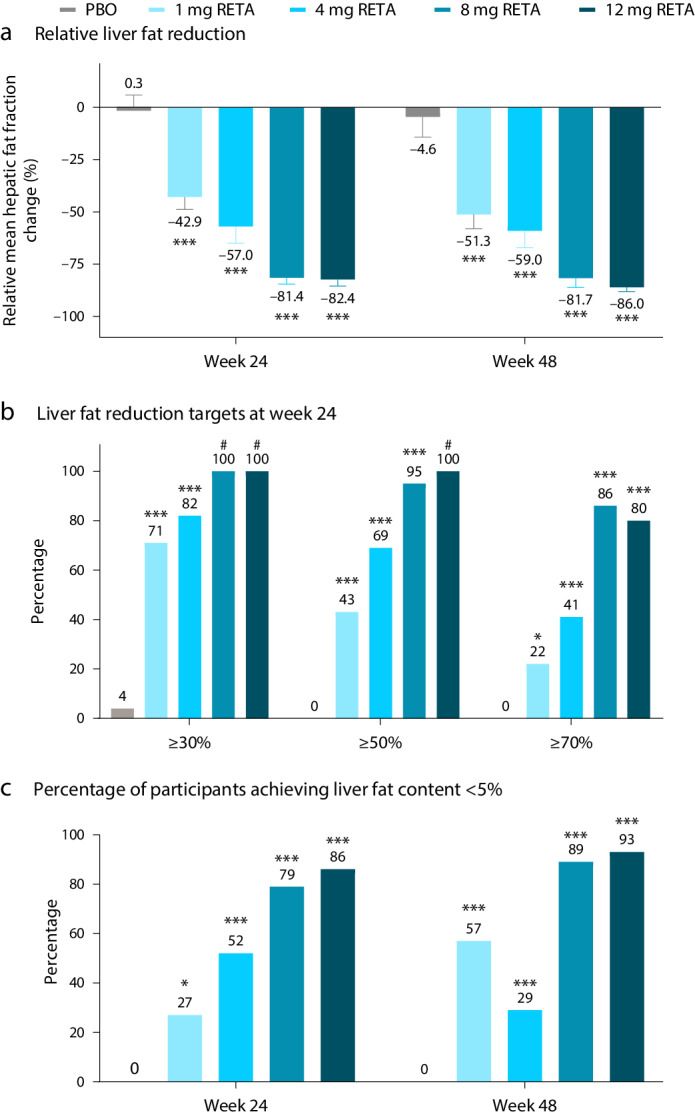
In 98 participants with fatty liver disease, retatrutide reduced liver fat by 42.9-82.4% at 24 weeks vs +0.3% with placebo.

Key resultLiver fat changed -82.4% with 12 mg vs +0.3% with placebo (P < 0.001); normal liver fat (<5%) achieved by 86% vs 0%.
Studied
Adults with obesity and MASLD with ≥10% liver fat
Compared with
Placebo
Main outcome
Mean relative change in liver fat at 24 weeks
Sample
98 participants in a phase 2 substudy
Authors' conclusion
Retatrutide produced large, dose-related liver fat reductions, related to changes in body weight, abdominal fat and insulin sensitivity.
Limitations
Substudy of a phase 2 obesity trial.
Fig. 1: Change in liver fat.a, Relative liver fat reduction. Results are shown as LSM ± s.e.m. (n = 19 (PBO), n = 20 (1 mg RETA), n = 19 (4 mg RETA)
Fig. 1. From PMC11271400, CC BY (terms); resized.
? Inconclusivehuman trialCell Metab · 2022

LY3437943, a novel triple glucagon, GIP, and GLP-1 receptor agonist for glycemic control and weight loss: From discovery to clinical proof of concept.

Humans and animalsDiscovery-to-proof-of-concept overview (in vitro, mouse and phase 1)Weight reduction persisted up to day 43 after a single dose

Discovery paper: in obese mice the drug lowered weight and glucose, and a phase 1 single-dose human study showed tolerability similar to other incretins with weight reduction persisting to day 43.

Key resultIn the phase 1 single ascending dose study, body weight reduction persisted up to day 43 after a single dose.
Studied
In vitro assays, obese mice and a phase 1 single ascending dose study in humans
Main outcome
Receptor activity, body weight, glycemic control, safety and pharmacokinetics
Authors' conclusion
LY3437943 (retatrutide) decreased body weight and improved glycemic control in obese mice, and showed incretin-like safety and once-weekly pharmacokinetics in phase 1; findings warrant further clinical assessment.
Limitations
Preclinical and phase 1 data; sample sizes not given in abstract.

Verdicts are judged on each paper's own main outcome; grades run from A (strong human evidence) to D (little or none). Details are read from the abstracts, and figures are reproduced only from openly licensed full texts. Not medical advice.