Peptide Price Finder

Home · Research · GLP-1 & metabolic

Semaglutide research

What published studies found for Semaglutide: 8 papers, 8 in humans, with sample sizes and key results, plus 406 registered clinical trials.

A
Strong human evidence
Why: Approved drug; large phase 3 RCTs (STEP, SELECT with 17,604 people) and meta-analyses show about 12% more weight loss than placebo and fewer heart events.

Semaglutide is supported by multiple large, placebo-controlled human phase 3 trials and meta-analyses showing substantial weight loss (roughly 12 percentage points more than placebo at 2.4 mg weekly) and, in one large outcomes trial, fewer cardiovascular events; gastrointestinal side effects are common and weight largely returns after stopping. Animal work mainly addresses mechanism.

✓ 5 positive✗ 1 negative~ 2 mixed

Weight is largely regained after stopping; the optic-neuropathy signal comes from observational data and causality is unproven.

US compounding: FDA-approved drug. FDA-approved (Ozempic, Wegovy, Rybelsus). The shortage ended in 2025, so pharmacies can no longer make copies of it; compounding is limited to genuine patient-specific changes. Research-chemical semaglutide isn't a legal drug. Status for every peptide.

Browse and filter these papersSemaglutide prices and vendors

Reported side effects

Registered clinical trials

406 trials of Semaglutide on ClinicalTrials.gov: 186 active, 185 completed, 56 with posted results. Registered trials include ones that haven't published yet.

TrialStatusPhasePeopleSponsor
Comparative Effectiveness of Tirzepatide vs Semaglutide in Participants With Type 2 Diabetes and Heart Failure With Preserved Ejection FractionNCT06980623 · started 2025-01-01Active, not recruiting–26,000Brigham and Women's Hospital
REDEFINE 3: A Research Study to See the Effects of CagriSema in People Living With Diseases in the Heart and Blood VesselsNCT05669755 · started 2023-03-01Active, not recruitingPhase 37,101Novo Nordisk A/S
A Research Study to See How Well CagriSema Helps People With Excess Body Weight Lose WeightNCT05567796 · started 2022-11-01Active, not recruitingPhase 33,400Novo Nordisk A/S
A Research Study to Look at How Two Different Doses of CagriSema and One Dose of Semaglutide Help People Living With Obesity With or Without Type 2 Diabetes Lose WeightNCT07564414 · started 2026-05-21RecruitingPhase 32,500Novo Nordisk A/S
A Research Study to Look at How Semaglutide Compared to Placebo Affects Diabetic Eye Disease in People With Type 2 DiabetesNCT03811561 · started 2019-05-08Active, not recruitingPhase 31,500Novo Nordisk A/S
Efficacy and Safety of Ribupatide Administered Once Weekly Compared With Semaglutide and Placebo in Participants Living With Obesity Who Do Not Have DiabetesNCT07284979 · started 2025-12-30Active, not recruitingPhase 31,270Kailera
A Two-year Prospective, Observational Study of Wegovy in Real-world Clinical PracticeNCT07055607 · started 2025-05-01Enrolling by invitation–1,250Novo Nordisk A/S
Research Study on Whether Semaglutide Works in People With Non-alcoholic Steatohepatitis (NASH)NCT04822181 · started 2021-04-01Active, not recruitingPhase 31,205Novo Nordisk A/S
A Phase III Clinical Study to Evaluate the Efficacy and Safety of GZR18 Injection in Adult Type 2 Diabetes MellitusNCT06778967 · started 2025-02-13Active, not recruitingPhase 31,100Gan & Lee Pharmaceuticals.
Special Use - Results Surveillance on Long-term Use With Wegovy®NCT06283667 · started 2024-06-11Active, not recruiting–1,071Novo Nordisk A/S
A Study to Test if Trevogrumab or Trevogrumab With Garetosmab When Taken With Semaglutide is Safe and How Well They Work in Adult Patients With Obesity for Weight Loss, Fat Loss, and Lean Mass PreservationNCT06299098 · started 2024-03-13Active, not recruitingPhase 21,005Regeneron Pharmaceuticals
AMAZE 8: A Research Study Investigating How Well the Medicine NNC0487-0111 Compared to Semaglutide Helps People With Excess Body Weight and Type 2 Diabetes Lose WeightNCT07400107 · started 2026-05-20Not yet recruitingPhase 31,000Novo Nordisk A/S

All 406 Semaglutide trials, with countries and recruiting status

Meta-analyses & systematic reviews

~ Mixedmeta-analysisJ ASEAN Fed Endocr Soc · 2022

Efficacy and Safety of Semaglutide for Weight Loss in Obesity Without Diabetes: A Systematic Review and Meta-Analysis.

n = 3,613 humansSystematic review and meta-analysis (random effects)

Pooling 4 RCTs (3,613 people), semaglutide reduced weight by 11.85% vs placebo but raised risk of GI adverse events (RR 1.59), discontinuation (RR 2.19) and serious adverse events (RR 1.60), mostly GI/hepatobiliary such as pancreatitis and gallstones.

Key resultMean weight difference -11.85% favoring semaglutide (95% CI -12.81 to -10.90, p<0.00001); GI adverse events RR 1.59 (1.34 to 1.88); discontinuation RR 2.19; serious adverse events RR 1.60 (1.24 to 2.07)
Studied
People with obesity without diabetes in randomized trials of subcutaneous semaglutide
Compared with
Placebo
Main outcome
Percent mean weight difference
Sample
4 randomized controlled trials, 3,613 individuals
Authors' conclusion
Semaglutide is effective for weight loss in obesity without diabetes, but risks of GI adverse events, discontinuation and serious adverse events were higher than with placebo.
Limitations
Only 4 trials pooled.

Human studies

✓ Positivehuman RCTN Engl J Med · 2023

Semaglutide and Cardiovascular Outcomes in Obesity without Diabetes.

n = 17,604 humansMulticenter, double-blind, randomized, placebo-controlled, event-driven superiority trialMean follow-up 39.8 months

In 17,604 adults with cardiovascular disease and overweight/obesity but no diabetes (SELECT), weekly semaglutide reduced major cardiovascular events vs placebo (6.5% vs 8.0%; HR 0.80); discontinuation due to adverse events was higher (16.6% vs 8.2%).

Key resultPrimary event in 569 of 8803 (6.5%) on semaglutide vs 701 of 8801 (8.0%) on placebo (HR 0.80; 95% CI 0.72 to 0.90; P<0.001); discontinuation for adverse events 16.6% vs 8.2% (P<0.001)
Studied
Patients aged 45 or older with preexisting cardiovascular disease and BMI of 27 or greater, no diabetes
Compared with
Placebo
Main outcome
Composite of cardiovascular death, nonfatal myocardial infarction, or nonfatal stroke
Sample
17,604 patients (8803 semaglutide, 8801 placebo)
Authors' conclusion
In patients with cardiovascular disease and overweight or obesity without diabetes, weekly semaglutide 2.4 mg was superior to placebo in reducing cardiovascular death, nonfatal MI, or nonfatal stroke.
Limitations
Funded by Novo Nordisk; more adverse-event discontinuations with semaglutide.
✓ Positivehuman RCTN Engl J Med · 2021

Once-Weekly Semaglutide in Adults with Overweight or Obesity.

n = 1,961 humansDouble-blind randomized trial (STEP 1)68 weeks

In 1961 adults with overweight/obesity without diabetes (STEP 1), 68 weeks of semaglutide 2.4 mg produced -14.9% body weight vs -2.4% with placebo; nausea and diarrhea were the most common adverse events.

Key resultWeight change -14.9% with semaglutide vs -2.4% with placebo (difference -12.4 percentage points; 95% CI -13.4 to -11.5; P<0.001)
Studied
Adults with BMI 30 or greater (27 or greater with a weight-related condition), without diabetes
Compared with
Placebo, plus lifestyle intervention
Main outcome
Percent change in body weight and weight reduction of at least 5%
Sample
1961 adults randomized 2:1
Authors' conclusion
Semaglutide 2.4 mg once weekly plus lifestyle intervention was associated with sustained, clinically relevant weight reduction. Nausea and diarrhea were the most common adverse events.
Limitations
Funded by Novo Nordisk.
✓ Positivehuman RCTLancet · 2021

Semaglutide 2·4 mg once a week in adults with overweight or obesity, and type 2 diabetes (STEP 2): a randomised, double-blind, double-dummy, placebo-controlled, phase 3 trial.

n = 1,210 humansDouble-blind, double-dummy, placebo-controlled phase 3 superiority trial (STEP 2)68 weeks

In 1210 adults with overweight/obesity and type 2 diabetes, semaglutide 2.4 mg gave -9.6% body weight vs -3.4% with placebo at 68 weeks; GI adverse events occurred in 63.5% vs 34.3%.

Key resultWeight change -9.6% (SE 0.4) with semaglutide 2.4 mg vs -3.4% (0.4) with placebo (difference -6.2 percentage points; 95% CI -7.3 to -5.2; p<0.0001); GI adverse events 63.5% vs 34.3%
Studied
Adults with overweight or obesity (BMI at least 27) and type 2 diabetes
Compared with
Semaglutide 1.0 mg and placebo
Main outcome
Percent change in body weight and weight reduction of at least 5%
Sample
1210 randomized (404 semaglutide 2.4 mg, 403 semaglutide 1.0 mg, 403 placebo)
Authors' conclusion
In adults with overweight or obesity and type 2 diabetes, semaglutide 2.4 mg weekly achieved a superior and clinically meaningful decrease in bodyweight versus placebo.
Limitations
Funded by Novo Nordisk.
✓ Positivehuman RCTJAMA · 2021

Effect of Continued Weekly Subcutaneous Semaglutide vs Placebo on Weight Loss Maintenance in Adults With Overweight or Obesity: The STEP 4 Randomized Clinical Trial.

n = 803 humansRandomized, double-blind, phase 3a withdrawal study (STEP 4)48 weeks after 20-week run-in (68 weeks total)

After a 20-week run-in, 803 adults continuing semaglutide lost a further 7.9% over 48 weeks while those switched to placebo regained 6.9%; GI events 49.1% vs 26.1%.

Key resultWeight change -7.9% with continued semaglutide vs +6.9% with placebo (difference -14.8 percentage points; 95% CI -16.0 to -13.5; P<.001); GI events 49.1% vs 26.1%
Studied
Adults with BMI of at least 30 (or 27 with comorbidity) without diabetes who reached semaglutide 2.4 mg during run-in
Compared with
Switch to placebo
Main outcome
Percent change in body weight from week 20 to week 68
Sample
803 randomized after 20-week run-in (535 continued, 268 placebo)
Authors' conclusion
Maintaining semaglutide 2.4 mg after a 20-week run-in led to continued weight loss over 48 weeks compared with switching to placebo.
Limitations
Participants had already tolerated and responded to the 20-week run-in.
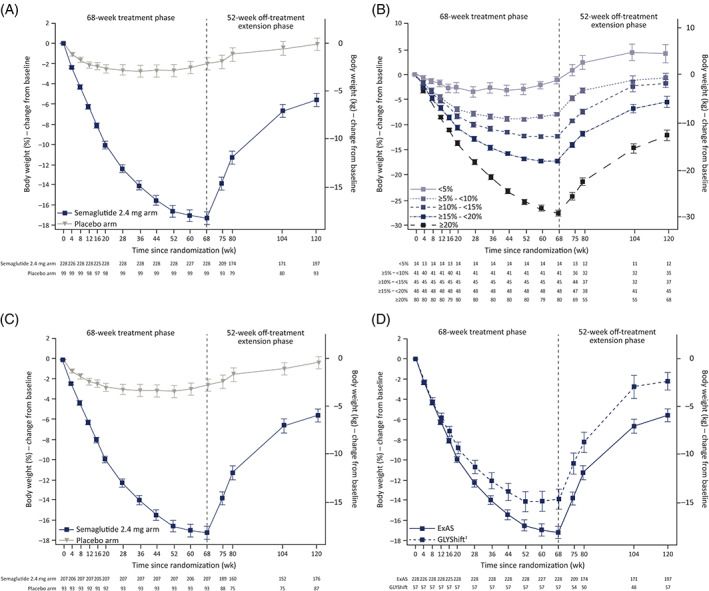
~ Mixedhuman RCTDiabetes Obes Metab · 2022

Weight regain and cardiometabolic effects after withdrawal of semaglutide: The STEP 1 trial extension.

n = 327 humansExploratory off-treatment extension of STEP 11 year after withdrawal (week 68 to 120)

In 327 STEP 1 participants followed off treatment, those who had lost 17.3% on semaglutide regained 11.6 percentage points within a year of stopping, and cardiometabolic improvements reverted toward baseline.

Key resultSemaglutide group regained 11.6 percentage points of lost weight by week 120 (placebo 1.9); net loss from week 0 was 5.6% vs 0.1%
Studied
Subset of STEP 1 participants who completed 68 weeks of treatment (Canada, Germany, UK, selected US and Japan sites)
Compared with
Placebo group
Main outcome
Body weight and cardiometabolic risk factors after treatment withdrawal
Sample
327 participants in the off-treatment extension
Authors' conclusion
One year after withdrawal, participants regained two-thirds of prior weight loss with similar cardiometabolic changes, suggesting ongoing treatment is required.
Limitations
All extension analyses exploratory; representative subset only.
FIGURE 1: Change from baseline in body weight by week for A, All participants in the ExAS, B, Participants in the semaglutide arm, grouped by categori
FIGURE 1. From PMC9542252, CC BY (terms); resized.
✓ Positivehuman RCTN Engl J Med · 2022

Once-Weekly Semaglutide in Adolescents with Obesity.

n = 201 humansDouble-blind, parallel-group, randomized, placebo-controlled trial (STEP TEENS)68 weeks

In 201 adolescents with obesity, 68 weeks of semaglutide changed BMI by -16.1% vs +0.6% with placebo.

Key resultBMI change -16.1% with semaglutide vs 0.6% with placebo (difference -16.7 percentage points; 95% CI -20.3 to -13.2; P<0.001); GI adverse events 62% vs 42%
Studied
Adolescents 12 to <18 years with obesity, or overweight with at least one weight-related condition
Compared with
Placebo plus lifestyle intervention
Main outcome
Percent change in BMI
Sample
201 adolescents randomized 2:1
Authors' conclusion
In adolescents with obesity, weekly semaglutide 2.4 mg plus lifestyle intervention reduced BMI more than lifestyle intervention alone.
Limitations
Cholelithiasis occurred in 5 participants (4%) on semaglutide and none on placebo.
✗ Negativehuman observationalJAMA Ophthalmol · 2024

Risk of Nonarteritic Anterior Ischemic Optic Neuropathy in Patients Prescribed Semaglutide.

16 827 patients screened; 710 with T2D and 979 overweight/obese in matched cohortsRetrospective propensity-matched cohort study36 months cumulative incidence

In a single-center neuro-ophthalmology cohort, semaglutide prescription was associated with higher risk of NAION (an optic nerve stroke) in type 2 diabetes (HR 4.28) and overweight/obesity (HR 7.64); causality not established.

Key resultHR for NAION 4.28 (95% CI 1.62-11.29) in T2D and 7.64 (95% CI 2.21-26.36) in overweight/obesity (both P < .001)
Studied
Neuro-ophthalmology patients at one academic institution with type 2 diabetes or overweight/obesity
Compared with
Non-GLP-1 RA medications
Main outcome
Cumulative incidence and hazard ratio of NAION
Authors' conclusion
Findings suggest an association between semaglutide and NAION; as an observational study, future study is required to assess causality.
Limitations
Retrospective, single academic center, observational; causality not established.

Verdicts are judged on each paper's own main outcome; grades run from A (strong human evidence) to D (little or none). Details are read from the abstracts, and figures are reproduced only from openly licensed full texts. Not medical advice.