Peptide Price Finder

Home · Research · GLP-1 & metabolic

Survodutide research

What published studies found for Survodutide: 10 papers, 9 in humans, with sample sizes and key results, plus 35 registered clinical trials.

A
Strong human evidence
Why: Three phase 3 RCTs (about 1,700 people) and several phase 2 RCTs show 8-15% weight loss vs 1-5% on placebo; not yet approved.

Survodutide (a glucagon/GLP-1 dual agonist) now has three published phase 3 trials (obesity, obesity with type 2 diabetes, and obesity with fatty liver disease), several phase 2 RCTs, and meta-analyses showing about 8-15% weight loss versus 1-5% on placebo and improvement in fatty-liver disease (MASH/MASLD). Gastrointestinal side effects are very frequent (often 75-90%); longer-term and cardiovascular outcome data are still pending.

✓ 8 positive~ 1 mixed? 1 inconclusive

Gastrointestinal intolerance is frequent; cardiovascular outcome data are not yet published in the candidates.

US compounding: Not compoundable. Not an FDA-approved drug and not nominated for FDA's 503A bulks list, so US pharmacies can't legally compound it. Status for every peptide.

Browse and filter these papersSurvodutide prices and vendors

Reported side effects

Registered clinical trials

35 trials of Survodutide on ClinicalTrials.gov: 10 active, 25 completed, 3 with posted results. Registered trials include ones that haven't published yet.

TrialStatusPhasePeopleSponsor
LIVERAGE™: A Study to Test Whether Survodutide Helps People With a Liver Disease Called NASH/MASH Who Have Moderate or Advanced Liver FibrosisNCT06632444 · started 2024-10-14RecruitingPhase 31,800Boehringer Ingelheim
LIVERAGE™ - Cirrhosis: A Study to Test Whether Survodutide Helps People With a Liver Disease Called NASH/MASH Who Have CirrhosisNCT06632457 · started 2024-11-12RecruitingPhase 31,590Boehringer Ingelheim
SYNCHRONIZE®-HERA: A Study to Test Whether Survodutide Helps Women Who Are Living With Overweight or Obesity and Are Going Through or Have Finished Menopause, to Lose WeightNCT07850050 · started 2026-10-31Not yet recruitingPhase 3600Boehringer Ingelheim
ELEVATE-LIVER: A Study to Test Whether Survodutide Helps Improve Heart Structure and Function in People With Overweight or Obesity and Fatty Liver DiseaseNCT07850063 · started 2026-10-23Not yet recruitingPhase 3600Boehringer Ingelheim
A Study to Test Whether Survodutide Helps People With Type 2 Diabetes Control Their Blood SugarNCT07754461 · started 2026-08-24RecruitingPhase 3600Boehringer Ingelheim
SYNCHRONIZE®-START- A Study to Test Whether Survodutide Helps People Living With Overweight or Obesity Who do Not Have Diabetes to Lose WeightNCT07855900 · started 2026-11-07Not yet recruitingPhase 3350Boehringer Ingelheim
Albuminuria Reduction Study With Survodutide Treatment in Kidney DiseaseNCT07206290 · started 2026-03-02Not yet recruitingPhase 2120University Medical Center Groningen
A Study to Test Whether Survodutide Improves How the Body Uses Energy and Breaks Down Fat in People With ObesityNCT06745284 · started 2025-03-26Active, not recruitingPhase 164Boehringer Ingelheim
A Study to Compare How 2 Different Formulations of Survodutide Are Taken up in the Body When Given by Injection in Healthy Men and Women With and Without Overweight or ObesityNCT07768813 · started 2026-09-02RecruitingPhase 144Boehringer Ingelheim
A Study in People With Obesity to Test the Effects of BI 456906 Compared With Semaglutide on Glucagon Receptor Activity in the LiverNCT05202353 · started 2024-11-01Active, not recruitingPhase 129Boehringer Ingelheim
A Study to Test Whether Different Doses of BI 456906 Are Effective in Treating Adults With Type 2 Diabetes.NCT04153929 · started 2020-04-30 · results postedCompletedPhase 2413Boehringer Ingelheim
A Study to Test Whether Different Doses of BI 456906 Help People With Overweight or Obesity to Lose WeightNCT04667377 · started 2021-03-08 · results postedCompletedPhase 2387Boehringer Ingelheim

All 35 Survodutide trials, with countries and recruiting status

Meta-analyses & systematic reviews

✓ Positivemeta-analysisDiabetol Metab Syndr · 2024

Effect of survodutide, a glucagon and GLP-1 receptor dual agonist, on weight loss: a meta-analysis of randomized controlled trials.

n = 1,029 humansSystematic review and random-effects meta-analysis to August 2024

Meta-analysis of survodutide RCTs (18 treatment arms, 1,029 participants): weight fell 8.33 kg more than control, with larger effects at higher doses and over longer treatment; heterogeneity was very high (I2 above 99%).

Key resultWeight WMD -8.33 kg (95% CI -10.80 to -5.86; I2 = 99.6%); BMI -4.03 kg/m2; waist -6.33 cm
Studied
Participants in randomized trials of injectable survodutide
Compared with
Control group
Main outcome
Weight, BMI and waist circumference
Sample
18 treatment arms, 1029 participants
Authors' conclusion
Survodutide is effective in reducing weight, BMI and waist circumference, especially with longer interventions and higher doses.
Limitations
Very high heterogeneity (I2 up to 99.6%); mixes trial populations and doses.
✓ Positivemeta-analysisDiabetes Obes Metab · 2026

Efficacy and Safety of Dual GLP-1/Glucagon Receptor Agonism in Overweight and Obesity: A Class-Specific Systematic Review and Meta-Analysis.

19 RCTs of mazdutide, survodutide, cotadutide and efinopegdutideSystematic review and random-effects meta-analysis (PROSPERO registered) with GRADE assessment

Class-specific meta-analysis of 19 RCTs of GLP-1/glucagon dual agonists (including survodutide): weight fell by 7.15% more than control and serious adverse events did not differ (RR 0.90), though any adverse event was more frequent (RR 1.16); it covers several drugs, not survodutide alone.

Key resultRelative weight MD -7.15%; at least 5% weight loss RR 4.75; any adverse event RR 1.16; serious adverse events RR 0.90
Studied
Adults with overweight or obesity in RCTs of GLP-1/glucagon dual agonists
Compared with
Placebo or control
Main outcome
Body weight, 5% weight loss, metabolic markers, adverse events
Authors' conclusion
Dual GLP-1/GCGR agonists produce meaningful weight loss and metabolic improvements with acceptable short-term safety, though longer head-to-head trials are needed for durability and cardiovascular safety.
Limitations
Pools different drugs; certainty of some outcomes low to moderate.

Human studies

✓ Positivehuman RCTN Engl J Med · 2026

Survodutide Once Weekly in Adults with Obesity and Type 2 Diabetes.

n = 752 humansMultinational, double-blind, placebo-controlled phase 3 RCT (1:1:1)76 weeks

In 752 adults with obesity and type 2 diabetes (SYNCHRONIZE-2, phase 3), 76 weeks of survodutide cut weight by 8.2% (3.6 mg) and 9.8% (6.0 mg) vs 3.9% with placebo; 57.6% and 64.5% lost at least 5% vs 35.1%.

Key resultMean weight change -8.2% (3.6 mg), -9.8% (6.0 mg) vs -3.9% placebo; at least 5% loss in 57.6%, 64.5% vs 35.1%
Studied
Adults with type 2 diabetes and BMI of 27 or more (mean age 55.7 years, mean BMI 36.5)
Compared with
Placebo
Main outcome
Percent change in body weight and weight loss of at least 5% at week 76
Sample
752 randomized (250 survodutide 3.6 mg, 251 survodutide 6.0 mg, 251 placebo)
Authors' conclusion
Survodutide at 3.6 mg or 6.0 mg weekly produced significantly greater weight reduction than placebo in adults with obesity and type 2 diabetes.
Limitations
Industry-funded; abstract does not report adverse event rates.
✓ Positivehuman RCTN Engl J Med · 2026

Survodutide Once Weekly for the Treatment of Adults with Obesity.

n = 725 humansPhase 3 double-blind randomized trial (SYNCHRONIZE-1), 1:1:176 weeks

In 725 adults with obesity without diabetes (SYNCHRONIZE-1), survodutide reduced weight by 12.2-13.0% at 76 weeks vs 5.4% with placebo; GI symptoms in 80.9-89.7% vs 47.9%.

Key resultMean body weight change -12.2% (3.6 mg), -13.0% (6.0 mg) vs -5.4% (placebo); at least 5% weight reduction in 72.6%, 71.9% and 46.3% (P<0.001 for all vs placebo)
Studied
Adults with BMI ≥30, or ≥27 with an obesity-related complication, without diabetes (mean age 47.1)
Compared with
Placebo plus lifestyle counseling
Main outcome
Percent change in body weight and weight reduction of at least 5% at week 76
Sample
725 participants (241 survodutide 3.6 mg, 242 survodutide 6.0 mg, 242 placebo)
Authors' conclusion
Survodutide led to significantly greater body weight reductions than placebo in adults with obesity without diabetes.
Limitations
Gastrointestinal adverse events in 80.9% and 89.7% vs 47.9% with placebo; participants without diabetes only; sponsor-funded.
✓ Positivehuman RCTDiabetologia · 2024

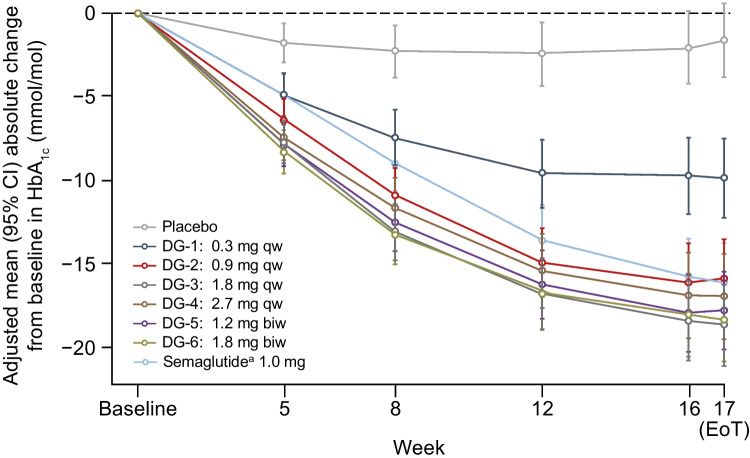
Dose-response effects on HbA1c and bodyweight reduction of survodutide, a dual glucagon/GLP-1 receptor agonist, compared with placebo and open-label semaglutide in people with type 2 diabetes: a randomised clinical trial.

n = 413 humansPhase II multicentre randomised, double-blind, placebo-controlled, parallel-group dose-response study with open-label semaglutide arm16 weeks

In 413 people with type 2 diabetes, 16 weeks of survodutide lowered HbA1c by up to 1.71% (similar to semaglutide at low dose) and weight by up to 8.7%; adverse events in 77.8% vs 52.5% on placebo.

Key resultHbA1c fell up to -18.72 mmol/mol (-1.71%) with survodutide; bodyweight fell up to -8.7% (DG6) vs -5.3% with semaglutide
Studied
Adults aged 18-75 with type 2 diabetes on metformin, HbA1c 7.0-10.0%, BMI 25-50 kg/m2
Compared with
Placebo and open-label semaglutide (up to 1.0 mg weekly)
Main outcome
Absolute change in HbA1c at 16 weeks; relative bodyweight change
Sample
413 participants randomised (8 arms)
Authors' conclusion
Survodutide reduced HbA1c and bodyweight after 16 weeks in type 2 diabetes; dose-related gastrointestinal adverse events could be mitigated by slower dose escalation.
Limitations
Short 16-week duration; semaglutide arm was open-label.
Fig. 1: MMRM estimates for the absolute change in HbA1c from baseline to EoT. aSemaglutide arm was open label
Fig. 1. From PMC10844353, CC BY (terms); resized.
~ Mixedhuman RCTLancet Diabetes Endocrinol · 2024

Glucagon and GLP-1 receptor dual agonist survodutide for obesity: a randomised, double-blind, placebo-controlled, dose-finding phase 2 trial.

n = 387 humansRandomised, double-blind, placebo-controlled, dose-finding phase 2 trial46 weeks

In 386 adults with obesity, survodutide reduced weight by 6.2-14.9% at 46 weeks vs 2.8% with placebo, but GI adverse events affected 75% (vs 42%) and only about 60% of participants completed treatment.

Key resultBodyweight change -6·2% (0·6 mg), -12·5% (2·4 mg), -13·2% (3·6 mg), -14·9% (4·8 mg) vs -2·8% with placebo
Studied
Adults aged 18-75 with BMI ≥27 kg/m2 without diabetes, 43 centres in 12 countries
Compared with
Placebo
Main outcome
Percentage change in bodyweight from baseline to week 46
Sample
387 enrolled; 386 treated (77-78 per arm); 233 completed
Authors' conclusion
All tested survodutide doses were tolerated and dose-dependently reduced bodyweight.
Limitations
About 40% did not complete treatment; adverse events in 91% vs 75% with placebo, mostly gastrointestinal.
✓ Positivehuman RCTN Engl J Med · 2024

A Phase 2 Randomized Trial of Survodutide in MASH and Fibrosis.

n = 293 humansPhase 2 randomized trial, 1:1:1:1, survodutide 2.4, 4.8 or 6.0 mg weekly48 weeks

In 293 adults with biopsy-confirmed MASH and fibrosis, 48 weeks of survodutide improved MASH without worsening fibrosis in 43-62% vs 14% with placebo; nausea 66% vs 23%, vomiting 41% vs 4%.

Key resultMASH improvement in 47% (2.4 mg), 62% (4.8 mg) and 43% (6.0 mg) vs 14% with placebo (P<0.001 for the quadratic dose-response curve)
Studied
Adults with biopsy-confirmed MASH and fibrosis stage F1 through F3
Compared with
Placebo
Main outcome
Histologic improvement in MASH with no worsening of fibrosis
Sample
293 randomized participants received at least one dose
Authors' conclusion
Survodutide was superior to placebo for improving MASH without worsening fibrosis, warranting phase 3 trials.
Limitations
Phase 2; nausea (66% vs 23%), diarrhea (49% vs 23%) and vomiting (41% vs 4%) more frequent with survodutide.
✓ Positivehuman RCTNat Med · 2026

Survodutide in adults with obesity and metabolic dysfunction-associated steatotic liver disease: SYNCHRONIZE-MASLD, a randomized, double-blind, placebo-controlled phase 3 trial.

n = 216 humansRandomized, double-blind, placebo-controlled phase 3 trial48 weeks

In 216 adults with obesity and at-risk MASLD/MASH (SYNCHRONIZE-MASLD, phase 3), 84.2% on survodutide vs 24.3% on placebo had at least 30% liver-fat reduction at 48 weeks, with weight -12.2% vs -1.0%; GI events were the most common adverse events.

Key resultAt least 30% liver-fat reduction in 84.2% vs 24.3% (P<0.0001, efficacy estimand); weight -12.2% vs -1.0%
Studied
Adults with obesity and at-risk MASLD/MASH
Compared with
Placebo
Main outcome
At least 30% reduction in MRI-PDFF liver fat and percent change in body weight
Sample
216 randomized 2:1 (146 survodutide 6.0 mg, 70 placebo)
Authors' conclusion
Survodutide was statistically and clinically superior to placebo for liver fat and body weight reduction; GI adverse events were mostly mild to moderate and occurred during dose escalation.
Limitations
Short duration (48 weeks); participants recruited only in the United States and Spain.
? Inconclusivehuman trialJ Hepatol · 2024

Efficacy, tolerability and pharmacokinetics of survodutide, a glucagon/glucagon-like peptide-1 receptor dual agonist, in cirrhosis.

Single-dose cohorts n = 41; multiple-dose cohorts n = 41Multinational, non-randomized, open-label phase I trial28 weeks in multiple-dose cohorts

Open-label phase 1 study in people with cirrhosis and controls: drug exposure was similar regardless of cirrhosis, drug-related adverse events occurred in over 80% over 28 weeks, and liver fat and stiffness generally fell.

Key resultMean AUC0-∞ and Cmax were similar in cirrhosis and healthy individuals; drug-related adverse events 82.4% and 87.5% in multiple-dose cohorts
Studied
People with Child-Pugh A, B or C cirrhosis, healthy individuals, and people with overweight/obesity with or without cirrhosis
Compared with
Healthy individuals matched for age, sex and weight
Main outcome
Pharmacokinetics (AUC0-∞, Cmax) and drug-related adverse events
Authors' conclusion
Survodutide is generally tolerable in compensated or decompensated cirrhosis, needs no pharmacokinetic dose adjustment, and may improve liver-related tests, supporting further study.
Limitations
Non-randomized, open-label phase I; efficacy markers were exploratory.

Animal & lab studies

✓ PositiveanimalMol Metab · 2022

BI 456906: Discovery and preclinical pharmacology of a novel GCGR/GLP-1R dual agonist with robust anti-obesity efficacy.

Humans and animalsPreclinical in vitro and in vivo pharmacology

In mice, survodutide produced greater weight loss than maximally effective semaglutide by both reducing food intake and increasing energy expenditure.

Studied
Cell-based assays and mice (including GLP-1R knockout and transgenic reporter mice)
Compared with
Semaglutide
Main outcome
Functional receptor agonism, bodyweight, energy expenditure and food intake
Authors' conclusion
BI 456906 (survodutide) is a potent GCGR/GLP-1R dual agonist with robust anti-obesity efficacy through increased energy expenditure and decreased food intake; in mice it reduced bodyweight more than semaglutide.
Limitations
Preclinical (cells and mice); sample sizes not given in abstract.

Verdicts are judged on each paper's own main outcome; grades run from A (strong human evidence) to D (little or none). Details are read from the abstracts, and figures are reproduced only from openly licensed full texts. Not medical advice.