Peptide Price Finder

Home · Research · Inflammation & immune

Thymosin Alpha-1 research

What published studies found for Thymosin Alpha-1: 8 papers, 8 in humans, with sample sizes and key results, plus 49 registered clinical trials.

B
Some human evidence
Why: Many human trials but conflicting: small, mostly Chinese trials and meta-analyses suggest benefit, while the largest RCT (1,089 sepsis patients) found none.

Thymosin alpha-1 (thymalfasin, Zadaxin) is approved in some countries and has been tested in many human trials for hepatitis B, sepsis, COVID-19 and cancer. Results are mixed: meta-analyses of mostly small, largely Chinese trials suggest benefits, but the largest and most rigorous trial (1,089 sepsis patients) found no reduction in mortality.

✓ 2 positive✗ 1 negative~ 3 mixed? 2 inconclusive

Human trials, including a 1,089-patient placebo-controlled sepsis trial, reported no excess of adverse events vs control; no specific side effects were described in the abstracts reviewed.

US compounding: Not compoundable (no pending nomination). Removed from FDA's Category 2 on about April 22, 2026 after its nominations were withdrawn. That doesn't add it to any allowed list, so US pharmacies still can't compound it from bulk ingredient. Status for every peptide.

Browse and filter these papersThymosin Alpha-1 prices and vendors

Registered clinical trials

49 trials of Thymosin Alpha-1 on ClinicalTrials.gov: 12 active, 19 completed, 2 with posted results. Registered trials include ones that haven't published yet.

TrialStatusPhasePeopleSponsor
Thymosin-alpha 1 for Adjuvant Treatment After Radical Resection of High-risk Stage II and III Colorectal CancerNCT05086614 · started 2021-04-01RecruitingPhase 32,500Fudan University
Long-term Prognosis of Patients With Sepsis After ImmunotherapyNCT04901104 · started 2021-07-01Not yet recruiting–900Sun Yat-sen University
AI-assisted Subtyping-directed Precision Treatment in Acute Aortic DissectionNCT07382375 · started 2027-12-31Not yet recruiting–300Nanjing Medical University
Thymosin-α1 for Recurrent Implantation FailureNCT07675980 · started 2026-02-11RecruitingPhase 2, Phase 3136Fakih IVF Fertility Center
Thymalfasin (Thymosin Alpha 1; Ta1) as an Enhancer of Vaccine Response Among Older Adults Receiving Booster Doses of COVID-19 VaccineNCT06821100 · started 2024-12-02RecruitingPhase 175The Methodist Hospital Research Institute
Thymosin Alpha 1 Combined With Anti-PD-1 Monoclonal Antibody in Elderly Patients With Advanced MelanomaNCT07644897 · started 2023-05-30RecruitingPhase 255Sun Yat-sen University
"Thymalfasin Immunotherapy Study with Triple Regimen in Advanced MSS/pMMR Colorectal Cancer"NCT06829355 · started 2025-02-11RecruitingPhase 252Beijing Friendship Hospital
Thymalfasin and Recombinant Human IL-2 Injections in Treating Lymphocytopenia for Patients With Malignant Hematological TumorsNCT06584006 · started 2024-09-01RecruitingPhase 250The First Affiliated Hospital of Xiamen University
Study of Adebrelimab Combined With Thymalfasin and Chemotherapy for Neoadjuvant Treatment of Esophageal CancerNCT07780721 · started 2026-08-30Not yet recruitingPhase 231The Affiliated Hospital of Putian University
Efficacy and Safety of Anti-PD-1, Thymalfasin, and SOX in Neoadjuvant Treatment of cStage III Gastric/Gastroesophageal Junction AdenocarcinomaNCT06461910 · started 2024-06-14RecruitingPhase 230Zekuan Xu
Radiotherapy With Sequential Chemotherapy Combined With PD-1 Inhibitor and Thymalfasin for BRPCNCT06573398 · started 2024-09-01Not yet recruitingPhase 220Ruijin Hospital
Neoadjuvant Chemoradiotherapy Combined With PD-1 Inhibitor and Thymalfasin for pMMR/MSS Locally Advanced Mid-low Rectal CancerNCT06056804 · started 2024-01-03Active, not recruitingPhase 220Beijing Friendship Hospital

All 49 Thymosin Alpha-1 trials, with countries and recruiting status

Meta-analyses & systematic reviews

✓ Positivemeta-analysisFront Immunol · 2025

Thymosin alpha 1 alleviates inflammation and prevents infection in patients with severe acute pancreatitis through immune regulation: a systematic review and meta-analysis.

n = 706 humansSystematic review and meta-analysis of randomized controlled studies

Meta-analysis in severe acute pancreatitis: thymosin alpha-1 reduced infections outside the pancreas (RR 0.56) and illness-severity scores but not hospital stay; authors call for more validation.

Key resultExtrapancreatic infections RR 0.56 (95% CI 0.40-0.78, P=0.0005); CD4+ MD 4.53 (3.02-6.04); hospital stay MD -4.22 (-11.53 to 3.10, P=0.26); APACHE II MD -1.52 (-2.22 to -0.83)
Studied
Patients with severe acute pancreatitis
Compared with
Non-thymosin alpha-1 control
Main outcome
CD4+ cells, CD4+/CD8+ ratio, CRP, extrapancreatic infection, hospital stay, APACHE II
Sample
5 RCTs, 706 patients with severe acute pancreatitis
Authors' conclusion
Thymosin alpha-1 may regulate immune balance and exert anti-inflammatory and infection-preventive effects in SAP; more research is needed to validate the results.
Limitations
Only five trials; no significant reduction in hospital stay or lung infections.
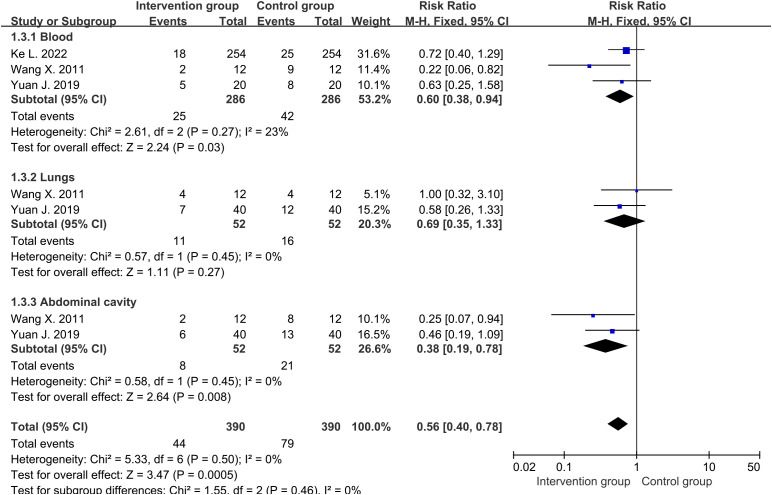
Figure 4: Forest plot of patients with infections.
Figure 4. From PMC12208829, CC BY (terms); resized.
~ Mixedmeta-analysisAntiviral Res · 2008

Comparison of the efficacy of thymosin alpha-1 and interferon alpha in the treatment of chronic hepatitis B: a meta-analysis.

n = 199 humansMeta-analysis of randomized controlled trials, thymosin alpha-1 vs interferon alpha6 months treatment and 6 months post-treatment follow-up

Meta-analysis of 4 RCTs (199 chronic hepatitis B patients): thymosin alpha-1 was not better than interferon alpha at end of therapy but had higher virological and biochemical response 6 months after treatment.

Key resultEnd of treatment complete response OR 0.54 (0.30, 0.97); 6 months post-treatment OR 3.71 (2.05, 6.71) virological, 3.12 (1.74, 5.62) biochemical, 2.69 (1.47, 4.91) complete response
Studied
Patients with chronic hepatitis B
Compared with
Interferon alpha
Main outcome
Virological, biochemical and complete response
Sample
4 RCTs, 199 chronic hepatitis B patients
Authors' conclusion
Compared with interferon alpha, benefit of thymosin alpha-1 was not immediately significant at end of therapy, but responses tended to accumulate gradually after therapy.
Limitations
Only four small trials; results mostly applicable to HBeAg-negative patients.
~ Mixedmeta-analysisFront Cell Infect Microbiol · 2025

Efficacy of thymosin α1 for sepsis: a systematic review and meta-analysis of randomized controlled trials.

11 RCTs (967 patients thymosin, 960 control)Systematic review and meta-analysis of RCTs with trial sequential analysis and heterogeneity-of-treatment-effect analysis28-day mortality

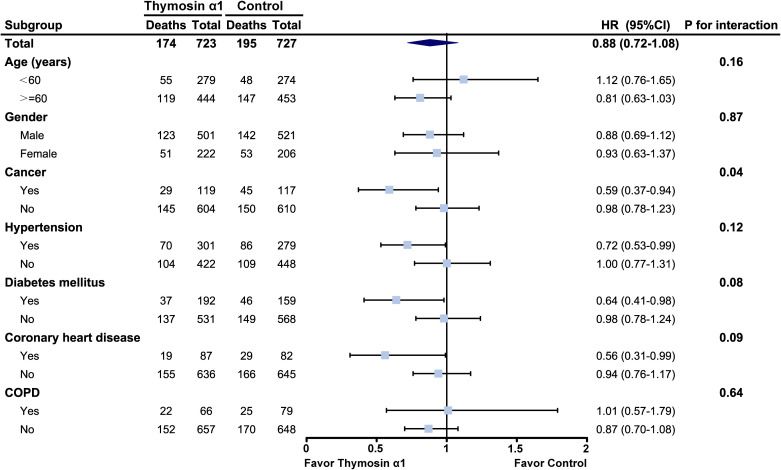
Meta-analysis of sepsis RCTs found a possible 28-day mortality reduction overall, but no significant benefit in high-quality or multicenter trials, and the total sample was judged inadequate.

Key resultOverall OR 0.73 (95% CI 0.59-0.90, P=0.003); high-quality subgroup OR 0.82 (0.65-1.03, P=0.09); multi-center subgroup OR 0.86 (0.68-1.08, P=0.20)
Studied
Patients with sepsis
Compared with
Control
Main outcome
28-day mortality
Authors' conclusion
Thymosin alpha-1 has the potential to decrease 28-day mortality in sepsis, but efficacy differs among subgroups; trial sequential analysis suggests the current sample size is inadequate.
Limitations
Benefit not seen in high-quality or multicenter subgroups; sample size inadequate per TSA.
Figure 3: Heterogeneity of treatment effects analysis. Hazard ratio (HR) was adjusted by the studies. COPD, chronic obstructive pulmonary disease.
Figure 3. From PMC12440967, CC BY (terms); resized.
~ Mixedmeta-analysisInflammopharmacology · 2023

The efficacy of thymosin alpha-1 therapy in moderate to critical COVID-19 patients: a systematic review, meta-analysis, and meta-regression.

8 studiesSystematic review, meta-analysis and meta-regression

Meta-analysis of 8 studies in moderate-to-critical COVID-19: lower mortality with thymosin alpha-1 (RR 0.59) but very high heterogeneity and no difference in need for ventilation or length of stay; authors call for RCTs.

Key resultMortality RR 0.59 (95% CI 0.37-0.93, p=0.02, I2=84%); mechanical ventilation RR 0.83 (0.48-1.44, p=0.51); length of stay MD 2.32 (-0.93 to 5.58, p=0.16)
Studied
Patients with moderate to critical COVID-19
Compared with
Placebo
Main outcome
Mortality, need for mechanical ventilation, hospital length of stay
Authors' conclusion
Thymosin alpha-1 may reduce mortality in moderate to critical COVID-19; randomized clinical trials are still required to verify the findings.
Limitations
High heterogeneity (I2 84%).

Human studies

✗ Negativehuman RCTBMJ · 2025

The efficacy and safety of thymosin α1 for sepsis (TESTS): multicentre, double blinded, randomised, placebo controlled, phase 3 trial.

n = 1,106 humansMulticentre, double-blind, randomised, placebo-controlled phase 3 trial (1:1)Subcutaneous injection every 12 hours for up to 7 days; primary outcome at 28 days

TESTS phase 3 trial in 1,089 adults with sepsis: 28-day mortality was 23.4% with thymosin alpha-1 vs 24.1% with placebo (HR 0.99); no secondary or safety outcome differed.

Key result28-day mortality 127 (23.4%) with thymosin alpha-1 vs 132 (24.1%) with placebo (HR 0.99, 95% CI 0.77 to 1.27; P=0.93)
Studied
Adults aged 18-85 with sepsis (Sepsis-3 criteria), 22 centres in China
Compared with
Placebo
Main outcome
28-day all-cause mortality
Sample
1106 adults randomized (thymosin n=552, placebo n=554); 1089 in modified intention-to-treat analysis
Authors' conclusion
This trial found no clear evidence that thymosin alpha-1 decreases 28-day all-cause mortality in adults with sepsis. No secondary or safety outcome differed significantly.
Limitations
Prespecified subgroups (age, diabetes) suggested possible differential effects, not confirmatory.
? Inconclusivehuman RCTJ Infect Dis · 2023

A Pilot Trial of Thymalfasin (Thymosin-α-1) to Treat Hospitalized Patients With Hypoxemia and Lymphocytopenia Due to Coronavirus Disease 2019 Infection.

n = 49 humansProspective open-label randomized pilot trial

Open-label randomized pilot in 49 hospitalized COVID-19 patients: clinical recovery was not significantly improved, though CD4+ T-cell counts rose faster in one subgroup; serious adverse events were judged unrelated.

Key resultClinical recovery subdistribution HR 1.48 (95% CI 0.68-3.25) with low-flow oxygen and 1.28 (0.35-4.63) with high-flow oxygen, neither significant; CD4+ T cells rose 3.84 times more by day 5 in low-flow subgroup (P=.01)
Studied
Hospitalized COVID-19 patients with hypoxemia and lymphocytopenia
Compared with
Standard of care
Main outcome
Clinical recovery; CD4+ T-cell count
Sample
49 patients included in analysis
Authors' conclusion
Thymosin alpha-1 increases CD4+ T-cell count faster than standard of care in patients on low-flow oxygen and may have a role in management of such patients.
Limitations
Open-label pilot; small; recovery differences not significant.
? Inconclusivehuman RCTHepatol Int · 2009

A randomized controlled trial of thymalfasin plus transarterial chemoembolization for unresectable hepatocellular carcinoma.

n = 25 humansPhase II randomized trial24 weeks treatment; survival assessed through 24 months

Phase II trial in 25 patients with unresectable liver cancer: adding thymalfasin to chemoembolization gave numerically better survival and fewer bacterial infections, but differences were not significant.

Key resultResponders 8/14 (57.1%) vs 5/11 (45.5%) (P=1.0); median overall survival 110.3 vs 57.0 weeks (P=0.45); no bacterial infections with thymalfasin vs 4 with TACE alone
Studied
Patients with unresectable hepatocellular carcinoma
Compared with
TACE alone
Main outcome
Response (transplant eligibility or no progression through week 72) and survival
Sample
25 patients (TACE + thymalfasin n=14, TACE alone n=11)
Authors' conclusion
TACE plus thymalfasin gave numerically higher survival and response rates with fewer bacterial infections; larger trials are needed.
Limitations
Small phase II trial; differences not statistically significant.
✓ Positivehuman trialVaccine · 2012

Thymosin-alpha 1 (Zadaxin) enhances the immunogenicity of an adjuvated pandemic H1N1v influenza vaccine (Focetria) in hemodialyzed patients: a pilot study.

n = 94 humansPilot clinical trial: vaccine alone vs vaccine + thymosin alpha-1 (3.2 mg or 6.4 mg)Immune response assessed through day 168

Pilot in 94 hemodialysis patients: adding thymosin alpha-1 to H1N1 flu vaccination improved antibody responses vs vaccine alone, with no related adverse events.

Key resultBoth vaccine + thymosin alpha-1 groups had better HI GMT and GMR on day 21 than vaccine alone; CHMP criteria fully met in thymosin groups; no AE related to thymosin alpha-1
Studied
Hemodialysis patients receiving H1N1v pandemic influenza vaccine
Compared with
Vaccine only
Main outcome
Hemagglutination inhibition (HI) geometric mean titer/ratio and seroconversion
Sample
94 patients in ITT population (82 per protocol, 99 safety)
Authors' conclusion
Thymosin alpha-1 enhanced the immunogenicity of the pandemic influenza vaccine and was safe and well tolerated; larger hemodialyzed populations need study.
Limitations
Pilot study; larger studies needed.

Verdicts are judged on each paper's own main outcome; grades run from A (strong human evidence) to D (little or none). Details are read from the abstracts, and figures are reproduced only from openly licensed full texts. Not medical advice.