Peptide Price Finder

Home · Research · GLP-1 & metabolic

Tirzepatide research

What published studies found for Tirzepatide: 8 papers, 8 in humans, with sample sizes and key results, plus 234 registered clinical trials.

A
Strong human evidence
Why: Approved drug; many large phase 3 RCTs (e.g. SURMOUNT-1, 2,539 people) show 15-21% weight loss and better glucose control.

Tirzepatide (a dual GIP/GLP-1 receptor agonist) is backed by many large phase 3 human RCTs showing roughly 15-21% average weight loss at 72 weeks, better glucose control in type 2 diabetes, and benefits in sleep apnea and heart failure with preserved ejection fraction; gastrointestinal side effects are common and weight is substantially regained after stopping.

✓ 7 positive~ 1 mixed

Most lost weight returns after stopping treatment (SURMOUNT-4).

US compounding: FDA-approved drug. FDA-approved (Mounjaro, Zepbound). The shortage ended in December 2024, so pharmacies can no longer make copies of it; compounding is limited to genuine patient-specific changes. Status for every peptide.

Browse and filter these papersTirzepatide prices and vendors

Reported side effects

Registered clinical trials

234 trials of Tirzepatide on ClinicalTrials.gov: 145 active, 82 completed, 45 with posted results. Registered trials include ones that haven't published yet.

TrialStatusPhasePeopleSponsor
Comparative Effectiveness of Tirzepatide vs Semaglutide in Participants With Type 2 Diabetes and Heart Failure With Preserved Ejection FractionNCT06980623 · started 2025-01-01Active, not recruiting–26,000Brigham and Women's Hospital
A Study of Tirzepatide (LY3298176) on the Reduction on Morbidity and Mortality in Adults With ObesityNCT05556512 · started 2022-10-11Active, not recruitingPhase 315,374Eli Lilly and Company
A Master Protocol of Multiple Agents in Adults With Metabolic Dysfunction-Associated Steatotic Liver Disease (SYNERGY-Outcomes)NCT07165028 · started 2025-10-15RecruitingPhase 34,500Eli Lilly and Company
A Study of Tirzepatide (LY3298176) Compared With Standard of Care in Adult Participants With Obesity and Without Diabetes (SURMOUNT-REAL UK)NCT07247084 · started 2025-11-24RecruitingPhase 43,000Eli Lilly and Company
Efficacy and Safety of Tirzepatide Once Weekly Versus Placebo in Participants Who Are Either Obese or Overweight With Weight-Related Comorbidities (SURMOUNT-1)NCT07481747 · started 2026-02-02RecruitingPhase 32,539Hudson Biotech
GLP-1 Medication & Behavioral Health Programs on Weight & Metabolic Outcomes: FLOURISH and THRIVE Prospective Cohort StudyNCT07588984 · started 2026-04-30Not yet recruiting–2,310Noom Inc.
Real-world Effectiveness and Dosing Patterns of Tirzepatide in People With ObesityNCT07504172 · started 2026-04-01Not yet recruiting–1,700Radboud University Medical Center
A Master Protocol Study (LY900038) of Multiple Intervention-Specific-Appendices (ISAs) in Adult Participants With Obesity or OverweightNCT06143956 · started 2023-11-17RecruitingPhase 21,481Eli Lilly and Company
The Long COVID Treatment TrialNCT07128082 · started 2025-10-30Active, not recruitingPhase 21,000Scripps Translational Science Institute
A Study of Tirzepatide (LY3298176) Compared With Placebo in Adults With Type 1 Diabetes and Obesity or OverweightNCT06914895 · started 2025-04-25Active, not recruitingPhase 3905Eli Lilly and Company
A Study of Retatrutide (LY3437943) Compared to Tirzepatide (LY3298176) in Adults Who Have ObesityNCT06662383 · started 2024-11-01Active, not recruitingPhase 3800Eli Lilly and Company
A Study of Tirzepatide Compared With Intensified Conventional Care in Adult Participants With Type 2 DiabetesNCT05433584 · started 2022-08-01Active, not recruitingPhase 4780Eli Lilly and Company

All 234 Tirzepatide trials, with countries and recruiting status

Meta-analyses & systematic reviews

✓ Positivemeta-analysisNat Med · 2022

Tirzepatide cardiovascular event risk assessment: a pre-specified meta-analysis.

7 randomized trials (SURPASS); 4,887 on tirzepatide and 2,328 controlsPre-specified cardiovascular meta-analysis with stratified Cox model

Pooling 7 SURPASS trials (7,215 participants), tirzepatide did not increase major cardiovascular events vs controls (HR 0.80, 95% CI 0.57-1.11).

Key resultHR for MACE-4 0.80 (95% CI 0.57-1.11); cardiovascular death HR 0.90 (95% CI 0.50-1.61); all-cause death HR 0.80 (95% CI 0.51-1.25)
Studied
Participants with type 2 diabetes in seven SURPASS trials of at least 26 weeks
Compared with
Pooled control groups
Main outcome
Time to first confirmed MACE-4
Authors' conclusion
Tirzepatide did not increase the risk of major cardiovascular events in participants with type 2 diabetes versus controls.
Limitations
Few events (142 with MACE-4); CIs include both benefit and harm.
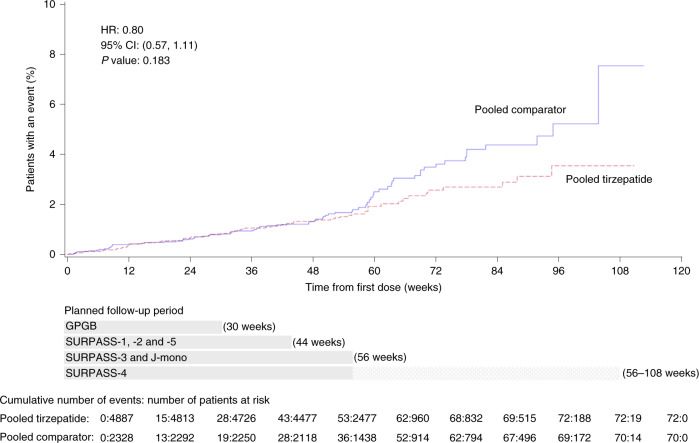
Fig. 2: Adjusted Kaplan–Meier plot of pooled tirzepatide versus pooled comparator effect on time to first occurrence of adjudication-confirmed MACE-
Fig. 2. From PMC8938269, CC BY (terms); resized.

Human studies

✓ Positivehuman RCTN Engl J Med · 2022

Tirzepatide Once Weekly for the Treatment of Obesity.

n = 2,539 humansPhase 3 double-blind randomized controlled trial (SURMOUNT-1)72 weeks including 20-week dose escalation

In 2539 adults with obesity without diabetes (SURMOUNT-1), 72 weeks of tirzepatide reduced weight by 15.0-20.9% depending on dose vs 3.1% with placebo; GI events were the most common adverse effects.

Key resultMean weight change at week 72 was -15.0% (5 mg), -19.5% (10 mg), -20.9% (15 mg) vs -3.1% with placebo (P<0.001 for all comparisons)
Studied
Adults with BMI of 30 or more, or 27 or more with at least one weight-related complication, excluding diabetes
Compared with
Placebo
Main outcome
Percent change in weight and weight reduction of 5% or more
Sample
2539 adults randomized 1:1:1:1
Authors' conclusion
In this 72-week trial in people with obesity, tirzepatide 5, 10 or 15 mg once weekly produced substantial and sustained reductions in body weight; adverse events were mainly gastrointestinal.
Limitations
Adverse events caused discontinuation in 4.3%, 7.1%, 6.2% (5, 10, 15 mg) vs 2.6% placebo.
✓ Positivehuman RCTN Engl J Med · 2021

Tirzepatide versus Semaglutide Once Weekly in Patients with Type 2 Diabetes.

n = 1,879 humansOpen-label phase 3 randomized trial (SURPASS-2)40 weeks

In 1879 people with type 2 diabetes (SURPASS-2), tirzepatide lowered HbA1c and weight more than semaglutide 1 mg; nausea 17-22%, diarrhea 13-16%, serious adverse events 5-7% vs 3%.

Key resultHbA1c change -2.01, -2.24 and -2.30 percentage points with tirzepatide 5, 10, 15 mg vs -1.86 with semaglutide (difference vs semaglutide -0.15 [P = 0.02], -0.39 and -0.45 [both P<0.001])
Studied
Patients with type 2 diabetes (mean HbA1c 8.28%)
Compared with
Semaglutide 1 mg
Main outcome
Change in glycated hemoglobin from baseline
Sample
1879 patients randomized 1:1:1:1
Authors' conclusion
Tirzepatide at all doses was noninferior and superior to semaglutide for the change in HbA1c at 40 weeks in type 2 diabetes.
Limitations
Open-label design.
✓ Positivehuman RCTN Engl J Med · 2025

Tirzepatide for Obesity Treatment and Diabetes Prevention.

n = 1,032 humansPhase 3 double-blind randomized controlled trial (SURMOUNT-1, prediabetes subgroup)176 weeks plus 17-week off-treatment period

Over 176 weeks in 1032 people with obesity and prediabetes, tirzepatide reduced weight 12.3-19.7% vs 1.3% with placebo and cut progression to type 2 diabetes (1.3% vs 13.3%).

Key resultWeight change at 176 weeks -12.3% (5 mg), -18.7% (10 mg), -19.7% (15 mg) vs -1.3% placebo (P<0.001); type 2 diabetes diagnosed in 1.3% vs 13.3% (HR 0.07; P<0.001)
Studied
Adults with obesity and prediabetes
Compared with
Placebo
Main outcome
Percent change in body weight at week 176 and onset of type 2 diabetes
Sample
1032 of 2539 SURMOUNT-1 participants had prediabetes and were analysed
Authors' conclusion
Three years of tirzepatide in persons with obesity and prediabetes produced substantial, sustained weight reduction and a markedly lower risk of progression to type 2 diabetes. No new safety signals were identified.
Limitations
Prediabetes subgroup analysis; funded by Eli Lilly.
✓ Positivehuman RCTN Engl J Med · 2025

Tirzepatide as Compared with Semaglutide for the Treatment of Obesity.

n = 751 humansPhase 3b open-label randomized controlled trial (SURMOUNT-5)72 weeks

In 751 adults with obesity (open-label SURMOUNT-5), tirzepatide produced -20.2% weight change at 72 weeks vs -13.7% with semaglutide.

Key resultMean weight change -20.2% (95% CI, -21.4 to -19.1) with tirzepatide vs -13.7% (95% CI, -14.9 to -12.6) with semaglutide (P<0.001)
Studied
Adults with obesity but without type 2 diabetes
Compared with
Semaglutide (maximum tolerated dose, 1.7 or 2.4 mg)
Main outcome
Percent change in weight from baseline to week 72
Sample
751 participants randomized 1:1
Authors' conclusion
In adults with obesity without diabetes, tirzepatide was superior to semaglutide for reduction in body weight and waist circumference at week 72.
Limitations
Open-label design; funded by Eli Lilly.
✓ Positivehuman RCTN Engl J Med · 2025

Tirzepatide for Heart Failure with Preserved Ejection Fraction and Obesity.

n = 731 humansInternational double-blind randomized placebo-controlled trialAt least 52 weeks; median follow-up 104 weeks

In 731 patients with HFpEF and obesity (SUMMIT), tirzepatide lowered cardiovascular death or worsening heart failure (9.9% vs 15.3%; HR 0.62) and improved quality-of-life scores; GI-related discontinuations 6.3% vs 1.4%.

Key resultDeath from cardiovascular causes or worsening heart failure in 36 patients (9.9%) vs 56 (15.3%) on placebo (HR 0.62; 95% CI 0.41 to 0.95; P = 0.026)
Studied
Patients with heart failure, ejection fraction of at least 50% and BMI of at least 30
Compared with
Placebo
Main outcome
Cardiovascular death or worsening heart-failure event; change in KCCQ-CSS at 52 weeks
Sample
731 patients (364 tirzepatide, 367 placebo)
Authors' conclusion
Tirzepatide led to a lower risk of the composite of cardiovascular death or worsening heart failure than placebo and improved health status in these patients.
Limitations
Cardiovascular deaths alone were not reduced (8 vs 5 patients, HR 1.58; wide CI).
~ Mixedhuman RCTJAMA · 2024

Continued Treatment With Tirzepatide for Maintenance of Weight Reduction in Adults With Obesity: The SURMOUNT-4 Randomized Clinical Trial.

n = 670 humansPhase 3 randomized withdrawal trial (SURMOUNT-4)36-week open-label lead-in then 52-week double-blind period

After 36 weeks of open-label tirzepatide (20.9% loss), those switched to placebo regained 14.0% of body weight over 52 weeks while those continuing lost a further 5.5%.

Key resultWeight change from week 36 to 88 was -5.5% with tirzepatide vs 14.0% with placebo (difference -19.4%; 95% CI -21.2% to -17.7%; P < .001)
Studied
Adults with BMI of 30 or more, or 27 or more with a weight-related complication, excluding diabetes
Compared with
Switch to placebo
Main outcome
Mean percent change in weight from week 36 to week 88
Sample
670 randomized after 36-week lead-in (783 enrolled in lead-in)
Authors' conclusion
Withdrawing tirzepatide led to substantial regain of lost weight, whereas continued treatment maintained and augmented initial weight reduction.
Limitations
Only participants who completed the open-label lead-in were randomized.
✓ Positivehuman RCTN Engl J Med · 2024

Tirzepatide for the Treatment of Obstructive Sleep Apnea and Obesity.

Two phase 3 trials; participant numbers not stated in abstractTwo phase 3 double-blind randomized controlled trials52 weeks

In two 52-week trials in adults with moderate-severe sleep apnea and obesity, tirzepatide reduced the apnea-hypopnea index by about 20-24 more events per hour than placebo.

Key resultTrial 1: AHI changed by -25.3 events per hour with tirzepatide vs -5.3 with placebo (difference -20.0; 95% CI -25.8 to -14.2; P<0.001); trial 2: -29.3 vs -5.5 (difference -23.8; P<0.001)
Studied
Adults with moderate-to-severe obstructive sleep apnea and obesity (trial 1 without PAP, trial 2 on PAP)
Compared with
Placebo
Main outcome
Change in apnea-hypopnea index (AHI)
Authors' conclusion
Among persons with moderate-to-severe obstructive sleep apnea and obesity, tirzepatide reduced AHI, body weight, hypoxic burden, hsCRP and systolic blood pressure.

Verdicts are judged on each paper's own main outcome; grades run from A (strong human evidence) to D (little or none). Details are read from the abstracts, and figures are reproduced only from openly licensed full texts. Not medical advice.