Peptide Price Finder

Home · Research · Vitamins & supplements

Vitamin B12 research

What published studies found for Vitamin B12: 8 papers, 8 in humans, with sample sizes and key results, plus 121 registered clinical trials.

B
Some human evidence
Why: Deficiency correction rests on small RCTs (Cochrane: 153 people) and mixed-design meta-analyses; tiny RCTs found injections no help for fatigue without deficiency.

Human evidence shows vitamin B12 corrects B12 deficiency, and multiple meta-analyses find oral or sublingual doses work about as well as injections. In people without deficiency, small RCTs of B12 injections for fatigue or performance found no benefit over placebo.

✓ 5 positive✗ 2 negative~ 1 mixed

B12 is generally well tolerated; rare allergic reactions and acne-like eruptions are reported with injections, and the IV effects above come from gram-level antidote doses.

US compounding: FDA-approved drug. Cyanocobalamin injection is FDA-approved; methylcobalamin is in 503A Category 1. Status for every peptide.

Browse and filter these papersVitamin B12 prices and vendors

Reported side effects

Registered clinical trials

121 trials of Vitamin B12 on ClinicalTrials.gov: 12 active, 76 completed, 23 with posted results. Registered trials include ones that haven't published yet.

TrialStatusPhasePeopleSponsor
Early Infant Micronutrition and DevelopmentNCT05005897 · started 2021-12-08RecruitingPhase 2, Phase 3600Sykehuset Innlandet HF
Electroacupuncture for PHN: Efficacy and Biomarker Evaluation in a Multicenter, Randomized, Sham-Controlled Trial ProtocolNCT06990854 · started 2025-07-01Not yet recruiting–207Dexiong Han
Microbiological and Clinical Effects of Pre- and Probiotics in Non-Surgical Periodontal TherapyNCT07443410 · started 2024-10-25Recruiting–60University Hospital Heidelberg
Effect of Methylcobalamin and Cyanocobalamin Consumption on Vitamin B12 Nutritional StatusNCT05785585 · started 2023-09-09Recruiting–54Fundació Eurecat
Methyl-donor Nutrient Supplementation and Methylation Profile in Lupus Patients With ObesityNCT05097365 · started 2022-01-01Enrolling by invitation–51University of Sao Paulo
Vitamin B12 Dose Escalation Trial in PregnancyNCT05426395 · started 2023-06-05Active, not recruitingPhase 150George Washington University
Effect of EGCG, Folic Acid, Vitamin B12 and Hyaluronic Acid on HPV DNA IntegrationNCT07697196 · started 2026-07Not yet recruiting–42IRCCS San Raffaele
Study of Vitamin B12 Metabolism in Children With Sickle Cell Disease Exposed to MEOPANCT06581900 · started 2024-11-27Recruiting–29CHU de Reims
This Randomized, Clinical Trial Evaluates the Efficacy of Oral Versus Sublingual Vitamin B12 Supplementation in Correcting Early-onset Vitamin B12 Deficiency in Adult Patients Using Proton Pump Inhibitors (PPIs). The Primary Outcome is the Change in Serum Vitamin B12 Levels Over a 6-weekNCT06966856 · started 2026-12-30Not yet recruitingPhase 323Tanta University
Effects of Vitamin B12 and Natural Orange Extract, and Their Combination on Physical and Mental PerformanceNCT07341789 · started 2025-12-01Enrolling by invitation–20Francisco Javier Martínez Noguera
A Study to Evaluate the Effects and Safety of Hydroxocobalamin in Participants With Combined Methylmalonic Academia (cblC Type)NCT07163364 · started 2025-08-31Not yet recruitingPhase 320CSPC ZhongQi Pharmaceutical Technology Co., Ltd.
Effect of a New Formulation of Vitamin B12 on Physical and MentalNCT06639789 · started 2024-07-01Recruiting–18Francisco Javier Martínez Noguera

All 121 Vitamin B12 trials, with countries and recruiting status

Meta-analyses & systematic reviews

✓ Positivemeta-analysisFront Pharmacol · 2025

Efficacy of sublingual and oral vitamin B12 versus intramuscular administration: insights from a systematic review and meta-analysis.

n = 6,098 humansSystematic review and random-effects meta-analysis (RCTs, cohort, case-control)

Meta-analysis of 16 studies (6,098 participants): B12 raised blood cobalamin and lowered homocysteine, with no significant difference between oral, sublingual and injected routes.

Key resultSerum cobalamin pooled mean difference +402.6 pg/mL (95% CI 293.6 to 511.5; p < 0.001); homocysteine -4.83 μmol/L (95% CI -6.55 to -3.11; p < 0.001); no difference between routes (p = 0.270 cobalamin)
Studied
Participants in 16 studies of oral, sublingual or IM vitamin B12
Compared with
Intramuscular injection vs oral vs sublingual
Main outcome
Serum cobalamin and homocysteine
Sample
16 studies, 6,098 participants
Authors' conclusion
Sublingual and oral B12 appear as effective as IM injections in improving cobalamin status and reducing homocysteine; further high-quality RCTs are warranted.
Limitations
Substantial heterogeneity (I2 > 80%) and possible publication bias.
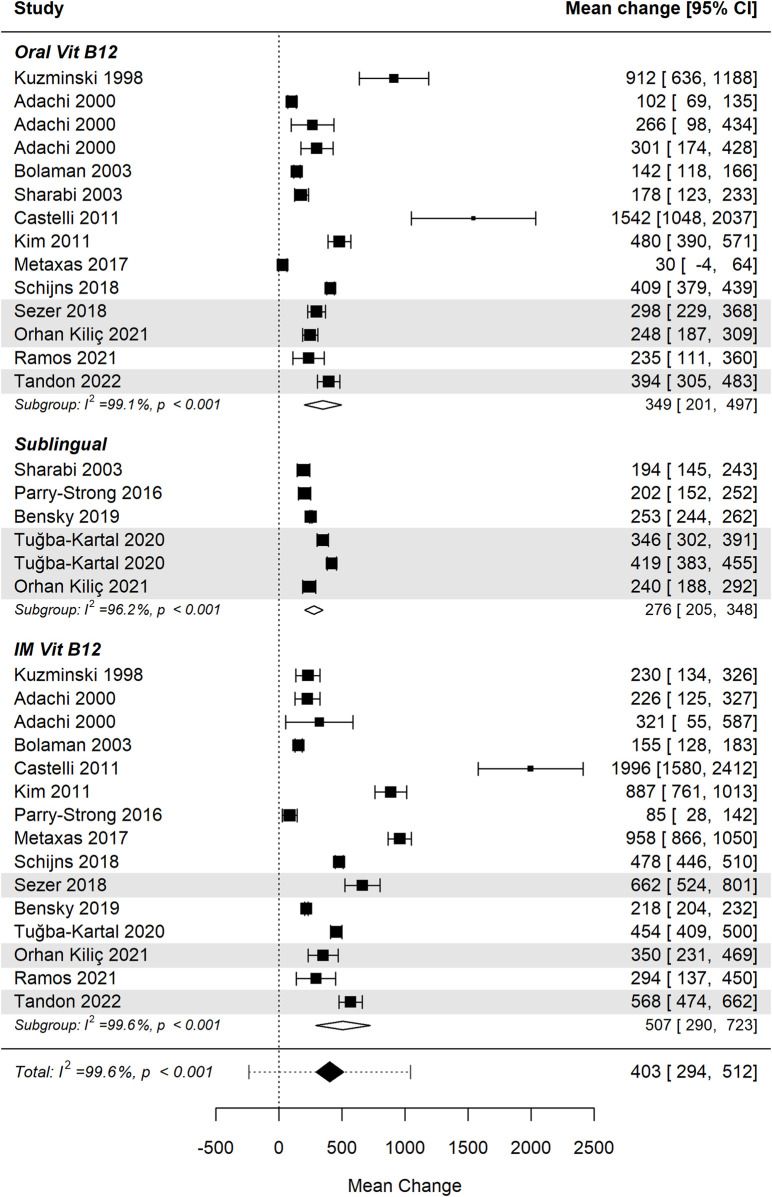
FIGURE 3: Cobalamin levels significantly increase following vitamin B12 administration. Differences between administration routes were not statistical
FIGURE 3. From PMC12757266, CC BY (terms); resized.
✓ Positivemeta-analysisIr J Med Sci · 2024

Efficacy of different routes of vitamin B12 supplementation for the treatment of patients with vitamin B12 deficiency: A systematic review and network meta-analysis.

n = 4,275 humansSystematic review and frequentist network meta-analysis of comparative studies

Network meta-analysis of 13 studies (4,275 patients): oral, sublingual and intramuscular B12 all raised B12 levels effectively, with no significant differences between routes.

Key resultVersus oral, IM and SL raised B12 by MD 94.09 and 43.31 pg/mL respectively, not statistically significant
Studied
Patients with vitamin B12 deficiency
Compared with
Oral vs intramuscular vs sublingual routes
Main outcome
Vitamin B12 level, hemoglobin, other CBC parameters, homocysteine
Sample
13 studies, 4275 patients
Authors' conclusion
IM, oral and SL routes can all effectively increase B12 without significant differences; IM ranked top statistically but without clinical significance.
Limitations
Differences non-significant owing to the limited number of studies.
✓ Positivesystematic reviewCochrane Database Syst Rev · 2018

Oral vitamin B12 versus intramuscular vitamin B12 for vitamin B12 deficiency.

n = 153 humansCochrane systematic review of RCTs (no meta-analysis)3 to 4 months of treatment and follow-up

Cochrane review of 3 RCTs (153 people): oral and intramuscular B12 normalised blood B12 similarly in deficiency (low-quality evidence), with oral treatment costing less.

Key resultAt 1000 μg/day oral, no clinically relevant difference in B12 levels vs IM; one trial at 2000 μg/day showed a mean difference of 680 pg/mL (95% CI 392.7 to 967.3) favouring oral
Studied
People with vitamin B12 deficiency (mean age 38.6 to 72 years) in three RCTs
Compared with
Intramuscular vitamin B12
Main outcome
Serum vitamin B12 levels, symptoms, adverse events
Sample
3 RCTs, 153 participants (74 oral, 79 IM)
Authors' conclusion
Low-quality evidence shows oral and IM B12 have similar effects on normalising serum B12 and oral costs less; very low-quality evidence suggests oral is as safe.
Limitations
Only 3 small trials, low to very low-quality evidence; no trial reported clinical signs and symptoms.
~ Mixedsystematic reviewCureus · 2025

The Neurological Sequelae of Vitamin B12 Deficiency: A Systematic Review and Randomized Controlled Trial.

10 RCTsSystematic review of randomized controlled trials

Review of 10 RCTs: supplementation improved neurological symptoms in overt deficiency, but not cognitive or neurological outcomes in older adults with subclinical deficiency.

Studied
Individuals with clinical and subclinical vitamin B12 deficiency
Main outcome
Neurological and cognitive outcomes
Authors' conclusion
B12 supplementation is effective in clinical deficiency but shows limited neurological benefit in subclinical cases; oral therapy had similar efficacy to IM; further trials needed.
Limitations
Homocysteine reductions did not consistently correlate with clinical improvements; standardized outcomes lacking.

Human studies

✓ Positivehuman RCTBlood · 1998

Effective treatment of cobalamin deficiency with oral cobalamin.

n = 38 humansRandomized trial4 months (120 days oral)

RCT in 38 B12-deficient patients: daily oral cyanocobalamin corrected blood and neurologic abnormalities as well as intramuscular injections and produced higher B12 levels at 4 months.

Key resultAt 4 months, serum cobalamin 1,005 pg/mL oral vs 325 pg/mL parenteral (P < .0005); methylmalonic acid 169 vs 265 nmol/L (P < .05)
Studied
Newly diagnosed cobalamin-deficient patients
Compared with
Cyanocobalamin 1 mg intramuscularly on a schedule
Main outcome
Hematologic and neurologic improvement; serum cobalamin, methylmalonic acid, homocysteine
Sample
38 patients randomized; 33 evaluable (18 oral, 15 parenteral)
Authors' conclusion
2 mg oral cyanocobalamin daily was as effective as 1 mg IM monthly and may be superior in cobalamin deficiency.
Limitations
Five patients excluded for folate deficiency, leaving 33 evaluable.
✗ Negativehuman RCTJAMA Otolaryngol Head Neck Surg · 2021

Effect of Vitamin B12 Injection on the Vocal Performance of Professional Singers: A Randomized, Double-blind, Placebo-Controlled, Crossover Trial.

n = 20 humansRandomized, double-blind, placebo-controlled crossover trialOutcomes up to 1 week; washout at least 4 weeks

Crossover RCT in 20 singers without B12 deficiency: a B12 injection did not improve vocal symptoms or fatigue more than a saline placebo.

Key resultMedian difference between placebo and B12 at 72 hours was 1.5 (95% CI -2 to 5) for SVHI-10; improvements were comparable and below minimal clinically important difference
Studied
Active adult singers (10 men, median age 22) without dysphonia but with mild vocal symptoms
Compared with
Saline placebo injection
Main outcome
Singing Voice Handicap Index-10 at 72 hours
Sample
20 singers, randomized crossover
Authors' conclusion
Empirical B12 injection did not produce a meaningful improvement in self-reported voice measures compared with placebo in singers.
Limitations
Small sample; participants not B12 deficient.
✗ Negativehuman RCTArch Intern Med · 1989

Liver extract-folic acid-cyanocobalamin vs placebo for chronic fatigue syndrome.

n = 15 humansDouble-blind placebo-controlled crossover trial

Crossover RCT in 15 chronic fatigue syndrome patients: injections of liver extract with folic acid and cyanocobalamin were no better than placebo.

Studied
Patients meeting CDC criteria for chronic fatigue syndrome
Compared with
Placebo
Main outcome
Functional status
Sample
15 chronic fatigue syndrome patients
Authors' conclusion
No significant difference between placebo and liver extract-folic acid-cyanocobalamin; the placebo response appeared strong.
Limitations
Small trial (15 patients); product combined liver extract, folic acid and cyanocobalamin.
✓ Positivehuman trialJ Gerontol A Biol Sci Med Sci · 2001

Cobalamin supplementation improves cognitive and cerebral function in older, cobalamin-deficient persons.

n = 16 humansSingle-blind placebo-controlled intervention (1 month placebo then 5 months IM hydroxycobalamin)6 months total

Single-blind study in 16 older adults with low B12: 5 months of hydroxocobalamin injections improved some verbal memory and fluency tests and EEG measures.

Studied
Community-dwelling elderly with low plasma cobalamin and no cognitive impairment
Compared with
Preceding placebo month
Main outcome
Plasma Cbl, tHcy, MMA, qEEG, psychometric tests
Sample
16 healthy elderly subjects with low plasma cobalamin
Authors' conclusion
Cbl supplementation was followed by improved electrographic and cognitive function in older subjects with low plasma Cbl, related to reduced tHcy.
Limitations
Small, single-blind, no parallel control (placebo period preceded treatment).

Verdicts are judged on each paper's own main outcome; grades run from A (strong human evidence) to D (little or none). Details are read from the abstracts, and figures are reproduced only from openly licensed full texts. Not medical advice.