Peptide Price Finder

Home · Research · Muscle & performance

ACE-031 research

What published studies found for ACE-031: 6 papers, 2 in humans, with sample sizes and key results, plus 4 registered clinical trials.

B
Some human evidence
Why: Two small placebo-controlled trials (48 healthy women, Duchenne boys) raised lean mass but showed no functional benefit; the Duchenne trial stopped early for bleeding.

ACE-031 (ramatercept) is a soluble activin receptor IIB decoy that blocks myostatin and related ligands. A phase 1 trial in healthy postmenopausal women and a placebo-controlled trial in boys with Duchenne muscular dystrophy both showed it increases lean mass, but the Duchenne trial was stopped early for nosebleeds and dilated skin vessels, and development was discontinued. No trial has shown it improves function.

✓ 4 positive✗ 1 negative~ 1 mixed

The Duchenne trial was halted early over bleeding and vascular side effects and clinical development was discontinued.

US compounding: Not compoundable. Not an FDA-approved drug and not nominated for FDA's 503A bulks list, so US pharmacies can't legally compound it. Status for every peptide.

Browse and filter these papersACE-031 prices and vendors

Reported side effects

Registered clinical trials

4 trials of ACE-031 on ClinicalTrials.gov: 0 active, 2 completed, 1 with posted results. Registered trials include ones that haven't published yet.

TrialStatusPhasePeopleSponsor
Study of ACE-031 in Subjects With Duchenne Muscular DystrophyNCT01099761 · started 2010-04 · results postedTerminatedPhase 224Acceleron Pharma, Inc., a wholly-owned subsidiary of Merck & Co., Inc., Rahway, NJ USA
A Safety, Tolerability, Pharmacokinetic and Pharmacodynamic Study of ACE-031 in Healthy Postmenopausal WomenNCT00952887 · started 2009-08CompletedPhase 170Acceleron Pharma, Inc., a wholly-owned subsidiary of Merck & Co., Inc., Rahway, NJ USA
A Safety, Tolerability, Pharmacokinetic and Pharmacodynamic Study of ACE-031 (ActRIIB-IgG1)in Healthy Postmenopausal VolunteersNCT00755638 · started 2008-09CompletedPhase 148Acceleron Pharma, Inc., a wholly-owned subsidiary of Merck & Co., Inc., Rahway, NJ USA
Extension Study of ACE-031 in Subjects With Duchenne Muscular DystrophyNCT01239758 · started 2010-10TerminatedPhase 211Acceleron Pharma, Inc., a wholly-owned subsidiary of Merck & Co., Inc., Rahway, NJ USA

All 4 ACE-031 trials, with countries and recruiting status

Human studies

✓ Positivehuman RCTMuscle Nerve · 2013

A single ascending-dose study of muscle regulator ACE-031 in healthy volunteers.

n = 48 humansDouble-blind, placebo-controlled single ascending-dose study (0.02-3 mg/kg s.c.)Lean mass and thigh volume assessed at day 29

In 48 healthy postmenopausal women given a single dose of ACE-031 or placebo, the 3 mg/kg group gained 3.3% total body lean mass and 5.1% thigh muscle volume by day 29; the main adverse event was injection-site redness.

Key resultAt 3 mg/kg, total body lean mass +3.3% (P = 0.03, DXA) and thigh muscle volume +5.1% (P = 0.03, MRI) at day 29
Studied
Healthy postmenopausal women
Compared with
Placebo
Main outcome
Safety, pharmacokinetics, pharmacodynamics (lean mass by DXA, thigh muscle volume by MRI)
Sample
48 healthy postmenopausal women, randomized 3:1 to ACE-031 or placebo
Authors' conclusion
Single-dose ACE-031 was generally well tolerated and increased muscle mass in healthy postmenopausal women.
Limitations
Single dose, healthy volunteers.
~ Mixedhuman RCTMuscle Nerve · 2017

Myostatin inhibitor ACE-031 treatment of ambulatory boys with Duchenne muscular dystrophy: Results of a randomized, placebo-controlled clinical trial.

Number of boys not stated in abstractRandomized, double-blind, placebo-controlled, ascending-dose trial; ACE-031 given subcutaneously every 2-4 weeks

In a randomized, double-blind, placebo-controlled ascending-dose trial in ambulatory boys with Duchenne muscular dystrophy, ACE-031 showed non-significant trends toward preserved 6-minute walk distance, higher lean mass and bone density and lower fat mass, but the study was stopped after the second dosing regimen because of epistaxis and telangiectasias.

Key resultNon-significant trend for maintained 6MWT distance in ACE-031 groups vs a decline with placebo; trends toward higher lean mass and BMD and lower fat mass
Studied
Ambulatory boys with Duchenne muscular dystrophy
Compared with
Placebo
Main outcome
Safety (primary); pharmacokinetics, pharmacodynamics, 6-minute walk test, lean mass, fat mass, BMD (secondary)
Authors' conclusion
ACE-031 showed pharmacodynamic trends; the study was stopped after the second dosing regimen because of epistaxis and telangiectasias. Myostatin inhibition is called a promising approach for DMD.
Limitations
Stopped early for safety concerns; efficacy trends not statistically significant.

Animal & lab studies

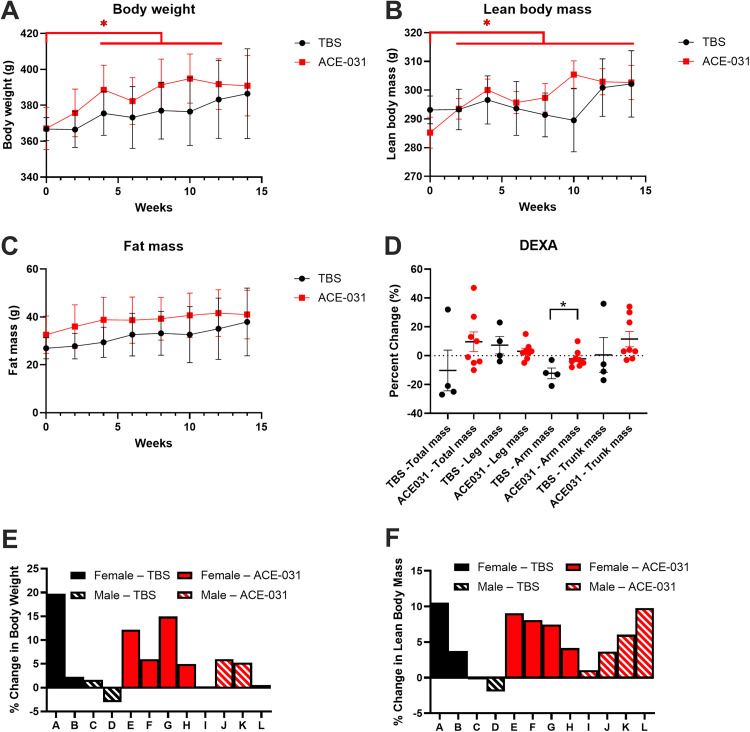
✓ PositiveanimalPLoS One · 2026

ACE-031, a soluble activin type IIB receptor, increases muscle mass and strength in the common marmoset (Callithrix jacchus).

Number of marmosets not stated in abstractRandomized ACE-031 vs vehicle14 weeks

In common marmosets randomized to 14 weeks of ACE-031 or vehicle, treated animals gained lean body mass and showed larger type I and type II fibres and greater absolute and specific muscle force.

Key resultSignificant time x treatment interaction for lean body mass (ACE-031 greater at euthanasia than baseline; not seen in vehicle controls); increased type I and II fiber cross-sectional area in biceps brachii and increased absolute and specific EDL force
Studied
Common marmosets (Callithrix jacchus)
Compared with
Vehicle (10 mM Tris buffered saline)
Main outcome
Lean body mass, fiber cross-sectional area, ex vivo muscle force
Authors' conclusion
Efficacy in non-human primates provides optimism that targeting multiple negative regulators of skeletal muscle may help treat human myopathies.
Limitations
Animal study; sample size not stated in abstract.
Fig 1: Body weight and body composition analysis.(A) Body weights of ACE-031 treated marmosets and control at the end of the treatment compared to
Fig 1. From PMC12904423, CC BY (terms); resized.
✓ PositiveanimalbioRxiv · 2025

ACE-031, a Soluble Activin Type IIB Receptor, Increases Muscle Mass and Strength in the Common Marmoset (Callithrix jacchus).

Number of marmosets not stated in abstractRandomized ACE-031 vs vehicle (preprint)14 weeks

Preprint of the same marmoset experiment, reporting increased body weight, lean mass, fibre cross-sectional area and ex vivo force with ACE-031.

Key resultSignificant increase in body weight and lean body mass from baseline with ACE-031, none in vehicle controls; increased type I and II fiber CSA and EDL absolute and specific force
Studied
Common marmosets (Callithrix jacchus)
Compared with
Vehicle (10 mM Tris buffered saline)
Main outcome
Body weight, lean body mass, fiber cross-sectional area, ex vivo muscle force
Authors' conclusion
Efficacy in non-human primates provides optimism that targeting multiple negative regulators of skeletal muscle may help treat human myopathies.
Limitations
Animal study; preprint; sample size not stated in abstract.
✗ NegativeanimalMol Ther · 2014

Blockade of ActRIIB signaling triggers muscle fatigability and metabolic myopathy.

Animals4-month pharmacological blockade of ActRIIB signaling with soluble ActRIIB-Fc4 months

Four months of soluble ActRIIB-Fc in mice caused extreme muscle fatigability, raised serum lactate, reduced muscle capillarization and a severe metabolic myopathy in the mdx model; the authors caution against this strategy as a sole treatment.

Studied
Mice including the mdx model of Duchenne muscular dystrophy
Main outcome
Muscle fatigability, serum lactate, muscle energy metabolism
Authors' conclusion
ActRIIB blockade triggered extreme muscle fatigability and a severe metabolic myopathy in mdx mice; the authors caution against deploying this strategy, at least in isolation, for neuromuscular disorders.
Limitations
Mouse study; uses soluble ActRIIB-Fc rather than ACE-031 itself.
✓ PositiveanimalJ Appl Physiol (1985) · 2010

Administration of a soluble activin type IIB receptor promotes skeletal muscle growth independent of fiber type.

AnimalsACE-031 vs vehicle control28 days

In mice, 28 days of ACE-031 increased body weight 16% and individual muscle weights 26-46% and enlarged both type I and type II fibres.

Key resultBody weight 16% greater than control; soleus, plantaris, gastrocnemius and EDL weights up 33, 44, 46 and 26% (P<0.05); fiber CSA up 22% (type I) and 28% (type II) in soleus
Studied
8-week-old C57BL/6 mice
Compared with
Vehicle
Main outcome
Body weight, muscle wet weight, fiber cross-sectional area and fiber type
Authors' conclusion
ACE-031 increased muscle mass independent of fiber type, providing optimism it may be a viable therapeutic for musculoskeletal diseases.
Limitations
Short duration; effects may be age dependent (authors call for confirmation).

Verdicts are judged on each paper's own main outcome; grades run from A (strong human evidence) to D (little or none). Details are read from the abstracts, and figures are reproduced only from openly licensed full texts. Not medical advice.