Peptide Price Finder

Home · Research · Mitochondria & energy

AICAR research

What published studies found for AICAR: 8 papers, 7 in humans, with sample sizes and key results, plus 1 registered clinical trials.

B
Some human evidence
Why: Large RCTs exist only for heart-surgery protection and conflict (3,080-patient trial negative); 'exercise mimetic' use rests on mouse data and tiny human studies.

AICAR (acadesine) has been given to humans mainly as an intravenous drug during heart surgery and in small metabolic and cancer studies, with mixed results: an early pooled analysis suggested fewer heart attacks, but a large later trial found no benefit. Its popular use as an 'exercise mimetic' rests on mouse data; there are no human trials of it for fitness or fat loss.

✓ 3 positive✗ 3 negative~ 1 mixed? 1 inconclusive

Human safety data come from IV hospital use (heart surgery, leukemia, metabolic studies); there are no safety data for self-administered use.

Browse and filter these papersAICAR prices and vendors

Reported side effects

Registered clinical trials

1 trials of AICAR on ClinicalTrials.gov: 0 active, 1 completed. Registered trials include ones that haven't published yet.

TrialStatusPhasePeopleSponsor
Contraction (Exercise) Mediated Glucose Uptake as a Therapeutic Target in Type 2 DiabetesNCT00168519 · started 2002-10Completed–40Baker Heart Research Institute

All 1 AICAR trials, with countries and recruiting status

Meta-analyses & systematic reviews

✓ Positivemeta-analysisJAMA · 1997

Effects of acadesine on myocardial infarction, stroke, and death following surgery. A meta-analysis of the 5 international randomized trials. The Multicenter Study of Perioperative Ischemia (McSPI) Research Group.

n = 4,043 humansIndividual patient-data meta-analysis of 5 placebo-controlled double-blind RCTs

Patient-level meta-analysis of 5 RCTs (4,043 bypass surgery patients): acadesine cut perioperative myocardial infarction by 27% and early cardiac death by 50%; stroke was not significantly reduced.

Key resultAcadesine reduced perioperative MI by 27% (OR 0.69; 95% CI 0.51-0.95; P=.02) and combined MI, stroke or cardiac death by 26% (OR 0.73; 95% CI 0.57-0.93; P=.01); stroke not significantly reduced (P=.10)
Studied
Patients undergoing CABG surgery in 5 trials at 81 centers
Compared with
Placebo
Main outcome
Perioperative myocardial infarction, cardiac death, stroke
Sample
5 randomized trials, 4043 patients
Authors' conclusion
Acadesine before and during CABG can reduce early cardiac death, MI and combined adverse cardiovascular outcomes.
Human studies

✗ Negativehuman RCTJAMA · 2012

Effect of adenosine-regulating agent acadesine on morbidity and mortality associated with coronary artery bypass grafting: the RED-CABG randomized controlled trial.

n = 3,080 humansRandomized, double-blind, placebo-controlled, parallel-group trial (RED-CABG), stopped for futility28 days postoperative

RED-CABG trial (3,080 bypass surgery patients): IV acadesine did not reduce death, stroke or severe heart failure versus placebo (5.1% vs 5.0%); stopped early for futility.

Key resultPrimary outcome in 75 of 1493 (5.0%) placebo vs 76 of 1493 (5.1%) acadesine (OR 1.01, 95% CI 0.73-1.41)
Studied
Intermediate- to high-risk patients (median age 66) undergoing non-emergency on-pump CABG, 300 sites in 7 countries
Compared with
Placebo
Main outcome
Composite of all-cause mortality, nonfatal stroke or mechanical support for severe LV dysfunction
Sample
3080 CABG patients randomized (1493 per group analysed)
Authors' conclusion
Acadesine did not reduce the composite of all-cause mortality, nonfatal stroke or severe LV dysfunction in CABG patients.
Limitations
Stopped early for futility after 3080 of 7500 planned.
✗ Negativehuman RCTCardiovasc Drugs Ther · 1994

Effect of acadesine, a new metabolic agent, on exercise-induced myocardial ischemia in chronic stable angina.

n = 12 humansFive-way randomized double-blind crossover-type comparison of four acadesine doses with placebo

Randomized crossover study in 12 people with stable angina: IV acadesine at four doses did not improve time to ischemia, angina or exercise time versus placebo.

Key resultPlacebo-adjusted change in time to 1-mm ST depression was -0.1 ± 6.2%, 11.1 ± 13.8%, 12.9 ± 8.6%, -3.2 ± 6.8% at 6, 12, 24, 48 mg/kg (p = NS vs. baseline)
Studied
Patients with chronic stable angina
Compared with
Placebo
Main outcome
Time to 1 mm ST-segment depression and exercise tolerance
Sample
12 patients with stable angina
Authors' conclusion
Acadesine did not consistently alter exercise tolerance in stable angina; the exercise-induced ischemia may have been insufficient to show an antiischemic effect.
Limitations
Only 12 patients.
~ Mixedhuman trialDiabetes · 2007

5-aminoimidazole-4-carboxamide 1-beta-D-ribofuranoside acutely stimulates skeletal muscle 2-deoxyglucose uptake in healthy men.

n = 29 humansHuman trial of AICAR vs exercise with 2-deoxyglucose uptake and euglycemic-hyperinsulinemic clamp3 hours AICAR

In 29 healthy men, IV AICAR doubled muscle glucose uptake (exercise more than quadrupled it) but raised whole-body glucose disposal by only 7%.

Key result2DG uptake rose 2.1 ± 0.8-fold with AICAR and 4.7 ± 1.7-fold with bicycle exercise; whole-body glucose disposal rose 7% with AICAR (P < 0.05)
Studied
Healthy men (age 26 ± 8 years, BMI 25 ± 4)
Compared with
Bicycle exercise
Main outcome
Muscle 2-deoxyglucose uptake
Sample
29 healthy men
Authors' conclusion
In healthy people AICAR acutely stimulates muscle 2DG uptake with a minor effect on whole-body glucose disposal.
Limitations
AMPK activity/phosphorylation was unchanged with AICAR.
✓ Positivehuman trialDiabetologia · 2008

Intravenous AICAR administration reduces hepatic glucose output and inhibits whole body lipolysis in type 2 diabetic patients.

Ten male type 2 diabetic patientsIntravenous AICAR vs saline infusion with stable isotope methodology and muscle biopsies

In 10 men with type 2 diabetes, IV AICAR reduced liver glucose output and lowered blood glucose and free fatty acids compared with saline.

Key resultGlucose disposal as percent of appearance increased and plasma glucose fell more with AICAR (both p < 0.001); plasma NEFA appearance and disappearance were reduced
Studied
Male type 2 diabetic patients (age 64 ± 2 years, BMI 28 ± 1)
Compared with
NaCl 0.9% control test
Main outcome
Glucose and fatty acid kinetics
Authors' conclusion
IV AICAR reduced hepatic glucose output and lowered blood glucose in type 2 diabetes, and may stimulate hepatic fatty acid oxidation and/or inhibit lipolysis.
Limitations
Small sample; muscle AMPK phosphorylation was not increased.
✗ Negativehuman trialJ Clin Pharmacol · 2011

Intravenous AICAR during hyperinsulinemia induces systemic hemodynamic changes but has no local metabolic effect.

Ten participants (paired data n = 8)Two euglycemic hyperinsulinemic clamps with AICAR or placebo infusion120-minute clamp, AICAR over last 60 minutes

In 10 healthy volunteers, IV AICAR during an insulin clamp did not change whole-body or forearm glucose uptake but raised heart rate and lowered blood pressure.

Key resultNo difference in glucose infusion rate or forearm glucose uptake; heart rate rose from 58 ± 3 to 70 ± 3 vs 60 ± 4 to 63 ± 4 bpm with placebo (P < .05)
Studied
Healthy humans
Compared with
Saline placebo
Main outcome
Whole-body glucose infusion rate and forearm glucose uptake
Authors' conclusion
AICAR does not seem to have a direct effect on systemic or local glucose uptake in humans; it increases heart rate and decreases blood pressure, probably by systemic vasodilation.
Limitations
Small sample.
? Inconclusivehuman trialCancer Chemother Pharmacol · 2013

Acadesine for patients with relapsed/refractory chronic lymphocytic leukemia (CLL): a multicenter phase I/II study.

24 patients (18 in Part I, 6 in Part II)Multicenter phase I/II open-label study

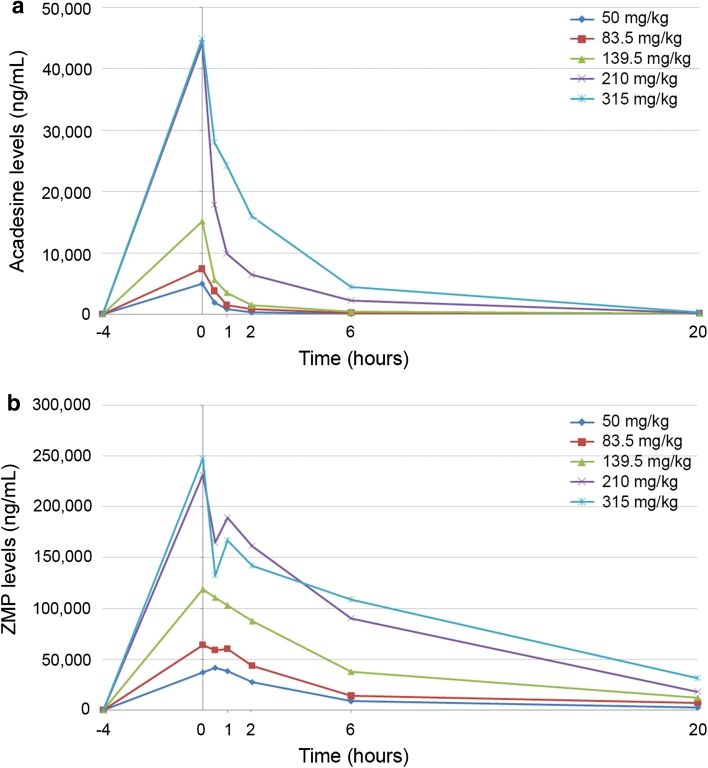
Phase I/II study in 24 patients with relapsed CLL: IV acadesine had a manageable safety profile and variable signs of anti-leukemic activity.

Key resultMaximum tolerated dose was 210 mg/kg single dose; efficacy trends included reduced peripheral CLL cells and lymphadenopathy
Studied
Patients with relapsed/refractory chronic lymphocytic leukemia
Main outcome
Safety, tolerability, maximum tolerated dose
Authors' conclusion
Acadesine had a manageable safety profile and might be a valuable agent for relapsed/refractory CLL.
Limitations
Small population and variable doses; efficacy results variable, open-label, no control.
Fig. 1: Acadesine mean plasma levels (ng/mL) (a) and ZMP mean whole blood levels (ng/mL) (b) are represented at 4 h pre-dosing (−4) and 0, 0.5, 1, 2
Fig. 1. From PMC3579463, CC BY (terms); resized.

Animal & lab studies

✓ PositiveanimalCell · 2008

AMPK and PPARdelta agonists are exercise mimetics.

AnimalsMouse treadmill endurance experiments with AMPK and PPARdelta agonists4 weeks AICAR

In sedentary mice, 4 weeks of AICAR switched on muscle metabolic genes and increased running endurance by 44%.

Key result4 weeks of AICAR alone enhanced running endurance by 44% in sedentary mice
Studied
Sedentary and trained adult mice in treadmill running tests
Compared with
Untreated sedentary mice
Main outcome
Running endurance
Authors' conclusion
The AMPK-PPARdelta pathway can be targeted by orally active drugs to enhance training adaptation or increase endurance without exercise.
Limitations
Mouse study.

Verdicts are judged on each paper's own main outcome; grades run from A (strong human evidence) to D (little or none). Details are read from the abstracts, and figures are reproduced only from openly licensed full texts. Not medical advice.