Peptide Price Finder

Home · Research · Sexual health & hormones

Alprostadil research

What published studies found for Alprostadil: 7 papers, 7 in humans, with sample sizes and key results, plus 40 registered clinical trials.

A
Strong human evidence
Why: Approved ED drug: placebo-controlled RCTs in over 1,100 men plus a meta-analysis of 11 RCTs consistently show erections improve, injection more than urethral forms.

Alprostadil (synthetic prostaglandin E1) is an approved erectile dysfunction treatment backed by multiple placebo-controlled human RCTs and a meta-analysis; injected into the penis it produces usable erections in most men, while urethral and topical forms are less effective but better tolerated. Penile pain is the most common side effect, with prolonged erection, priapism and penile fibrosis as less common risks.

✓ 5 positive~ 2 mixed

US compounding: FDA-approved drug. FDA-approved (Caverject, Edex, Muse); also a common ingredient in compounded erectile-dysfunction injections. Status for every peptide.

Browse and filter these papersAlprostadil prices and vendors

Reported side effects

Registered clinical trials

40 trials of Alprostadil on ClinicalTrials.gov: 3 active, 11 completed, 5 with posted results. Registered trials include ones that haven't published yet.

TrialStatusPhasePeopleSponsor
ALP-1 Continuous Intravenous Infusion to Maintain Clinical Stability in Advanced Heart FailureNCT00610051 · started 2026-10Not yet recruitingPhase 3600Biopeutics Co., Ltd
Comparing MOP, Prostaglandin E1, and Calcitriol to Accelerate Orthodontic Tooth MovementNCT07842120 · started 2026-04-16RecruitingPhase 260Ghufran Dhari Awad
Platelet Rich Plasma (PRP) as Terapeutical Option in Erectil Disfunction (DE)NCT06768177 · started 2023-04-01Enrolling by invitation–60Azienda Ospedaliero-Universitaria Consorziale Policlinico di Bari
Alprostadil in Peripheral Arterial Occlusive Disease (PAOD) Stage IVNCT00596752 · started 2004-03 · results postedCompletedPhase 4840UCB BIOSCIENCES GmbH
Prostaglandin E1 in Outpatients With Intermittent ClaudicationNCT01263925 · started 2001-04 · results postedCompletedPhase 3561UCB Pharma
ED Recovery in Men Age </=65 Treated With Bilateral Nerve Sparing Robotic Assisted Prostatectomy for Prostate CancerNCT00544076 · started 2006-01 · results postedTerminatedPhase 3110City of Hope Medical Center
Pharmacological Penile Rehabilitation in the Preservation of Erectile Function Following Bilateral Nerve-Sparing Radical ProstatectomyNCT00955929 · started 2009-08-06 · results postedTerminated–76Memorial Sloan Kettering Cancer Center
Alprostadil in Maculopathy Study (AIMS)NCT00619229 · started 2006-07 · results postedTerminatedPhase 337UCB Pharma
Topical Alprostadil for Female Sexual Arousal DisorderNCT00324948 · started 2004-09CompletedPhase 2300VIVUS LLC
Cervical Ripening: A Comparison Between Intravaginal Misoprostol Tablet and Intracervical Foley's Catheter and Subsequent Induction of Labor, Safety and Efficacy in Federal Teaching Hospital Abakaliki, Ebonyi State, Nigeria.NCT02574338 · started 2015-09Completed–135Nwali Matthew Igwe
Nerve-Sparing Radical Prostatectomy With or Without Nerve Grafting Followed by Standard Therapy for Erectile Dysfunction in Treating Patients With Localized Prostate CancerNCT00080808 · started 2001-08CompletedPhase 2111M.D. Anderson Cancer Center
Intravenous Dexamethasone for Inducing Labor in Women With Term Pregnancy and Pre-Labour Rupture of MembranesNCT07503184 · started 2025-07-15CompletedPhase 460Nishtar Medical University

All 40 Alprostadil trials, with countries and recruiting status

Meta-analyses & systematic reviews

✓ Positivemeta-analysisAndrology · 2025

The effect of topical and intraurethral alprostadil on erectile function: A systematic review and meta-analysis.

n = 5,869 humansSystematic review and meta-analysis, random-effects model (PROSPERO registered)

Meta-analysis of 11 RCTs and 4 non-randomized studies (5,869 men): topical alprostadil improved IIEF score by 4.7 points vs placebo and intraurethral alprostadil also improved ED vs placebo; study quality was low and heterogeneity high.

Key resultTopical alprostadil improved IIEF by 4.7 points (95% CI: 2.4-7.1, I2 = 97%); intraurethral pooled odds ratio 0.08 (95% CI: 0.04-0.16, I2 = 54%)
Studied
Men with erectile dysfunction (mean age 60 ± 9.4 years)
Compared with
Placebo
Main outcome
IIEF score (topical); erectile dysfunction improvement (intraurethral)
Sample
11 randomized controlled trials and 4 non-randomized studies, 5869 patients
Authors' conclusion
Topical and intraurethral alprostadil significantly improve ED symptoms vs placebo and are generally safe with no serious adverse events; further trials are needed.
Limitations
Study design variability, few studies and low methodological quality; very high heterogeneity for topical (I2 = 97%).
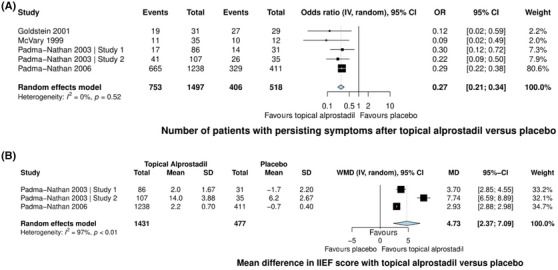
FIGURE 2: (A) Forest plot of the odds ratio in the number of patients with persisting erectile dysfunction symptoms after the use of topical alprostad
FIGURE 2. From PMC12569735, CC BY (terms); resized.

Human studies

✓ Positivehuman RCTUrology · 2000

Intracavernous alprostadil alfadex is more efficacious, better tolerated, and preferred over intraurethral alprostadil plus optional actis: a comparative, randomized, crossover, multicenter study.

n = 111 humansCrossover, randomized, open-label multicenter study

Randomized crossover trial in 111 men: injected alprostadil gave erections sufficient for intercourse after 82.5% of uses vs 53.0% for intraurethral alprostadil, and was preferred by patients.

Key resultPatients with at least one erection sufficient for intercourse: 92.6% with EDEX vs 61.8% with MUSE (P <0.0001)
Studied
Patients with erectile dysfunction of at least 6 months' duration
Compared with
Intraurethral alprostadil (MUSE) plus optional ACTIS
Main outcome
Erections sufficient for intercourse, safety, patient preference
Sample
111 patients
Authors' conclusion
Intracavernous injection was more efficacious, better tolerated and preferred, so it should be offered first-choice if oral therapy fails or is contraindicated.
Limitations
Open-label design.
✓ Positivehuman RCTUrology · 1996

A double-blind, placebo-controlled evaluation of the erectile response to transurethral alprostadil.

n = 68 humansProspective, multicenter, double-blind, placebo-controlled; random sequence of four doses and placebo at home2 to 4 weeks

Double-blind, placebo-controlled study in 68 men with organic ED: with transurethral alprostadil 49% achieved an erection sufficient for intercourse and 64% reported intercourse; no priapism.

Key result75.4% (49 of 65) achieved full penile enlargement, 49.2% (32 of 65) achieved an erection sufficient for intercourse; 63.6% (42 of 66) reported intercourse
Studied
Men with long-standing (mean 41 months) erectile dysfunction of primarily organic etiology
Compared with
Placebo
Main outcome
Erectile response and intercourse
Sample
68 men enrolled; 65-66 evaluable for outcomes
Authors' conclusion
Short-term transurethral alprostadil produced erections leading to intercourse in most patients with chronic ED and may be a useful option.
Limitations
Short-term treatment; penile pain in 9.1% to 18.3% of administrations.
~ Mixedhuman RCTBJU Int · 1999

Intracavernosal versus intraurethral alprostadil: a prospective randomized study.

n = 60 humansProspective randomized study with 3-month home treatment3 months

60 men randomized to injected vs intraurethral alprostadil: injection worked better (intercourse after 85% vs 55% of doses) but caused more pain (47% vs 7%) and a 67% withdrawal rate.

Key resultGood erection in outpatient dosing: 27 (90%) intracavernosal vs 18 (60%) MUSE (P<0.05); withdrawal 67% vs 17% (P<0.05)
Studied
Men with organic erectile dysfunction
Compared with
MUSE 1 mg intraurethral alprostadil
Main outcome
Erection response, intercourse, adverse reactions, ease of use
Sample
60 men randomized (30 per group)
Authors' conclusion
MUSE is less effective than intracavernosal PGE1 but is more accepted as an easy method with minimal or no discomfort.
Limitations
High withdrawal in the injection group (10 of 30 completed).
✓ Positivehuman RCTJ Urol · 1997

Recovery of spontaneous erectile function after nerve-sparing radical retropubic prostatectomy with and without early intracavernous injections of alprostadil: results of a prospective, randomized trial.

n = 30 humansProspective randomized trial; alprostadil injections 3 times per week vs observation12 weeks of treatment; 6-month follow-up

30 men after nerve-sparing prostatectomy: 12 weeks of alprostadil injections led to more recovery of spontaneous erections at 6 months (67% vs 20% with observation).

Key result8 patients (67%) in the alprostadil group vs 3 patients (20%) in the control group recovered spontaneous erections (p <0.01)
Studied
Potent men with localized prostate cancer after nerve-sparing radical retropubic prostatectomy
Compared with
Observation without erectogenic treatment
Main outcome
Recovery of spontaneous erections sufficient for intercourse
Sample
30 potent patients (15 per group)
Authors' conclusion
Early postoperative alprostadil injections significantly increased recovery of spontaneous erections after nerve-sparing prostatectomy.
Limitations
Small trial; only 12 of 15 treated patients completed the schedule; no blinding or placebo.
✓ Positivehuman RCTN Engl J Med · 1996

Efficacy and safety of intracavernosal alprostadil in men with erectile dysfunction. The Alprostadil Study Group.

Three studies: dose-response 296 men, dose-finding 201 men, six-month self-injection 683 menThree multi-institutional prospective studies (dose-response vs placebo, dose-finding, self-injection)Six months (self-injection study)

NEJM studies in over 1,100 men with ED: intracavernosal alprostadil outperformed placebo with a dose-response; in a 6-month self-injection study (683 men) sexual activity was possible after 94% of injections.

Key resultSexual activity possible after 94 percent of injections; rated satisfactory after 87 and 86 percent by men and partners; penile pain in 50 percent of men, priapism in 1 percent
Studied
Men with erectile dysfunction of vasculogenic, neurogenic, psychogenic and mixed causes
Compared with
Placebo (dose-response study)
Main outcome
Erection and satisfactory sexual activity rated by men and partners
Authors' conclusion
Intracavernosal alprostadil injection is an effective therapy for erectile dysfunction with tolerable side effects.
Limitations
Only the dose-response study was placebo-controlled.
~ Mixedhuman trialEur Urol · 2000

Safety and efficacy of alprostadil sterile powder (S. Po., CAVERJECT) in diabetic patients with erectile dysfunction.

n = 31 humansSingle-group long-term self-injection study with dose titration6 months home phase

31 diabetic men with ED on 6 months of home injections: 76.5% of injections gave satisfactory sexual activity, but penile pain affected 61% and about half dropped out.

Key resultSatisfactory sexual activity after 76.5% of injections (patient-assessed) and 72.5% (partner-assessed); penile pain in 19 (61%) of 31 patients; 16 patients dropped out
Studied
Diabetic men aged 44-75 with erectile dysfunction of at least 4 months
Main outcome
Efficacy and adverse events of intracavernosal alprostadil
Sample
31 diabetic men
Authors' conclusion
Despite high penile pain incidence and higher withdrawal, intracavernosal alprostadil is relatively effective and safe in some diabetic patients if dose is titrated and they are trained.
Limitations
No control group; high dropout (16 of 31).

Verdicts are judged on each paper's own main outcome; grades run from A (strong human evidence) to D (little or none). Details are read from the abstracts, and figures are reproduced only from openly licensed full texts. Not medical advice.