Peptide Price Finder

Home · Research · Healing & recovery

BPC-157 research

What published studies found for BPC-157: 13 papers, 6 in humans, with sample sizes and key results, plus 2 registered clinical trials.

C
Mostly animal studies
Why: No controlled human trials, only three tiny uncontrolled pilots and a chart survey; the evidence is mainly rat studies, largely from one research group.

Evidence for BPC-157 comes almost entirely from rat and other animal studies, many from a single research group, showing faster healing of tendon, muscle, gut and skin injuries. Human data are limited to three small uncontrolled pilot reports (knee pain, interstitial cystitis, IV safety in 2 people); there are no published randomized controlled trials.

✓ 3 positive~ 1 mixed? 9 inconclusive

No adverse events were reported in three small uncontrolled human pilot studies (about 30 people in total); a 2026 preprint of 1,039 real-world users found infrequently noted adverse events (about 1-1.4% each) with likely under-reporting. There are no controlled human safety data, and products sold outside regulated channels may vary in purity.

US compounding: Recommended for compounding, not legal yet. FDA's Pharmacy Compounding Advisory Committee voted on July 23-24, 2026 to recommend adding it to the 503A bulks list (FDA staff had recommended against). The vote isn't binding: compounding stays illegal until FDA accepts it and finishes proposed and final rulemaking, which typically takes a year or more. Vote: 8 yes, 6 no, 1 abstain (evaluated for ulcerative colitis). Status for every peptide.

Browse and filter these papersBPC-157 prices and vendors

Reported side effects

Registered clinical trials

2 trials of BPC-157 on ClinicalTrials.gov: 2 active, 0 completed. Registered trials include ones that haven't published yet.

TrialStatusPhasePeopleSponsor
BPC 157 for Acute Hamstring Muscle Strain RepairNCT07437547 · started 2026-02-02RecruitingPhase 2120Hudson Biotech
Impact of BPC-157 on Recovery Following Rotator Cuff Repair SurgeryNCT07803250 · started 2027-01-01Not yet recruitingPhase 130University of Arkansas

All 2 BPC-157 trials, with countries and recruiting status

Meta-analyses & systematic reviews

? Inconclusivesystematic reviewHSS J · 2025

Emerging Use of BPC-157 in Orthopaedic Sports Medicine: A Systematic Review.

36 studies (35 preclinical, 1 clinical) from 544 articlesSystematic review (level IV and V studies)

Systematic review of 36 studies (35 preclinical, 1 clinical) for musculoskeletal injury: animal models showed improved tendon, ligament, muscle and bone healing, but evidence is level IV/V and no clinical safety data were found.

Key resultIn the one retrospective clinical study, 7 of 12 patients with chronic knee pain reported relief for >6 months
Studied
Preclinical and clinical literature on BPC-157 for musculoskeletal injury
Main outcome
Mechanism, musculoskeletal effects, metabolism and safety
Authors' conclusion
BPC-157 shows promise for promoting recovery from musculoskeletal injuries, but no clinical safety data were found and adverse effects are possible due to unregulated manufacturing and contamination.
Limitations
35 of 36 studies preclinical; only low-level evidence; no clinical safety data.
? Inconclusivesystematic reviewInt J Mol Sci · 2026

BPC 157 in Rodent Ischemia-Reperfusion Injury: A Critical Review of Preclinical Evidence.

No new dataCritical review with database search up to 24 June 2026; no meta-analysis because of heterogeneity

Critical review of rodent ischemia-reperfusion studies: BPC 157 was associated with less oxidative injury and inflammation, but the evidence is heterogeneous, with short observation periods and single doses; no meta-analysis; seen as hypothesis-generating, not established therapy.

Studied
Review of rodent ischemia-reperfusion injury studies of BPC 157
Main outcome
Oxidative stress, NO-related responses, inflammation, apoptosis, tissue injury
Authors' conclusion
Current evidence supports BPC 157 as a hypothesis-generating investigational candidate rather than an established therapy; independent blinded replication, toxicology and controlled human studies are needed.
Limitations
Heterogeneous models, short observation periods, single-dose designs, incompletely characterized risk of bias.

Human studies

? Inconclusivehuman trialAltern Ther Health Med · 2024

Effect of BPC-157 on Symptoms in Patients with Interstitial Cystitis: A Pilot Study.

n = 12 humansSingle-arm pilot study at a private clinicSingle treatment procedure

Uncontrolled pilot in 12 women with interstitial cystitis unresponsive to pentosan polysulfate: after one round of bladder-wall injections, 10 of 12 reported complete symptom resolution; no placebo group.

Key resultComplete symptom resolution in 10 of 12 patients; remaining 2 of 12 rated success at 80%; no adverse events
Studied
Women with moderate to severe interstitial cystitis unresponsive to pentosan polysulfate
Main outcome
Global Response Assessment questionnaire
Sample
12 women aged 39 to 76 who had not responded to pentosan polysulfate
Authors' conclusion
All 12 patients scored 5/5 on the Global Response Assessment after BPC-157 10 mg bladder injections, the first such report; no adverse events were reported.
Limitations
12 patients, no control group, subjective questionnaire, private clinic.
? Inconclusivehuman trialAltern Ther Health Med · 2025

Safety of Intravenous Infusion of BPC157 in Humans: A Pilot Study.

n = 2 humansIRB-approved pilot safety study of intravenous infusions on 3 days (10 mg then 20 mg)3 days

IV safety pilot in 2 adults (10 mg then 20 mg infusions): no changes in heart, liver, kidney, thyroid or glucose markers and no side effects reported; far too small to establish safety.

Key resultNo measurable effects on tested biomarkers and no side effects with up to 20 mg BPC-157 IV
Studied
Two adults who had previously received intravenous BPC-157
Main outcome
Safety biomarkers (heart, liver, kidney, thyroid, glucose), vital signs, side effects
Sample
2 participants (58-year-old man, 68-year-old woman)
Authors' conclusion
Intravenous infusion of up to 20 mg of BPC-157 in 2 adults was well tolerated with no adverse effects; future studies are needed to confirm safety.
Limitations
Only 2 participants, no control group, short follow-up.
? Inconclusivehuman observationalPreprints.org · 2026preprint

Rising Use of Unapproved BPC-157 (“Wolverine Peptide”) and Associated Patient-Reported Outcomes Curated from Clinical Notes

n = 1,039 humansRetrospective observational study using LLM curation of de-identified clinical notes with physician validation (preprint)Reported use averaged 2.2 months among 130 patients with documented duration

Preprint (not peer-reviewed): In US clinical notes mentioning BPC-157, 1,039 patients had documented use; of 354 with a recorded direction, 79% reported improvement and 5% worsening, and adverse events were noted in about 1-1.4% each; the authors state this cannot establish efficacy.

Key resultSymptomatic improvement documented in 79% of 354 users with a directional response and worsening in 5%; neuropsychiatric 1.4%, injection-site hypersensitivity 1.4%, GI 1.3% adverse events
Studied
Patients in a US federated clinical-note network with documented BPC-157 use, 2020-2026
Main outcome
Patterns of use, patient-reported response, co-therapies and adverse events
Sample
1,536 patients with a BPC-157 note; 1,039 with confirmed use; 354 with a directional response
Authors' conclusion
Authors state reports cannot establish efficacy or separate BPC-157 effects from co-treatments, placebo, or selection and reporting biases; adverse events were infrequently noted and probably under-reported.
Limitations
Preprint; uncontrolled; LLM extraction (74-96% accuracy); response unknown for 65.9% of users; gray-market products.
? Inconclusivehuman observationalAltern Ther Health Med · 2021

Intra-Articular Injection of BPC 157 for Multiple Types of Knee Pain.

n = 17 humansRetrospective chart review with telephone surveyInjection 6 months to 1 year before study

Retrospective phone survey of 16 clinic patients given knee injections of BPC-157 (some with thymosin beta-4): 14 of 16 (87.5%) reported pain relief; no control group or validated outcome measures.

Key result11 of 12 (91.6%) on BPC 157 alone improved significantly; overall 14 of 16 (87.5%) had relief
Studied
Patients with multiple types of knee pain at a primary care clinic
Compared with
BPC 157 alone vs BPC 157 plus thymosin-beta-4
Main outcome
Patient-rated knee pain relief
Sample
17 patients in the study; 16 contacted by phone
Authors' conclusion
This small study suggests intra-articular BPC-157 helps with multiple types of knee pain; future studies with follow-up MRI are needed.
Limitations
Retrospective, small, no control group, no validated outcome tools, variable follow-up.

Reviews

? InconclusivereviewAm J Sports Med · 2026

Peptide Supplements and Their Therapeutic Applications in Sports Medicine.

No new dataScoping review (PubMed, PRISMA)

Review of six popular sports-medicine peptides including BPC-157 concluded that claimed benefits for musculoskeletal recovery remain unsubstantiated by human trials and should not replace standard care.

Studied
Literature on 6 peptides (BPC-157, TB-500, CJC-1295, MK-677, ipamorelin, GHK-Cu) for musculoskeletal recovery
Main outcome
Musculoskeletal recovery and performance in animal and human models
Authors' conclusion
67% of publications were preclinical; human data were limited and showed modest improvements at best. Claimed benefits remain unsubstantiated by human trials, and these peptides should not currently be recommended.
Limitations
Few, poorly controlled human studies; heterogeneous dosing and routes.
? InconclusivereviewCurr Rev Musculoskelet Med · 2025

Regeneration or Risk? A Narrative Review of BPC-157 for Musculoskeletal Healing.

Three human pilot studies identifiedNarrative/scoping review

Scoping review: robust regenerative effects in animal models, but only three human pilot studies exist; authors recommend BPC-157 be treated as investigational.

Studied
Preclinical and clinical literature on BPC-157 in musculoskeletal healing
Main outcome
Mechanisms, therapeutic potential and safety
Authors' conclusion
BPC-157 shows robust regenerative and cytoprotective effects preclinically, but human data are minimal; it should be considered investigational until well-designed clinical trials are done.
Limitations
Only three human pilot studies; no large-scale trials.
? InconclusivereviewPharmaceutics · 2026

BPC-157 as an Investigational Peptide Therapeutic: Biopharmaceutical Challenges, Formulation Strategies, and Translational Development Barriers.

Narrative review; clinical data from fewer than 30 subjects across three pilot studiesNarrative review (PubMed, Embase, Cochrane to April 2026)

Narrative review concluding BPC-157 has compelling preclinical activity but no validated formulation or dosing, no completed phase II trial, and clinical data from fewer than 30 subjects in three uncontrolled pilot studies.

Key resultPlasma half-life under 30 min preclinically; intramuscular bioavailability 14-51% depending on species
Studied
Narrative review of BPC-157 pharmacology, formulation and clinical development
Authors' conclusion
The primary barrier to clinical translation is the absence of fundamental pharmaceutical science: characterized formulations, validated pharmacokinetics and a coherent development strategy.
Limitations
Narrative review with no formal quality assessment.
Figure 2: Pharmacological overview of BPC-157. The diagram illustrates the compound’s origin from human gastric juice protein fractions [2], its core
Figure 2. From PMC13210877, CC BY (terms); resized.

Animal & lab studies

✓ PositiveanimalJ Orthop Res · 2003

Gastric pentadecapeptide BPC 157 accelerates healing of transected rat Achilles tendon and in vitro stimulates tendocytes growth.

AnimalsControlled animal study; BPC 157 (10 microg, 10 ng or 10 pg/kg i.p. daily) vs salineAssessed on day 1, 4, 7, 10 and 14

In rats with transected Achilles tendons, daily BPC-157 injections improved biomechanical strength, function and tissue healing versus saline over 14 days.

Studied
Rats with transected Achilles tendon, plus cultured tendocytes
Compared with
Saline
Main outcome
Biomechanical, functional (Achilles functional index), microscopic and macroscopic healing
Authors' conclusion
BPC 157 improved recovery of transected rat Achilles tendon (biomechanics, function, histology) and opposed an inhibitor of tendocyte growth in vitro, favoring it for future tendon therapy.
Limitations
Rat and cell study.
✓ PositiveanimalRegul Toxicol Pharmacol · 2020

Preclinical safety evaluation of body protective compound-157, a potential drug for treating various wounds.

AnimalsPreclinical toxicity studies (single-dose, repeated-dose, local tolerance, genetic and embryo-fetal toxicity)

Preclinical toxicology in mice, rats, rabbits and dogs found no serious toxicity, genotoxicity or embryo-fetal toxicity; only a reversible creatinine decrease at the highest dog dose.

Studied
Mice, rats, rabbits and dogs
Compared with
Solvent control
Main outcome
Toxicity and tolerability
Authors' conclusion
BPC157 was well tolerated and did not cause any serious toxicity in mice, rats, rabbits and dogs; irritation was mild. The data support an ongoing clinical study.
Limitations
Animal safety data only; a creatinine decrease occurred in dogs at 2 mg/kg.
~ MixedanimalJt Dis Relat Surg · 2026

Effects of BPC-157 and TB-500 on Achilles tendon healing in rats: A histopathological and biomechanical study.

Thirty-two rats, eight per groupRandomized, four-group animal study (control, BPC-157, TB-500, BPC-157 + TB-500)4 weeks

In 32 rats with repaired Achilles tendons, BPC-157, TB-500 and the combination improved histology, but only TB-500 significantly raised the load to failure; combining the peptides added nothing.

Key resultMaximum load to failure was higher with TB-500 than control (p < 0.05); total Bonar score lower with TB-500 (p = 0.016).
Studied
Male Sprague-Dawley rats with Achilles tendon transection and repair
Compared with
Untreated control; BPC-157 alone
Main outcome
Biomechanical maximum load to failure and histopathology (Bonar, Movin scores)
Authors' conclusion
Both BPC-157 and TB-500 were associated with improved histology and matrix organization in this exploratory rat study; TB-500 also showed a biomechanical advantage. No additive effect of combination. Preliminary.
Limitations
Exploratory rat study; dose-optimization and longer-term studies needed.
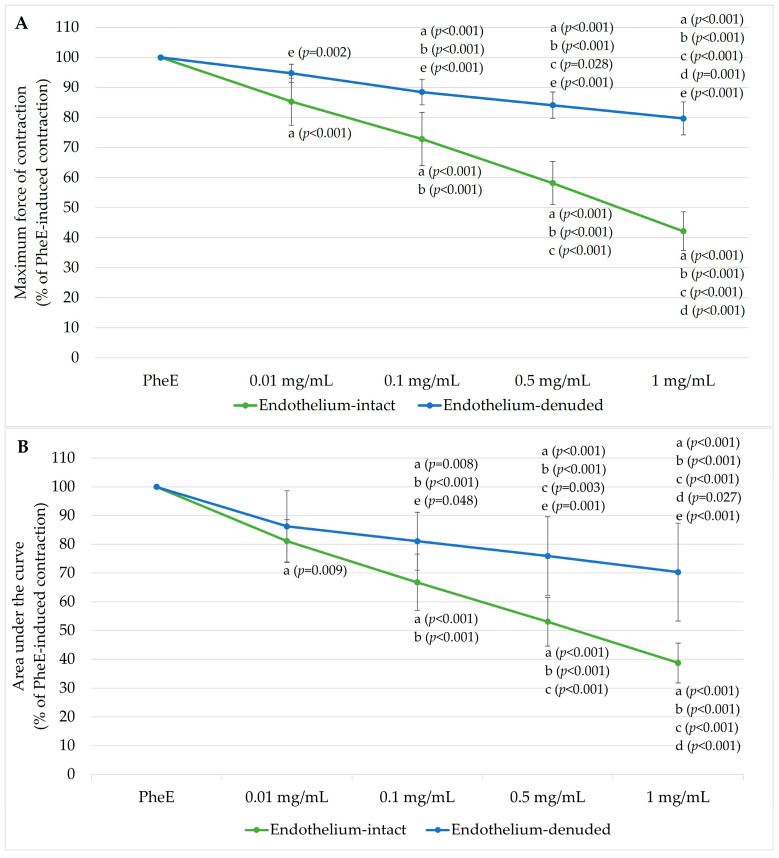
✓ Positivein vitroJ Clin Med · 2026

Endothelium-Dependent Nitric Oxide-Mediated Vasorelaxant Effects of BPC 157 in Human Internal Mammary Artery.

n = 12 humansEx vivo organ-bath study with and without the NOS inhibitor L-NAME

In human internal mammary artery rings from 12 bypass-surgery patients, BPC 157 caused concentration-dependent relaxation, greater with intact endothelium and mediated largely by nitric oxide; ex vivo tissue, not a clinical study.

Key resultConcentration-dependent relaxation (0.01-1 mg/mL), significantly greater in endothelium-intact rings
Studied
Human internal mammary artery rings, endothelium-intact and denuded, ex vivo
Compared with
Endothelium-denuded rings and L-NAME pre-incubation
Main outcome
Reduction of phenylephrine-induced contraction
Sample
Residual internal mammary artery segments from 12 elective bypass surgeries
Authors' conclusion
BPC 157 induces vasorelaxation in human arterial tissue mainly through endothelium-dependent NO signalling; further molecular and in vivo studies are needed.
Limitations
Ex vivo tissue from 12 surgical patients; not a treatment trial.
Figure 1: Concentration-dependent vasorelaxant effects of Body Protection Compound-157 (BPC 157) in phenylephrine (PheE)-precontracted human internal
Figure 1. From PMC13163310, CC BY (terms); resized.

Verdicts are judged on each paper's own main outcome; grades run from A (strong human evidence) to D (little or none). Details are read from the abstracts, and figures are reproduced only from openly licensed full texts. Not medical advice.