Peptide Price Finder

Home · Research · Cognitive & nootropic

Dihexa research

What published studies found for Dihexa: 7 papers, 1 in humans, with sample sizes and key results.

C
Mostly animal studies
Why: No human trials; several rat and mouse studies report cognitive benefit, one was negative and a key mechanistic paper was retracted.

Dihexa (an angiotensin IV-derived HGF/c-Met modulator) has only animal and cell studies; there are no human trials in the candidate literature, and a key mechanistic paper was later retracted. One rodent Huntington's model found no benefit.

✓ 4 positive✗ 1 negative~ 1 mixed? 1 inconclusive

No human safety data in the published literature.

US compounding: Under review, not compoundable yet. Removed from Category 2 in April 2026; FDA plans to put it to its compounding advisory committee before the end of February 2027. Until FDA adds it to the 503A bulks list, US pharmacies can't compound it from bulk. Status for every peptide.

Browse and filter these papersDihexa prices and vendors

Meta-analyses & systematic reviews

✓ Positivesystematic reviewNeurosci Biobehav Rev · 2018

Cognitive benefits of angiotensin IV and angiotensin-(1-7): A systematic review of experimental studies.

32 experimental studies included (of 450 articles identified)Systematic review of experimental studies

Systematic review of animal studies: in 8 of 9 cognitive-deficit models, angiotensin IV and analogs (including dihexa) improved spatial working memory or passive-avoidance performance.

Key resultIn models of cognitive deficit, eight of nine studies found Ang IV and its analogs (including dihexa) improved spatial working memory and passive avoidance
Studied
Non-human experimental studies of angiotensin IV, angiotensin-(1-7) and analogs (including dihexa)
Main outcome
Cognitive performance (avoidance, object recognition, spatial working memory)
Authors' conclusion
Studies of cognitive impairment show beneficial effects of acute administration of Ang IV and analogs and of AT4R activation; effects are greatest when given intracerebroventricularly near learning or testing.
Limitations
Preclinical studies only; dihexa is one of several analogs reviewed.
Animal & lab studies

✓ PositiveanimalJ Pharmacol Exp Ther · 2013

Evaluation of metabolically stabilized angiotensin IV analogs as procognitive/antidementia agents.

AnimalsChemical optimization and testing of stabilized angiotensin IV analogs

Development study: dihexa was orally active, brain-penetrant and reversed memory deficits in scopolamine-treated and aged rats, with increased synaptogenesis.

Studied
Scopolamine-treated and aged rats; hippocampal synaptogenesis assays
Main outcome
Metabolic stability, Morris water maze performance, synaptogenesis
Authors' conclusion
Dihexa is an orally active, blood-brain-barrier permeant, stabilized analog with antidementia and synaptogenic activity in rats, and may have therapeutic potential in disorders such as Alzheimer's disease.
Limitations
Rodent and in vitro data only; sample sizes not given in abstract.
? InconclusiveanimalJ Pharmacol Exp Ther · 2014retracted

The procognitive and synaptogenic effects of angiotensin IV-derived peptides are dependent on activation of the hepatocyte growth factor/c-met system.

Humans and animalsMechanistic study in vitro and in vivo with HGF antagonist and c-Met shRNA

Reported that dihexa's pro-cognitive and synaptogenic effects depend on HGF/c-Met activation in rats; this paper has since been retracted.

Studied
Cell cultures, hippocampal neurons and rats (Morris water maze)
Main outcome
HGF binding, c-Met phosphorylation, spinogenesis/synaptogenesis, spatial learning
Authors' conclusion
Dihexa binds HGF with high affinity and its procognitive effects depend on HGF/c-Met activation; an HGF antagonist blocked orally delivered dihexa's effect in the water maze.
Limitations
Preclinical; sample sizes not given in abstract.
✓ PositiveanimalBrain Sci · 2021

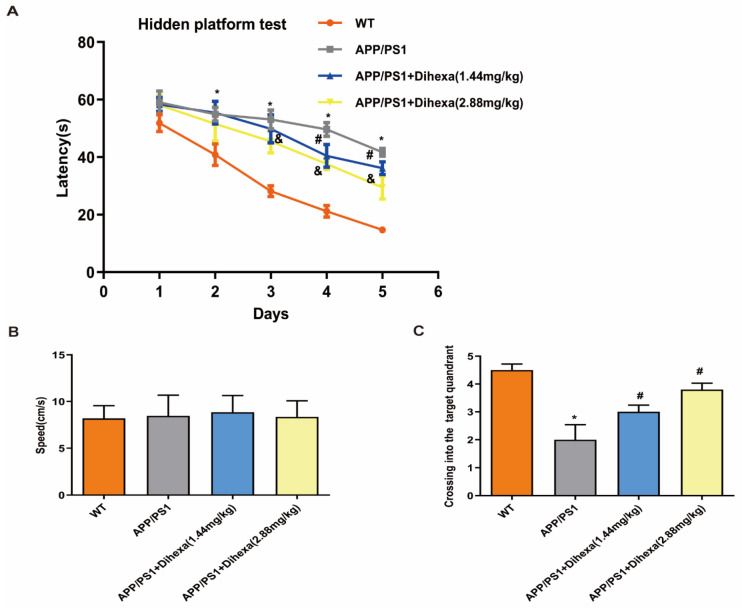
AngIV-Analog Dihexa Rescues Cognitive Impairment and Recovers Memory in the APP/PS1 Mouse via the PI3K/AKT Signaling Pathway.

AnimalsDose-ranging animal study with PI3K inhibitor wortmannin

In APP/PS1 Alzheimer's mice, dihexa improved Morris water maze performance, increased neuron counts and reduced glial activation and inflammatory cytokines.

Studied
APP/PS1 transgenic mice (Alzheimer's model)
Main outcome
Morris water maze learning, neuronal markers, neuroinflammation, PI3K/AKT signaling
Authors' conclusion
Dihexa restored spatial learning, reduced neuroinflammation and activated PI3K/AKT in APP/PS1 mice, highlighting the brain AngIV/PI3K/AKT axis as a potential AD target.
Limitations
Mouse model; sample sizes not given in abstract.
Figure 2: Dihexa rescued the cognitive ability of APP/PS1 mice. (A) Dihexa improved spatial learning when locating the hidden platform. Data were anal
Figure 2. From PMC8615599, CC BY (terms); resized.
✗ NegativeanimalJ Huntingtons Dis · 2024

Effects of an Angiotensin IV Analog on 3-Nitropropionic Acid-Induced Huntington's Disease-Like Symptoms in Rats.

Forty male Wistar rats in three groupsRandomized three-group animal study: vehicle, 3-NP, 3-NP plus PNB-0408 (dihexa)5 weeks

In rats with 3-NP-induced Huntington's-like disease, dihexa (PNB-0408) did not protect against weight, motor or cognitive deficits.

Studied
Male Wistar rats given 3-nitropropionic acid (Huntington's-like model)
Compared with
Vehicle and 3-NP alone
Main outcome
Body weight, motor function, cognition, histopathology
Authors' conclusion
PNB-0408 did not protect rats from 3-NP-induced deficits; it may not be an efficacious strategy in this model, and other models or approaches need study.
Limitations
Single toxin-induced rat model.
~ MixedanimalAnn Med Surg (Lond) · 2021

Stem cell, Granulocyte-Colony Stimulating Factor and/or Dihexa to promote limb function recovery in a rat sciatic nerve damage-repair model: Experimental animal studies.

10 experimental groups, 6-8 rats per groupAnimal study of MSC, G-CSF and/or dihexa given locally or systemically16 weeks

Rat sciatic nerve repair model: motor function improved with stem cells plus dihexa injected into muscle; effects of dihexa alone are not reported as distinct.

Key resultMotor function at 8-16 weeks improved significantly (P < 0.05) with MSC + G-CSF or MSC + Dihexa into gastrocnemius muscle
Studied
Male Lewis rats with sciatic nerve transection-repair
Compared with
Vehicle
Main outcome
Sensory and motor limb function (walking foot print grades)
Authors' conclusion
MSC, G-CSF and dihexa are promising candidates for adjunct therapy to promote limb recovery after nerve repair.
Limitations
Benefit seen with combinations in specific delivery routes; small groups.
✓ PositiveanimalFront Cell Neurosci · 2015

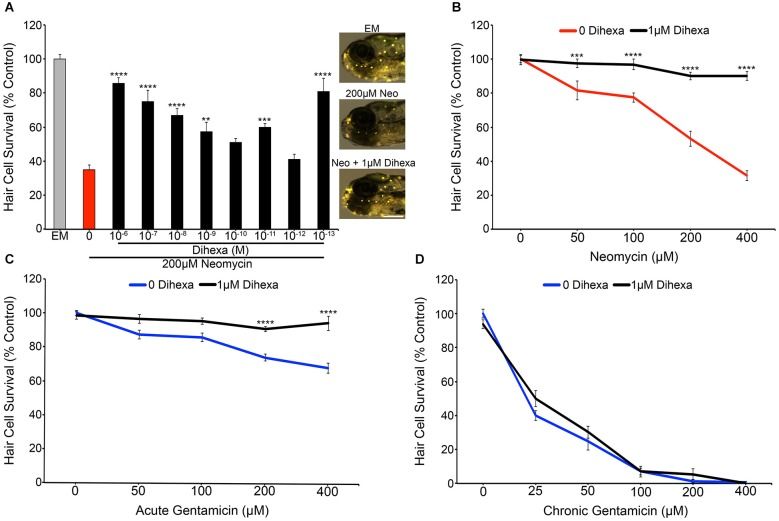
Hepatocyte growth factor mimetic protects lateral line hair cells from aminoglycoside exposure.

AnimalsIn vivo dose-response and inhibitor experiments

In zebrafish larvae, dihexa protected lateral-line hair cells from neomycin and gentamicin toxicity, an effect blocked by an HGF antagonist.

Studied
Larval zebrafish lateral line hair cells exposed to neomycin or gentamicin
Main outcome
Hair cell protection from aminoglycoside toxicity
Authors' conclusion
Dihexa at 1 μM gave optimal protection, apparently via HGF-mediated intracellular mechanisms, and may hold clinical potential for mitigating chemical ototoxicity.
Limitations
Zebrafish larvae; sample sizes not given in abstract.
Figure 2: Dihexa protects hair cells from acute aminoglycoside treatment. (A) Dihexa confers dose-dependent protection from 200 μM neomycin with two p
Figure 2. From PMC4309183, CC BY (terms); resized.

Verdicts are judged on each paper's own main outcome; grades run from A (strong human evidence) to D (little or none). Details are read from the abstracts, and figures are reproduced only from openly licensed full texts. Not medical advice.