Peptide Price Finder

Home · Research · Longevity & bioregulators

Epithalon research

What published studies found for Epithalon: 11 papers, 3 in humans, with sample sizes and key results.

C
Mostly animal studies
Why: Human data are poorly described, uncontrolled or non-randomized reports; the evidence comes mainly from rodent and monkey studies by one research group.

Epithalon (Epitalon, AEDG) has been studied mainly in rodents, cell cultures and a few monkeys, overwhelmingly by a single St. Petersburg research group, with reports of extended lifespan, fewer tumors and telomerase activation. Human data are limited to brief, poorly described or uncontrolled reports (retinitis pigmentosa, melatonin output, a non-randomized burn-patient comparison), with no independent randomized trials; a 2026 narrative review reaches the same conclusion.

✓ 4 positive~ 3 mixed? 4 inconclusive

No human adverse-event data in the published literature; telomere lengthening seen in cancer cell lines in vitro is a theoretical concern that has not been studied in people.

US compounding: Recommended for compounding, not legal yet. FDA's Pharmacy Compounding Advisory Committee voted on July 23-24, 2026 to recommend adding it to the 503A bulks list (FDA staff had recommended against). The vote isn't binding: compounding stays illegal until FDA accepts it and finishes proposed and final rulemaking, which typically takes a year or more. Vote: 7-5 (evaluated for insomnia). Status for every peptide.

Browse and filter these papersEpithalon prices and vendors

Human studies

? Inconclusivehuman trialМедико-фармацевтический журнал «Пульс» · 2007Russian-language

Влияние эпиталона на состояние иммунитета у больных при ожоговой болезни

n = 92 humansNon-randomized comparison of standard therapy vs standard therapy plus epitalon at two doses; randomization and blinding not describedImmunoglobulins measured on days 2, 10 and 20 after injury; epitalon given for 5 days

In 92 burn patients (Chita burn centre), adding intramuscular epitalon to standard care was followed by higher serum immunoglobulins and lower reported mortality (40.4% standard care vs 34.6% and 14.2% in two epitalon groups); no randomization or blinding described, small groups, so inconclusive.

Key resultMortality was 40.4% with standard therapy, 34.6% with epitalon 10 mcg and 14.2% with epitalon 20 mcg; IgM on day 10 was 4.1 and 3.9 times higher in the epitalon groups
Studied
Patients aged 15-69 with burns over 5-85% of body surface, Chita regional burn centre
Compared with
Standard (conventional) therapy
Main outcome
Serum immunoglobulins A, M, G; complications; mortality
Sample
92 burn patients in 3 groups (52 standard care, 26 epitalon 10 mcg, 14 epitalon 20 mcg)
Authors' conclusion
The authors concluded epitalon is promising for restoring immune function in burn disease and reducing complications.
Limitations
Unequal group sizes, no randomization or blinding described, no statistics beyond 'significant' wording; small dose groups.
? Inconclusivehuman trialNeuro Endocrinol Lett · 2002

Pineal-regulating tetrapeptide epitalon improves eye retina condition in retinitis pigmentosa.

Humans and animalsRat experiments plus patient treatment with Epitalon

Rat and patient study: Epitalon preserved retinal structure in Campbell rats, and patients with degenerative retinal disease reportedly had a 'positive clinical effect' in 90% of cases; the abstract gives no control-group or outcome details.

Key resultPositive clinical effect in 90% of patients with degenerative retinal lesions
Studied
Campbell rats with congenital retinal degeneration and patients with degenerative retinal lesions
Main outcome
Retinal bioelectric and functional activity; clinical effect
Authors' conclusion
Epitalon preserved retinal structure and activity in rats; authors suggest the tetrapeptide participates in transcription mechanisms common to the epiphysis and retina.
Limitations
Abstract gives no patient numbers, controls or design details.
? Inconclusivehuman trialAdv Gerontol · 2020

[AEDG peptide regulates human circadian rhythms genes expression during pineal gland accelerated aging.].

HumansReport of AEDG peptide effects on melatonin metabolite excretion and circadian gene expression

Report that AEDG increased urinary melatonin metabolite excretion 1.7-fold in middle-aged people and normalized expression of circadian genes in blood cells of people with reduced pineal function; design and controls not described.

Studied
Middle-aged people, including those with reduced pineal melatonin-producing function
Main outcome
Urinary 6-sulfatoxymelatonin and circadian gene expression (Clock, Csnk1e, Cry2)
Authors' conclusion
The authors concluded the AEDG peptide's geroprotective effect rests on restoring pineal melatonin-producing function by regulating human circadian gene expression.
Limitations
Abstract gives no sample size, design or controls.

Reviews

? InconclusivereviewPreprints.org · 2026preprint

Epitalon and Epithalamin in Regenerative and Longevity Medicine: Mechanisms, Evidence, and Translational Gaps

No new dataNarrative review (preprint)

Preprint (not peer-reviewed): Narrative review concluding human epitalon evidence is limited to small physiological or biomarker studies and an older retinitis pigmentosa report, with no adequately powered randomized trial and no human pharmacokinetic or safety studies; telomerase findings in cell lines were replicated in 2025.

Key resultIn female mice epitalon did not increase mean lifespan but increased maximum lifespan by 12.3%
Studied
Narrative review of mechanistic, preclinical and human epitalon evidence
Authors' conclusion
Epitalon demonstrates biologically relevant activity but remains clinically unproven; independent replication, pharmacokinetic and safety studies and appropriately designed human trials are needed.
Limitations
Preprint, not peer-reviewed; narrative review.

Animal & lab studies

✓ PositiveanimalBull Exp Biol Med · 2002

Epithalon decelerates aging and suppresses development of breast adenocarcinomas in transgenic her-2/neu mice.

AnimalsLifelong subcutaneous epithalon 1 mg, 5 times a week from the 2nd month of lifeUntil death

HER-2/neu transgenic mice given Epitalon from 2 months of age lived 13.5% longer on average and had fewer breast adenocarcinomas and lung metastases.

Key resultAverage lifetime prolonged by 13.5% (p<0.05); mice without breast tumors increased 3.7-fold (p<0.05)
Studied
Female transgenic FVB/N HER-2/neu mice (breast cancer model)
Compared with
Untreated mice (implied)
Main outcome
Lifespan and mammary tumor development
Authors' conclusion
Epithalon showed geroprotective activity and inhibited breast carcinogenesis in transgenic mice, probably related to suppression of HER-2/neu expression.
Limitations
Mouse study.
~ MixedanimalBull Exp Biol Med · 2007

Effect of Ala-Glu-Asp-Gly peptide on life span and development of spontaneous tumors in female rats exposed to different illumination regimes.

AnimalsEpithalon 0.1 microg daily 5 times a week from age 4 monthsLifelong

In female rats, Epitalon did not change lifespan under a standard light regimen but extended maximum lifespan under natural or constant light; it inhibited spontaneous tumors only under natural light.

Key resultMaximum life span extended by 95 and 24 days in rats under natural and constant light; no change under standard regimen
Studied
Female rats under standard, natural or constant illumination
Compared with
Untreated rats
Main outcome
Life span and spontaneous tumors
Authors' conclusion
Epithalon extended maximum life span in rats under disrupted light regimes and inhibited tumor development under natural light, with no effect on life span under standard light.
Limitations
Rat study; effects depended on light regime.
✓ PositiveanimalIn Vivo · 2006

Effect of the synthetic pineal peptide epitalon on spontaneous carcinogenesis in female C3H/He mice.

AnimalsEpitalon 0.1 microg injected 5 times a week6.5 months

Older female C3H/He mice given Epitalon for 6.5 months had fewer malignant tumors and no metastases (vs metastases in 3 of 9 tumor-bearing controls), with no toxicity observed.

Key resultMetastases in 3 of 9 tumor-bearing control mice and none in treated mice
Studied
One-year-old female C3H/He mice
Compared with
Control mice
Main outcome
Spontaneous tumors and metastases
Authors' conclusion
Epitalon showed an antimetastatic effect as part of its oncostatic properties, with no toxic effect at small doses.
Limitations
Mouse study, small number of tumor-bearing animals.
✓ PositiveanimalExp Gerontol · 2005

Pineal peptides restore the age-related disturbances in hormonal functions of the pineal gland and the pancreas.

AnimalsEpitalon administration with glucose tolerance testing

In old rhesus monkeys, Epitalon lowered basal glucose and insulin, raised night-time melatonin and improved glucose tolerance; young monkeys were unaffected.

Studied
Old (20-27 years) and young (6-8 years) rhesus monkeys
Compared with
Young animals / pre-treatment state
Main outcome
Glucose, insulin and night melatonin levels
Authors' conclusion
Epitalon lowered basal glucose and insulin, raised night melatonin, and improved glucose handling in old monkeys but not young ones, making it a promising factor for age-related endocrine dysfunction.
Limitations
Nonhuman primate study; sample size not given.
✓ PositiveanimalLife Sci · 2025

Epitalon-activated telomerase enhance bovine oocyte maturation rate and post-thawed embryo development.

Cells / labIn vitro laboratory study with untreated control

In bovine in vitro embryo production, Epitalon (used to activate telomerase) improved oocyte maturation rate and post-thaw blastocyst hatching and implantation potential versus control (p < 0.05).

Key resultSignificant improvement in oocyte maturation rate and blastocyst hatching rate with Epitalon vs control (p < 0.05)
Studied
Bovine cumulus-oocyte complexes and post-thawed embryos in vitro
Compared with
Untreated control group
Main outcome
Oocyte maturation rate, blastocyst hatching, implantation potential, ROS and mitochondrial potential
Authors' conclusion
The authors suggest telomerase activation via Epitalon improves bovine in vitro embryo production.
Limitations
Bovine in vitro embryo model; not a clinical study.
~ Mixedin vitroBiogerontology · 2025

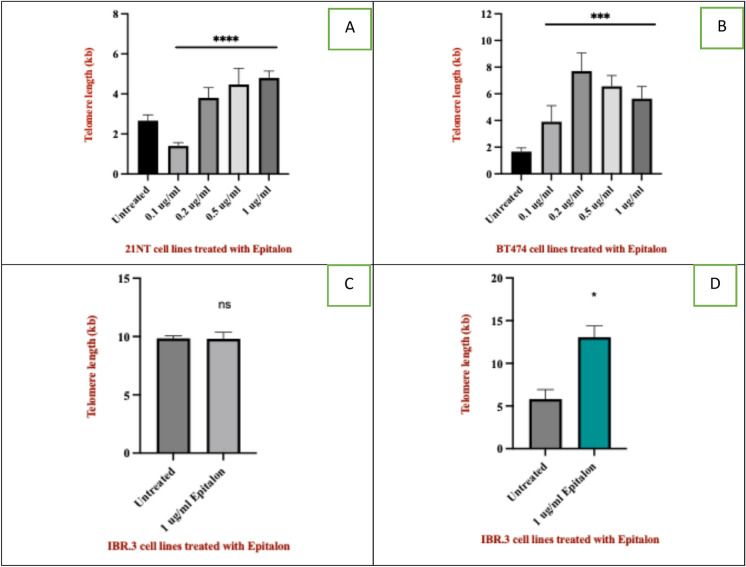
Epitalon increases telomere length in human cell lines through telomerase upregulation or ALT activity.

Cells / labIn vitro epitalon treatment with qPCR and immunofluorescence

In human cell lines, Epitalon lengthened telomeres in normal cells via telomerase upregulation, but in breast cancer cell lines it also extended telomeres through ALT activation.

Studied
Breast cancer cell lines 21NT and BT474, and normal epithelial and fibroblast cells
Main outcome
Telomere length, hTERT expression, telomerase activity, ALT activity
Authors' conclusion
Epitalon extended telomere length in normal cells via hTERT upregulation and telomerase, and in cancer cells via ALT activation.
Limitations
In vitro cell lines only.
Fig. 1: Telomere length of breast cancer cells and normal cells treated with epitalon. A 21NT cells B BT474 cells. Both cells were treated for 4 day
Fig. 1. From PMC12411320, CC BY (terms); resized.
~ Mixedin vitroInt J Mol Sci · 2022

Peptides Regulating Proliferative Activity and Inflammatory Pathways in the Monocyte/Macrophage THP-1 Cell Line.

Cells / labIn vitro comparison of five peptides (Epitalon, Vilon, Thymogen, Thymalin, Chonluten)

In human THP-1 monocyte/macrophage cells, Epitalon and four other Khavinson peptides increased kinase phosphorylation and reduced LPS-induced TNF and IL-6 expression and cell adhesion to activated endothelial cells.

Studied
Human THP-1 monocytic leukemia cell line (and LPS-activated HUVEC endothelial cells)
Compared with
Untreated cells
Main outcome
Proliferative signalling, TNF and IL-6 expression, adhesion to endothelial cells
Authors' conclusion
The authors suggest the Khavinson peptides act as natural inducers of TNF tolerance in monocytes and as anti-inflammatory molecules in macrophages.
Limitations
Cell-line study of five peptides together; not specific to Epitalon.

Verdicts are judged on each paper's own main outcome; grades run from A (strong human evidence) to D (little or none). Details are read from the abstracts, and figures are reproduced only from openly licensed full texts. Not medical advice.