Peptide Price Finder

Home · Research · Muscle & performance

EPO research

What published studies found for EPO: 8 papers, 7 in humans, with sample sizes and key results, plus 408 registered clinical trials.

B
Some human evidence
Why: Huge anaemia RCTs prove it raises haemoglobin, but for performance there is one 48-person RCT (lab gains, no race benefit) and small trials pooled at low quality.

Recombinant erythropoietin reliably raises haemoglobin, and in healthy trained people it improves maximal laboratory exercise tests - but the one well-designed trial that also measured a real road race found no benefit there. In patients it is an established anaemia treatment, where large meta-analyses show increased mortality in cancer and clotting risk, which is also the main hazard in non-medical use.

✓ 1 positive✗ 1 negative~ 4 mixed? 2 inconclusive

Non-medical use is banned in sport and the chief hazard is thrombosis from raised blood viscosity; in cancer patients controlled trials show worse survival.

US compounding: Approved biologic: not compoundable. Epoetin is an FDA-approved biologic; biologics can't be compounded from bulk under section 503A. Status for every peptide.

Browse and filter these papers

Reported side effects

Registered clinical trials

408 trials of EPO on ClinicalTrials.gov: 22 active, 294 completed, 123 with posted results. Registered trials include ones that haven't published yet.

TrialStatusPhasePeopleSponsor
MYELOMATCH: A Screening Study to Assign People With Myeloid Cancer to a Treatment Study or Standard of Care Treatment Within myeloMATCH (MyeloMATCH Screening Trial)NCT05564390 · started 2024-06-18RecruitingPhase 22,000National Cancer Institute (NCI)
Erythropoietin for Neonatal Encephalopathy in LMIC (EMBRACE Trial)NCT05395195 · started 2022-12-31RecruitingPhase 3504Imperial College London
A Phase 3 Study of Efepoetin Alfa for Treatment of Anemia in Patients With Chronic Kidney Disease on DialysisNCT06466785 · started 2024-01-25RecruitingPhase 3429Genexine, Inc.
ELEMENT-MDS: A Study to Compare the Efficacy and Safety of Luspatercept in Participants With Myelodysplastic Syndrome (MDS) and Anemia Not Receiving Blood TransfusionsNCT05949684 · started 2023-10-24Active, not recruitingPhase 3402Bristol-Myers Squibb
The Effect of Combined Iron Protocols on Perioperative Allogeneic TransfusionNCT06012760 · started 2025-01-04Recruiting–400Second Affiliated Hospital, Zhejiang University, School of Medicine
Study of the Efficacy and Safety of BCD-131 and Mircera® in the Treatment of Anemia in Patients With Chronic Kidney Disease on DialysisNCT07119372 · started 2025-03-01Active, not recruitingPhase 3228Biocad
Darbepoetin in Patients Candidates for Liver Transplant. (EPO-LT Trial)NCT07169643 · started 2025-11-25RecruitingPhase 3140Fundacion Clinic per a la Recerca Biomédica
Darbe Plus IV Iron to Decrease Transfusions While Maintaining Iron Sufficiency in Preterm InfantsNCT05340465 · started 2022-11-27RecruitingPhase 2120University of Washington
National Collaborative Centre for Hepatic Regenerative Medicine (NC-CHRM): Single vs Repeated Cycle of Granulocyte Colony-Stimulating Factor (GCSF) & Darbepoetin in Early Decompensated CirrhosisNCT07131280 · started 2025-09Not yet recruiting–110Institute of Liver and Biliary Sciences, India
Dietary Supplements in Patients With Coronary Artery Bypass Grafting for Improving the Quality of Healthcare Delivery.NCT06995586 · started 2026-09-01Not yet recruiting–108Nicosia General Hospital
A Study to Evaluate Efficacy and Safety of QLG1218(Daprodustat) in Chinese Hemodialysis (HD)-Dependent Subjects With Anemia Associated With Chronic Kidney Disease (CKD)NCT07300111 · started 2025-12-31Not yet recruitingPhase 3100Qilu Pharmaceutical Co., Ltd.
Impact of Medically Supervised Performance-Enhancing Substances (PES) on Elite AthletesNCT07568574 · started 2026-03-12Enrolling by invitation–60Enhanced Emirates Limited

All 408 EPO trials, with countries and recruiting status

Meta-analyses & systematic reviews

✗ Negativemeta-analysisCochrane Database Syst Rev · 2009

Erythropoietin or Darbepoetin for patients with cancer--meta-analysis based on individual patient data.

n = 13,933 humansIndividual patient data meta-analysis of randomized controlled trials

An individual-patient meta-analysis of 53 trials and 13,933 cancer patients found erythropoiesis-stimulating agents increased on-study mortality (hazard ratio 1.17, 95% CI 1.06-1.30) and worsened overall survival.

Key resultESAs increased on-study mortality (combined HR 1.17; 95% CI 1.06-1.30) and worsened overall survival (cHR 1.06; 95% CI 1.00-1.12)
Studied
Adult and pediatric cancer patients with or without antineoplastic therapy
Compared with
Red blood cell transfusion alone (as necessary)
Main outcome
On-study mortality and overall survival
Sample
53 trials, 13,933 cancer patients (individual patient data)
Authors' conclusion
ESA treatment in cancer patients increased on-study mortality and worsened overall survival; for patients on chemotherapy the increase was less pronounced, but an adverse effect could not be excluded.
~ Mixedsystematic reviewClin Ther · 2006

Clinical benefits and risks associated with epoetin and darbepoetin in patients with chemotherapy-induced anemia: a systematic review of the literature.

n = 21,378 humansSystematic review with meta-analyses

A systematic review of 40 studies and 21,378 patients with chemotherapy-induced anaemia found epoetin and darbepoetin roughly halved transfusion need and modestly improved fatigue scores, with no statistically significant increase in venous thromboembolism or death in that analysis.

Key resultTransfusion OR 0.44 (95% CI 0.35-0.55) for epoetin and 0.41 (0.31-0.55) for darbepoetin vs controls; VTE OR 1.41 (0.81-2.47); all-cause mortality OR 1.00 (0.69-1.44)
Studied
Cancer patients with chemotherapy-induced anemia (hemoglobin <11 g/dL)
Compared with
Standard care or placebo
Main outcome
Transfusions, quality of life, venous thromboembolism and death
Sample
40 studies, 21,378 patients
Authors' conclusion
Epoetin and darbepoetin showed efficacy in chemotherapy-induced anemia with no clinically relevant differences between the drugs; VTE and death were not significantly different from controls.
Limitations
Included studies varied in design, patients and treatments; English-language studies up to July 2005.
~ Mixedsystematic reviewBMJ Open Sport Exerc Med · 2020

Effect of erythropoietin on athletic performance: a systematic review and meta-analysis.

Number of trials/participants not stated in abstractSystematic review and meta-analysis (GRADE, Cochrane risk of bias)

A systematic review and meta-analysis found low-to-moderate quality evidence that rHuEPO improves haematological measures, maximal power output and time to exhaustion versus placebo, but almost only at maximal intensities less relevant to actual competition.

Studied
Healthy participants aged 18-65 in trials of rHuEPO vs placebo
Compared with
Placebo
Main outcome
Haematological parameters, pulmonary measures, maximal power output, time to exhaustion
Authors' conclusion
Low-to-moderate quality evidence suggests rHuEPO may be more beneficial than placebo for haematological parameters, maximal power output and time to exhaustion, but almost only at maximal exercise intensities, which may be less relevant to competition.
Limitations
Heterogeneity among trials; low-to-moderate quality evidence.
~ Mixedsystematic reviewSports Health · 2024

Performance-Enhancing Drugs in Healthy Athletes: An Umbrella Review of Systematic Reviews and Meta-analyses.

27 papers (systematic reviews/meta-analyses) evaluating 5 interventionsUmbrella review of systematic reviews and meta-analyses

An umbrella review of performance-enhancing drugs in healthy athletes concluded that recombinant EPO raises haemoglobin and aerobic measures but carries thrombotic risk, and noted the evidence base for performance gain in competition is weak.

Studied
Healthy athletes taking performance-enhancing drugs (AAS, GH, creatine, rHuEPO, cannabis)
Main outcome
Body mass, muscle strength, performance and recovery
Authors' conclusion
Limited evidence supports rHuEPO benefit on performance despite increases in VO2max and maximal power output, and severe cardiovascular risks are documented.
Limitations
Umbrella review (Level 4 evidence) of 7 interventions, not rHuEPO-specific.

Human studies

~ Mixedhuman RCTLancet Haematol · 2017

Effects of erythropoietin on cycling performance of well trained cyclists: a double-blind, randomised, placebo-controlled trial.

n = 48 humansDouble-blind, randomised, placebo-controlled trial (1:1)8 weeks

In 48 well-trained male cyclists randomized to 8 weeks of epoetin beta or placebo, maximal power output and VO2 max rose significantly, but submaximal exercise performance and time up Mont Ventoux (1 h 40 min 32 s vs 1 h 40 min 15 s) did not differ.

Key resultPmax 351.55 W vs 341.23 W (difference 10.32, 95% CI 3.47 to 17.17) and VO2 max 60.121 vs 57.415 mL/min per kg higher with rHuEPO; Mont Ventoux race times 1 h 40 min 32 s vs 1 h 40 min 15 s did not differ (0.3%, -8.3 to 9.6)
Studied
Healthy, well-trained non-professional male cyclists aged 18-50
Compared with
Placebo (0.9% NaCl)
Main outcome
Maximal power output, VO2 max, submaximal exercise performance and Mont Ventoux race time
Sample
48 participants randomized (24 rHuEPO, 24 placebo)
Authors' conclusion
rHuEPO improved a laboratory test of maximal exercise, but submaximal exercise performance and road race performance were not affected.
Limitations
Non-professional cyclists; mean dose 6000 IU per week for 8 weeks.
? Inconclusivehuman RCTPhysiol Rep · 2018

Recombinant human erythropoietin does not affect several microvascular parameters in well-trained cyclists.

n = 47 humansRandomized, double-blind, placebo-controlled parallel trial (microcirculation sub-study using laser speckle contrast imaging)8 weeks

In a randomized trial in well-trained cyclists, recombinant human erythropoietin did not change several microvascular parameters.

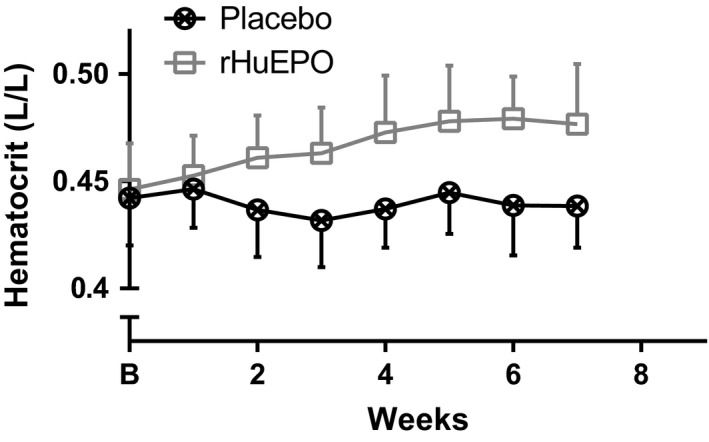
Key resultHematocrit rose in the rHuEPO group but no statistically significant difference in microvascular function vs placebo
Studied
Well-trained adult cyclists aged 18-50
Compared with
Placebo
Main outcome
Basal blood flux, post-occlusion reperfusion, time to return to baseline
Sample
47 well-trained adult cyclists (part of a randomized trial)
Authors' conclusion
Increased hematocrit in rHuEPO-treated well-trained cyclists was not associated with changes in microvascular blood flow or post-occlusive reactive hyperemia measured with LSCI.
Limitations
Cutaneous microcirculation only; sub-study of a larger trial.
Figure 1: Time course of mean (±SD) hematocrit levels measured in the subjects who received placebo (n = 24) or rHuEPO (n = 23).
Figure 1. From PMC6308108, CC BY (terms); resized.
✓ Positivehuman RCTJ Korean Med Sci · 2014

Prophylactic effect of erythropoietin injection to prevent acute mountain sickness: an open-label randomized controlled trial.

n = 39 humansOpen-label randomized controlled trial4 weekly injections before ascent

In an open-label randomized trial, prophylactic erythropoietin injection reduced acute mountain sickness.

Key resultHemoglobin on day 29 was 15.4 +/- 1.1 vs 14.2 +/- 1.0 g/dL (P=0.001); the erythropoietin group had a significantly lower mean LLS and AMS incidence at base camp
Studied
Healthy volunteers with hemoglobin <=15.5 g/dL trekking to Annapurna base camp (4,130 m)
Compared with
Control (no injection)
Main outcome
Acute mountain sickness (Lake Louise score and incidence)
Sample
39 healthy volunteers (erythropoietin n=20, control n=19)
Authors' conclusion
Erythropoietin may be an effective prophylaxis for acute mountain sickness; no erythropoietin-related adverse effects were observed.
Limitations
Open-label design; small sample.

Reviews

? InconclusivereviewPrzegl Lek · 2010

[Pure red cell aplasia (PRCA) induced by anti-EPO antibodies: epidemiology, diagnosis and treatment].

No new dataNarrative review

A review describes pure red cell aplasia caused by antibodies against injected erythropoietin - a rare but severe anaemia first reported with subcutaneous epoetin and later with other agents.

Authors' conclusion
Pure red-cell aplasia can result from antibodies against recombinant erythropoietin; the review covers epidemiology, diagnostic criteria and treatment including immunosuppression and kidney transplantation.
Limitations
Narrative review with no original data.

Verdicts are judged on each paper's own main outcome; grades run from A (strong human evidence) to D (little or none). Details are read from the abstracts, and figures are reproduced only from openly licensed full texts. Not medical advice.