Peptide Price Finder

Home · Research · Muscle & performance

Follistatin research

What published studies found for Follistatin: 11 papers, 1 in humans, with sample sizes and key results, plus 7 registered clinical trials.

C
Mostly animal studies
Why: Muscle gains come from gene-therapy studies in mice and monkeys plus a 6-patient uncontrolled trial; no human data on injected follistatin peptide.

Follistatin blocks myostatin and activin, and gene-therapy delivery of the FS344 isoform increases muscle size and strength in mice and monkeys. The only human data are a 6-patient open-label phase 1/2a gene therapy trial in Becker muscular dystrophy where 4 of 6 walked further; there are no controlled human trials, and no human data at all on follistatin given as an injected peptide.

✓ 6 positive✗ 1 negative~ 2 mixed? 2 inconclusive

The only human trial was an uncontrolled 6-patient gene therapy study that reported no adverse effects; there is no human safety data for follistatin administered as an injectable peptide, and follistatin's suppression of follicle-stimulating hormone is a theoretical reproductive concern raised in reviews.

US compounding: Not compoundable. Not an FDA-approved drug and not nominated for FDA's 503A bulks list, so US pharmacies can't legally compound it. Status for every peptide.

Browse and filter these papersFollistatin prices and vendors

Registered clinical trials

7 trials of Follistatin on ClinicalTrials.gov: 2 active, 5 completed. Registered trials include ones that haven't published yet.

TrialStatusPhasePeopleSponsor
Possible Sarcopenia, Sarcopenia, and Functional Status in Patients With Primary Sjögren's SyndromeNCT07804719 · started 2025-07-20Active, not recruiting–120Antalya Training and Research Hospital
CALM-AF-AI: Counteracting Age-related Loss of Muscle With AAV-Follistatin Combined With Angiogenesis-Inducing VEGF Plasmid Gene TherapyNCT07443826 · started 2026-06-01RecruitingPhase 1, Phase 212Unlimited Biotechnology LLC
Evaluation of Serum Follistatin-Like Protein 1 Levels in Behcet's Disease and Its Association With Disease ActivityNCT06730958 · started 2024-01-01Completed–80Assiut University
Follistatin Levels in Metabolically Healthy and Unhealthy Obese IndividualsNCT06229899 · started 2022-01-15Completed–62Goztepe Prof Dr Suleyman Yalcın City Hospital
Phase I: Safety and Efficacy of an Injectable Follistatin Plasmid Gene Therapy in HumansNCT06411366 · started 2022-08-18CompletedPhase 143Minicircle
Follistatin Gene Transfer to Patients With Becker Muscular Dystrophy and Sporadic Inclusion Body MyositisNCT01519349 · started 2012-01CompletedPhase 115Nationwide Children's Hospital
Safety and Efficacy of Klotho and Follistatin Gene TherapyNCT07285629 · started 2025-12-16CompletedEarly phase 114Minicircle

All 7 Follistatin trials, with countries and recruiting status

Human studies

~ Mixedhuman trialMol Ther · 2015

A phase 1/2a follistatin gene therapy trial for becker muscular dystrophy.

n = 6 humansPhase 1/2a open dose-escalation gene therapy trial (AAV1.CMV.FS344 by bilateral intramuscular quadriceps injection)

In an open-label phase 1/2a trial, AAV1-follistatin was injected into the quadriceps of six Becker muscular dystrophy patients; four improved their 6-minute walk distance by 29-125 metres while two showed no change, with no adverse effects and reduced fibrosis on biopsy.

Key resultCohort 1 (3 × 10(11) vg/kg/leg): +58 m and +125 m in two patients, no change in one; Cohort 2 (6 × 10(11) vg/kg/leg): +108 m and +29 m, one patient no improvement; no adverse effects
Studied
Six patients with Becker muscular dystrophy
Compared with
None (no control group)
Main outcome
Distance walked on the 6-minute walk test (6MWT)
Sample
6 Becker muscular dystrophy patients in two dose cohorts
Authors' conclusion
Results are encouraging for treatment of dystrophin-deficient muscle diseases, with histological improvements especially at high dose.
Limitations
Six patients, no control group, proof-of-principle.
Reviews

? InconclusivereviewJ Neuromuscul Dis · 2015

Follistatin Gene Therapy Improves Ambulation in Becker Muscular Dystrophy.

No new dataNarrative review including the first clinical gene transfer trial of FS344 in Becker muscular dystrophy

A review of follistatin as a genetic muscle enhancer summarizes the preclinical case and the first Becker muscular dystrophy gene transfer trial, and concludes further clinical trials are needed.

Authors' conclusion
The review examines evidence supporting follistatin (FS344 isoform) gene therapy as a muscle enhancer, including the first clinical trial in Becker muscular dystrophy, and future directions.
✓ PositivereviewMuscle Nerve · 2009

Inhibition of myostatin with emphasis on follistatin as a therapy for muscle disease.

No new dataReview of myostatin inhibition with emphasis on follistatin

A review of myostatin inhibition notes follistatin's potency but flags the risk of suppressing follicle-stimulating hormone, and describes using the alternatively spliced FS344 isoform to avoid reproductive off-target effects.

Authors' conclusion
Translational studies of AAV-delivered FS344 show increased muscle size and strength from mice to monkeys without adverse effects, supporting gene therapy trials in neuromuscular disease.

Animal & lab studies

✓ PositiveanimalSci Transl Med · 2009

Follistatin gene delivery enhances muscle growth and strength in nonhuman primates.

AnimalsNonhuman primate gene delivery studyLong-term expression

Intramuscular AAV1-FS344 in cynomolgus macaque quadriceps produced pronounced and durable increases in muscle size and strength with no abnormal organ morphology or function.

Studied
Cynomolgus macaque monkeys injected in the quadriceps with AAV1-FS344
Main outcome
Muscle size and strength; organ morphology and function
Authors' conclusion
AAV1-FS344 induced pronounced, durable increases in muscle size and strength without abnormal organ changes; it may improve muscle mass and function in certain degenerative muscle disorders.
Limitations
Nonhuman primate study.
✓ PositiveanimalJCI Insight · 2018

AAV-mediated follistatin gene therapy improves functional outcomes in the TIC-DUX4 mouse model of FSHD.

AnimalsMouse model characterization and AAV1.Follistatin gene therapy test

In the TIC-DUX4 mouse model of facioscapulohumeral dystrophy, AAV1-follistatin increased muscle mass and strength even while the toxic DUX4 gene was expressed.

Studied
Tamoxifen-inducible TIC-DUX4 mouse model of FSHD
Compared with
Untreated DUX4-expressing mice
Main outcome
Muscle mass and strength
Authors' conclusion
AAV1.Follistatin significantly increased muscle mass and strength even with DUX4 expression, suggesting myostatin inhibition may be a promising approach for FSHD-associated weakness.
Limitations
Mouse model; therapy does not target DUX4 itself.
~ MixedanimalExp Mol Med · 2017

Follistatin N terminus differentially regulates muscle size and fat in vivo.

AnimalsAAV overexpression of wild-type, N-terminus mutant/deleted and FST-I-I follistatin constructs

In mice, full-length follistatin increased muscle and decreased fat, but N-terminus-mutated or deleted versions increased no muscle and only modestly reduced fat, showing which domain does what.

Studied
Normal mice overexpressing follistatin constructs via AAV, plus C2C12 myotubes
Compared with
Different follistatin constructs
Main outcome
Muscle mass and fat mass
Authors' conclusion
Wild-type FST increased muscle and decreased fat; the N-terminal domain appears critical for myostatin blockade and muscle increase, informing future FST-based gene therapy design.
Limitations
Mouse and cell study.
✓ PositiveanimalSci Adv · 2020

Gene therapy for follistatin mitigates systemic metabolic inflammation and post-traumatic arthritis in high-fat diet-induced obesity.

AnimalsAAV9-mediated follistatin gene delivery

AAV9-follistatin in high-fat-diet mice reduced obesity-related inflammatory adipokines and protected against post-traumatic knee osteoarthritis and bone remodelling.

Studied
Mice on a high-fat diet with joint injury
Compared with
Control mice
Main outcome
Systemic and synovial inflammation; post-traumatic osteoarthritis and bone remodeling
Authors' conclusion
FST gene therapy decreased obesity-induced inflammatory markers and protected mice from post-traumatic OA, suggesting a multifactorial approach for injury-induced OA and metabolic inflammation.
Limitations
Mouse study.
? InconclusiveanimalProc Natl Acad Sci U S A · 2022retracted

New intranasal and injectable gene therapy for healthy life extension.

AnimalsIntranasal and injectable CMV gene therapy lifespan study

A mouse study reporting that cytomegalovirus-vectored follistatin extended median lifespan by 32.5% has since been retracted, so its findings should not be relied on.

Key resultMedian lifespan extended by 41.4% (MCMV-TERT) and 32.5% (MCMV-FST)
Studied
Mice treated with mouse cytomegalovirus carrying TERT or follistatin
Main outcome
Median lifespan, glucose tolerance, physical performance
Authors' conclusion
CMV-delivered TERT or FST extended longevity in mice with no carcinogenicity or unwanted side effects reported; translation to humans could benefit healthspan.
Limitations
Mouse study; comparator not described in abstract.
✗ NegativeanimalProc Natl Acad Sci U S A · 2026

Follistatin drives AR-independent prostate cancer through BMP signaling inactivation and microenvironmental remodeling.

Humans and animalsMechanistic cell, animal and patient-association study; tested follistatin inhibition (FST-Trap), not follistatin supplementation

Safety signal: in prostate cancer models and patient data, follistatin upregulation drove resistance to anti-androgen therapy and metastatic traits, and high FST associated with poor outcomes in enzalutamide-treated patients; a follistatin-neutralizing trap resensitized tumors.

Studied
Prostate cancer cells and models plus enzalutamide-treated patient data
Main outcome
Resistance to AR-targeted therapy, tumor microenvironment, patient outcomes
Authors' conclusion
The authors identify FST as a biomarker and therapeutic target for AR-independent prostate cancer; neutralizing it resensitized resistant tumors.
Limitations
Studies the role of endogenous FST in cancer, not follistatin administered as a treatment.
✓ PositiveanimalCells · 2026

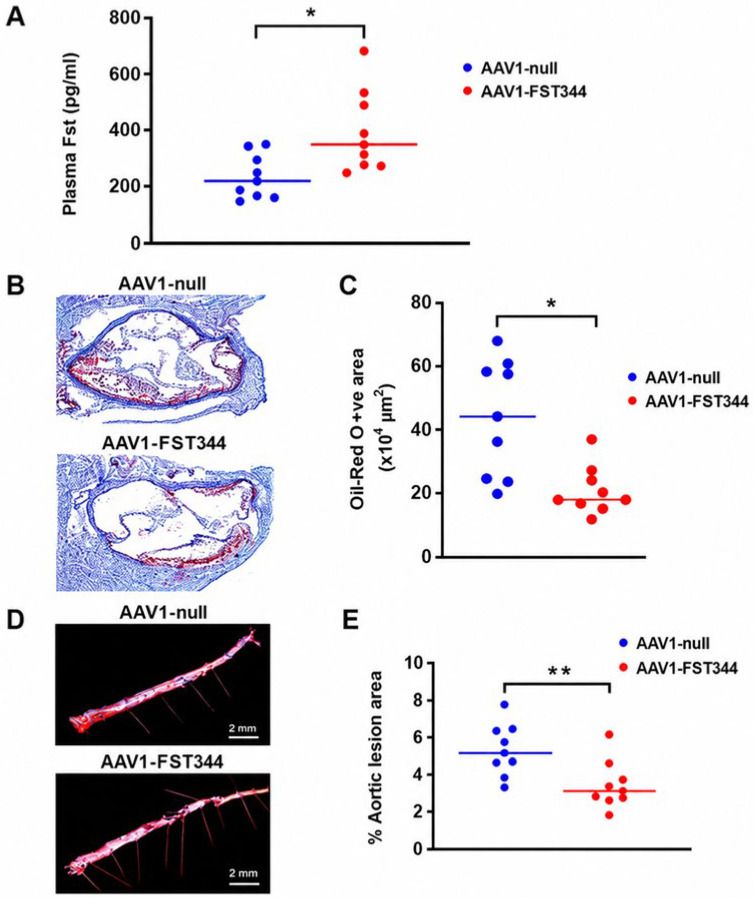
Follistatin Mitigates Atherosclerosis Through Activation of Arginine Metabolism and Adipose Browning.

AnimalsAnimal study of AAV1-FST344 gene delivery with transcriptomic and metabolomic analyses

In Ldlr-knockout mice, AAV delivery of follistatin (FST344) reduced aortic lesion area, improved plasma lipids and lowered inflammatory markers, with more white-fat browning; mouse gene-delivery study.

Studied
Ldlr-/- mice (atherosclerosis model) plus Hybrid Mouse Diversity Panel gene-expression analysis
Main outcome
Aortic lesion area, plasma lipids, inflammatory and adhesion markers, UCP1 expression
Authors' conclusion
The authors identify Fst as a novel anti-atherogenic regulator protecting against vascular disease, possibly through Arg1-mediated macrophage reprogramming.
Limitations
Mouse model; gene delivery rather than injected follistatin protein.
Figure 1: (A): Effect of AAV1-FST344 gene delivery on plasma Fst levels and atherosclerotic lesions. Eight-week-old Ldlr−/− male mice were injected vi
Figure 1. From PMC13360072, CC BY (terms); resized.
✓ PositiveanimalbioRxiv · 2026preprint

Sequential VEGF-A165 plasmid and AAV-follistatin gene therapy enhances muscle hypertrophy and capillarisation in C57BL/6 mice

36 C57BL/6 mice (18 male, 18 female) in four groups of 6-10Four-arm animal study: vehicle, AAV-FST, VEGF plasmid, combination (preprint)115 days

Preprint (not peer-reviewed): In 36 mice, intramuscular AAV-follistatin alone gave a borderline muscle-mass gain (p=0.050); adding a VEGF plasmid gave the largest gain (p=0.004) and more capillaries, with no adverse hematological, biochemical or histopathological findings.

Key resultMuscle mass ratio R/L 1.176 for combination (p=0.004) vs 1.113 for AAV-FST alone (p=0.050)
Studied
C57BL/6 mice receiving intramuscular gene therapy in one hindlimb (other limb as control)
Compared with
PBS vehicle and contralateral limb
Main outcome
Hindlimb muscle mass ratio, FST expression, fibre size, capillary density, safety
Authors' conclusion
Combined AAV-FST and VEGF enhanced muscle hypertrophy and capillary density versus AAV-FST alone and was well tolerated, supporting further evaluation.
Limitations
Preprint; mouse study; AAV-FST alone showed only a borderline effect.

Verdicts are judged on each paper's own main outcome; grades run from A (strong human evidence) to D (little or none). Details are read from the abstracts, and figures are reproduced only from openly licensed full texts. Not medical advice.