Peptide Price Finder

Home · Research · Sexual health & hormones

HCG research

What published studies found for HCG: 8 papers, 7 in humans, with sample sizes and key results, plus 213 registered clinical trials.

B
Some human evidence
Why: One 282-man RCT (vs clomiphene) and a meta-analysis of mostly non-randomized studies show it raises testosterone; placebo-controlled symptom data are lacking.

hCG is an established drug for hypogonadotropic hypogonadism and male fertility. A systematic review of 103 mostly non-randomized studies found gonadotropins including hCG reliably raise testosterone and testicular size, and a 282-man RCT found hCG raised testosterone as much as clomiphene. Randomized evidence for symptom benefit in ordinary 'low testosterone' men is limited and small.

✓ 7 positive✗ 1 negative

Few adverse-event data appear in the abstracts; frequencies are not given.

US compounding: Approved biologic: not compoundable. Chorionic gonadotropin became a regulated biologic in 2020; biologics can't be compounded from bulk under section 503A. Status for every peptide.

Browse and filter these papers

Reported side effects

Registered clinical trials

213 trials of HCG on ClinicalTrials.gov: 22 active, 117 completed, 39 with posted results. Registered trials include ones that haven't published yet.

TrialStatusPhasePeopleSponsor
Gonadotropin Therapy in Idiopathic Hypogonadal Non-ObstructiveNCT07540611 · started 2026-07-17Not yet recruiting–860Indira IVF Hospital Pvt Ltd
The Application of HCG in Luteal Support for Frozen Embryo Transfer in Ovulation Cycle of Obese WomenNCT07633002 · started 2026-07-01Not yet recruiting–750The Second Hospital of Shandong University
Comparison of the Effect of Gonadotropin and Clomiphene Citrate Treatment on Sperm Parameters and the Outcome of Assisted Reproductive Procedures in Subfertile Men Based on the APHRODITE GroupsNCT07523022 · started 2024-09-01Enrolling by invitationPhase 4500Szeged University
Purpose to Evaluate the Effectiveness of the Superovulation Stimulation Protocol Using Human Chorionic Gonadotropin (hCG) by Demonstrating Its Equivalence to Standard Controlled Ovarian Stimulation Protocols in Terms of Oocytes Retrieved, Blastulation While Maintaining an Economic AdvantageNCT07771283 · started 2026-08-17Enrolling by invitation–360LTD "EKODNIPRO", Medical centre Medical Plaza Dnipro
Comparison of Live Birth Rate in Natural Cycle Single Euploid FET Versus Without Luteal Phase SupportNCT05969795 · started 2023-09-05RecruitingPhase 1342ART Fertility Clinics LLC
Impact of the Presence of the Corpus Luteum on Pregnancies Obtained Through Frozen Embryo Transfer(FET)NCT06896617 · started 2025-02-01RecruitingPhase 4334Fundacion Clinic per a la Recerca Biomédica
Triggering Ovulation in Normo-responders Using a Modified Dual Trigger Protocol or HCG TriggerNCT07569302 · started 2026-06-01Not yet recruitingPhase 2196Bedaya Hospital
Is There a Need for Luteal Support in Modified Natural Cycle Frozen Embryo Transfer CyclesNCT06875752 · started 2025-04-12RecruitingPhase 4180Dunamenti REK Istenhegyi IVF Center
Triggering Oocyte Maturation in POSEIDON Group 3 and 4 Poor Responders Using Double Trigger or HCG TriggerNCT07569289 · started 2026-06-01Not yet recruitingPhase 2164Bedaya Hospital
Sex Steroids Balance for Metabolic and Reproductive Health in Klinefelter SyndromeNCT05586802 · started 2023-03-21RecruitingPhase 3150Georgios Papadakis
Ovulation Trigger Strategies in Low Ovarian Reserve (TRIGGERBEST)NCT07816562 · started 2024-09-17RecruitingPhase 3126Fundación para la Investigación del Hospital Clínico de Valencia
FET-LET-2x2: Clinical Pregnancy Rates After Frozen Embryo Transfer in Natural and Modified Natural CyclesNCT07425990 · started 2026-03-13Recruiting–120University of Novi Sad

All 213 HCG trials, with countries and recruiting status

Meta-analyses & systematic reviews

✓ Positivemeta-analysisEur J Endocrinol · 2024

Gonadotropins for pubertal induction in males with hypogonadotropic hypogonadism: systematic review and meta-analysis.

n = 5,328 humansSystematic review and meta-analysisMedian treatment/follow-up 18 months (IQR 10.5-24)

Systematic review and meta-analysis of 103 studies (5,328 males with hypogonadotropic hypogonadism): gonadotropins increased testicular volume, penile size and testosterone in over 98% of analyses; spermatogenesis 40% with hCG alone vs 86% with hCG plus FSH; heterogeneity high and few RCTs.

Key resultSpermatogenesis rates were 86% (95% CI 82%-91%) with hCG + FSH vs 40% (95% CI 25%-56%) with hCG alone; significant increases in testicular volume, penile size and testosterone in over 98% of analyses
Studied
Males with hypogonadotropic hypogonadism treated with gonadotropins for pubertal induction
Compared with
hCG alone vs hCG + FSH (spermatogenesis)
Main outcome
Testicular volume, penile size, testosterone, spermatogenesis
Sample
103 studies, 5328 patients
Authors' conclusion
The review provides convincing evidence of gonadotropin efficacy for pubertal induction, but treatment choice, dose, duration and outcomes are very heterogeneous; formal guidelines and randomized studies are needed.
Limitations
High study heterogeneity and treatment variability.
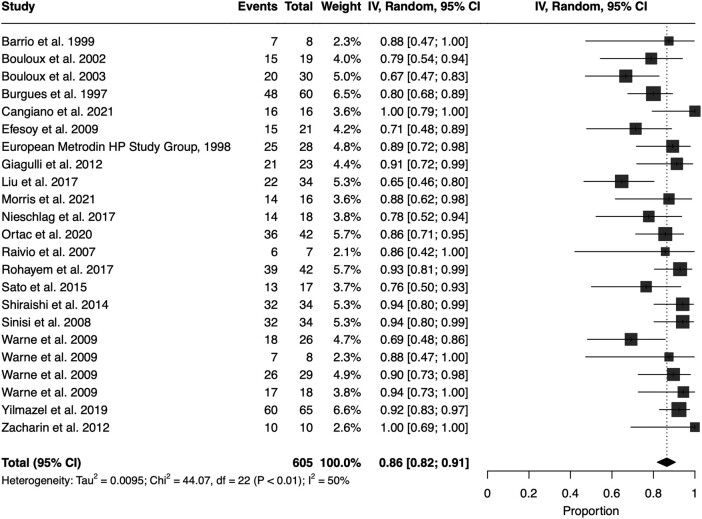
Figure 4.: Meta-analysis of proportions for spermatogenesis achieved by hCG + FSH in patients with hypogonadotropic hypogonadism—pooled proportion (ran
Figure 4.. From PMC10773669, CC BY (terms); resized.

Human studies

✓ Positivehuman RCTBJU Int · 2018

Clomiphene citrate and human chorionic gonadotropin are both effective in restoring testosterone in hypogonadism: a short-course randomized study.

n = 282 humansRandomized three-arm study (clomiphene citrate, hCG, or both)3 months

282 hypogonadal men wishing to preserve fertility randomized to clomiphene, hCG 5000 IU twice weekly, or both for 3 months: testosterone rose in all arms (223% overall) with no difference between them; symptom scores improved most with the combination.

Key resultMean testosterone rose to 5.17 ± 1.77 nmol/L (223% increase) with no statistically significant difference among groups; qADAM improvement larger with CC + hCG (P < 0.01)
Studied
Men with hypogonadism wishing to preserve fertility
Compared with
Clomiphene citrate 50 mg vs hCG 5000 IU twice weekly vs combination
Main outcome
Serum total testosterone and qADAM symptom score
Sample
282 men with hypogonadism randomized to three arms (95, 94, 94)
Authors' conclusion
All three treatments were equally effective in restoring testosterone; single-agent clomiphene is simple and cheap and may be used when fertility is to be preserved.
Limitations
Short course (3 months).
✓ Positivehuman RCTAging Male · 2016

Late-onset hypogonadism: the advantages of treatment with human chorionic gonadotropin rather than testosterone.

n = 40 humansComparative treatment study of extractive hCG vs three testosterone formulations6 months

40 men with late-onset hypogonadism (10 per group) treated 6 months with hCG or one of three testosterone forms: hCG gave higher vitamin D, lower estrogens, hematocrit, PSA and prostate volume, and preserved sperm parameters that fell with testosterone.

Key resultHCG group had higher 25-OH-vitamin D, lower oestrogens, and lower hematocrit, PSA and prostate volume than other groups (p < 0.05); testosterone groups showed reduced sperm density and progressive motility vs HCG (p < 0.05)
Studied
Patients with late-onset hypogonadism
Compared with
Transdermal, undecanoate and enanthate testosterone
Main outcome
Hormonal, metabolic, sperm and safety parameters
Sample
40 late-onset hypogonadism patients, 10 per group
Authors' conclusion
The data are presented as showing advantages of HCG over testosterone in late-onset hypogonadism, including sperm parameters and safety markers.
Limitations
Small groups (10 patients each).
✓ Positivehuman trialHorm Res · 2007

Clinical effects of treatment for hypogonadism in male adolescents with Prader-Labhart-Willi syndrome.

n = 6 humansClinical study before and after hCG startAt least 2 years of hCG therapy

6 adolescent boys with Prader-Willi syndrome: 2 years of hCG raised testosterone (2.3 to 10.7 nmol/L) and lean mass without worsening behavior; no control group.

Key resultTestosterone rose from 2.3 ± 0.9 to 10.7 ± 1.3 nmol/l and lean mass SD from -3.1 ± 0.3 to -1.4 ± 0.6 after 2 years of hCG; behaviour did not deteriorate
Studied
Boys with Prader-Labhart-Willi syndrome on long-term growth hormone, hypogonadism
Compared with
Before vs during hCG
Main outcome
Pubertal development, lean mass, testosterone, behaviour
Sample
6 peripubertal boys with Prader-Labhart-Willi syndrome
Authors' conclusion
Timely hCG promoted virilization and normalized muscle mass without detrimental effects on behaviour; larger studies comparing with testosterone would be useful.
Limitations
Only 6 boys, no control group.
✓ Positivehuman observationalArch Endocrinol Metab · 2021

Role of testosterone to estradiol ratio in predicting the efficacy of recombinant human chorionic gonadotropin and testosterone treatment in male hypogonadism.

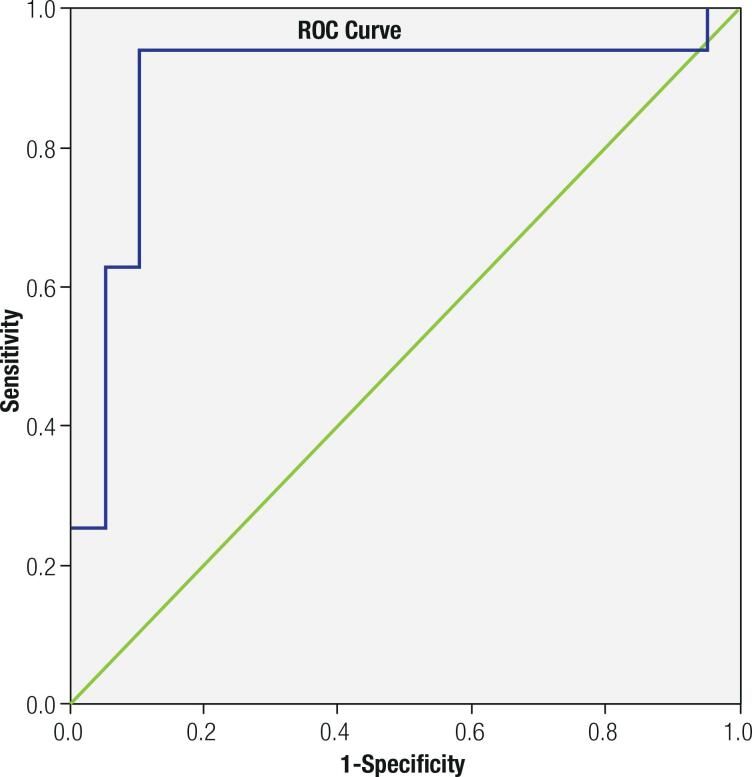
36 male patients with hypogonadotropic hypogonadism (17 hCG, 19 testosterone)Comparison of recombinant hCG and testosterone treatment groups

36 men with hypogonadotropic hypogonadism on recombinant hCG or testosterone: similar testosterone levels and morning erections, but larger testicular volume with hCG.

Key resultA T/E ratio cut-off of 12.0 predicted adequate morning erections (sensitivity 93.8%, specificity 90.0%); no difference between treatments in total testosterone, T/E or morning erections (p > 0.05); testicular volume differed in favor of hCG (p < 0,05)
Studied
Male patients with hypogonadotropic hypogonadism, mean age 28.5 ± 8.7 years
Compared with
Testosterone replacement every 21 days
Main outcome
Testosterone to estradiol ratio, morning erections, testicular volume
Authors' conclusion
Even with normal testosterone, high estradiol may keep erectile dysfunction symptoms; the T/E ratio can be used as a predictive value for effective hCG and testosterone treatment.
Limitations
Small study (n=36).
Figure 2: ROC curve analysis for testosterone to estradiol ratio according to spontaneous morning erection frequency.
Figure 2. From PMC10528572, CC BY (terms); resized.
✓ Positivehuman observationalClin Endocrinol (Oxf) · 2013

Effects of three different medications on metabolic parameters and testicular volume in patients with hypogonadotropic hypogonadism: 3-year experience.

77 never-treated IHH patients (28 testosterone esters, 25 hCG, 24 testosterone gel) and 42 healthy controlsRetrospective comparison of three treatments6 months

Retrospective study of 77 men with idiopathic hypogonadotropic hypogonadism: 6 months of hCG increased LH, Tanner stage and testicular volume and lowered triglycerides, whereas testosterone esters raised testosterone but also hemoglobin, hematocrit and triglycerides.

Key resultIn the hCG group, triglyceride decreased, and LH, Tanner stage and testicular volume increased significantly; no treatment changed insulin resistance markers
Studied
Patients with idiopathic hypogonadotropic hypogonadism and BMI-matched healthy controls
Compared with
Testosterone esters vs testosterone gel
Main outcome
Biochemical parameters, Tanner stage and testicular volume
Authors' conclusion
hCG had favourable effects particularly on testicular volume and lipid parameters; testosterone gel may be better for older patients when testicular volume is less important.
Limitations
Retrospective design.
✓ Positivehuman observationalAsian J Androl · 2019

Testosterone undecanoate supplementation together with human chorionic gonadotropin does not impair spermatogenesis in males with isolated hypogonadotropic hypogonadism: a retrospective study.

107 IHH patients (54 hCG + testosterone undecanoate, 53 hCG alone)Retrospective studyMedian follow-up 29 months (range 12-72)

Retrospective study of 107 men with isolated hypogonadotropic hypogonadism: adding oral testosterone undecanoate to hCG normalized testosterone faster without impairing hCG-driven spermatogenesis; acne and gynecomastia rates were similar.

Key resulthCG/TU normalized testosterone faster (P < 0.001) with no significant differences in seminal spermatozoa appearance or sperm concentration vs hCG alone
Studied
Male patients with isolated hypogonadotropic hypogonadism
Compared with
hCG alone
Main outcome
Spermatogenesis, time to normal testosterone and virilization
Authors' conclusion
Oral testosterone undecanoate with hCG did not impair spermatogenesis compared with hCG alone and shortened time to normal testosterone and virilization.
Limitations
Retrospective design.

Reviews

✗ NegativereviewFront Endocrinol (Lausanne) · 2019

Hypogonadism and Cryptorchidism.

No new dataNarrative review

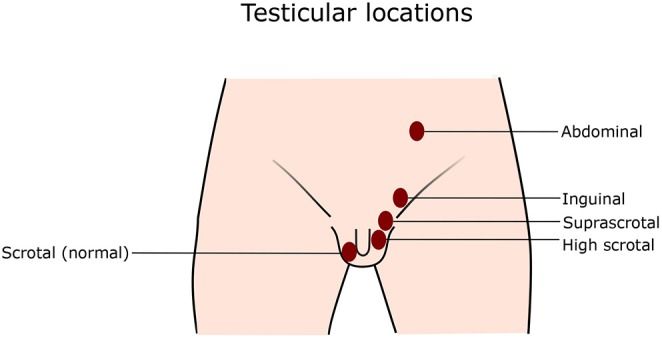
Review of cryptorchidism: hormonal treatment with hCG or GnRH to induce testicular descent has low success rates and is not recommended by current guidelines.

Authors' conclusion
Hormonal treatment with hCG or GnRH to induce testicular descent has low success rates and is not recommended by current guidelines; more research is needed on hormonal treatment in infancy.
Figure 1: Testicular locations. Normally, both testes locate at the bottom of the scrotum. In cryptorchidism, one or both testes do not stay at the no
Figure 1. From PMC6974459, CC BY (terms); resized.

Verdicts are judged on each paper's own main outcome; grades run from A (strong human evidence) to D (little or none). Details are read from the abstracts, and figures are reproduced only from openly licensed full texts. Not medical advice.