Peptide Price Finder

Home · Research · Skin, hair & tanning

Hyaluronic Acid research

What published studies found for Hyaluronic Acid: 8 papers, 8 in humans, with sample sizes and key results, plus 166 registered clinical trials.

A
Strong human evidence
Why: Meta-analyses of many RCTs (one of 11 RCTs with 935 people) consistently support HA fillers for wrinkles and lip volume; rare vascular complications.

Injectable hyaluronic acid fillers are well studied: meta-analyses of trials support lip augmentation (about 91% responders at 2 months, 46% at 12 months) and improved skin hydration, and a meta-analysis of 7 RCTs of oral HA reported modest skin benefits. Side effects are usually mild and short-lived (tenderness, swelling, bruising), but rare vascular occlusion can cause skin necrosis or vision loss.

✓ 4 positive✗ 2 negative~ 2 mixed
Browse and filter these papersHyaluronic Acid prices and vendors

Reported side effects

Registered clinical trials

166 trials of Hyaluronic Acid on ClinicalTrials.gov: 41 active, 83 completed, 13 with posted results. Registered trials include ones that haven't published yet.

TrialStatusPhasePeopleSponsor
Sperm Selection Strategies and Male-Factor Phenotypes in ICSINCT07825584 · started 2020-01-02Active, not recruiting–12,561Center for Reproductive Medicine Bocian
Allogenic Adipose-Derived Mesenchymal Stem Cells for the Treatment of Knee OsteoarthritisNCT06570291 · started 2025-02-28RecruitingPhase 3520Wuxi Cellular Biopharmaceutical Group Ltd.
Evaluation of Facial HA Dermal Fillers in Real-Life ConditionsNCT07255261 · started 2025-07-02Recruiting–460Symatese
A-eyedrops on Ocular Alignment and Binocular VisionNCT05379855 · started 2024-03-02Recruiting–339Eye & ENT Hospital of Fudan University
Ganyan-1 in Dry EyeNCT06818487 · started 2025-07-01Not yet recruiting–219Beijing Tongren Hospital
Clinical Study of i-PRF Intrauterine Perfusion for Endometrial Regeneration and Repair in Moderate to Severe Intrauterine AdhesionsNCT07536971 · started 2026-05-01Not yet recruiting–200Beijing Obstetrics and Gynecology Hospital
The Combined Effect of Magnesium, Palmitoylethanolamide, High-Molecular-weight Hyaluronic Acid, Vitamin B6, and Vitamin D in Preventing Preterm Birth:NCT07305519 · started 2026-04-01Recruiting–150University of Roma La Sapienza
Multicenter Clinical Trial Comparing Treatment with Allogeneic Mesenchymal Cells Versus Autologous Mesenchymal Cells and Versus Active Control with Hyaluronic Acid in Patients with Knee Osteoarthritis.NCT05086939 · started 2021-05-26Active, not recruitingPhase 3124Fundación Instituto de Estudios de Ciencias de la Salud de Castilla y León
Efficacy and Safety of Adapalene Gel and Hyaluronic Acid Versus Adapalene Gel Alone in Mild to Moderate Acne VulgarisNCT07102186 · started 2025-07-21RecruitingPhase 4120Badr University
Efficacy and Safety Analysis of Polylauric Alcohol More Stable Foam Versus Ordinary Foam in the Treatment of Head and Neck Venous MalformationsNCT07066527 · started 2022-06-01Recruiting–110Qilu Hospital of Shandong University
Sodium Hyaluronate for Myofascial Thoracic PainNCT07775274 · started 2026-08-31Not yet recruiting–100EPC Education s.r.o.
The Effect of Different Types of Mouthwash on Extraction Sockets' HealingNCT06587880 · started 2025-08-10RecruitingPhase 4100University of Jordan

All 166 Hyaluronic Acid trials, with countries and recruiting status

Meta-analyses & systematic reviews

✓ Positivemeta-analysisFront Surg · 2021

Hyaluronic Acid Is an Effective Dermal Filler for Lip Augmentation: A Meta-Analysis.

n = 1,496 humansSystematic review and meta-analysis (PRISMA, PROSPERO-registered)Responders assessed at 2, 6 and 12 months

Meta-analysis of HA lip augmentation (32 records, 10 pooled): responders with increased lip fullness 91% at 2 months, 74% at 6 months and 46% at 12 months; tenderness 88.8%, swelling 74.3%, bruising 39.5%; rare granulomas (0.6%), herpes labialis (0.6%) and angioedema (0.3%).

Key resultResponders 91% (95% CI 0.85-0.96) at 2 months, 74% (0.66-0.82) at 6 months and 46% (0.28-0.65) at 12 months
Studied
People receiving hyaluronic acid (HA) filler for lip augmentation (RCTs, cohorts, case series, case reports)
Main outcome
Responder rate (increase in lip fullness by one point or more); adverse events
Sample
32 records descriptive, 10 in quantitative synthesis; 1,496 participants used for adverse-event rates
Authors' conclusion
Injectable HA is an efficient method for increasing lip fullness for at least up to 6 months. Most adverse events were mild or moderate, but a small number of serious ones occurred. Further well-designed RCTs are needed.
Limitations
Included case reports and case series; authors call for more well-designed RCTs.
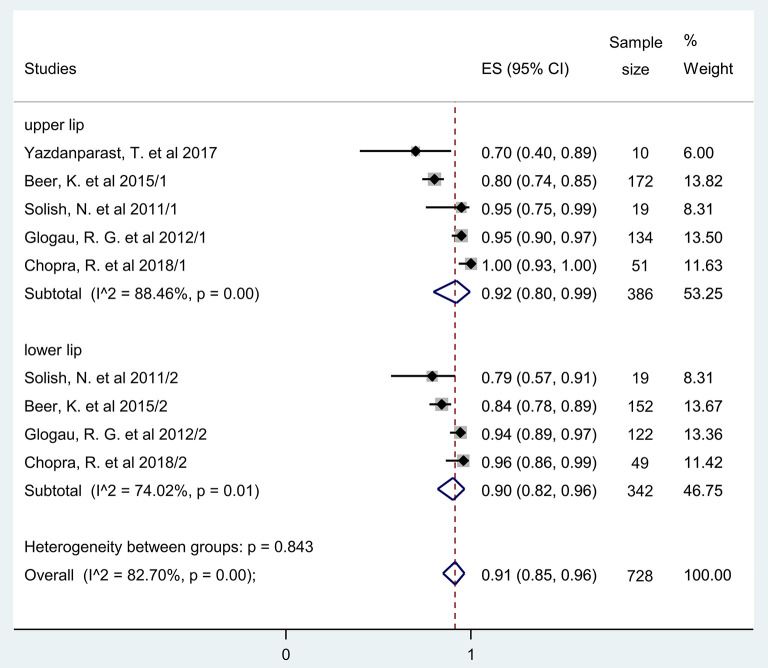
Figure 3: Estimate of rate of responders at 2 months after treatment for the upper and lower lips. Overall, 92% (95% CI: 80–99%) and 90% (95% CI: 0.82
Figure 3. From PMC8377277, CC BY (terms); resized.
✓ Positivemeta-analysisJ Cosmet Dermatol · 2022

Monophasic versus biphasic hyaluronic acid filler for correcting nasolabial folds: a systematic review and meta-analysis.

n = 935 humansSystematic review and meta-analysis of RCTs

Meta-analysis of 11 RCTs (935 people) comparing monophasic and biphasic HA fillers for nasolabial folds: monophasic fillers gave somewhat better wrinkle-severity and aesthetic-improvement scores, with no difference in adverse events.

Key resultMonophasic filler improved WSRS (SMD -0.38, 95% CI -0.49 to -0.27) and GAIS (SMD 0.34, 0.24-0.45) versus biphasic; no significant difference in pain or adverse events (RR 1.00, 0.89-1.12)
Studied
Individuals with moderate-to-severe bilateral nasolabial folds
Compared with
Biphasic HA filler (BHA)
Main outcome
Wrinkle severity rating scale (WSRS), pain VAS, global aesthetic improvement scale (GAIS), adverse events
Sample
11 RCTs, 935 participants
Authors' conclusion
Monophasic HA filler showed discernable cosmetic results and comparable efficacy and tolerability to biphasic filler.
✗ Negativemeta-analysisAesthetic Plast Surg · 2026

Hyaluronidase Protocol in Management of Hyaluronic Acid Filler-Related Vascular Complications: A Systematic Review and Meta-Analysis.

n = 231 humansSystematic review and meta-analysis (RCTs, cohorts, case series)

Meta-analysis of 21 studies (231 patients) with HA-filler vascular complications: skin necrosis occurred in 60.6% and visual impairment in 52.8% of these cases; hyaluronidase resolved necrosis in 78.4% and visual impairment in 45.2%, better if given within 6 hours.

Key resultResolution rates 78.4% for skin necrosis and 45.2% for visual impairment; early intervention (within 6 hours) significantly improved outcomes
Studied
Patients with HA filler-related vascular complications (mean age 30.1 years, 90.9% female)
Main outcome
Resolution rates after hyaluronidase treatment
Sample
21 studies, 231 patients
Authors' conclusion
Hyaluronidase is effective for HA-related vascular complications, particularly when given promptly. Findings support standardized treatment protocols; dosing needs further research.
Limitations
Includes case series; no control group for hyaluronidase.
~ Mixedmeta-analysisJ Cosmet Dermatol · 2025

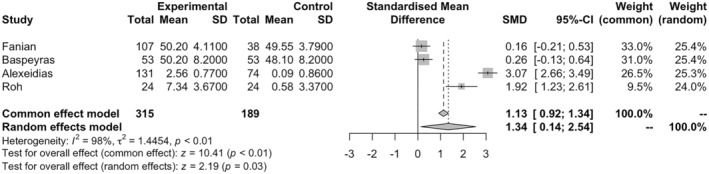
The Effect of Local Hyaluronic Acid Injection on Skin Aging: A Systematic Review and Meta-Analysis.

12 studies included, 6 with enough data for meta-analysisSystematic review and random-effects meta-analysis (PROSPERO-registered)

Meta-analysis of HA injections for skin aging (6 studies pooled): improved hydration (SMD 1.34) and radiance (SMD 0.51), but no significant change in elasticity or melanin index.

Key resultHydration SMD 1.34 (95% CI 0.14-2.54, p<0.05); radiance SMD 0.51 (0.22-0.80, p<0.05); elasticity SMD 0.25 (-0.20-0.70, p=0.27); melanin index SMD -1.74 (-4.89-1.41, p=0.28)
Studied
People receiving local HA-based injectable products for skin aging
Compared with
Controls
Main outcome
Skin hydration, radiance, elasticity, melanin index
Authors' conclusion
HA injections improved skin hydration and radiance, but no significant change was found in elasticity or melanin index. Further research is required to confirm effectiveness.
Limitations
Only 6 of 12 studies had enough data for meta-analysis.
FIGURE 2: Forest plot for the hydration meta‐analysis.
FIGURE 2. From PMC11731322, CC BY (terms); resized.
~ Mixedmeta-analysisJ Drugs Dermatol · 2025

Oral Hyaluronic Acid Supplement: Efficacy in Skin Hydration, Elasticity, and Wrinkle Depth Reduction.

7 randomized controlled trialsMeta-analysis of RCTs

Meta-analysis of 7 RCTs of oral HA supplements: significant improvements in skin hydration, elasticity and wrinkle depth vs placebo, but not in firmness, wrinkle volume or water loss; studies were small and heterogeneous.

Studied
Participants in RCTs of oral HA supplements versus placebo for skin
Compared with
Placebo
Main outcome
Skin hydration, elasticity, firmness, wrinkle reduction, transepidermal water loss
Authors' conclusion
Oral HA gave statistically significant improvements in skin hydration, elasticity and wrinkle depth; firmness, wrinkle volume and transepidermal water loss showed non-significant trends. Larger, more robust trials are needed.
Limitations
Limited sample size and heterogeneity among included studies.
✓ Positivesystematic reviewAesthetic Plast Surg · 2024

Adverse Events Associated with Hyaluronic Acid Filler Injection for Non-surgical Facial Aesthetics: A Systematic Review of High Level of Evidence Studies.

48 randomized controlled studiesSystematic review of high level of evidence studies (RCTs only; Cochrane standards)

Systematic review of 48 randomized studies of facial HA fillers: most adverse events were short-lived injection-site reactions; severe events such as severe edema and angioedema were rare but sometimes required treatment.

Studied
People receiving HA dermal fillers for non-surgical facial aesthetics
Main outcome
Classification of adverse events
Authors' conclusion
HA dermal fillers are generally safe and effective; most adverse events were transient and mild to moderate. Severe adverse events were rare but occur. Informed consent, patient education and training are crucial.
Limitations
Excluded case reports, case series and observational studies.

Human studies

✓ Positivehuman RCTJ Dermatolog Treat · 2023

A hyaluronic acid-based micro-filler improves superficial wrinkles and skin quality: a randomized prospective controlled multicenter study.

n = 146 humansRandomized, prospective, active-controlled multicenter studyFollow-up to Day 120 (primary endpoint Day 75)

146 adults randomized 3:1 to an HA-based micro-filler (NCTF 135HA) plus cream or cream alone: superficial wrinkles on face, neck and decolletage fell significantly more at days 75 and 120; adverse events were mostly mild and resolved within 48 hours.

Key resultAt Day 75 and Day 120, NCTF135HA significantly reduced wrinkles in all three areas and improved facial radiance versus control
Studied
Adults treated on the face (crow's feet), neck and decolletage for superficial wrinkles
Compared with
Anti-aging moisturizer cream alone
Main outcome
Reduction in superficial wrinkles (profilometry, clinical scoring) between baseline and Day 75
Sample
146 randomized: 107 to NCTF135HA, 38 to control (3:1)
Authors' conclusion
NCTF135HA was effective and well tolerated for reducing skin signs of aging, significantly superior to a routine anti-aging cream alone. Most adverse events were mild and resolved within 48 h.
Limitations
Funded by the product manufacturer; control arm was cream only (no injection).
✗ Negativehuman RCTToxins (Basel) · 2025

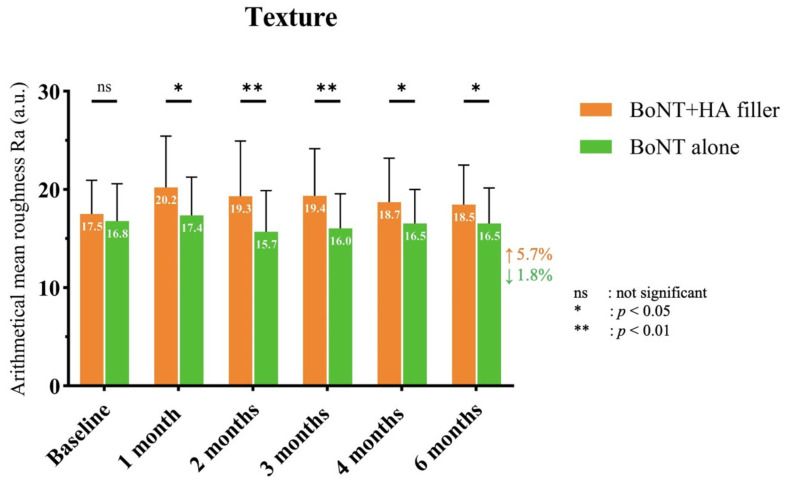
A Study of Combined Onabotulinumtoxin A and Hyaluronic Acid Filler for the Treatment of Enlarged Facial Pores.

n = 32 humansProspective, randomized, single-blinded, split-face controlled trialUp to 24 weeks

32 adults, split-face trial for enlarged pores: adding intradermal HA filler to onabotulinumtoxinA gave slightly less improvement at 6 months than toxin alone, and 56% developed a palpable lump on the HA side.

Key resultPalpable lump on the combination side in 18 subjects (56.25%); monotherapy side showed slightly better improvement at 6 months
Studied
Asian adults with visibly enlarged pores on both cheeks
Compared with
OnaBoNT-A monotherapy on the other side of the face
Main outcome
Pore volume, skin roughness, visual assessment, pain, improvement score, side effects
Sample
32 subjects, split-face
Authors' conclusion
BoNT-A and HA filler both reduced pore size, but monotherapy was slightly better at 6 months and combination had more adverse events such as edema and nodules. Careful patient selection and technique are important.
Limitations
Small trial in Asian subjects; single-blinded.
Figure 1: The comparison of skin roughness at baseline and follow-up visits between the combination of HA filler and onaBoNT-A and onaBoNT-A alone.
Figure 1. From PMC11768511, CC BY (terms); resized.

Verdicts are judged on each paper's own main outcome; grades run from A (strong human evidence) to D (little or none). Details are read from the abstracts, and figures are reproduced only from openly licensed full texts. Not medical advice.