Peptide Price Finder

Home · Research · Skin, hair & tanning

Matrixyl research

What published studies found for Matrixyl: 9 papers, 2 in humans, with sample sizes and key results.

B
Some human evidence
Why: One 93-woman split-face RCT found fewer wrinkles and a 21-woman trial was inconclusive; the rest is cell and animal work.

Matrixyl (palmitoyl pentapeptide-4, pal-KTTKS) has two small human trials: a 93-woman split-face RCT found less wrinkling than with placebo moisturizer, and a 21-woman trial was too small to be conclusive. The rest of the evidence is cell-culture and animal work showing collagen stimulation.

✓ 6 positive~ 2 mixed? 1 inconclusive

No adverse-event data for Matrixyl on its own were found in the published abstracts.

Browse and filter these papersMatrixyl prices and vendors

Human studies

✓ Positivehuman RCTInt J Cosmet Sci · 2005

Topical palmitoyl pentapeptide provides improvement in photoaged human facial skin.

n = 93 humansDouble-blind, placebo-controlled, split-face, left-right randomized study12 weeks

93 women aged 35-55 in a 12-week double-blind split-face RCT: moisturizer with 3 ppm pal-KTTKS significantly reduced wrinkles/fine lines vs the same moisturizer without it, by image analysis and expert grading; well tolerated.

Key resultSignificant improvement vs placebo control for reduction in wrinkles/fine lines (3 ppm pal-KTTKS)
Studied
Caucasian women aged 35-55 with photoaged facial skin
Compared with
Same moisturizer without pal-KTTKS
Main outcome
Wrinkles and fine lines by image analysis and expert grading
Sample
93 Caucasian women aged 35-55
Authors' conclusion
Pal-KTTKS was well tolerated and gave significant wrinkle and fine-line improvement versus the control moisturizer by technical and expert grading and self-assessment.
Limitations
Abstract gives no effect sizes or p-values; product-sponsored design not described.
? Inconclusivehuman RCTJ Clin Aesthet Dermatol · 2023

Double-blind, Randomized Trial on the Effectiveness of Acetylhexapeptide-3 Cream and Palmitoyl Pentapeptide-4 Cream for Crow's Feet.

n = 21 humansDouble-blind randomized trial: acetylhexapeptide-3 cream, palmitoyl pentapeptide-4 cream or placebo, twice daily8 weeks

21 Indonesian women, 8 weeks, three arms (acetyl hexapeptide-3, palmitoyl pentapeptide-4, placebo cream) for crow's feet: palmitoyl pentapeptide-4 appeared to give the best results, but the authors describe it as an initial study needing larger samples.

Studied
Indonesian women aged 26 to 55 with crow's feet
Compared with
Placebo cream and acetylhexapeptide-3 cream
Main outcome
Skin hydration, barrier, elasticity, photographs and Crow's Feet Grading Scale
Sample
21 Indonesian women across three groups
Authors' conclusion
Palmitoyl pentapeptide-4 appeared to show better results than acetylhexapeptide-3 and placebo; the authors call it an initial study needing more samples and longer duration.
Limitations
Very small sample (21 across three arms), short duration, no numerical results in the abstract.

Animal & lab studies

✓ PositiveanimalACS Omega · 2022

Matrixyl Patch vs Matrixyl Cream: A Comparative In Vivo Investigation of Matrixyl (MTI) Effect on Wound Healing.

Animals randomly divided into seven groups; total number not statedRandomized in vivo wound-healing study comparing Matrixyl patches (0.1 and 1 mg), Matrixyl cream, vehicle controls and Comfeel21 days

In an animal wound model, Matrixyl patches or cream improved wound healing by 63.5-81.8% vs sham controls, with the 1 mg cream and patch outperforming a commercial dressing.

Key resultWound healing improved from 63.5 up to 81.81% in treatment groups vs the negative control (P < 0.05 and P < 0.001)
Studied
Animals with experimental wounds
Compared with
Negative control (sham), vehicle patch/cream, and Comfeel positive control
Main outcome
Wound area, collagen density, angiogenesis, re-epithelialization
Authors' conclusion
Matrixyl cream and patch improved wound healing, with the 1 mg doses exceeding the commercial dressing, and the patch gave higher re-epithelialization than the cream.
Limitations
Animal model; species and group sizes not stated in the abstract.
✓ PositiveanimalArch Dermatol Res · 2024

Mesenchymal stem cell therapy using Pal-KTTKS-enriched carboxylated cellulose improves burn wound in rat model.

AnimalsRandomized animal study: Vaseline gauze, carboxylated cellulose, pal-KTTKS-cellulose, or MSCs on pal-KTTKS-celluloseDays 3, 7 and 14

Rat burn wounds: dressings containing pal-KTTKS (with or without stem cells) healed better than Vaseline gauze, with more collagen and faster closure; the effect of the peptide alone is not separated from the cellulose dressing.

Studied
Healthy male rats with burn wounds
Compared with
Vaseline gauze; cellulose dressing
Main outcome
Wound closure, inflammation, collagen deposition, angiogenesis
Authors' conclusion
Pal-KTTKS-enriched composites improved burn wound healing, best when combined with mesenchymal stem cells.
Limitations
Rat study; combined dressing/stem-cell product.
✓ Positivein vitroMol Pharm · 2013

Collagen stimulating effect of peptide amphiphile C16-KTTKS on human fibroblasts.

Cells / labIn vitro study of peptide amphiphile C16-KTTKS solutions and self-assembly

C16-KTTKS stimulated collagen production by human dermal and corneal fibroblasts in a concentration-dependent manner close to its self-assembly concentration.

Studied
Human dermal and corneal fibroblasts
Main outcome
Collagen production
Authors' conclusion
C16-KTTKS stimulated collagen production in a concentration-dependent manner close to its critical aggregation concentration, suggesting self-assembly and collagen stimulation are inter-related.
Limitations
In vitro only.
✓ Positivein vitroJ Pept Sci · 2026

Nanostructure and Collagen-Stimulating Activity of Cationic Pentapeptide Lipopeptides.

Cells / labIn vitro study of self-assembly, cytocompatibility and collagen production of C16-KTTKS and C16-RTTRS

C16-KTTKS (Matrixyl) stimulated collagen production in human dermal fibroblasts at low concentration (0.0062 wt%) and was cytocompatible at sufficiently low concentrations.

Studied
Human dermal fibroblasts (HDFa)
Compared with
C16-RTTRS variant; TFA vs acetate salt forms
Main outcome
Cell viability and collagen production
Authors' conclusion
Both lipopeptides were cytocompatible at sufficiently low concentration and stimulated collagen production in HDFa at 0.0062 wt%; counterion had no significant effect.
Limitations
In vitro only.
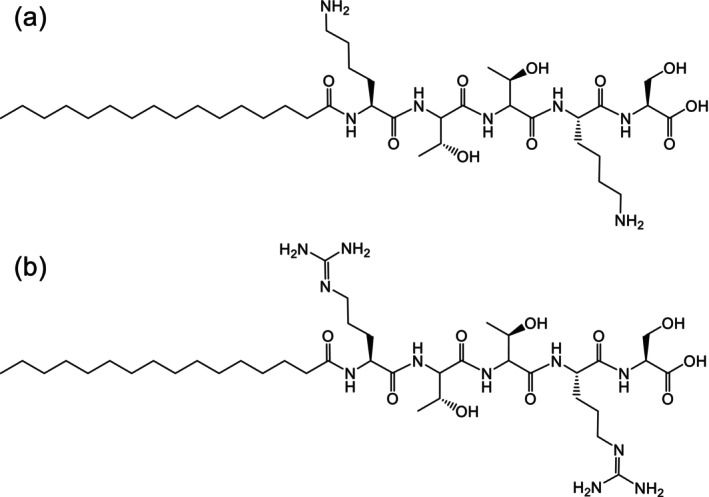
SCHEME 1: Molecular structures for (a) C16‐KTTKS and (b) C16‐RTTRS.
SCHEME 1. From PMC13280649, CC BY (terms); resized.
~ Mixedin vitroTissue Eng Regen Med · 2017

Effect of Palmitoyl-Pentapeptide (Pal-KTTKS) on Wound Contractile Process in Relation with Connective Tissue Growth Factor and α-Smooth Muscle Actin Expression.

n = 3 for the quantified experimentIn vitro study of Pal-KTTKS (0-0.5 uM) on fibroblast-to-myofibroblast transformation

In fibroblast cultures, pal-KTTKS at 0.1 µM halved myofibroblast transformation (alpha-SMA-positive cells 75% vs 38.6%), but 0.5 µM had no significant effect; authors caution about balancing healing and pro-fibrotic effects.

Key resultalpha-SMA-positive stress fibers fell twofold with 0.1 uM Pal-KTTKS (75 +/- 7.1 vs 38.6 +/- 16.1%, n = 3, p < 0.05); not significant at 0.5 uM
Studied
Cultured fibroblasts and 3D collagen lattices
Compared with
Untreated fibroblasts
Main outcome
alpha-SMA-positive cells, CTGF, lattice contraction
Authors' conclusion
Pal-KTTKS at 0.1 uM reduced alpha-SMA expression and myofibroblast transformation in a dose-dependent manner; a balance between wound-healing and pro-fibrotic properties should be considered.
Limitations
In vitro with n = 3; effect lost at higher concentration.
✓ Positivein vitroPharmaceutics · 2024

Liposome Encapsulation of the Palmitoyl-KTTKS Peptide: Structural and Functional Characterization.

Cells / labIn vitro formulation and collagen synthesis assay

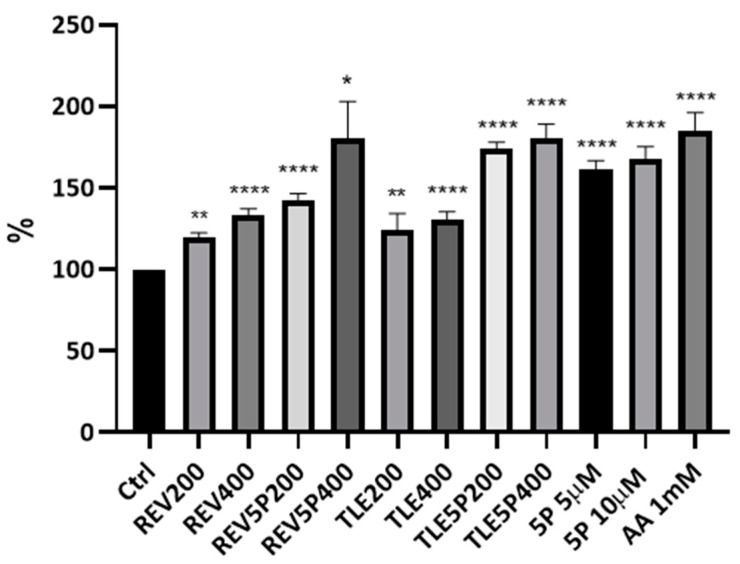
Mouse fibroblasts: liposome-delivered palmitoyl-KTTKS stimulated more collagen production than free peptide or 1 mM ascorbic acid; a formulation study, cells only.

Studied
3T3-NIH fibroblasts
Compared with
Free pentapeptide; 1 mM ascorbic acid
Main outcome
Collagen and extracellular matrix synthesis
Authors' conclusion
Liposomal pal-KTTKS stimulated collagen production more than free pentapeptide and ascorbic acid, and liposomes could improve peptide stability and skin delivery.
Limitations
Cell culture; no human or in vivo skin data.
Figure 3: Collagen production by NIH-3T3 fibroblasts upon treatment with liposomes and loaded-liposome preparations. The Sirius Red colorimetric assay
Figure 3. From PMC10892597, CC BY (terms); resized.
~ Mixedin vitroMolecules · 2019

The Effects of a Novel Series of KTTKS Analogues on Cytotoxicity and Proteolytic Activity.

Cells / labIn vitro synthesis and screening of KTTKS analogues

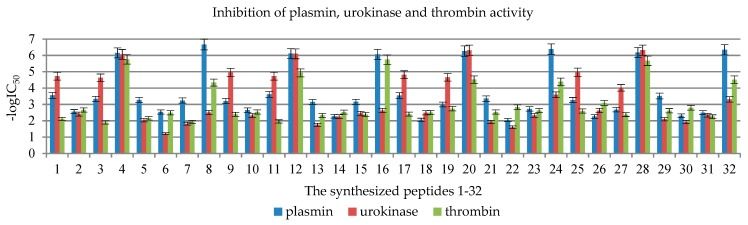
Lab study of new KTTKS analogues: palmitoyl versions were the strongest plasmin inhibitors; none was cytotoxic to fibroblasts, but the three that boosted cell growth showed no concentration-dependent effect on collagen or DNA synthesis.

Studied
Fibroblasts and purified proteases
Main outcome
Protease inhibition, cytotoxicity, collagen and DNA biosynthesis
Authors' conclusion
Palmitoyl peptides were the most active plasmin inhibitors and none were cytotoxic; no concentration-activity relationship was seen in the collagen and DNA assays.
Limitations
In vitro; tests analogues rather than only Matrixyl.
Figure 1: Inhibition of plasmin, urokinase, and thrombin by 1–32 peptides presented as -logIC50.
Figure 1. From PMC6832239, CC BY (terms); resized.

Verdicts are judged on each paper's own main outcome; grades run from A (strong human evidence) to D (little or none). Details are read from the abstracts, and figures are reproduced only from openly licensed full texts. Not medical advice.