Peptide Price Finder

Home · Research · Sleep & mood

Oxytocin research

What published studies found for Oxytocin: 8 papers, 8 in humans, with sample sizes and key results, plus 362 registered clinical trials.

B
Some human evidence
Why: Many intranasal RCTs, but the largest (290 children with autism) and meta-analyses in schizophrenia and Prader-Willi were negative; positive results are small.

Intranasal oxytocin has been tested in many human RCTs and meta-analyses; large, well-designed trials in autism and obesity were negative, meta-analyses in schizophrenia and Prader-Willi syndrome found no consistent benefit, and positive findings are mostly small or limited to secondary outcomes.

✓ 1 positive✗ 4 negative~ 2 mixed? 1 inconclusive

Several RCTs report adverse event rates similar to placebo and no serious adverse events.

US compounding: FDA-approved drug. FDA-approved (Pitocin) for labor; compounded nasal oxytocin is made from the approved ingredient. Status for every peptide.

Browse and filter these papersOxytocin prices and vendors

Reported side effects

Registered clinical trials

362 trials of Oxytocin on ClinicalTrials.gov: 38 active, 230 completed, 100 with posted results. Registered trials include ones that haven't published yet.

TrialStatusPhasePeopleSponsor
Double Simultaneous Uterotonic Agents Versus Single Agent Regimen to Prevent Early Postpartum HemorrhageNCT05245227 · started 2025-01-27RecruitingPhase 31,358Stony Brook University
Oxytocin Rest to Reduce Cesarean DeliveryNCT06268431 · started 2024-03-19Recruiting–350Christiana Care Health Services
Evaluating the Efficacy of Intranasal Oxytocin on Chronic PainNCT04903002 · started 2022-04-01Active, not recruitingPhase 2, Phase 3336Memorial University of Newfoundland
Carbetocin Monotherapy Versus Carbetocin Plus Oxytocin Infusion in Elective Cesarean Delivery: A Non-Inferiority TrialNCT07636421 · started 2026-08Not yet recruitingPhase 4332Mansoura University
Sublingual Oxytocin for the Prevention of Post-partum HemorrhageNCT06968481 · started 2026-05-30Not yet recruitingPhase 2330Insud Pharma
Rectal Misoprostol for Reducing Blood Loss in Elective Cesarean SectionNCT07188207 · started 2025-10-01Not yet recruiting–282Assiut University
The Effect of Oral Oxytocin and Atosiban on Top-down Attention ( OTAtosiban )NCT07140237 · started 2025-09RecruitingEarly phase 1250University of Electronic Science and Technology of China
The Effect of Oral Oxytocin and Atosiban on Social AttentionNCT07093060 · started 2025-06-09RecruitingEarly phase 1250University of Electronic Science and Technology of China
Mother-Baby Study - ObservationalNCT06039878 · started 2023-12-21Active, not recruiting–250University of Michigan
Examining Intranasal Oxytocin Augmentation of Brief Couples Therapy for Veterans With PTSDNCT06194851 · started 2024-10-28RecruitingPhase 2240VA Office of Research and Development
Dog Presence and Oxytocin on Trust Towards TherapistsNCT06248710 · started 2024-01-29RecruitingPhase 2, Phase 3176Dr. Karin Hediger
Oxytocin in Multiparous WomenNCT06372522 · started 2024-04Not yet recruiting–166Rambam Health Care Campus

All 362 Oxytocin trials, with countries and recruiting status

Meta-analyses & systematic reviews

~ Mixedmeta-analysisPsychoneuroendocrinology · 2018

Intranasal oxytocin, social cognition and neurodevelopmental disorders: A meta-analysis.

n = 466 humansMeta-analysis of randomized controlled trials (random effects)

Meta-analysis of 17 RCTs (466 people with neurodevelopmental disorders): small significant effect on theory of mind, none on emotion recognition.

Key resultEmotion recognition Hedges' g=0.08 (not significant); empathy g=0.49 (not significant); theory of mind g=0.21 (significant)
Studied
Participants with neurodevelopmental disorders
Compared with
Placebo
Main outcome
Social cognition (emotion recognition, empathy, theory of mind)
Sample
17 RCTs, 466 participants with neurodevelopmental disorders
Authors' conclusion
Intranasal oxytocin had a small significant effect on theory of mind only; more well-designed RCTs are needed and the promise of oxytocin should be considered tentative.
Limitations
Small trials; effect not moderated by diagnosis, age, dose or frequency.
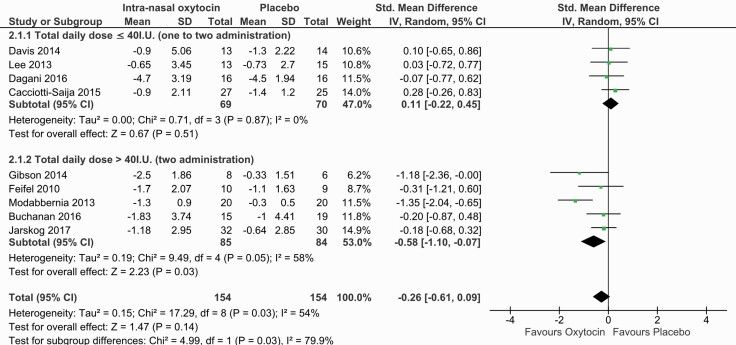
✗ Negativemeta-analysisInt J Neuropsychopharmacol · 2021

Intranasal Oxytocin for Negative Symptoms of Schizophrenia: Systematic Review, Meta-Analysis, and Dose-Response Meta-Analysis of Randomized Controlled Trials.

9 randomized clinical trials (participant total not stated)Systematic review, random-effects meta-analysis and dose-response meta-analysis of RCTs

Meta-analysis of 9 RCTs in schizophrenia: no significant effect on negative or positive symptoms; a high-dose signal disappeared after removing one outlier.

Key resultNo significant effect on negative symptoms across all 9 RCTs; a beneficial effect at higher doses (>40-80 IU) disappeared after exclusion of 1 outlier study
Studied
People with schizophrenia (negative symptoms)
Compared with
Placebo
Main outcome
Change in negative symptoms
Authors' conclusion
No consistent beneficial effect of intranasal oxytocin for negative or positive symptoms; dose-response analysis suggests high doses may be more efficacious but permits no firm conclusions.
Limitations
Results depended on one outlier study; dose-response analysis cannot support firm conclusions.
Figure 2.: Forest plot for negative symptoms including the subgroup analysis according to daily dose of oxytocin.
Figure 2.. From PMC8378078, CC BY (terms); resized.
~ Mixedmeta-analysisDiabetes Metab Syndr · 2023

The efficacy of intranasal oxytocin in patients with Prader-Willi syndrome: A systematic review and meta-analysis.

3 studies (92 patients) for hyperphagia; 3 studies (94 patients) for weightSystematic review and meta-analysis of RCTs

Meta-analysis of RCTs in Prader-Willi syndrome: no effect on hyperphagia or weight; some improvement on the Aberrant Behaviour Checklist.

Key resultHyperphagia MD = 0.18 (95% CI -0.44, 0.80; P = 0.56); weight MD = 0.30 (95% CI -0.22, 0.83; P = 0.25)
Studied
Patients with Prader-Willi syndrome
Compared with
Placebo
Main outcome
Hyperphagia, weight, Aberrant Behaviour Checklist
Authors' conclusion
Oxytocin had no significant effects on hyperphagia or weight; additional large prospective RCTs are needed.
Limitations
Few small trials.
? Inconclusivesystematic reviewJ Child Adolesc Psychopharmacol · 2014

Oxytocin and autism: a systematic review of randomized controlled trials.

7 RCTs, 101 subjects with ASD (males=95) plus 8 males with Fragile X syndromeSystematic review of randomized controlled trials

Review of 7 small autism RCTs (101 participants, medium-high risk of bias): some positive findings on eye gaze and emotion recognition; larger trials needed.

Studied
People with autism spectrum disorder (mostly male)
Compared with
Placebo
Main outcome
Repetitive behaviors, eye gaze, emotion recognition
Authors' conclusion
Findings on emotion recognition and eye gaze were potentially promising and oxytocin was generally well tolerated, but larger, more rigorous RCTs and long-term human studies are needed.
Limitations
Medium to high risk of bias; small samples (median=15); females rarely included.

Human studies

✗ Negativehuman RCTN Engl J Med · 2021

Intranasal Oxytocin in Children and Adolescents with Autism Spectrum Disorder.

n = 290 humansPlacebo-controlled randomized phase 2 trial (1:1), intranasal oxytocin, target dose 48 IU daily24 weeks

24-week phase 2 RCT in 290 children with autism: no difference from placebo on social withdrawal (difference -0.2, P=0.61) or secondary outcomes; adverse events similar.

Key resultLS mean change -3.7 oxytocin vs -3.5 placebo; difference -0.2 (95% CI -1.5 to 1.0; P = 0.61)
Studied
Children and adolescents aged 3 to 17 with autism spectrum disorder
Compared with
Intranasal placebo
Main outcome
Change from baseline in ABC-mSW (social withdrawal) score
Sample
290 enrolled (146 oxytocin, 144 placebo)
Authors' conclusion
Intranasal oxytocin showed no significant between-group differences on measures of social or cognitive functioning over 24 weeks; adverse events were similar between groups.
✓ Positivehuman RCTNeuropsychobiology · 2023

Intranasal Oxytocin as Add-On Treatment for Inpatients with Severe Mental Illness: A Randomized Clinical Trial.

n = 87 humansDouble-blind, placebo-controlled randomized trial; intranasal oxytocin twice daily as add-on to usual care4 weeks

4-week RCT in 87 psychiatric inpatients: oxytocin add-on gave larger improvement in symptoms, depression and distress than placebo, but not anxiety.

Key resultLarger symptomatic improvement with oxytocin (B = -0.01, t [437] = -2.36, p = 0.01); no significant effect on anxiety, working alliance or attachment
Studied
Inpatients with severe mental illness at a public psychiatric hospital in Israel
Compared with
Placebo
Main outcome
Symptom severity, anxiety, depression, distress, working alliance
Sample
87 psychiatric inpatients (71.3% female)
Authors' conclusion
Oxytocin has the potential to improve treatment outcome among inpatients; additional controlled research is needed.
Limitations
Short 4-week trial; mixed diagnoses; no effect on anxiety or alliance.
✗ Negativehuman RCTNEJM Evid · 2024

Intranasal Oxytocin for Obesity.

Sixty-one adults with obesity randomized 1:1Randomized, double-blind, placebo-controlled trial, intranasal oxytocin 24 IU four times daily8 weeks

8-week RCT in 61 adults with obesity: no difference in weight change vs placebo (0.20 vs 0.26 kg), though calorie intake at a test meal was lower.

Key resultWeight change 0.20 vs 0.26 kg with oxytocin vs placebo (P=0.934); test-meal caloric intake difference -152.0 kcal (95% CI -302.3 to -1.7)
Studied
Adults with obesity (mean age 33.6, BMI 36.9)
Compared with
Placebo
Main outcome
Change in body weight from baseline to week 8
Authors' conclusion
Intranasal oxytocin four times daily for 8 weeks did not reduce body weight, and showed no beneficial effects on body composition or resting energy expenditure.
Limitations
Short 8-week duration.
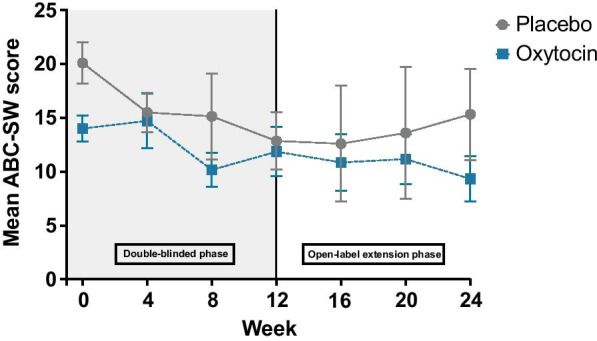
✗ Negativehuman RCTMol Autism · 2021

A randomized controlled trial of intranasal oxytocin in Phelan-McDermid syndrome.

Eighteen children aged 5-17 (written as a word)Double-blind, parallel-group RCT with open-label extension12-week double-blind phase plus 12-week open-label extension

12-week RCT in 18 children with Phelan-McDermid syndrome: no significant improvement in social withdrawal or secondary outcomes; well tolerated.

Key resultNo statistically significant improvement on ABC-SW (Mann-Whitney U = 50, p = 0.055) or any secondary outcome
Studied
Children aged 5-17 with Phelan-McDermid syndrome
Compared with
Intranasal saline placebo
Main outcome
Aberrant Behavior Checklist-Social Withdrawal subscale
Authors' conclusion
Intranasal oxytocin was generally well tolerated but not efficacious for core ASD symptoms in children with PMS.
Limitations
Small sample size, drug administration challenges, and expectancy bias from parent-reported outcomes.
Fig. 1: Mean scores on the Aberrant Behavior Checklist Social Withdrawal subscale across study visits. Bars represent standard error
Fig. 1. From PMC8482590, CC BY (terms); resized.

Verdicts are judged on each paper's own main outcome; grades run from A (strong human evidence) to D (little or none). Details are read from the abstracts, and figures are reproduced only from openly licensed full texts. Not medical advice.