Peptide Price Finder

Home · Research · Cognitive & nootropic

PE-22-28 research

What published studies found for PE-22-28: 4 papers, 0 in humans, with sample sizes and key results.

D
Little or no evidence
Why: Only one paper tests PE-22-28 itself (cells and mice); other work concerns spadin and mini-spadin, different analogues.

PE-22-28 is a 7-amino-acid fragment of the antidepressant peptide spadin; only one paper directly characterizes it (in cells and mice), with related work on the spadin analog 'mini-spadin' and a review of shortened spadin analogs. There are no human studies.

✓ 4 positive

No human safety data in the published literature.

US compounding: Not compoundable. Not an FDA-approved drug and not nominated for FDA's 503A bulks list, so US pharmacies can't legally compound it. Status for every peptide.

Browse and filter these papersPE-22-28 prices and vendors

Reviews

✓ PositivereviewPharmacol Ther · 2019

Fighting against depression with TREK-1 blockers: Past and future. A focus on spadin.

No new dataNarrative review

Review by the developing group summarizing spadin and its shortened analogs as fast-acting TREK-1-blocking antidepressant candidates in rodents.

Main outcome
Development of spadin and shortened analogs as TREK-1 blocking antidepressants
Authors' conclusion
Spadin acts within 4 days, and shortened analogs show increased TREK-1 inhibition, improved antidepressant activity and longer bioavailability than spadin, which is stable for less than 7 h in vivo.
Limitations
Review; supporting data are preclinical.
Animal & lab studies

✓ PositiveanimalFront Pharmacol · 2017

Shortened Spadin Analogs Display Better TREK-1 Inhibition, In Vivo Stability and Antidepressant Activity.

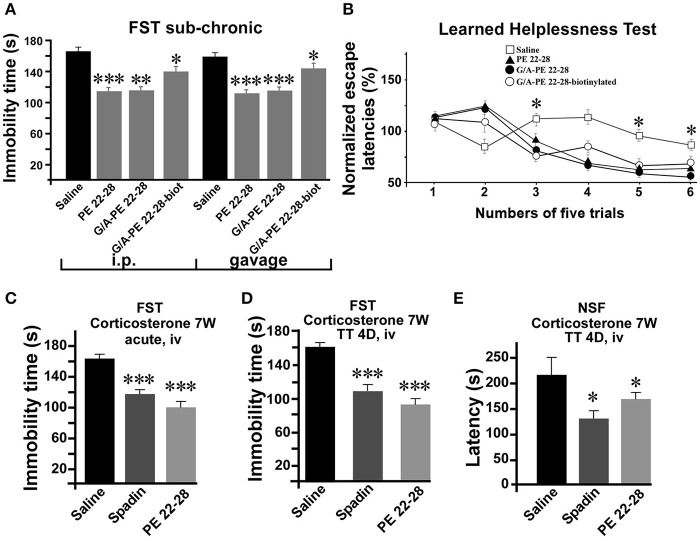
Humans and animalsIn vitro patch-clamp plus in vivo mouse behavioral tests (forced swimming, novelty suppressed feeding) of PE 22-28 and derivatives4-day sub-chronic treatment

PE 22-28 blocked TREK-1 channels more potently than spadin (IC50 0.12 nM vs 40–60 nM), reduced immobility in mouse depression tests, induced neurogenesis after 4 days and lasted up to 23 h vs 7 h for spadin.

Key resultIC50 0.12 nM for PE 22-28 vs 40-60 nM for spadin; action duration up to 23 h instead of 7 h
Studied
hTREK-1/HEK cells and mice (behavioral models of depression, cortical neurons)
Compared with
Spadin
Main outcome
TREK-1 inhibition, immobility time, latency to eat, neurogenesis, duration of action
Authors' conclusion
PE 22-28 and its derivatives are promising alternatives to spadin for treating depression, with better TREK-1 affinity, antidepressant-like activity in mice and longer duration.
Limitations
Mouse and cell study; no human data.
Figure 5: Behavior of spadin-analogs in mouse model of depression. (A) FST performed after a sub-chronic (4 days) treatment (3.0–4.0 μg/kg) with each
Figure 5. From PMC5601071, CC BY (terms); resized.
✓ PositiveanimalNeuropharmacology · 2019

First evidence of protective effects on stroke recovery and post-stroke depression induced by sortilin-derived peptides.

AnimalsMini-spadin (0.03 micrograms/kg early, then 3 micrograms/kg) injected intraperitoneally; electrophysiology and behavioral tests7 days of low dose, then higher dose 4 days/week until sacrifice

In a mouse stroke model, mini-spadin (a shortened spadin analogue) improved motor and cognitive deficits and prevented post-stroke depression-like behaviour.

Studied
Mice with focal ischemia and post-stroke depression
Main outcome
Motor and cognitive deficits, dopaminergic degeneration, post-stroke depression (forced swim, novelty suppressed feeding)
Authors' conclusion
Mini-spadin improved stroke deficits and prevented post-stroke depression in mice, with enhanced neurogenesis and synaptogenesis; the authors call this the first evidence that TREK-1 modulation may be protective.
Limitations
Mouse model; mini-spadin is a spadin analog, not PE 22-28 itself.
✓ Positivein vitroPharmacol Res · 2021

Sortilin-derived peptides promote pancreatic beta-cell survival through CREB signaling pathway.

Cells / labIn vitro biochemical, imaging and cell biology experiments with PE, Spadin and Mini-Spadin

Sortilin propeptide derivatives spadin and mini-spadin protected pancreatic beta cells from cytokine-induced death; mini-spadin promoted beta-cell proliferation.

Studied
Pancreatic beta-cells exposed to Interleukin-1beta
Main outcome
Beta-cell survival, CaM-Kinase/CREB signaling, proliferation
Authors' conclusion
PE and derivatives protected beta-cells against cytokine-induced death via CaM-Kinase and CREB, and Mini-Spadin promoted proliferation, suggesting possible roles against diabetes.
Limitations
In vitro cell study.

Verdicts are judged on each paper's own main outcome; grades run from A (strong human evidence) to D (little or none). Details are read from the abstracts, and figures are reproduced only from openly licensed full texts. Not medical advice.