Peptide Price Finder

Home · Research · Cognitive & nootropic

Pinealon research

What published studies found for Pinealon: 9 papers, 3 in humans, with sample sizes and key results.

C
Mostly animal studies
Why: Human reports are uncontrolled or poorly described Russian studies; the controlled data come from a few rat, mouse and two-monkey studies.

Pinealon (the tripeptide Glu-Asp-Arg) is studied almost entirely by one Russian research network; evidence consists of cell, rat, mouse and two-monkey studies plus a few small, uncontrolled or poorly described human studies measuring 'biological age' or psychological markers. A 2026 preprint mouse screen found a non-significant trend toward better working memory and no detectable adverse effects.

✓ 3 positive~ 2 mixed? 4 inconclusive

Human data come from small, uncontrolled studies; no systematic adverse-event reporting.

US compounding: Not compoundable. Not an FDA-approved drug and not nominated for FDA's 503A bulks list, so US pharmacies can't legally compound it. Status for every peptide.

Browse and filter these papersPinealon prices and vendors

Reported side effects

Human studies

~ Mixedhuman trialAdv Gerontol · 2015

[EFFECT OF SYNTHETIC PEPTIDES ON AGING OF PATIENTS WITH CHRONIC POLYMORBIDITY AND ORGANIC BRAIN SYNDROME OF THE CENTRAL NERVOUS SYSTEM IN REMISSION].

n = 32 humansClinical study of Vesugen and Pinealon on biological age

32 patients with polymorbidity and organic brain syndrome given pinealon and vesugen: authors report improved biological-age indicators, but also prooxidant activity and reduced circulating CD34+ blood stem cells.

Studied
People aged 41-83 with polymorbidity and organic brain syndrome in remission
Main outcome
Biological age indicators, oxidative and hematopoietic markers
Sample
32 people (18 men, 12 women)
Authors' conclusion
Vesugen and Pinealon had an anabolic effect and slowed biological aging indicators, Vesugen more visibly; prooxidant activity and reduced CD34+ cells were also found. Chromatin condensation was unaffected.
Limitations
Small study, no control arm described, no numerical results in the abstract.
? Inconclusivehuman trialAdv Gerontol · 2012

[The peptide correction of neurotic disorders among professional truck-drivers].

150 male lorry-drivers and 150 male metal craftsmenQuestionnaire-based comparison with peptide correction

Study of 150 truck drivers vs 150 metal workers: bioregulator peptides (best with pinealon plus vesugen) reportedly improved psycho-emotional indices; design and controls for the peptide arm are unclear.

Studied
Professional truck drivers compared with metal craftsmen controls
Compared with
Metal craftsmen (control group)
Main outcome
Neurotic states and psychoemotional indices
Authors' conclusion
Bioregulating peptides were reported to restore adaptive potential and improve psychoemotional indices (p < 0.001-0.05); combined pinealon and vezugen had the best effect.
Limitations
Peptide-treatment design and group sizes are not clearly described in the abstract.
? Inconclusivehuman trialAdv Gerontol · 2012

[Analysis of some parameters of biological age and adaptation possibilities of workers of locomotive brigades].

Number of workers not statedUncontrolled use of Pinealon, 100 mkg capsule twice dailyTwo weeks

Locomotive crew workers took pinealon for two weeks; authors report improved biological-age and adaptation measures without a described control group.

Studied
Workers of locomotive brigades
Main outcome
Biological age and adaptive reaction indicators
Authors' conclusion
The authors report that Pinealon improved biological-age parameters and adaptive reaction indicators and support its use for professional reliability.
Limitations
No control group or numerical data in the abstract.

Animal & lab studies

? InconclusiveanimalВестник Московского университета. Серия 23. Антропология · 2019Russian-language

Влияние трипептида Пинеалона на реабилитацию когнитивных функций в процессе старения на примере макак-резусов (Macaca mulatta)

n = 2 animalsUncontrolled before-and-after comparison in the same animals10-day oral course

In two healthy aged rhesus macaques (developer's institute co-authors), a 10-day oral pinealon course was followed by shorter learning time (p<0.01) and faster motor reactions (p<0.001) in a visual discrimination task; uncontrolled before-after design with n=2.

Key resultSignificant shortening of learning duration (p<0.01) and of motor reaction time (p<0.001) after pinealon
Studied
Healthy aging rhesus macaques (Macaca mulatta)
Compared with
Same animals before treatment
Main outcome
Learning speed and success, motor reaction time, attention in a visual discrimination task
Sample
2 healthy rhesus macaques (13±0.9 years)
Authors' conclusion
The authors concluded pinealon improved selective attention and spatial orientation and shortened motor reaction time in aging macaques.
Limitations
Only 2 animals, no control group, co-authors from the developer's institute.
✓ PositiveanimalInt J Clin Exp Med · 2012

Pinealon protects the rat offspring from prenatal hyperhomocysteinemia.

AnimalsAnimal experiment, pinealon (Glu-Asp-Arg) given to pregnant rats

Pinealon given to pregnant rats with hyperhomocysteinemia improved offspring spatial learning and reduced oxidative stress in their cerebellar neurons.

Studied
Offspring of rats with methionine-induced hyperhomocysteinemia during pregnancy
Compared with
Hyperhomocysteinemic rats without pinealon
Main outcome
Offspring spatial learning; ROS and necrotic cells in cerebellar neurons
Authors' conclusion
Pinealon improved offspring spatial orientation and learning and reduced ROS accumulation and necrotic neurons, supporting a neuroprotective effect.
Limitations
Rat study; no numbers in the abstract.
~ MixedanimalAdv Gerontol · 2011

[Effects of introduction of short peptides before carotid artery occlusion on behaviour and caspase-3 activity in the brain of old rats].

AnimalsComparison of Pinealon and Cortexin before carotid artery occlusion

In old rats with carotid occlusion, pinealon improved survival but reduced exploratory and motor behaviour and modestly raised caspase-3 activity.

Studied
Old rats with carotid artery occlusion
Compared with
Cortexin; untreated and sham-operated animals
Main outcome
Survival, behaviour, brain caspase-3 activity
Authors' conclusion
Short peptides increased survival after occlusion; Pinealon increased sleep time but reduced exploratory, motivational and motor behaviour, and moderately raised caspase-3 activity.
Limitations
Rat study; no numbers in the abstract; mixed behavioural effects.
? InconclusiveanimalbioRxiv · 2026preprint

Short-Term Performance Assay Identifies Functional Benefits and Early Toxicity of Longevity Interventions in Mice

Small groups of mice per treatment (pinealon group size not stated in abstract)Multi-arm preclinical screening assay (preprint) comparing five candidate interventions8 weeks

Preprint (not peer-reviewed): In an 8-week mouse screen of five anti-aging candidates, pinealon showed a trend toward improved working memory (Y-maze) without detectable adverse effects; no significant effect was reported.

Studied
Mice in an 8-week short-term performance screen
Main outcome
Body weight, temperature, food intake, grip strength, locomotion, Y-maze cognition, social behavior, blood and urine parameters
Authors' conclusion
Pinealon showed a trend toward improved working memory without detectable adverse effects.
Limitations
Preprint; short, small screening study; trend only.
✓ Positivein vitroRejuvenation Res · 2011

Pinealon increases cell viability by suppression of free radical levels and activating proliferative processes.

Cells / labIn vitro study under oxidative stress

Pinealon reduced reactive oxygen species accumulation and necrotic death in cerebellar neurons, neutrophils and PC12 cells under oxidative stress.

Studied
Cerebellar granule cells, neutrophils and PC12 cells
Main outcome
ROS accumulation, necrotic cell death, ERK 1/2 activation, cell cycle
Authors' conclusion
Pinealon restricted ROS accumulation and necrotic death in a dose-dependent manner and modified the cell cycle, suggesting direct interaction with the cell genome beyond antioxidant activity.
Limitations
In vitro only.
✓ Positivein vitroInt J Mol Sci · 2024

Short Peptides Protect Fibroblast-Derived Induced Neurons from Age-Related Changes.

Cells / labIn vitro model of neuronal aging testing EDR (pinealon), KED and AEDG peptides

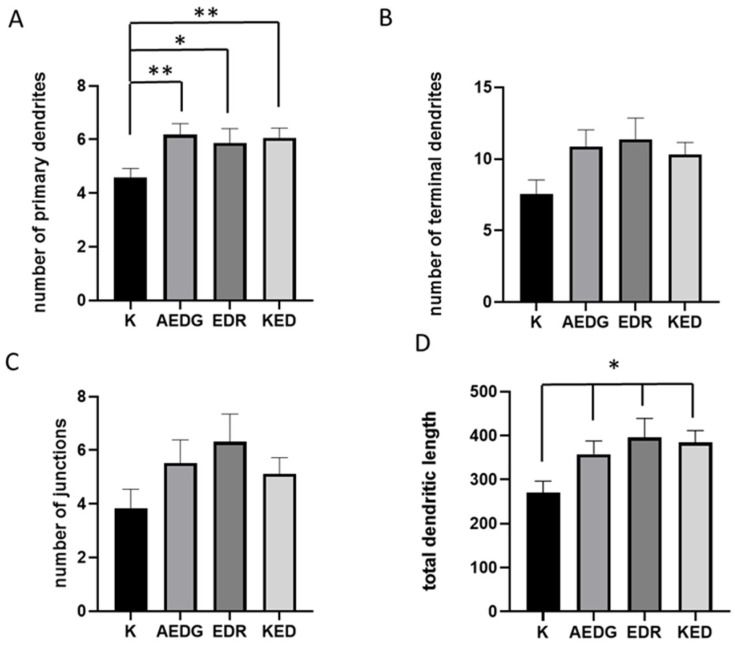
In neurons derived from elderly donors' fibroblasts, EDR (pinealon) and related peptides increased dendritic branching and EDR reduced oxidative DNA damage.

Studied
Induced cortical neurons transdifferentiated from dermal fibroblasts of elderly donors
Compared with
Untreated induced neurons
Main outcome
Dendritic arborization, mitochondria, lysosomes, p16, oxidative DNA damage
Authors' conclusion
All peptides promoted dendritic arborization; EDR reduced oxidative DNA damage; tripeptides did not affect mitochondria, lysosomes or p16. Short peptides partially protect induced neurons from age-related changes.
Limitations
In vitro cell model only.
Figure 6: Histogram illustrating the number of primary processes (A), the number of branching points (B), the number of terminal processes (C), and th
Figure 6. From PMC11546785, CC BY (terms); resized.

Verdicts are judged on each paper's own main outcome; grades run from A (strong human evidence) to D (little or none). Details are read from the abstracts, and figures are reproduced only from openly licensed full texts. Not medical advice.