Peptide Price Finder

Home · Research · Skin, hair & tanning

PTD-DBM research

What published studies found for PTD-DBM: 6 papers, 0 in humans, with sample sizes and key results.

C
Mostly animal studies
Why: Several mouse studies from one Korean group show hair regrowth and better wound healing; no human trials.

PTD-DBM is an experimental peptide that blocks the CXXC5-Dishevelled interaction to switch on Wnt/beta-catenin signaling; all published work comes from one Korean research group and consists of mouse and cell studies on hair regrowth and wound healing. No human trials were found in PubMed.

✓ 5 positive? 1 inconclusive

No human safety data in the published literature; Wnt-pathway activation has theoretical long-term risks that have not been studied for this peptide.

US compounding: Not compoundable. Not an FDA-approved drug and not nominated for FDA's 503A bulks list, so US pharmacies can't legally compound it. Status for every peptide.

Browse and filter these papersPTD-DBM prices and vendors

Reviews

? InconclusivereviewCells · 2025

Revolutionary Approaches to Hair Regrowth: Follicle Neogenesis, Wnt/ß-Catenin Signaling, and Emerging Therapies.

No new dataNarrative review

Narrative review of emerging hair-loss therapies discusses PTD-DBM as a Wnt-pathway activator but states such therapies still need research to validate efficacy and risk profile.

Studied
Alopecia therapies, including the CXXC5-targeting peptide PTD-DBM
Main outcome
Hair follicle neogenesis and Wnt/beta-catenin-modulating therapies
Authors' conclusion
Peptides such as PTD-DBM, which activate Wnt/beta-catenin by interfering with CXXC5, show potential, but these novel therapies require further research to validate efficacy and risk profile.
Limitations
Narrative review with no original data; clinical efficacy claims not quantified in the abstract.
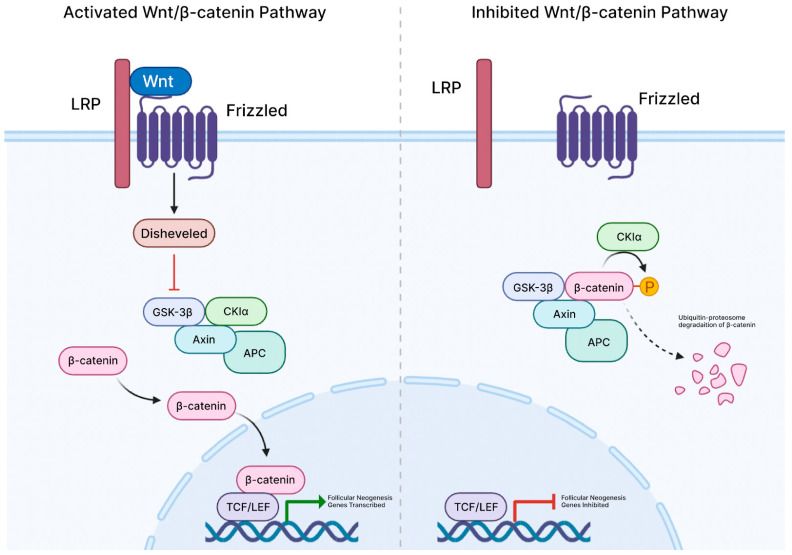
Figure 1: Overview of activated and inhibited Wnt/β-catenin pathway.
Figure 1. From PMC12153676, CC BY (terms); resized.

Animal & lab studies

✓ PositiveanimalJ Invest Dermatol · 2017

Targeting of CXXC5 by a Competing Peptide Stimulates Hair Regrowth and Wound-Induced Hair Neogenesis.

Humans and animalsHuman tissue, in vitro and mouse studies incl. a competitor peptide disrupting CXXC5-Dishevelled

CXXC5 was elevated in balding human scalp; in mice, a competitor peptide blocking CXXC5-Dishevelled binding activated Wnt signaling and accelerated hair regrowth and wound-induced hair follicle formation.

Studied
Human balding scalp tissue, human dermal papilla cells, CXXC5-/- mice and wild-type mice
Main outcome
Hair regrowth and wound-induced hair follicle neogenesis
Authors' conclusion
CXXC5 is a negative regulator of Wnt/beta-catenin; disrupting its interaction with Dishevelled with a competitor peptide accelerated hair regrowth and wound-induced hair follicle neogenesis in mice, suggesting a target for hair loss.
Limitations
Preclinical; numbers not in the abstract.
✓ PositiveanimalCells · 2023

CXXC5 Mediates DHT-Induced Androgenetic Alopecia via PGD2.

AnimalsMouse study with PTD-DBM treatment or Cxxc5 knockout, incl. wound-induced hair neogenesis model

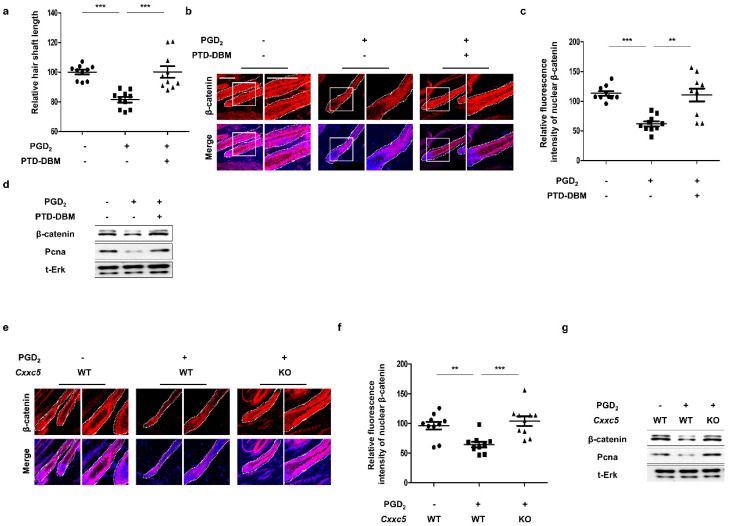
In mice, PTD-DBM (or CXXC5 knockout) reversed hair loss induced by prostaglandin D2 and countered DHT-linked hair-loss signaling.

Studied
Mice with prostaglandin D2- or DHT-induced hair loss, including Cxxc5 knockout mice
Main outcome
Hair loss and neogenic hair growth
Authors' conclusion
PGD2-induced hair loss was restored by PTD-DBM or Cxxc5 knockout, and DHT-induced hair loss was alleviated by inhibiting both GSK-3beta and CXXC5; CXXC5 mediates hair loss via the DHT-PGD2 axis.
Limitations
Mouse study; numbers not in the abstract.
Figure 3: Effects of blockade of Cxxc5 function on hair regrowth. (a–d) The dorsal skins of C57BL/6N 7-week-old wild-type mice were depilated and harv
Figure 3. From PMC9954685, CC BY (terms); resized.
✓ PositiveanimalJ Exp Med · 2015

The Dishevelled-binding protein CXXC5 negatively regulates cutaneous wound healing.

Humans and animalsHuman tissue, in vitro and mouse studies; PTD-DBM with valproic acid co-treatment

PTD-DBM activated beta-catenin and collagen production in cells, and combined with valproic acid accelerated skin wound healing in mice.

Studied
Human wound tissue, cultured cells, CXXC5-/- mice and wild-type mice with skin wounds
Main outcome
Cutaneous wound healing; beta-catenin and collagen production
Authors' conclusion
CXXC5 negatively regulates wound healing via Dishevelled; PTD-DBM activated beta-catenin and collagen in vitro, and with valproic acid synergistically accelerated wound healing in mice.
Limitations
Preclinical; effect of PTD-DBM alone in vivo not stated in the abstract.
✓ PositiveanimalAdv Healthc Mater · 2023

Adhesive Hydrogel Patch-Mediated Combination Drug Therapy Induces Regenerative Wound Healing through Reconstruction of Regenerative Microenvironment.

AnimalsMouse wound-healing study with patches loaded with PTD-DBM and/or valproic acid

An adhesive hydrogel patch loaded with PTD-DBM and/or valproic acid reduced scar formation and promoted regenerative wound healing in mice.

Studied
Mice with wounds treated with pyrogallol-functionalized hyaluronic acid (HA-PG) patches
Main outcome
Scar formation and regenerative wound healing markers
Authors' conclusion
Patches loaded with PTD-DBM and/or valproic acid significantly inhibited scar formation and induced stem cell markers and collagen III, suggesting potential to promote wound healing and scar attenuation.
Limitations
Mouse study; patch material contributes to the effect; numbers not in the abstract.
✓ Positivein vitroCell Death Differ · 2015

CXXC5 is a negative-feedback regulator of the Wnt/β-catenin pathway involved in osteoblast differentiation.

Humans and animalsMouse genetics, in vitro osteoblast differentiation and ex vivo skull culture with a competitor peptide

Blocking the CXXC5-Dishevelled interaction with a competitor peptide activated Wnt signaling and osteoblast differentiation and thickened cultured mouse skull bone.

Studied
Cxxc5-deficient mice, osteoblast cultures and ex vivo cultured mouse calvariae
Main outcome
Bone mineral density, osteoblast differentiation, calvarial thickness
Authors' conclusion
CXXC5 deficiency raised bone mineral density in mice; blocking the Dvl-CXXC5 interaction with a competitor peptide activated Wnt signaling and osteoblast differentiation and thickened cultured calvariae.
Limitations
Peptide tested in cells and ex vivo bone only; numbers not in the abstract.

Verdicts are judged on each paper's own main outcome; grades run from A (strong human evidence) to D (little or none). Details are read from the abstracts, and figures are reproduced only from openly licensed full texts. Not medical advice.