Peptide Price Finder

Home · Research · Cognitive & nootropic

Semax research

What published studies found for Semax: 11 papers, 7 in humans, with sample sizes and key results.

C
Mostly animal studies
Why: Human data are small non-randomized, unblinded Russian studies; the controlled evidence comes from rat and mouse experiments.

Semax (an ACTH(4-10) analogue) has been tested in small Russian clinical studies (open-label or without described randomization) in stroke, optic nerve disease, motor neuron disease, psoriasis and atopic dermatitis; no large placebo-controlled RCTs are in the candidate literature. Most other evidence is rat gene-expression and behaviour work, so benefit in people is plausible but not firmly established.

✓ 7 positive~ 1 mixed? 3 inconclusive

No adverse effects are described in the human study abstracts; published human safety data are limited to small trials.

US compounding: Recommended for compounding, not legal yet. FDA's Pharmacy Compounding Advisory Committee voted on July 23-24, 2026 to recommend adding it to the 503A bulks list (FDA staff had recommended against). The vote isn't binding: compounding stays illegal until FDA accepts it and finishes proposed and final rulemaking, which typically takes a year or more. Vote: 8-5 (evaluated for cerebral ischemia, migraine, trigeminal neuralgia). Status for every peptide.

Browse and filter these papersSemax prices and vendors

Human studies

? Inconclusivehuman trialАктуальные проблемы медицины · 2012Russian-language

Оценка влияния препарата семакс на эффективность антиоксидантной терапии у больных псориазом

n = 95 humansClinical observation of Semax added to antioxidant therapy; control group not described in the abstract

95 patients with psoriasis were observed; the authors report that adding Semax to antioxidant therapy improved the course of psoriasis, reduced inflammatory activity and normalised serum lipids, but no control group or numbers are given in the abstract (Russian regional journal).

Studied
Patients with psoriasis
Main outcome
Quality of life, disease course, inflammatory activity, serum lipids
Sample
95 patients with psoriasis
Authors' conclusion
Authors conclude Semax markedly improves the course of psoriasis and lowers inflammatory activity, citing lipotropic, membrane-stabilising and antioxidant action.
Limitations
No numbers, control group or blinding in the abstract; mechanism claims are inferred.
? Inconclusivehuman trialDokl Biol Sci · 2020

Functional Connectomic Approach to Studying Selank and Semax Effects.

n = 52 humansResting-state fMRI before and after 5 and 20 min of injectionImaging up to 20 min after injection

52 healthy volunteers given semax, selank or placebo: changes in resting-state amygdala-temporal cortex functional connectivity on fMRI; no clinical outcomes measured.

Studied
Healthy participants
Compared with
Placebo
Main outcome
Whole-brain resting-state functional connectivity of amygdala and DLPFC
Sample
52 healthy participants
Authors' conclusion
Group and condition differences were found in connectivity between the right amygdala and right temporal cortex regions, giving general and specific effects of Selank and Semax.
Limitations
Healthy volunteers; connectivity imaging only, no clinical outcomes.
~ Mixedhuman trialZh Nevrol Psikhiatr Im S S Korsakova · 2007

[The study of chronic partial denervation and quality of life in patients with motor neuron disease treated with semax].

n = 27 humansOpen-label clinical trial in sequential groupsTwo 10-day courses with 2-week break; assessed through day 48

Open-label study in 27 motor neuron disease patients: semax did not change denervation course or clinical ALS scores, but improved quality-of-life scores (emotional state, motivation).

Studied
Patients with definite, probable or possible motor neuron disease
Compared with
No separate control group
Main outcome
Chronic partial denervation (needle EMG), ALS scales and ALSAQ-40 quality of life
Sample
27 patients with motor neuron disease
Authors' conclusion
Semax did not influence the course of denervation or clinical estimates, but 1% semax significantly improved total quality-of-life estimate (emotional state, motivation), with maximal effect on day 10.
Limitations
Open-label, no control group.
✓ Positivehuman trialZh Nevrol Psikhiatr Im S S Korsakova · 2018

[The efficacy of semax in the tretament of patients at different stages of ischemic stroke].

110 patients after ischemic stroke, written out in words in the abstractComparative study of rehabilitation timing with and without semax2 courses of 10 days with 20-day interval

Study of 110 post-ischemic-stroke patients split into semax and no-semax subgroups: adding semax raised plasma BDNF and was associated with faster improvement in Barthel index and motor scores.

Studied
Patients after ischemic stroke in early (89±9 days) or late (214±22 days) rehabilitation, each split into semax+ and semax- subgroups
Compared with
Semax- subgroups (no semax)
Main outcome
Plasma BDNF, motor performance (MRC scale) and Barthel index
Authors' conclusion
Semax, regardless of rehabilitation timing, increased plasma BDNF and accelerated Barthel index improvement; early rehabilitation and semax increased BDNF, sped functional recovery and improved motor performance.
Limitations
Not clearly randomized or blinded; correlational findings.
✓ Positivehuman trialZh Nevrol Psikhiatr Im S S Korsakova · 1997

[Effectiveness of semax in acute period of hemispheric ischemic stroke (a clinical and electrophysiological study)].

30 semax patients vs 80 controlsControlled clinical and electrophysiological study with conventional-therapy control groupTreatment courses of 5 and 10 days

30 acute hemispheric stroke patients given semax vs 80 conventionally treated controls: authors report faster regression of general and motor deficits.

Studied
Patients in the acute period of hemispheric ischemic stroke
Compared with
80 patients with analogous strokes on conventional therapy
Main outcome
Clinical rating scales, EEG mapping and somatosensory evoked potentials
Authors' conclusion
Adding Semax to combined intensive therapy had some influence on the rate of restoration of neurological functions, especially motor disorders. Most effective daily doses were 12 mg (moderate strokes) and 18 mg (severe).
Limitations
Not described as randomized or blinded.
✓ Positivehuman trialVestn Oftalmol · 2000

[Evaluation of therapeutic effect of new Russian drug semax in optic nerve disease].

HumansThree-group comparison of administration routes plus control

Controlled study in optic nerve disease: semax added to standard therapy was reported to improve visual acuity, visual field and optic nerve conductivity vs control.

Studied
Patients with vascular, toxic allergic, inflammatory optic nerve disease or partial optic atrophy
Compared with
Control group on basic therapy without semax
Main outcome
Visual acuity, visual field, optic nerve electric sensitivity and conductivity, color vision
Authors' conclusion
Adding semax to the therapeutic complex had a favorable impact on intensity and rate of recovery and improved visual functions.
Limitations
Abstract gives no numbers or sample size.
✓ Positivehuman trialЧеловек и его здоровье · 2008Russian-language

Клиническая эффективность комплексной терапии атопического дерматита с применением семакса

Patient numbers not stated in the abstractControlled comparison of Semax plus standard therapy vs standard therapy alone; randomization not stated

In patients with atopic dermatitis, adding Semax to standard therapy gave a lower Dermatology Life Quality Index (by 55.31%) and SCORAD than standard therapy alone (Russian regional journal; allocation method and sample size not given in the abstract).

Key resultAfter the course DLQI was 55.31% lower than in controls (p value cut off in the available abstract)
Studied
Patients with atopic dermatitis
Compared with
Standard therapy only
Main outcome
Dermatology Life Quality Index (DLQI) and SCORAD
Authors' conclusion
Authors report high efficacy of Semax added to complex treatment of atopic dermatitis.
Limitations
Abstract gives no sample size or randomization/blinding; abstract truncated.

Reviews

? InconclusivereviewZh Nevrol Psikhiatr Im S S Korsakova · 2024

[Place of oligopeptide H-Met-Glu-His-Phe-Pro-Gly-Pro-OH in the therapy and rehabilitation of patients with ischemic stroke].

Narrative review; number of studies not stated in abstractNarrative review of clinical studies

A Russian narrative review of clinical studies concludes the Semax heptapeptide (MGHPPGP, intranasal) is clinically effective in acute and recovery-phase ischemic stroke; it is not a systematic review and the underlying studies are the same small Russian trials.

Studied
Patients with ischemic stroke (reviewed studies)
Main outcome
Clinical efficacy in acute and recovery stroke
Authors' conclusion
The review concludes MGHPPGP is clinically effective in ischemic stroke in both acute and recovery periods and across stroke subtypes.
Limitations
Narrative, non-systematic; no pooled data; relies on previously published small studies.

Animal & lab studies

✓ PositiveanimalJ Neurochem · 2006

Semax, an analogue of adrenocorticotropin (4-10), binds specifically and increases levels of brain-derived neurotrophic factor protein in rat basal forebrain.

AnimalsRadioligand binding and BDNF immunoenzymatic analysisBDNF measured 3 h after dosing

In rats, intranasal semax bound specific basal-forebrain sites and rapidly increased BDNF protein in the basal forebrain (not cerebellum).

Key resultSpecific binding of labelled Semax with KD 2.4±1.0 nm and BMAX 33.5±7.9 fmol/mg protein; intranasal Semax at 50 and 250 microg/kg raised BDNF after 3 h in basal forebrain but not cerebellum
Studied
Rat basal forebrain membranes and rats given intranasal Semax
Compared with
Cerebellum as comparison region
Main outcome
Semax binding and BDNF protein levels
Authors' conclusion
Specific Semax binding sites exist in rat basal forebrain, and cognitive effects of Semax might be associated at least in part with increased BDNF protein there.
Limitations
Rat study.
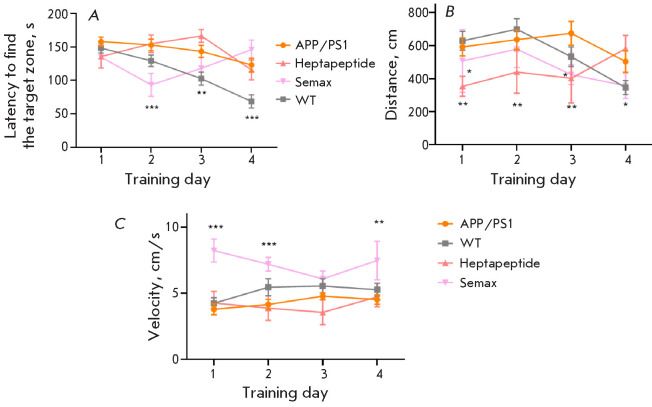
✓ PositiveanimalActa Naturae · 2025

The Potential of the Peptide Drug Semax and Its Derivative for Correcting Pathological Impairments in the Animal Model of Alzheimer's Disease.

AnimalsBehavioural tests and histology

In APP/PS1 Alzheimer's model mice, semax and a derivative improved cognitive test performance and reduced amyloid inclusions in cortex and hippocampus.

Studied
Transgenic APPswe/PS1dE9/Blg mice (Alzheimer's model)
Main outcome
Cognition (open field, novel object recognition, Barnes maze) and amyloid inclusions
Authors' conclusion
Semax and its derivative improved cognitive functions in mice and reduced amyloid inclusions in cortex and hippocampus, indicating potential for Alzheimer's strategies.
Limitations
Mouse model only.
Fig. 4: Results of the Barnes maze test (days 1–4). Latency to find the target zone (A); total distance traveled (B); velocity (C); * – p < 0.05, **
Fig. 4. From PMC12755871, CC BY (terms); resized.
✓ PositiveanimalBr J Pharmacol · 2025

Semax peptide targets the μ opioid receptor gene Oprm1 to promote deubiquitination and functional recovery after spinal cord injury in female mice.

Humans and animalsMouse SCI model with RNA-seq, network pharmacology, docking and USP18 knockdown

In female mice with spinal cord injury, semax improved functional recovery scores and reduced lysosomal-membrane-permeabilization-related pyroptosis.

Studied
Female C57BL/6 mice with T9-T10 spinal cord injury and PC12 cell neuroinflammation model
Main outcome
Functional recovery (footprint, Basso scores, inclined plane), lysosomal membrane permeabilization-related pyroptosis
Authors' conclusion
Semax improved SCI functional recovery and inhibited LMP-related pyroptosis, apparently via mu-opioid receptor, USP18 and FTO deubiquitination, suggesting potential for SCI treatment.
Limitations
Female mice and cell models only.

Verdicts are judged on each paper's own main outcome; grades run from A (strong human evidence) to D (little or none). Details are read from the abstracts, and figures are reproduced only from openly licensed full texts. Not medical advice.