Peptide Price Finder

Home · Research · Mitochondria & energy

SS-31 research

What published studies found for SS-31: 8 papers, 8 in humans, with sample sizes and key results, plus 30 registered clinical trials.

B
Some human evidence
Why: Several RCTs with conflicting results: the 218-person phase 3 myopathy trial and a heart-failure trial failed; benefit in Barth syndrome is mainly open-label.

SS-31 (elamipretide) has been tested in several human RCTs. Results are mixed: the phase 3 trial in mitochondrial myopathy and a heart-failure trial missed their primary endpoints, while Barth syndrome patients improved mainly in open-label extensions, supporting a 2025 US accelerated approval for that rare disease. Evidence is for specific diseases, not general anti-aging use.

✓ 3 positive✗ 3 negative~ 2 mixed

Generally well tolerated in trials of up to several years in rare mitochondrial diseases; no data on use in healthy people.

US compounding: Not compoundable. Not an FDA-approved drug and not nominated for FDA's 503A bulks list, so US pharmacies can't legally compound it. Status for every peptide.

Browse and filter these papersSS-31 prices and vendors

Reported side effects

Registered clinical trials

30 trials of SS-31 on ClinicalTrials.gov: 3 active, 22 completed, 14 with posted results. Registered trials include ones that haven't published yet.

TrialStatusPhasePeopleSponsor
ReNEW:Phase 3 Study of Efficacy, Safety & Pharmacokinetics of Subcutaneous Injections of Elamipretide in Subjects With Dry Age-Related Macular Degeneration (Dry AMD)NCT06373731 · started 2024-05-30Active, not recruitingPhase 3313Stealth BioTherapeutics Inc.
Clinical Trial in Patients With Barth Syndrome- 4TAZPowerNCT07531251 · started 2026-07-02RecruitingPhase 448Stealth BioTherapeutics Inc.
Study of Healthy Aging and Physical Function With ElamipretideNCT07275424 · started 2025-11-26RecruitingPhase 230David Marcinek
Evaluation of Myocardial Effects of MTP-131 for Reducing Reperfusion Injury in Patients With Acute Coronary EventsNCT01572909 · started 2012-04 · results postedCompletedPhase 2300Stealth BioTherapeutics Inc.
A Trial to Evaluate Safety and Efficacy of Elamipretide Primary Mitochondrial Myopathy Followed by Open-Label ExtensionNCT03323749 · started 2017-10-09 · results postedTerminatedPhase 3218Stealth BioTherapeutics Inc.
ReCLAIM-2 Study to Evaluate Safety,Efficacy & Pharmacokinetics of Elamipretide in Subjects With AMD With Non-central GANCT03891875 · started 2019-03-27 · results postedCompletedPhase 2176Stealth BioTherapeutics Inc.
Effect of Elamipretide on Left Ventricular Function in Subjects With Stable Heart Failure With Reduced Ejection FractionNCT02788747 · started 2016-06 · results postedCompletedPhase 271Stealth BioTherapeutics Inc.
A Phase 2 Study to Evaluate the Impact of MTP-131 (Bendavia™) on Skeletal Muscle Function in ElderlyNCT02245620 · started 2015-01-15 · results postedCompletedPhase 241Stealth BioTherapeutics Inc.
An Open-Label, Phase 1 Clinical Study to Evaluate the Safety and Tolerability of Subcutaneous Elamipretide in Subjects With Intermediate Age-Related Macular DegenerationNCT02848313 · started 2016-10-28 · results postedCompletedPhase 140Stealth BioTherapeutics Inc.
Safety, Tolerability, and Efficacy of MTP-131 for the Treatment of Mitochondrial MyopathyNCT02367014 · started 2015-02 · results postedCompletedPhase 1, Phase 236Stealth BioTherapeutics Inc.
Safety, Tolerability, Efficacy of MTP-131 for Treatment of Mitochondrial Disease in Subjects From the MMPOWER StudyNCT02805790 · started 2016-08-22 · results postedCompletedPhase 230Stealth BioTherapeutics Inc.
Open-Label Extension Trial to Characterize the Long-term Safety and Tolerability of Elamipretide in Subjects With Genetically Confirmed Primary Mitochondrial Myopathy (PMM)NCT02976038 · started 2016-12 · results postedTerminatedPhase 228Stealth BioTherapeutics Inc.

All 30 SS-31 trials, with countries and recruiting status

Human studies

✗ Negativehuman RCTNeurology · 2023

Efficacy and Safety of Elamipretide in Individuals With Primary Mitochondrial Myopathy: The MMPOWER-3 Randomized Clinical Trial.

n = 218 humansPhase 3 randomized, double-blind, placebo-controlled trial (MMPOWER-3), 40 mg/d subcutaneous elamipretide24 weeks

MMPOWER-3 phase 3 RCT (218 adults with primary mitochondrial myopathy): 24 weeks of daily elamipretide did not improve 6-minute walk or fatigue scores versus placebo; well tolerated.

Key result6MWT difference -3.2 m (95% CI -18.7 to 12.3; p = 0.69); PMMSA total fatigue difference -0.07 (95% CI -0.10 to 0.26; p = 0.37)
Studied
Participants with genetically confirmed primary mitochondrial myopathy (mean age 45.6 years)
Compared with
Placebo
Main outcome
Change in 6-minute walk distance and PMMSA total fatigue score
Sample
218 adults randomized (109 elamipretide, 109 placebo)
Authors' conclusion
Subcutaneous elamipretide did not improve 6MWT or fatigue at 24 weeks versus placebo, though it was well tolerated.
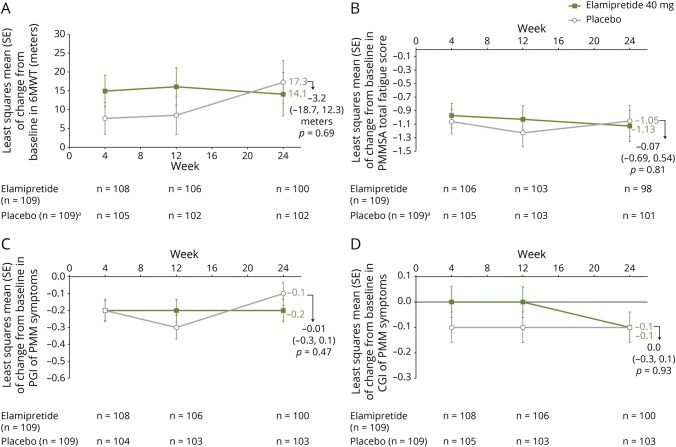
Figure 2: MMPOWER3 Change in Endpoints From Baseline to End of Treatment (Week 24)In 6-minute walk test (6MWT) (A), in Primary Mitochondrial Myopathy
Figure 2. From PMC10382259, CC BY (terms); resized.
✗ Negativehuman RCTJ Card Fail · 2020

Effects of Elamipretide on Left Ventricular Function in Patients With Heart Failure With Reduced Ejection Fraction: The PROGRESS-HF Phase 2 Trial.

n = 71 humansPhase 2 double-blind, placebo-controlled trial, placebo vs 4 mg vs 40 mg elamipretide daily28 days

PROGRESS-HF phase 2 RCT (71 patients with reduced-ejection-fraction heart failure): 4 weeks of elamipretide did not improve left ventricular volumes or ejection fraction versus placebo.

Key result4 mg vs placebo difference of means -0.3 (95% CI -4.6 to 4.0; P = 0.90); 40 mg vs placebo 2.3 (95% CI -1.9 to 6.5; P = 0.28)
Studied
Patients with heart failure with reduced ejection fraction (LVEF <= 40%), mean age 65
Compared with
Placebo
Main outcome
Change in left ventricular end-systolic volume (cardiac MRI)
Sample
71 patients randomized 1:1:1
Authors' conclusion
Elamipretide was well tolerated but did not improve LVESV at 4 weeks in patients with stable HFrEF compared with placebo.
Limitations
Only 4 weeks of treatment.
~ Mixedhuman RCTJ Cachexia Sarcopenia Muscle · 2020

A randomized crossover trial of elamipretide in adults with primary mitochondrial myopathy.

n = 30 humansRandomized, double-blind, placebo-controlled crossover trial (MMPOWER-2), 40 mg/day SC elamipretide4 weeks per period with 4-week washout

MMPOWER-2 crossover RCT (30 adults with mitochondrial myopathy): 6-minute walk improved by 19.8 m (not statistically significant) while patient-reported fatigue improved.

Key result6MWT 398.3 (+/-134.16) m vs 378.5 (+/-125.10) m, difference 19.8 m (95% CI -2.8, 42.5; P = 0.0833)
Studied
Adults with genetically confirmed primary mitochondrial myopathy
Compared with
Placebo
Main outcome
Distance walked on 6-minute walk test
Sample
30 participants in a crossover design
Authors' conclusion
A clinically meaningful 6MWT change did not reach statistical significance; patient-reported fatigue outcomes were suggestive of an effect and supported starting the phase 3 trial.
Limitations
Primary endpoint not significant; small trial; patient-reported outcomes are nominal.
~ Mixedhuman RCTGenet Med · 2021

A phase 2/3 randomized clinical trial followed by an open-label extension to evaluate the effectiveness of elamipretide in Barth syndrome, a genetic disorder of mitochondrial cardiolipin metabolism.

n = 12 humansRandomized double-blind placebo-controlled crossover trial followed by open-label extension (TAZPOWER)12 weeks per period with 4-week washout; open-label extension to 36 weeks

TAZPOWER in 12 Barth syndrome patients: the 12-week placebo-controlled crossover missed both primary endpoints, but the 36-week open-label extension showed improved 6-minute walk (+95.9 m) and symptoms.

Key resultNeither primary endpoint met in part 1; at 36 weeks in part 2, 6MWT improved +95.9 m (p = 0.024) and BTHS-SA -2.1 points (p = 0.031)
Studied
People with Barth syndrome
Compared with
Placebo (crossover) in part 1; baseline in the open-label extension
Main outcome
6-minute walk test and BTHS Symptom Assessment
Sample
12 subjects in part 1; 10 continued into the open-label extension, 8 reached 36 weeks
Authors' conclusion
Daily elamipretide led to improvement in BTHS symptoms in the open-label extension, although the randomized phase missed its primary endpoints.
Limitations
Very small sample; open-label extension has no placebo control.
✗ Negativehuman RCTOphthalmology · 2024

Elamipretide Topical Ophthalmic Solution for the Treatment of Subjects with Leber Hereditary Optic Neuropathy: A Randomized Trial.

n = 12 humansPhase II prospective randomized vehicle-controlled single-center trial of 1% topical elamipretide, with open-label extension52 weeks double-masked, plus open-label extension up to 108 weeks

Phase 2 RCT of elamipretide eye drops in 12 patients with Leber hereditary optic neuropathy: no significant improvement in visual acuity versus vehicle; some post hoc visual-field signals.

Key resultBCVA change in elamipretide eyes not significantly different from vehicle eyes at any time point; 6 of 12 subjects met criteria for clinically relevant benefit
Studied
Patients aged 18 to 50 with Leber hereditary optic neuropathy (m.11778G>A)
Compared with
Vehicle in fellow eye
Main outcome
Adverse events; change in best-corrected visual acuity
Sample
12 patients with LHON
Authors' conclusion
Elamipretide was generally well tolerated but did not meet its primary BCVA endpoint; post hoc visual-field findings were encouraging and need further exploration.
Limitations
Small single-center trial; visual-field finding was post hoc.
✓ Positivehuman RCTCirc Heart Fail · 2017

Novel Mitochondria-Targeting Peptide in Heart Failure Treatment: A Randomized, Placebo-Controlled Trial of Elamipretide.

Cohorts of 8, 8 and 8 on elamipretide plus 12 on placebo (36 in total)Double-blind, placebo-controlled, ascending-dose trial of a single 4-hour infusionSingle 4-hour infusion, assessed to 24 hours

Single-infusion dose-ranging RCT in 36 heart-failure patients: the highest dose briefly reduced left ventricular volumes versus placebo with no serious adverse events.

Key resultIn the highest dose cohort, left ventricular end-diastolic volume fell by 18 mL (P=0.009) and end-systolic volume by 14 mL (P=0.005) vs placebo at end infusion
Studied
Patients with heart failure with reduced ejection fraction (EF <= 35%)
Compared with
Placebo
Main outcome
Safety and echocardiographic left ventricular volumes
Authors' conclusion
A single infusion of elamipretide was safe and well tolerated, and high-dose elamipretide favorably changed left ventricular volumes; further study is needed for long-term safety and efficacy.
Limitations
Small cohorts, single infusion and 24-hour follow-up only.
✓ Positivehuman RCTCirc Cardiovasc Interv · 2017

Phase 2a Clinical Trial of Mitochondrial Protection (Elamipretide) During Stent Revascularization in Patients With Atherosclerotic Renal Artery Stenosis.

14 patients: elamipretide n=6, placebo n=8Phase 2a pilot randomized placebo-controlled trial, IV elamipretide 0.05 mg/kg per hour3 months

Pilot RCT in 14 patients undergoing renal artery stenting: elamipretide reduced post-procedure kidney hypoxia and was associated with improved renal blood flow and kidney function at 3 months.

Key resultFractional hypoxia at 24 hours rose +47% with placebo vs -6% with elamipretide; stenotic kidney RBF rose 202+/-29 to 262+/-115 mL/min (P=0.04) in the elamipretide group only
Studied
Patients with severe atherosclerotic renal artery stenosis undergoing renal angioplasty and stenting
Compared with
Placebo
Main outcome
Renal oxygenation, blood flow and function
Authors' conclusion
Adjunctive elamipretide was associated with attenuated postprocedural hypoxia, increased renal blood flow and improved kidney function in this pilot trial.
Limitations
Pilot trial with 6 vs 8 patients.
✓ Positivehuman trialGenet Med · 2024

Long-term efficacy and safety of elamipretide in patients with Barth syndrome: 168-week open-label extension results of TAZPOWER.

10 patients entered the open-label extension; 8 reached week 168168-week open-label extension of the TAZPOWER randomized trial, elamipretide 40 mg SC daily168 weeks

168-week open-label extension in 10 Barth syndrome patients: sustained improvements in walking distance, fatigue and some cardiac measures.

Key result6MWT improved at all time points, cumulative 96.1 m at week 168 (P = .003)
Studied
Individuals with Barth syndrome
Compared with
Baseline of the open-label extension (no control)
Main outcome
Safety and tolerability; change in 6MWT and BTHS-SA Total Fatigue
Authors' conclusion
Elamipretide was associated with sustained long-term tolerability and efficacy, with improvements in functional assessments and cardiac function in Barth syndrome.
Limitations
Open-label extension without control; very few patients.

Verdicts are judged on each paper's own main outcome; grades run from A (strong human evidence) to D (little or none). Details are read from the abstracts, and figures are reproduced only from openly licensed full texts. Not medical advice.