Peptide Price Finder

Home · Research · Inflammation & immune

Thymogen research

What published studies found for Thymogen: 11 papers, 9 in humans, with sample sizes and key results.

B
Some human evidence
Why: Several RCTs with conflicting results: a 202-patient Kaposi's sarcoma phase III and a prostate trial were negative, small gastritis and surgery trials positive.

Thymogen is the dipeptide L-Glu-L-Trp, also developed in the West as IM862 (oglufanide). Small Russian clinical studies report immune and clinical benefits, including two recent placebo-controlled gastritis analyses of an alpha-Glu-Trp product, but the most rigorous Western trials of the same dipeptide were negative: a 202-patient phase III trial in AIDS-related Kaposi's sarcoma and a 71-patient prostate cancer trial showed no benefit over placebo.

✓ 5 positive✗ 3 negative? 3 inconclusive

Western IM862 trials reported the dipeptide as well tolerated, with only mild transient symptoms; Russian thymogen studies report no complications but give little safety detail.

US compounding: Not compoundable. Not an FDA-approved drug and not nominated for FDA's 503A bulks list, so US pharmacies can't legally compound it. Status for every peptide.

Browse and filter these papersThymogen prices and vendors

Reported side effects

Human studies

✓ Positivehuman RCTArkh Patol · 2023

[Repair stimulator alpha-glutamyl-tryptophan in the complex therapy of chronic atrophic gastritis: results of histological examination].

n = 116 humansMulticenter double-blind randomized placebo-controlled study (histology analysis)

Multicenter double-blind placebo-controlled RCT biopsy analysis in 116 patients with H. pylori-associated chronic atrophic gastritis: alpha-glutamyl-tryptophan (same dipeptide as thymogen) increased gastric gland number 26.1% vs baseline (p=0.028) and vs placebo (p=0.026).

Key resultGlands per 1 mm2 rose 26.1% vs baseline (p=0.028) and differed from placebo (p=0.026)
Studied
Patients with Helicobacter pylori-associated chronic atrophic gastritis
Compared with
Placebo
Main outcome
Gastric gland density, parietal cells, intestinal metaplasia, CXCL-12 and CDX-2 expression
Sample
116 patients with biopsies analysed
Authors' conclusion
The authors found a significant positive effect on regenerative mechanisms and histology of the atrophic gastric mucosa versus baseline and placebo.
Limitations
Histology sub-analysis; drug is a marketed alpha-Glu-Trp product; duration and doses not given in abstract.
✓ Positivehuman RCTTer Arkh · 2023

[Endoscopic and morphometric analysis of the reduction of acute inflammatory process in the gastric mucosa after therapy with Regasthym Gastro].

n = 80 humansRetrospective analysis of a double-blind placebo-controlled study (gastroscopy + morphometry)

Double-blind placebo-controlled study (retrospective analysis) in 80 patients with H. pylori-associated chronic atrophic gastritis (43 alpha-Glu-Trp product vs 37 placebo): less mucosal edema (p=0.008) and lower overall endoscopic inflammation score (p=0.006).

Key resultDecrease in edema (p=0.008) and total acute-inflammation signs (p=0.006); fewer negative-dynamics outcomes (p=0.038)
Studied
Patients with H. pylori-associated chronic atrophic gastritis in exacerbation
Compared with
Placebo
Main outcome
Endoscopic inflammation score and inflammatory cells per mm2 of mucosa
Sample
80 patients (43 drug, 37 placebo)
Authors' conclusion
The authors conclude the drug significantly reduces inflammation on gastroscopy and morphometry and recommend adding it to complex therapy of chronic gastritis.
Limitations
Retrospective analysis of a trial; marketed alpha-Glu-Trp product (Regasthym Gastro); added to other therapy.
✗ Negativehuman RCTJ Clin Oncol · 2005

Angiogenesis inhibitor IM862 is ineffective against AIDS-Kaposi's sarcoma in a phase III trial, but demonstrates sustained, potent effect of highly active antiretroviral therapy: from the AIDS Malignancy Consortium and IM862 Study Team.

202 HIV-positive patients enrolled: 104 on IM862, 98 on placeboRandomized, double-blinded, placebo-controlled phase III trial of IM862 (dipeptide L-Glu-L-Trp), 5 mg intranasally every other day24 weeks

Phase III placebo-controlled trial of intranasal IM862 (L-Glu-L-Trp) in 202 people with AIDS-related Kaposi's sarcoma: response rate 23% vs 21% on placebo, and time to progression was shorter with IM862 (16 vs 35 weeks).

Key resultResponse rate 23% with IM862 vs 21% with placebo (P = .46); median time to progression 16 vs 35 weeks (P = .012)
Studied
HIV-positive patients with AIDS-related Kaposi's sarcoma
Compared with
Placebo
Main outcome
Tumor response rate
Authors' conclusion
IM862 was not superior to placebo and may accelerate time to progression. Antiretroviral therapy alone gave substantial sustained responses and may have confounded earlier estimates.
Limitations
Antiretroviral use differed between arms (88% vs 96%); IM862 is the thymogen-related dipeptide, not thymogen itself.
✗ Negativehuman RCTProstate · 2007

Employing the treatment-free interval of intermittent androgen ablation to screen candidate prostate cancer therapies.

71 evaluable patients (34 IM862, 37 placebo)Double-blind randomized placebo-controlled trial during intermittent androgen ablation6 months or until progression

Double-blind phase II trial in 71 men with recurrent prostate cancer: IM862 did not delay PSA progression vs placebo (41% vs 49% progressed at 6 months, p=0.39); well tolerated.

Key resultAt 6 months disease progressed in 14 (41%) of 34 on IM862 vs 18 (49%) of 37 on placebo (P = 0.39)
Studied
Men with prostate cancer and rising PSA after prostatectomy and/or radiation
Compared with
Placebo
Main outcome
Time to PSA progression
Authors' conclusion
IM862 was well tolerated but failed to show superiority over placebo in prolonging time to PSA progression; the design was an efficient platform for drug screening.
Limitations
Small trial.
✓ Positivehuman RCTAdv Gerontol · 2011

[Application thymogen for preoperative preparation of elderly patients with tumor processes in abdominal cavity].

HumansDouble-blind, randomized, placebo-controlled study of Thymogen 100 mg intranasally once daily7 days before surgery

Russian double-blind, placebo-controlled study in elderly patients before abdominal tumor surgery: 7 days of intranasal thymogen restored cellular immune measures and reduced postoperative complications; patient numbers not stated in abstract.

Studied
Elderly patients undergoing surgery for solid tumors in the abdominal cavity and retroperitoneal space
Compared with
Isotonic sodium chloride placebo
Main outcome
Cellular immunity parameters, postoperative complications, postoperative period
Authors' conclusion
Preoperative Thymogen helped restore cellular immunity parameters and significantly decreased postoperative complications and shortened the postoperative period.
Limitations
Abstract gives no sample size or numerical results.
? Inconclusivehuman RCTJ Clin Oncol · 2000

Results of a randomized study of IM862 nasal solution in the treatment of AIDS-related Kaposi's sarcoma.

44 patients randomized to two schedules (18 five-days-on/off, 26 every-other-day)Randomized comparison of two IM862 5 mg intranasal dosing schedulesRepeated cycles until progression or toxicity

Randomized comparison of two IM862 dosing schedules (no placebo) in 44 people with AIDS-related Kaposi's sarcoma: 36% had major responses, but most were also on new HIV therapy, which the later phase III trial showed could explain responses.

Key resultMajor responses in 36% (five complete and 11 partial remissions)
Studied
Patients with AIDS-related Kaposi's sarcoma (median age 38 years)
Compared with
Two dosing schedules (no placebo)
Main outcome
Tumor response
Authors' conclusion
Intranasal IM862 was well tolerated and had antitumor activity in AIDS-KS; a randomized double-blinded study was in progress.
Limitations
No placebo arm; most patients on concurrent protease inhibitors.
? Inconclusivehuman trialВестник Авиценны · 2008Russian-language

Эффективность тимогена и кларитина в комплексном лечении больных крапивницей

n = 79 humansUncontrolled treatment series (no control group described in abstract)

Russian-language study of 79 patients with urticaria given thymogen plus the antihistamine Claritin: remission over 6 months in 25% and over 3 months in 43%, with improved immune indices; no control group described, so thymogen's own effect cannot be separated.

Key resultRemission over 6 months in 25% of patients and over 3 months in 43%
Studied
Patients with urticaria and reduced T-suppressor/T-helper levels and raised IgE
Main outcome
Remission duration and immune indices
Sample
79 patients with urticaria
Authors' conclusion
The authors report that the thymogen and Claritin regimen produced long remissions and improved immune indices.
Limitations
No control group; combined with an antihistamine, so the effect of thymogen cannot be isolated.
? Inconclusivehuman trialProbl Tuberk · 1994

[Changes of immune and non-specific reactivity in patients with chronic suppurative obstructive bronchitis in comprehensive treatment with thymogen].

n = 33 humansThymogen added to multimodality treatment

Controlled study of 33 patients with chronic suppurative bronchitis: adding thymogen to treatment normalized several T-cell and non-specific immune measures, with authors reporting higher clinical efficacy.

Studied
Patients with chronic pyoobstructive bronchitis with immunological disorders
Main outcome
T-cell immunity and nonspecific responsiveness parameters
Sample
33 patients
Authors' conclusion
Thymogen in multimodality treatment contributed to normalization of T-cell immunity and nonspecific responsiveness, with higher clinical efficacy.
Limitations
Abstract describes no control group.
✗ Negativehuman trialBr J Cancer · 2004

Phase II trial of the antiangiogenic agent IM862 in metastatic renal cell carcinoma.

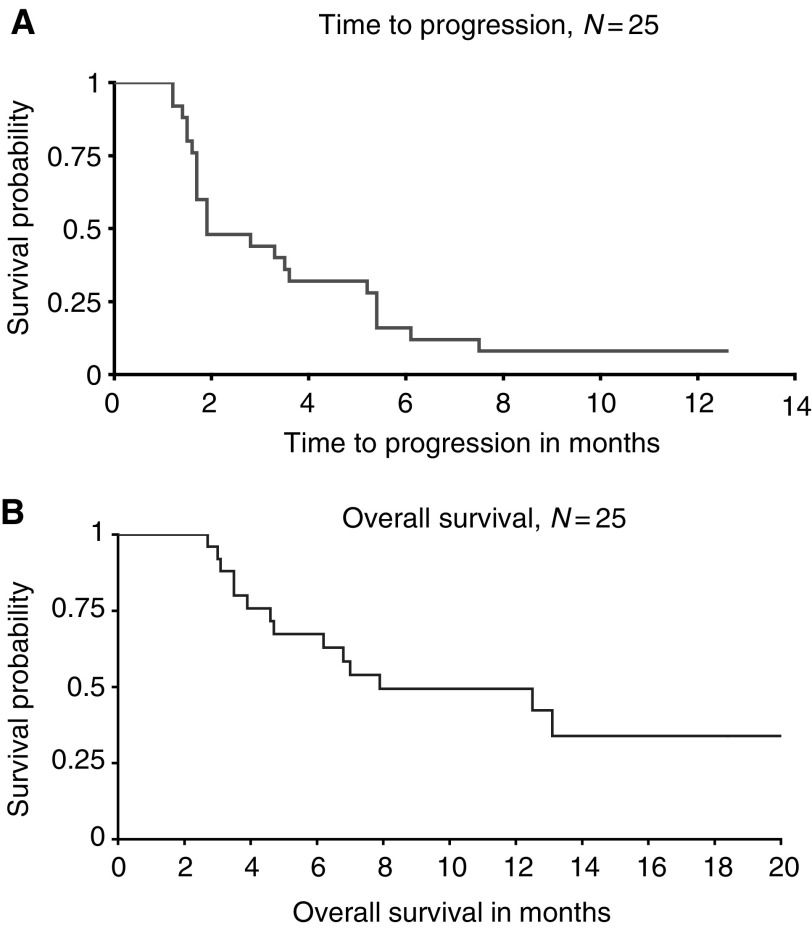
n = 25 humansProspective phase II trial, IM862 20 mg intranasally three times daily8-week cycles

Phase II single-arm trial in 25 patients with metastatic kidney cancer: IM862 produced no objective responses (8 stable, 17 progressed), with no significant toxicity.

Key result8 patients had stable disease and 17 progressed; median survival 7.9 months; median time to progression 1.9 months
Studied
Patients with metastatic renal cell carcinoma
Main outcome
Objective response
Sample
25 patients accrued
Authors' conclusion
IM862 had no toxicity but no significant objective responses in metastatic RCC and should not be further evaluated as a single agent at these doses. The fall in VEGF warrants further investigation.
Limitations
Single-arm phase II; no comparator.
Figure 1: Kaplan–Meier estimates of (A) time to progression and (B) overall survival for all enrolled patients (n=25).
Figure 1. From PMC2409952, CC BY (terms); resized.

Animal & lab studies

✓ PositiveanimalBiogerontology · 2000

Immunomodulatory synthetic dipeptide L-Glu-L-Trp slows down aging and inhibits spontaneous carcinogenesis in rats.

76 female rats: 32 controls, 44 dipeptide-treatedRandomized, saline-controlled; L-Glu-L-Trp 5 micrograms/rat s.c. 5 times per week12 months of treatment, followed to natural death

In 76 female rats injected for 12 months, L-Glu-L-Trp did not change mean lifespan but extended survival of the longest-lived 10% and reduced total and malignant tumor incidence.

Key resultLife span of longest-lived 10% was 1048 days vs 949 in controls (P < 0.001); total tumor incidence 1.5 times lower (P < 0.01)
Studied
Five-month-old outbred female rats
Compared with
Saline
Main outcome
Life span, aging rate, spontaneous tumor incidence
Authors' conclusion
L-Glu-L-Trp delayed the aging rate and decreased spontaneous tumor incidence in rats. Mean life span did not differ between groups.
Limitations
Rat study; mean life span was similar in both groups.
✓ PositiveanimalInt J Cancer · 2003

Natural killer cell cytolytic activity is necessary for in vivo antitumor activity of the dipeptide L-glutamyl-L-tryptophan.

AnimalsIn vivo mouse tumor studies in NK-deficient, perforin, IFN-gamma and IL-12 knockout mice

L-Glu-L-Trp inhibited tumor growth in mice without direct toxicity to tumor cells; the effect required natural killer cell activity.

Studied
Mice (including gene-knockout strains) with tumors, and human tumor cell lines
Main outcome
Antitumor activity of L-glu-L-trp
Authors' conclusion
L-glu-L-trp antitumor activity in mice depends on cytolytic NK or NKT cell activity and perforin; it is independent of IFN-gamma and partly dependent on IL-12.
Limitations
Mouse study.

Verdicts are judged on each paper's own main outcome; grades run from A (strong human evidence) to D (little or none). Details are read from the abstracts, and figures are reproduced only from openly licensed full texts. Not medical advice.