Peptide Price Finder

Home · Research · Inflammation & immune

LL-37 research

What published studies found for LL-37: 8 papers, 3 in humans, with sample sizes and key results, plus 5 registered clinical trials.

B
Some human evidence
Why: Three small topical RCTs in leg and foot ulcers conflict: early and diabetic-foot trials looked positive, but the largest (148 patients) found no healing benefit.

LL-37 is the human cathelicidin antimicrobial peptide; most literature is lab and animal work on its antimicrobial and immune roles. A few small human trials of topical LL-37 for chronic leg and foot ulcers exist: an early trial and a diabetic-foot trial looked positive, but the largest (148-patient phase IIb) trial found no overall healing benefit over placebo.

✓ 1 positive✗ 3 negative~ 2 mixed? 2 inconclusive

Topical LL-37 on leg ulcers was well tolerated in trials of up to 148 patients; there are no human safety data for injected LL-37 outside a melanoma trial.

US compounding: Under review, not compoundable yet. Removed from Category 2 in April 2026; FDA plans to put it to its compounding advisory committee before the end of February 2027. Until FDA adds it to the 503A bulks list, US pharmacies can't compound it from bulk. Status for every peptide.

Browse and filter these papersLL-37 prices and vendors

Reported side effects

Registered clinical trials

5 trials of LL-37 on ClinicalTrials.gov: 0 active, 4 completed, 1 with posted results. Registered trials include ones that haven't published yet.

TrialStatusPhasePeopleSponsor
Intratumoral Injections of LL37 for MelanomaNCT02225366 · started 2015-07-08 · results postedCompletedPhase 1, Phase 24M.D. Anderson Cancer Center
Salivary TAS, TOS, LL-37 and Dental Status in Passive Smoking ChildrenNCT04292548 · started 2016-11-16Completed–180Merve Erkmen Almaz
Effects of Smoking and Vitamin D3 on the Levels of Human Cathelicidin Peptide LL-37NCT03923218 · started 2011-12Completed–60Gazi University
Peri-implant Vitamin D and Cathelicidin (LL-37) LevelsNCT06867250 · started 2021-04-01Completed–33Altinbas University
Efficacy of LL-37 Cream on Bacteria Colonization, Inflammation Response and Healing Rate of Diabetic Foot UlcersNCT04098562 · started 2019-10Unknown statusPhase 240Fakultas Kedokteran Universitas Indonesia

All 5 LL-37 trials, with countries and recruiting status

Human studies

✗ Negativehuman RCTWound Repair Regen · 2021

Evaluation of LL-37 in healing of hard-to-heal venous leg ulcers: A multicentric prospective randomized placebo-controlled clinical trial.

n = 148 humansPhase IIb double-blind, randomized, placebo-controlled multicentre trial (HEAL LL-37) of topical LL-37 (0.5 or 1.6 mg/mL) plus compression

Phase IIb trial in 148 patients with hard-to-heal venous leg ulcers: topical LL-37 plus compression did not improve healing vs placebo overall; a post hoc subgroup with large wounds did better. Well tolerated.

Key resultNo significant improvement in healing with LL-37 vs placebo in the full population; a post hoc analysis showed significant improvement in several healing parameters in patients with wounds of at least 10 cm2.
Studied
Patients with hard-to-heal venous leg ulcers (mean age 67.6 years, median ulcer duration 20.3 months)
Compared with
Placebo
Main outcome
Ulcer healing
Sample
148 patients in three arms
Authors' conclusion
The trial did not detect significant healing differences overall; a subgroup with large ulcers suggested possible benefit and warrants a further adequately powered study. LL-37 was well tolerated.
Limitations
Primary result negative; subgroup finding was post hoc.
~ Mixedhuman RCTWound Repair Regen · 2014

Treatment with LL-37 is safe and effective in enhancing healing of hard-to-heal venous leg ulcers: a randomized, placebo-controlled clinical trial.

n = 34 humansFirst-in-man randomized, double-blind, placebo-controlled dose-response trial after an open-label placebo run-in3-week run-in, 4-week treatment, 4-week follow-up

First-in-human trial in 34 venous leg ulcer patients: the two lower LL-37 doses healed faster than placebo (significant for the lowest dose), but the highest dose showed no difference; no safety concerns.

Key resultHealing rate constants for 0.5 and 1.6 mg/mL LL-37 were about six- and threefold higher than placebo (p = 0.003 and p = 0.088); mean ulcer area fell 68% (0.5 mg/mL) and 50% (1.6 mg/mL).
Studied
Patients with hard-to-heal venous leg ulcers
Compared with
Placebo
Main outcome
Safety and healing rate
Sample
34 participants with venous leg ulcers
Authors' conclusion
Topical LL-37 was safe and well tolerated, with a marked effect on healing predictors at the two lower doses, warranting further investigation. No difference from placebo at 3.2 mg/mL.
Limitations
Small first-in-man trial; the 1.6 mg/mL rate difference was not significant (p = 0.088).
~ Mixedhuman RCTArch Dermatol Res · 2023

Efficacy of LL-37 cream in enhancing healing of diabetic foot ulcer: a randomized double-blind controlled trial.

HumansRandomized, double-blind, placebo-controlled trial of LL-37 cream4 weeks (twice weekly application)

Double-blind trial in mildly infected diabetic foot ulcers: LL-37 cream improved granulation (healing) index vs placebo at days 7-28 but did not reduce inflammatory cytokines or bacterial colonization.

Key resultGranulation index increased more with LL-37 on days 7, 14, 21 and 28 (p = 0.031, 0.009, 0.006 and 0.037).
Studied
Patients with diabetic foot ulcer with mild infection (Jakarta)
Compared with
Placebo cream
Main outcome
Wound healing (granulation index), IL-1α, TNF-α, aerobic bacterial colonization
Authors' conclusion
LL-37 cream enhanced the healing rate of diabetic foot ulcers with mild infection but did not reduce IL-1α, TNF-α or aerobic bacterial colonization.
Limitations
Sample size not given in the abstract; cytokine and bacterial differences were not significant.
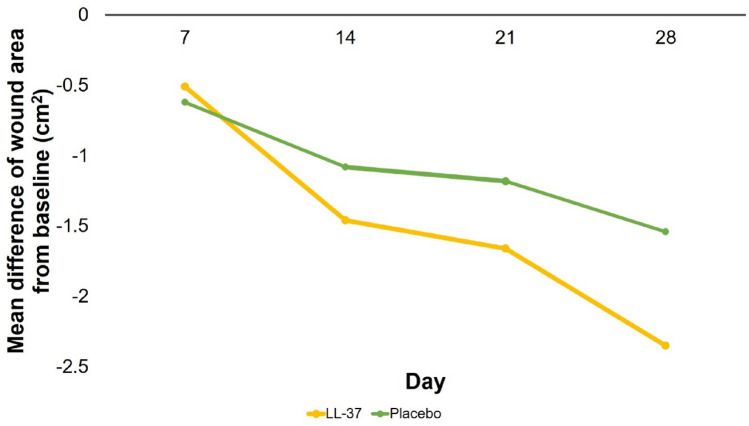
Fig. 2: Mean difference of wound area from baseline using ImageJ
Fig. 2. From PMC10514151, CC BY (terms); resized.

Reviews

? InconclusivereviewFront Immunol · 2013

The Human Cathelicidin Antimicrobial Peptide LL-37 as a Potential Treatment for Polymicrobial Infected Wounds.

No new dataNarrative review

A 2013 review argues LL-37 has anti-biofilm, antibacterial and wound-healing properties that may suit topical treatment of polymicrobial infected wounds, but presents it as a potential, not proven, therapy.

Studied
Infected diabetic and other chronic wounds (reviewed literature)
Main outcome
Mechanisms and therapeutic potential of LL-37 in wounds
Authors' conclusion
LL-37 or its derivatives could be a platform for new strategies against biofilm-mediated wound infections.
Limitations
Review with no new data; both deficient and excessive LL-37 levels are discussed as harmful.
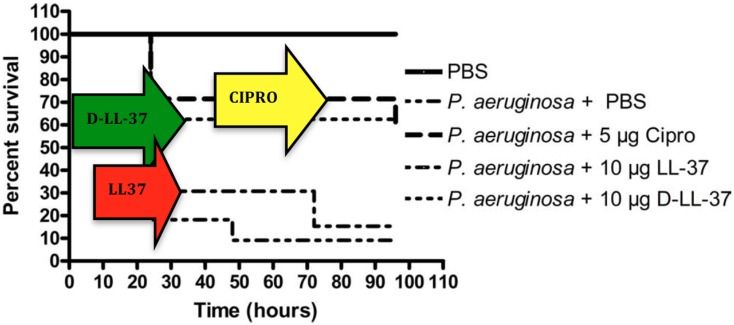
Figure 6: Treatment of P. aeruginosa-infected G. mellonella. d-LL-37 significantly prolonged the survival of G. mellonella infected with 1 × 10³ CFU P
Figure 6. From PMC3699762, CC BY (terms); resized.
? InconclusivereviewWorld J Microbiol Biotechnol · 2023

Antibiofilm properties of cathelicidin LL-37: an in-depth review.

No new dataNarrative review of antibiofilm effects of LL-37

A 2023 review finds LL-37 prevents biofilm formation by many bacterial species in laboratory studies, but notes many open questions about in vivo efficacy and safety.

Studied
Biofilm-forming bacteria in laboratory studies (reviewed literature)
Main outcome
Antibiofilm mechanisms
Authors' conclusion
LL-37 may open opportunities to prevent and treat biofilm-mediated infections, but efficacy and safety in vivo remain to be answered.
Limitations
Review with no new data; mostly in vitro evidence.

Human studies

✗ Negativecase reportJ Cutan Pathol · 2018

Dermatologic toxicity from novel therapy using antimicrobial peptide LL-37 in melanoma: A detailed examination of the clinicopathologic features.

Single case reportCase report8 weekly injections; lesions resolved within 2 months of stopping

A melanoma patient in a phase 1 trial of LL-37 injected into tumors developed multiple wart-like and keratoacanthoma-like skin lesions about 45 days in; they resolved within 2 months of stopping.

Studied
63-year-old woman with stage IIIC melanoma receiving intra-tumoral LL-37 injections
Main outcome
Dermatologic toxicity
Authors' conclusion
LL-37 injections were followed by verrucous, keratoacanthoma-like skin lesions that resolved after stopping therapy; the authors highlight adverse dermatological effects of LL-37 therapy.
Limitations
Single case.

Animal & lab studies

✓ PositiveanimalMil Med Res · 2020

Chitosan hydrogel encapsulated with LL-37 peptide promotes deep tissue injury healing in a mouse model.

Mouse groups of n = 6In vitro tests and randomized mouse study of LL-37 in chitosan hydrogel21 days

In a mouse pressure-ulcer model, LL-37 in a chitosan hydrogel shrank wounds faster and increased new blood vessel formation compared with controls.

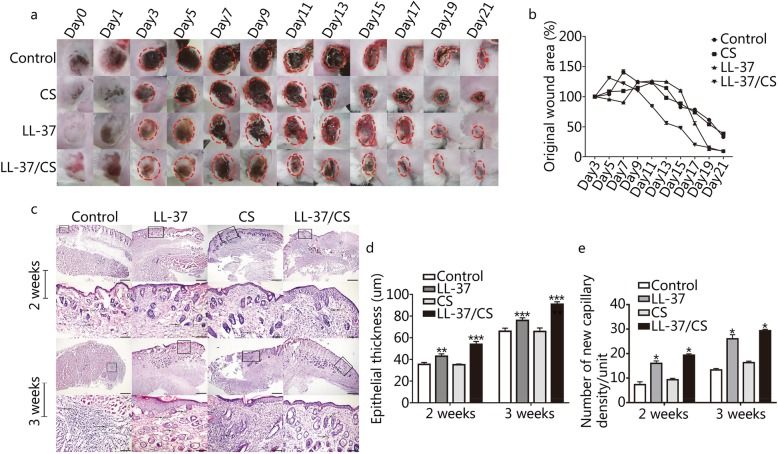
Key resultUlcer area was significantly lower with LL-37/CS hydrogel than all other groups on days 11, 13 and 15 (84.24% ± 0.25%, 56.22% ± 3.91%, 48.12% ± 0.28%).
Studied
Cultured fibroblasts and macrophages, plus male C57BL/6 mice with magnet-induced pressure ulcers
Compared with
Naked LL-37, hydrogel alone, no intervention
Main outcome
Pressure ulcer area, histology, angiogenesis markers
Authors' conclusion
Chitosan hydrogel encapsulating LL-37 is biocompatible and could promote healing of pressure ulcers, in mice.
Limitations
Mouse model; the unit for the reported percentages is not defined in the abstract.
Fig. 3: LL-37/CS accelerates wound healing. a. Representative images of wounds of four tested groups, ruler units in mm. b. The results are expresse
Fig. 3. From PMC7175584, CC BY (terms); resized.
✗ Negativein vitroCancers (Basel) · 2023

LL-37 Might Promote Local Invasion of Melanoma by Activating Melanoma Cells and Tumor-Associated Macrophages.

Humans and animalsImmunohistochemistry plus in vivo and in vitro experiments

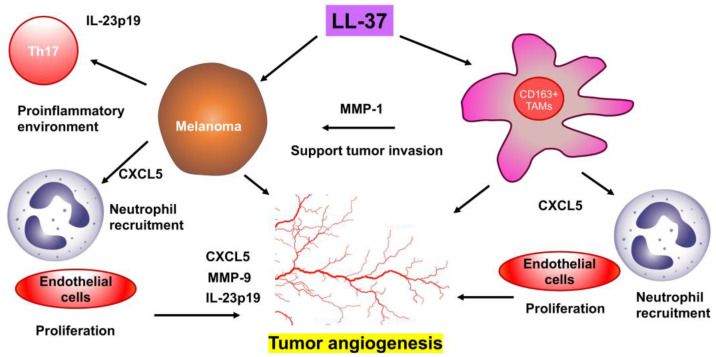
LL-37 levels in human melanoma rose with tumor stage, and LL-37 stimulated melanoma cells and macrophages to make pro-invasion, pro-angiogenic factors in cell and mouse experiments, a possible safety concern.

Studied
Melanoma tissue from patients (immunohistochemistry), B16F10 mouse melanoma, A375 human melanoma cells and M2 macrophages
Main outcome
LL-37 expression vs T stage; pro-angiogenic and invasion factor expression
Authors' conclusion
LL-37 expression correlated positively with melanoma T stage and stimulated tumor cells and macrophages to induce pro-angiogenic factors, suggesting LL-37 might promote melanoma invasion. A safety signal for LL-37, not a treatment study.
Limitations
Mostly preclinical; correlation in tissue.
Figure 6: Summary of the present study.
Figure 6. From PMC10046113, CC BY (terms); resized.

Verdicts are judged on each paper's own main outcome; grades run from A (strong human evidence) to D (little or none). Details are read from the abstracts, and figures are reproduced only from openly licensed full texts. Not medical advice.