Peptide Price Finder

Home · Research · Healing & recovery

Teriparatide research

What published studies found for Teriparatide: 8 papers, 7 in humans, with sample sizes and key results, plus 152 registered clinical trials.

A
Strong human evidence
Why: Approved osteoporosis drug: large RCTs (1,637 and 1,360 women) and meta-analyses of dozens of RCTs consistently show fewer vertebral fractures.

Teriparatide (PTH 1-34) is an approved osteoporosis drug backed by large human randomized trials and multiple meta-analyses showing it reduces vertebral fractures and raises bone density, including head-to-head superiority over risedronate in severe osteoporosis. The rat osteosarcoma signal has not been borne out in large human registry studies, though more people stop treatment because of side effects than on placebo.

✓ 7 positive✗ 1 negative

Approved prescription drug; rat studies showed bone cancer at high lifetime doses, but large human registry studies have not found an increased osteosarcoma rate.

US compounding: FDA-approved drug. FDA-approved (Forteo and others) for osteoporosis. Status for every peptide.

Browse and filter these papersTeriparatide prices and vendors

Reported side effects

Registered clinical trials

152 trials of Teriparatide on ClinicalTrials.gov: 15 active, 106 completed, 56 with posted results. Registered trials include ones that haven't published yet.

TrialStatusPhasePeopleSponsor
Study of the Key Techniques of Prevention and Treatment of Osteoporotic RefractureNCT05866029 · started 2023-05-26Recruiting–2,478Peking Union Medical College Hospital
To Evaluate the Efficacy and Safety of Abaloparatide Injection (QLG2128) in the Treatment of Postmenopausal Women With Osteoporosis and at High Risk of FractureNCT06898060 · started 2025-06Not yet recruitingPhase 3282Qilu Pharmaceutical Co., Ltd.
Preoperative Teriparatide Use on Insertional Torque of Pedicle Screws for Lumbar Fusion SurgeryNCT03770338 · started 2019-03-01Active, not recruiting–192The University of Hong Kong
Fracture Recovery for Returning to Duty (Teriparatide STRONG)NCT04589819 · started 2022-12-08Enrolling by invitationPhase 4183University of South Carolina
Sequential Therapies After Osteoanabolic TreatmentNCT06164795 · started 2023-11-25Recruiting–150424 General Military Hospital
Effects of Teriparatide (PTH) on Bone in Men and Women With OsteoporosisNCT01155232 · started 2004-11Active, not recruiting–100University Health Network, Toronto
Comparation of Treatment Strategies for OVF: Teriparatide Injection and PVPNCT03692143 · started 2017-01-01Active, not recruiting–90Nanfang Hospital, Southern Medical University
Novel Precision Medicine Approach to Treatment of Osteoporosis Based on Bone TurnoverNCT05151484 · started 2022-03-21Active, not recruitingPhase 460Madhumathi Rao
Teriparatide (PTH) and Bone Strength in Postmenopausal WomenNCT01155245 · started 2008-06Active, not recruiting–60University Health Network, Toronto
PROactive HEALing in High-Risk Pelvic and Non-hip Lower Extremity Fragility Fractures (PRO HEAL Pilot)NCT06303284 · started 2027-03-15Not yet recruitingPhase 1, Phase 254University of Calgary
Combined Anabolic TherapyNCT06558188 · started 2025-02-03RecruitingPhase 450Massachusetts General Hospital
Treatment of Adynamic Bone Disorder With Parathyroid Hormone in Chronic Kidney DiseaseNCT04522622 · started 2021-12-15RecruitingPhase 448Ditte Hansen

All 152 Teriparatide trials, with countries and recruiting status

Meta-analyses & systematic reviews

✓ Positivemeta-analysisArch Osteoporos · 2024

Efficacy and safety of teriparatide vs. bisphosphonates and denosumab vs. bisphosphonates in osteoporosis not previously treated with bisphosphonates: a systematic review and meta-analysis of randomized controlled trials.

n = 6,680 humansSystematic review and meta-analysis of head-to-head RCTsTreatment cycles of over 12 months

Meta-analysis of 23 head-to-head RCTs (6,680 patients): teriparatide lowered fracture risk vs bisphosphonates (RR 0.61) and raised spine and hip bone density, with no overall increase in adverse events.

Key resultTeriparatide reduced fracture risk vs bisphosphonates (RR = 0.61, 95% CI 0.51-0.74, P < 0.001); denosumab showed no fracture benefit (RR 0.99, 95% CI 0.62-1.57, P = 0.96)
Studied
Patients with osteoporosis not previously treated with bisphosphonates
Compared with
Bisphosphonates
Main outcome
Fracture risk, bone mineral density, adverse events
Sample
6680 patients across 23 randomized trials
Authors' conclusion
Teriparatide was superior to bisphosphonates in decreasing fracture risk, and teriparatide and denosumab both increased BMD more than bisphosphonates without more adverse events.
Limitations
Clinical heterogeneity between trials, handled with fixed- and random-effect models.
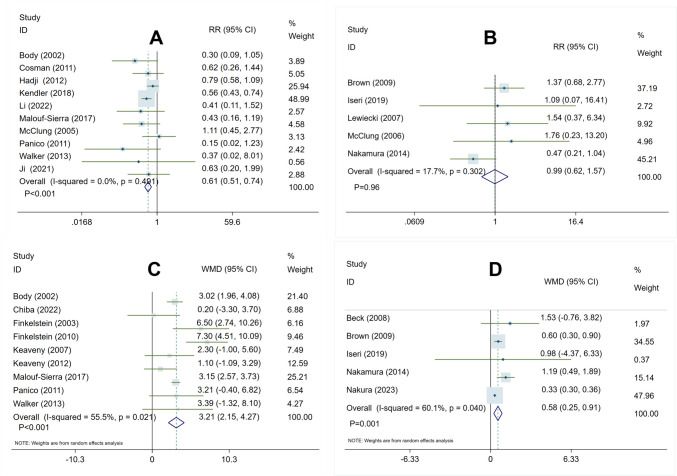
Fig. 3: Forest plot of meta-analysis result in risk of fractures and percent changes at femoral neck BMD. A Teriparatide vs. bisphosphonates in risk
Fig. 3. From PMC11420281, CC BY (terms); resized.
✓ Positivemeta-analysisAltern Ther Health Med · 2024

The Fracture Incidence and Safety of Teriparatide and Bisphosphonate in Postmenopausal Women With Osteoporosis: A Meta-Analysis.

n = 3,376 humansMeta-analysis of randomized controlled trials

Meta-analysis of RCTs vs bisphosphonates in postmenopausal women: fewer new and clinical vertebral fractures with teriparatide; adverse events similar overall but dizziness was more frequent with teriparatide.

Key resultClinical vertebral fracture OR=1.97 (95% CI=1.43-2.73, P < .0001) and new vertebral fractures OR=2.44 (95% CI=1.70-3.50, P < .00001), both reduced more with teriparatide
Studied
Postmenopausal women with osteoporosis
Compared with
Bisphosphonates
Main outcome
Fracture incidence and adverse effects
Sample
3376 participants in 5 RCTs
Authors' conclusion
Clinical and new vertebral fractures decreased more with teriparatide than bisphosphonate, but teriparatide had a higher rate of dizziness and of discontinuation due to adverse events.
Limitations
Only 5 RCTs included.
✓ Positivesystematic reviewAnn Intern Med · 2023

Effectiveness and Safety of Treatments to Prevent Fractures in People With Low Bone Mass or Primary Osteoporosis: A Living Systematic Review and Network Meta-analysis for the American College of Physicians.

34 RCTs (100 publications) and 36 observational studiesLiving systematic review and network meta-analysis for the American College of Physicians

Living network meta-analysis for the American College of Physicians (34 RCTs): teriparatide reduced clinical and radiographic vertebral fractures in postmenopausal women but increased withdrawals due to adverse events (moderate-to-high certainty).

Studied
Adults with low bone mass or primary osteoporosis
Main outcome
Fracture prevention and harms
Authors' conclusion
Bisphosphonates, denosumab, abaloparatide, teriparatide and romosozumab followed by alendronate reduce clinical fractures in postmenopausal women with osteoporosis; abaloparatide and teriparatide increased withdrawals due to adverse events.
Limitations
Few studies in low bone mass, males, Black-identifying persons, sequential therapy or treatment beyond 3 years.
✓ Positivesystematic reviewOsteoporos Int · 2025

PTH1 receptor agonists for fracture risk: a systematic review and network meta-analysis.

17 studies (11 RCTs, 6 real-world evidence studies)Systematic review with pairwise meta-analysis and Bayesian network meta-analysis

Network meta-analysis of 11 RCTs and 6 real-world studies: teriparatide and abaloparatide both reduced vertebral and non-vertebral fractures vs placebo, with abaloparatide slightly better for non-vertebral and hip fractures; no increased cardiovascular risk.

Key resultAbaloparatide vs teriparatide: non-vertebral fractures OR 0.87 (95% CI 0.80-0.95), hip fractures OR 0.81 (95% CI 0.71-0.93)
Studied
Patients with osteoporosis in trials and real-world studies of PTH1 receptor agonists
Compared with
Abaloparatide, placebo and other osteoporosis treatments
Main outcome
Vertebral, non-vertebral, hip and all fractures; safety
Authors' conclusion
PTH1 receptor agonists effectively reduce fracture risk, with abaloparatide offering enhanced benefit over teriparatide for non-vertebral and hip fractures; both have acceptable safety.
Limitations
Mixes RCT and real-world data; the comparison of interest is teriparatide vs abaloparatide.

Human studies

✓ Positivehuman RCTN Engl J Med · 2001

Effect of parathyroid hormone (1-34) on fractures and bone mineral density in postmenopausal women with osteoporosis.

n = 1,637 humansRandomized trial of PTH (1-34) 20 or 40 microg daily subcutaneouslyMedian 21 months of observation

Pivotal trial in 1,637 postmenopausal women with prior vertebral fractures: daily PTH(1-34) reduced vertebral and non-vertebral fractures and raised spine bone density by 9-13 points vs placebo; side effects were minor (occasional nausea, headache).

Key resultNew vertebral fractures in 14 percent with placebo vs 5 percent (20 microg) and 4 percent (40 microg); relative risks 0.35 and 0.31
Studied
Postmenopausal women with prior vertebral fractures
Compared with
Placebo
Main outcome
New vertebral fractures and bone mineral density
Sample
1637 postmenopausal women
Authors' conclusion
PTH (1-34) decreased vertebral and nonvertebral fracture risk, increased bone density and was well tolerated; the 40-microg dose had similar fracture effects but more side effects.
Limitations
Abstract does not state blinding details.
✓ Positivehuman RCTLancet · 2018

Effects of teriparatide and risedronate on new fractures in post-menopausal women with severe osteoporosis (VERO): a multicentre, double-blind, double-dummy, randomised controlled trial.

680 patients in each groupMulticentre, double-blind, double-dummy randomised controlled trial (VERO)24 months

VERO trial in 1,360 women with severe osteoporosis: new vertebral fractures at 24 months were 5.4% with teriparatide vs 12.0% with risedronate (RR 0.44); non-vertebral fractures did not differ significantly.

Key resultNew vertebral fractures in 28 (5·4%) of 680 with teriparatide vs 64 (12·0%) of 680 with risedronate (risk ratio 0·44, 95% CI 0·29-0·68; p<0·0001)
Studied
Post-menopausal women with severe osteoporosis (at least two moderate or one severe vertebral fracture)
Compared with
Risedronate 35 mg weekly
Main outcome
New radiographic vertebral fractures
Authors' conclusion
In post-menopausal women with severe osteoporosis, new vertebral and clinical fractures were significantly lower with teriparatide than risedronate.
Limitations
Non-vertebral fragility fracture difference was not significant (p=0·10); industry-funded.
✓ Positivehuman observationalBone · 2022

Assessing the incidence of osteosarcoma among teriparatide-treated patients using linkage of commercial pharmacy and state cancer registry data, contributing to the removal of boxed warning and other labeling changes.

18 osteosarcoma cases across four cohortsObservational cohort study linking pharmacy dispensing data to state cancer registries10-year period

Ten-year US pharmacy/cancer-registry linkage study: osteosarcoma incidence in teriparatide users was within the expected background range (estimates imprecise), supporting removal of the boxed warning.

Key resultIncidence rate ratio 1.0 (95% CI: 0.2, 4.5) vs osteoporosis and 1.3 (95% CI: 0.2, 5.1) vs general population using the coverage fraction
Studied
Adults dispensed teriparatide, matched to unexposed osteoporosis patients and general population patients
Compared with
Unexposed osteoporosis and general population cohorts
Main outcome
Osteosarcoma incidence
Authors' conclusion
Estimates were imprecise because of few cases, but osteosarcoma incidence in each cohort was within the expected background range; the evidence supported removal of the boxed warning.
Limitations
Very few cases; incomplete registry coverage; imprecise estimates.
✗ Negativecase reportOsteoporos Int · 2022

Teriparatide-associated calciphylaxis: a case series.

n = 12 humansCase series from literature and FDA adverse event reports through March 31, 2021

FDA and literature review found 12 cases of calciphylaxis after starting teriparatide (median age 81), one fatal; all patients had multiple other risk factors.

Key resultMedian time to onset 3.5 (range 1-20) months; three hospitalized, one death
Studied
Patients with calciphylaxis after teriparatide exposure of < 2 years (median age 81)
Main outcome
Calciphylaxis cases
Sample
12 cases of teriparatide-associated calciphylaxis
Authors' conclusion
Teriparatide exposure together with underlying risk factors may have triggered new-onset calciphylaxis; expedited diagnosis is important.
Limitations
Spontaneous reports without a control group; all cases had multiple risk factors; causality not established.

Verdicts are judged on each paper's own main outcome; grades run from A (strong human evidence) to D (little or none). Details are read from the abstracts, and figures are reproduced only from openly licensed full texts. Not medical advice.